


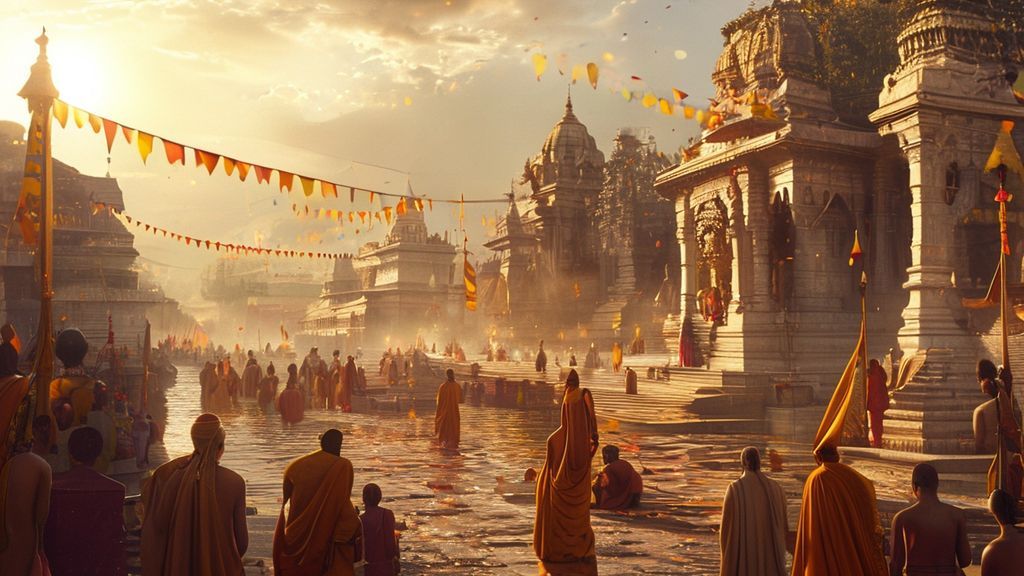
Prayagraj Kumbh Mela, held at the sacred Triveni Sangam, is the largest peaceful congregation on Earth, an unparalleled spiritual pilgrimage where millions gather to bathe at the confluence of the Ganga, Yamuna, and the mythical Saraswati rivers. This profound act, prescribed by ancient scriptures, is believed to cleanse sins, bestow liberation (Moksha), and align the individual soul with cosmic energies.
| Attribute | Details |
|---|---|
| Deity/Focus | Lord Vishnu (as dispenser of Amrita), Lord Brahma (as creator), Lord Shiva (as destroyer of ignorance), and the river goddesses Ganga, Yamuna, Saraswati. |
| Location/Origin | Triveni Sangam, Prayagraj (formerly Allahabad), Uttar Pradesh, India. |
| Key Festival | Maha Kumbh Mela (every 12 years), Ardha Kumbh Mela (every 6 years), Magh Mela (annual, smaller scale). |
| Scripture Reference | Padma Purana, Skanda Purana, Matsya Purana, Shrimad Bhagavatam, Mahabharata (Tirtha Yatra Parva). |
The Confluence of Faith and Eternity: Triveni Sangam’s Enduring Embrace
The very name “Prayagraj” evokes a sense of sacredness, translating to “King of Sacrifices” or “King of Tirthas” (pilgrimage sites). At its heart lies the Triveni Sangam (त्रिवेणी संगम), the revered confluence where the mighty Ganga (गङ्गा), the serene Yamuna (यमुना), and the elusive Saraswati (सरस्वती) rivers unite. This site is not merely a geographical marvel but a profound spiritual epicenter, representing the confluence of Sattva, Rajas, and Tamas gunas, or perhaps the past, present, and future, offering a rare opportunity for purification and spiritual ascension. The Kumbh Mela, especially the Maha Kumbh at Prayagraj, is the ultimate expression of this faith, drawing millions to partake in a ritual bath (शाही स्नान) believed to confer immense spiritual merit and liberation.
For millennia, Sanatan Dharma has upheld the sanctity of water, particularly the waters of holy rivers. The Sangam at Prayagraj holds a unique position, being described in the Puranas as the most auspicious bathing place. It is here that pilgrims seek not just physical cleansing, but a profound spiritual renewal, an experience that transcends the ordinary and connects the individual soul to the cosmic consciousness. It is a testament to the enduring power of faith and the timeless wisdom embedded in our ancient traditions.
Puranic History and Cosmic Legends of the Kumbh
The genesis of the Kumbh Mela is deeply interwoven with one of the most significant episodes in Hindu mythology: the Samudra Manthan, or the churning of the cosmic ocean. As detailed in the *Shrimad Bhagavatam* (Canto 8) and the *Vishnu Purana*, Devas (gods) and Asuras (demons) collaborated to churn the ocean to obtain Amrita (अमृत), the nectar of immortality. During the 12 days and 12 nights (equivalent to 12 human years) of fierce struggle for the pot (Kumbh) of Amrita, Lord Vishnu, in His Mohini avatar, eventually secured the nectar for the Devas.
However, during the chase for the pot, a few drops of this divine nectar are said to have spilled at four sacred sites on Earth: Haridwar, Prayagraj, Nashik, and Ujjain. Prayagraj, being one of these hallowed spots, became eternally blessed. The exact timing of the Kumbh Mela at each location is determined by specific astrological positions of the Sun, Moon, and Jupiter, reflecting the cosmic alignment during the original Samudra Manthan. For Prayagraj, the Maha Kumbh occurs when Jupiter is in Aries or Taurus and the Sun and Moon are in Capricorn, a configuration believed to amplify the spiritual potency of the Sangam waters manifold. The *Matsya Purana* speaks extensively of the glories of bathing at the confluence during specific astrological periods, especially during Magh Mela and Kumbh.
The Sangam’s Mystical Geography & Engineering Feat
While not a traditional architectural site, the Prayagraj Kumbh Mela is a logistical and spiritual marvel of unparalleled scale. The Triveni Sangam itself is a natural wonder. The distinct colors of the rivers – the greenish-blue of the Yamuna and the muddy, sacred brown of the Ganga – are visibly separate for a distance before merging into a singular, powerful flow. The invisible Saraswati is not merely mythical but represents a deeper spiritual current, often identified with a subterranean channel or a river of divine wisdom that flows through the consciousness of the devout.
The organization of the Kumbh Mela involves an extraordinary temporary city built from scratch on the floodplains. This includes roads, bridges, electricity, water supply, sanitation, hospitals, and security for tens of millions of pilgrims, Sadhus, and spiritual leaders. It is an annual feat during Magh Mela, and a monumental undertaking during the Ardha and Maha Kumbh. This temporary infrastructure, designed to accommodate millions for several weeks, is a testament to human ingenuity and devotion, a modern-day engineering marvel that rises from the sands and then dissolves, leaving behind only spiritual vibrations and cherished memories. The sheer scale and meticulous planning reflect a collective understanding of Dharma and community service (Seva).
Sacred Rituals and the Path of Purification (Puja Vidhi)
The central ritual at the Triveni Sangam during Kumbh Mela is the holy bath, or Snan. Pilgrims observe specific steps to maximize the spiritual benefits:
- Sankalpa (Intention): Before entering the waters, one makes a firm intention (संकल्प) for the bath, dedicating it to specific ancestors, deities, or for spiritual purification and Moksha.
- Pranama (Obeisance): Offer respectful salutations to the divine rivers, chanting prayers to Ganga, Yamuna, and Saraswati.
- Mantra Japa (Chanting): While immersing, devotees often chant sacred mantras like “Om Namah Shivaya” (ॐ नमः शिवाय), “Om Namo Narayanaya” (ॐ नमो नारायणाय), or specifically Ganga Mantras.
- Dip (Snan): Take at least three dips, fully immersing oneself in the confluence. The belief is that the holy waters cleanse the body, mind, and soul of all impurities and karmic burdens.
- Tarpan (Ancestral Offerings): After the bath, many perform Pitru Tarpan (पितृ तर्पण), offering water and sesame seeds to their ancestors, ensuring their peace and liberation. This ritual is considered highly efficacious at the Sangam.
- Dana (Charity): Giving charity to Sadhus, Brahmins, and the needy after the bath is an integral part of the spiritual merit acquisition, as mentioned in the *Skanda Purana*.
- Darshan (Vision): Visiting nearby temples, especially the Bade Hanuman Ji Temple and the Alopi Devi Shakti Peeth, completes the pilgrimage.
Potent Mantras for Inner Harmony
Chanting mantras during the Kumbh Mela enhances the spiritual experience and invokes divine blessings. Here are some significant ones:
- Ganga Mantra:
ॐ गंगे च यमुने चैव गोदावरी सरस्वति। नर्मदे सिन्धु कावेरी जलेऽस्मिन् सन्निधिं कुरु॥
Om Gange Cha Yamune Chaiva Godavari Saraswati | Narmade Sindhu Kaveri Jale Asmin Sannidhim Kuru ||
(Invoking the presence of all holy rivers into the bathing water)
- Vishnu Mantra:
ॐ नमो नारायणाय॥
Om Namo Narayanaya ||
(Salutations to Lord Narayana, preserver of the universe)
- Shiva Mantra:
ॐ नमः शिवाय॥
Om Namah Shivaya ||
(Salutations to Lord Shiva, the auspicious one)
- Gayatri Mantra:
ॐ भूर्भुवः स्वः तत्सवितुर्वरेण्यं भर्गो देवस्य धीमहि धियो यो नः प्रचोदयात्॥
Om Bhur Bhuvah Svah Tat Savitur Varenyam Bhargo Devasya Dhimahi Dhiyo Yo Nah Prachodayat ||
(A universal prayer for enlightenment and wisdom)
Cultural Etiquette: Dos and Don’ts for the Devotee
- Do: Maintain personal hygiene and respect the sanctity of the environment.
- Do: Observe silence and devotion during the bath.
- Do: Show utmost respect to Sadhus, ascetics, and spiritual leaders.
- Do: Participate in Seva (selfless service) if opportunities arise.
- Do: Carry minimal valuables and be mindful of your belongings.
- Don’t: Litter or pollute the sacred rivers or the Mela grounds.
- Don’t: Engage in frivolous activities or unnecessary chatter at the Sangam.
- Don’t: Disrespect any spiritual tradition or sect present at the Mela.
- Don’t: Use harsh language or display anger.
- Don’t: Take photographs without permission, especially of ascetics.
What is the spiritual significance of the invisible Saraswati River?
The invisible Saraswati is often seen as a symbolic representation of Jnana (knowledge) and Buddhi (intellect) merging with Bhakti (devotion, represented by Yamuna) and Karma (action, represented by Ganga). In the *Rigveda*, Saraswati is revered as a goddess of wisdom, purity, and eloquence. At the Triveni Sangam, her unseen presence signifies a deeper spiritual current, indicating that true liberation comes from the confluence of spiritual knowledge, devotional practices, and righteous action.
Why is the Kumbh Mela held only every 12 years at Prayagraj?
The timing of the Maha Kumbh Mela at Prayagraj (and the other three sites) is determined by specific astronomical alignments, particularly the positions of Jupiter, Sun, and Moon. This 12-year cycle corresponds to the 12 divine days and nights (12 human years) during which the struggle for the Amrita pot occurred after the Samudra Manthan. These specific planetary conjunctions are believed to create a uniquely auspicious energy field, maximizing the spiritual efficacy of the holy bath and other rituals performed at the Sangam.
What is the difference between Maha Kumbh, Ardha Kumbh, and Magh Mela?
The Maha Kumbh Mela is the grandest and occurs once every 12 years at each of the four sites, including Prayagraj, based on specific planetary alignments. The Ardha Kumbh Mela (meaning ‘half Kumbh’) takes place every 6 years at two of the sites (Haridwar and Prayagraj), signifying half a 12-year cycle. The Magh Mela is an annual, month-long bathing festival held at Prayagraj during the Hindu month of Magh (January-February), considered a precursor or a smaller manifestation of the spiritual currents found during the larger Kumbh events.
Why This Matters for Every Hindu: Preserving Sanatan Dharma’s Essence
The Prayagraj Kumbh Mela at Triveni Sangam is far more than a festival; it is a living testament to the enduring principles of Sanatan Dharma. It embodies the belief in the sanctity of nature, the power of collective faith, and the continuous quest for spiritual purification and liberation. This gathering unites diverse sects of Hinduism – Naga Sadhus, Urdhwavahurs, Parivrajakas, Shirshasinis – under a single spiritual banner, demonstrating the inherent unity and diversity within our ancient tradition. Participating in, or even contemplating, the sanctity of the Kumbh Mela reinforces the importance of Dharma in daily life, reminds us of our ancestral heritage, and rekindles the flame of devotion. It ensures that the profound wisdom enshrined in our scriptures continues to be a vibrant, lived experience for generations to come, securing the eternal spiritual future of Bharatvarsha.