


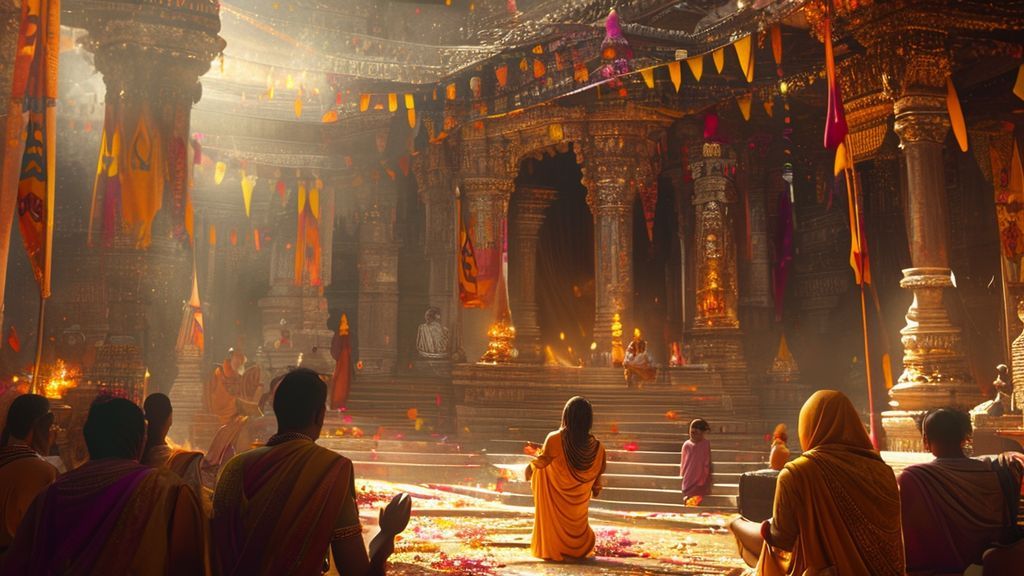
Pumsavana is a significant prenatal samskara (sacrament) in Sanatan Dharma, traditionally performed during the early stages of pregnancy to invoke divine blessings for a healthy, intelligent, and virtuous male child, ensuring the continuation of the lineage and fulfillment of ancestral duties. This ancient ritual emphasizes the spiritual well-being of both mother and unborn, rooted deeply in Vedic wisdom for progeny and dharma.
| Attribute | Details |
|---|---|
| Ritual Name | Pumsavana (पुंसवन) |
| Primary Purpose | Divine blessings for a virtuous, healthy, intelligent male child; ensuring lineage continuation. |
| Traditional Timing | During the second or third month of pregnancy, before the quickening (Garba-spandana). |
| Key Deities Invoked | Prajapati, Vishnu, various Pitru Devatas, Vayu, Agni, Soma. |
| Scripture References | Atharva Veda, Grihya Sutras (e.g., Ashvalayana, Gobhila, Paraskara), Manusmriti, Charaka Samhita. |
The Spiritual and Cultural Significance of Pumsavana
In the vast tapestry of Sanatan Dharma, the human journey is sanctified by a series of samskaras, or purificatory rites, stretching from conception to cremation. Among these, Pumsavana stands as a profound prenatal ritual, holding immense spiritual and cultural weight. It is not merely a custom but a sacred invocation, a fervent prayer offered to the cosmos for the gift of a virtuous and dharmic progeny, particularly a male child, deemed essential for fulfilling ancestral obligations and continuing the family lineage. The very word “Pumsavana” derives from Sanskrit, where “Puman” means a male person and “Savana” means creation or generation, thereby signifying the ritual dedicated to the creation or invocation of a male progeny.
This samskara underscores the Hindu philosophical understanding that life begins not at birth, but at conception, making the prenatal period crucial for shaping the child’s destiny and character. It reflects a holistic approach where the physical, mental, and spiritual well-being of the unborn child is diligently nurtured through Vedic rites, medicinal herbs, and the pure intentions of the parents. Pumsavana, therefore, is a testament to the profound respect for life and lineage inherent in Hindu traditions, a spiritual undertaking to ensure the continuity of Dharma through worthy descendants.
Puranic History & Vedic Roots of Pumsavana
The practice of Pumsavana is not a modern innovation but a ritual deeply embedded in the ancient Vedic and Puranic traditions of Bharatavarsha. Its roots can be traced to the Atharva Veda (Kanda VI, Sukta 11), where mantras are dedicated to the invocation of male offspring. The core principles and procedures for Pumsavana are elaborately described in various Grihya Sutras, which are manuals for domestic rituals and are integral parts of the Kalpa Sutras. Prominent among these are the Ashvalayana Grihya Sutra, Gobhila Grihya Sutra, and Paraskara Grihya Sutra, which provide detailed guidelines for its performance, often recommending the second or third month of pregnancy, before the fetus begins to show distinct movements (known as quickening or garbha-spandana).
The significance of male progeny, particularly a “putra” (पुत्र), is repeatedly emphasized in Hindu scriptures. The term “putra” itself is often etymologically derived from “put-tra,” meaning “one who delivers from the hell called Put.” This highlights the belief that a male child performs rites (like Shraaddha) that ensure the salvation and liberation of ancestors from Pitru Rina (debt to ancestors). While not a direct narrative from the Puranas, the longing for progeny and the importance of a virtuous son for the continuation of Dharma and for offering ancestral oblations is a recurring theme. For instance, the story of King Dilipa in Kalidasa’s Raghuvamsham vividly portrays the anguish of a childless king and his arduous penance to secure a son, highlighting the spiritual imperative of progeny.
Furthermore, ancient medical texts like the Charaka Samhita also allude to practices similar to Pumsavana, suggesting a confluence of spiritual and empirical knowledge aimed at ensuring a healthy and desired child. The ritual thus aligns the spiritual aspirations of the parents with the profound wisdom of ancient seers and medical practitioners.
The Vedic Wisdom Behind Pumsavana: Holistic Dimensions
While Pumsavana is a ritual, not a temple, its marvel lies in its holistic, multi-faceted approach, blending spiritual invocation with what we might today term psychosomatic science. It is an intricate design of Vedic wisdom aiming to influence the unborn child’s development positively. The selection of specific medicinal herbs, the chanting of powerful mantras, and the strict regimen prescribed for the mother are all interconnected.
One of the key elements involves the use of certain botanical substances. The Vatashunga (वटशुङ्ग), or the tender shoot of the Banyan tree (Ficus benghalensis), is often crushed with barley and black gram and administered to the pregnant woman. This particular ingredient is chosen not just for its symbolic representation of longevity and growth but also for its traditional medicinal properties believed to strengthen the womb and promote healthy development. Other ingredients might include Ushira (Vetiveria zizanioides) and Soma, all selected for their purported sattvic qualities and their ability to purify and vitalize.
The chanting of Vedic mantras during the ritual, such as those invoking Vishnu or Prajapati, creates a profound vibrational environment. Modern science increasingly recognizes the impact of sound frequencies on biological systems. In the context of Pumsavana, these divine vibrations are believed to purify the mother’s being, calm her mind, and positively influence the developing fetus at a subtle, energetic level. The mother’s mental state, her pure intentions (bhavana), and her unwavering faith are considered paramount, creating a conducive inner environment for the spiritual and physical shaping of the child. This emphasis on the mother’s consciousness highlights a sophisticated understanding of prenatal influence, long before contemporary psychological studies confirmed its significance.
Rituals & Puja Vidhi for Pumsavana
The performance of Pumsavana is a sacred undertaking that requires precise adherence to scriptural guidelines, typically conducted by a qualified priest (purohit) or a learned elder. The procedure, though varying slightly across Grihya Sutras, generally follows these steps:
- Selection of Auspicious Time (Muhurta): The ritual is performed on an auspicious day (e.g., a Pushya nakshatra day) during the second or third month of pregnancy, before the quickening. The lunar tithi, nakshatra, and planetary positions are carefully considered.
- Purification (Achamana & Sankalpa): The pregnant woman, her husband, and the priest perform Achamana (ritual sipping of water) and wear clean clothes. A Sankalpa (vow) is taken, clearly stating the purpose of the ritual – to obtain a healthy, virtuous, and male child.
- Ganesh Puja & Punyaha Vachanam: The ritual commences with an invocation of Lord Ganesha to remove obstacles, followed by Punyaha Vachanam, a blessing ritual invoking purity and auspiciousness.
- Agni Pratistha & Homa: A sacred fire (Agni) is kindled, and oblations (Aahutis) of ghee, grains, and other sacred offerings are made into the fire while chanting specific Vedic mantras, primarily from the Atharva Veda and Grihya Sutras. These mantras invoke various deities like Prajapati, Vishnu, and other Devatas associated with creation and progeny.
- Preparation of the Medicinal Elixir: The tender shoot of a Banyan tree (Vatashunga), along with barley (yava) and black gram (masha), is ground and mixed with water or curd. Sometimes, other medicinal herbs or milk are used as specified in different traditions.
- Administering the Elixir: The prepared elixir is gently placed into the right nostril of the pregnant woman by her husband or the priest, typically three drops, while specific mantras are chanted. This is a symbolic act signifying the infusion of vital energy and the desired qualities into the unborn child.
- Blessings & Aashirvada: After the ritual, the priest and elders offer blessings (Aashirvada) to the couple, praying for the well-being of the mother and the healthy development of the child.
- Bhojana (Feast) & Dakshina: A sattvic meal is prepared, and Brahmins, guests, and family members are fed. The priest is given Dakshina (offering) as a mark of respect and gratitude.
Mantras & Chants for Pumsavana
The power of Pumsavana largely resides in the potency of its Vedic mantras, which are chanted with utmost sincerity and correct pronunciation to invoke divine energies. Some key mantras include:
- The primary mantra, often found in the Grihya Sutras and Atharva Veda, for invoking male progeny:
“ॐ पुमानग्निं पुमानिन्द्रः पुमान् देवो बृहस्पतिः ।
पुमांसं पुत्रं विन्दस्व तं पुमाननु जायताम् ॥”
“Om Pumānam Agnim Pumānam Indraḥ Pumān Devo Brihaspatiḥ |
Pumāmsam Putram Vindasva Tam Pumān Anujāyatām ||”
(May Agni be male, Indra be male, Brihaspati be male. May you obtain a male child, and let a male child be born after him.) - Mantras invoking Lord Vishnu, the preserver, for protecting the fetus:
“ॐ नमो भगवते वासुदेवाय।”
“Om Namo Bhagavate Vasudevaya.” - Prayers to Prajapati, the creator deity, for granting progeny:
“ॐ प्रजापतये नमः।”
“Om Prajāpataye Namaḥ.” - Mantras for overall well-being and protection:
“ॐ भूः भुवः स्वः तत् सवितुर्वरेण्यं भर्गो देवस्य धीमहि धियो यो नः प्रचोदयात्।”
“Om Bhur Bhuvah Svah Tat Savitur Varenyam Bhargo Devasya Dhimahi Dhiyo Yo Nah Prachodayat.” (Gayatri Mantra)
Dos and Don’ts for Pumsavana
- Do:
- Consult a knowledgeable priest or Vedic scholar for guidance on specific rituals and auspicious timing.
- Maintain absolute physical and mental purity (Shaucha) throughout the ritual.
- Perform the ritual with complete faith (Shraddha) and devotion.
- Ensure the husband and wife are both actively involved and share a pure intention.
- Observe any dietary or lifestyle recommendations given by the priest.
- Don’t:
- Perform the ritual haphazardly or without proper guidance from scriptural texts.
- Treat Pumsavana as a mere superstition or a magic trick; it is a sacred spiritual invocation.
- Harbor negative thoughts or impure intentions during the preparation or performance.
- Neglect the post-ritual guidelines or responsibilities towards the developing child.
- Seek the ritual for frivolous or materialistic reasons, rather than for dharmic progeny.
Frequently Asked Questions About Pumsavana
Is Pumsavana about gender discrimination?
Pumsavana, in its purest Vedic context, is not rooted in gender discrimination but in the specific dharmic necessity of a male progeny for the continuation of family lineage, the performance of ancestral rites (Pitru Yajna), and the fulfillment of specific social and spiritual roles within the ancient Hindu societal structure. The emphasis on a male child is linked to concepts like Pitru Rina and the belief that a son performs certain rituals crucial for the liberation of ancestors. It is about fulfilling a spiritual obligation and ensuring the perpetuation of the family’s spiritual heritage, rather than devaluing a female child. Sanatan Dharma equally reveres the feminine as Shakti.
Can Pumsavana be performed for a healthy child regardless of gender?
Traditionally, Pumsavana is specifically invoked for a male child (Puman). However, in modern interpretations and in light of evolving societal understandings, many spiritual leaders and families adapt the spirit of the ritual to pray for a healthy, intelligent, and dharmic child, irrespective of gender. The core intent of divine blessing for progeny remains, and the emphasis shifts from a specific gender to the overall well-being and virtues of the child to be born.
What if Pumsavana is not performed?
While Pumsavana is an important samskara, its non-performance is generally not considered a severe transgression leading to adverse karmic outcomes. However, it is believed that performing the samskaras helps in the spiritual purification and refinement of the individual, contributing to their overall well-being and aligning them with cosmic rhythms. Its absence might be seen as a missed opportunity to invoke specific divine blessings and establish a strong spiritual foundation for the unborn child, rather than a punitive omission.
Who can perform the Pumsavana ritual?
The Pumsavana ritual is primarily performed by the pregnant woman’s husband, guided by a qualified Vedic priest (purohit) or a knowledgeable elder. The priest ensures the correct chanting of mantras and adherence to ritualistic procedures. The active participation of both parents, especially the husband, is crucial, signifying their joint spiritual commitment to the well-being and dharmic upbringing of their unborn child.
Dharmic Significance: Preserving Sanatan Dharma
The Pumsavana samskara stands as a luminous example of how Sanatan Dharma meticulously designs every stage of life to be infused with spiritual meaning and purpose. It is more than a ritual; it is a profound declaration of faith in the cosmic order, a humble plea to the divine for a progeny that will uphold dharma, contribute to society, and ensure the unbroken chain of spiritual heritage. By performing Pumsavana, parents not only seek blessings for their child but also consciously align themselves with the ancient wisdom of the Vedas, understanding their role as custodians of lineage and dharma.
In an age where material pursuits often overshadow spiritual imperatives, these samskaras remind us of the deeper dimensions of existence and the sacred responsibility of parenthood. Pumsavana reinforces the foundational principles of family, ancestry, and righteous living, ensuring that future generations are not just physically present but are spiritually endowed to carry forward the light of Sanatan Dharma. For those seeking to understand and practice these timeless traditions, Hindutva.online offers invaluable resources to deepen their journey.