


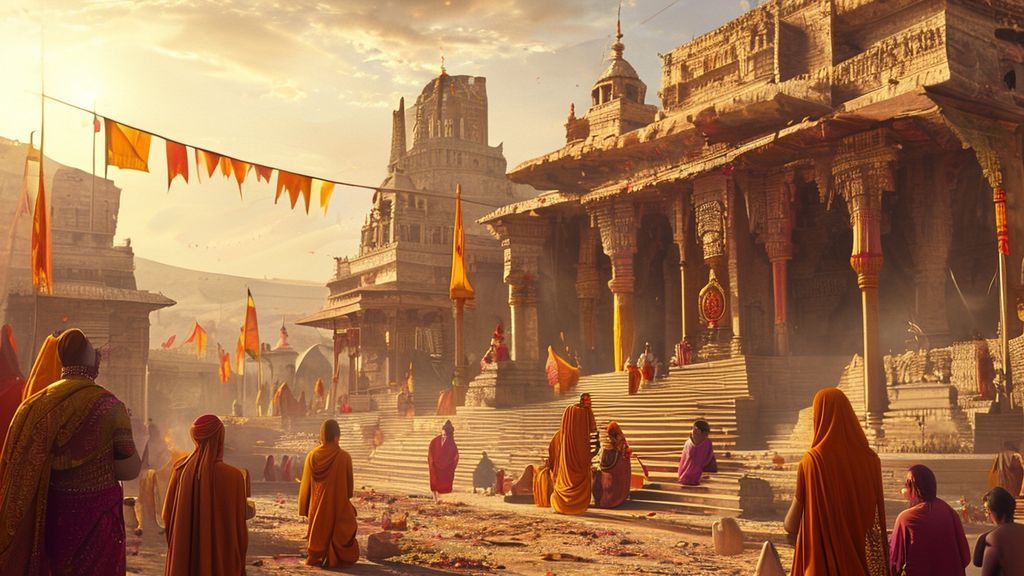
Rajasthani Hindu customs, deeply rooted in the vibrant desert region, exemplify a profound synthesis of ancient Vedic wisdom, Puranic narratives, and a unique cultural resilience shaped by its arid landscape and royal heritage. These traditions honor a pantheon of deities, particularly various forms of Devi, Shiva, and Krishna, manifest in intricate rituals, grand festivals, and distinctive architectural marvels that reflect centuries of unwavering Sanatan Dharma.
| Attribute | Details |
|---|---|
| Primary Deities | Devi (Karni Mata, Ambika, Gauri), Shiva (Eklingji), Krishna (Shrinathji), Surya Dev. |
| Key Festivals | Gangaur, Teej, Pushkar Mela, Mewar Festival. |
| Architectural Marvels | Nagara style temples, elaborate stepwells (Baoris), fort temples, Havelis. |
| Scriptural References | Skanda Purana, Devi Bhagavata Purana, Bhagavata Purana, local Sthala Puranas. |
Introduction: The Resplendent Dharma of Rajasthan
The land of Rajasthan, a majestic canvas painted with golden sands, ancient forts, and vibrant hues, is a crucible of profound Hindu traditions. Far from being a mere collection of folk practices, the customs of this desert region are a living testament to Sanatan Dharma’s adaptability and enduring spirit. The severe yet beautiful landscape has profoundly influenced its spiritual expressions, fostering a deep reverence for water, fierce devotion to protecting dharma, and an unshakeable faith in divine protection. Here, every festival, every architectural marvel, and every daily ritual is imbued with a spiritual significance that connects the individual to the cosmos, reflecting the universal principles expounded in our sacred texts. The worship often revolves around powerful divine feminine energies, protector deities, and the playful yet profound manifestations of Lord Krishna, weaving a rich tapestry of devotion that inspires countless seekers.
Puranic History & Legend: Echoes of Eternity in the Desert Sands
The legends underpinning Rajasthani Hindu customs are deeply etched in the Puranas and local Sthala Puranas. A prime example is the worship of Karni Mata at Deshnok. Revered as an incarnation of Hinglaj Mata, a manifestation of Devi, her legend is vividly recounted in local oral traditions and texts akin to Puranic narratives. It speaks of a divine woman with extraordinary powers, protecting her devotees and establishing a lineage of spiritual custodians. The temple, famous for its sacred rats (kabas), is believed to house the souls of her devotees, symbolizing an eternal bond.
Another profound narrative is associated with Eklingji Mahadev, near Udaipur. As detailed in the Skanda Purana (specifically the Mewar Mahatmya Khanda), this ancient temple complex is dedicated to Lord Shiva, the tutelary deity of the Mewar rulers. The legend narrates how Lord Shiva himself appeared here as a four-faced lingam, signifying His cosmic form as the creator, preserver, and destroyer. The Ranas of Mewar traditionally considered themselves not as kings, but as Diwans (prime ministers) of Eklingji, ruling in His name. This deep devotion ensured the perpetuation of Shaivism in the region for centuries.
The exquisite Shrinathji temple in Nathdwara holds immense significance for Vaishnavites. Its origins are tied to Lord Krishna’s own revelation. The idol of Shrinathji, a seven-year-old manifestation of Krishna, was brought from Govardhan near Mathura in the 17th century to protect it from Mughal incursions. As per local accounts, echoing sentiments from the Bhagavata Purana, Lord Krishna Himself willed the chariot carrying the idol to stop at Sinhad (Nathdwara), thus establishing His divine abode in Rajasthan. This act of preservation by devout kings and priests cemented Rajasthan’s role as a sanctuary for Sanatan Dharma during challenging times.
Architectural & Cultural Marvels: Stone, Water, and Devotion
Rajasthan’s architecture is a devotional offering in stone, reflecting both spiritual conviction and ingenious adaptation to the environment. The Nagara style of temple architecture, characterized by its curvilinear shikhara (spire) and intricate carvings, is prominent. Temples like the Ranakpur Jain Temple (though Jain, its influence on regional Hindu temple aesthetics is undeniable) and the Eklingji Temple showcase this grandeur. The Eklingji complex, with its multiple shrines, reflects a syncretic approach, incorporating various deities within a unified sacred space.
A unique architectural marvel born of necessity and devotion are the Baoris (stepwells). These inverted temples dedicated to water, such as Chand Baori in Abhaneri, are not merely utilitarian structures. Their elaborate steps and pavilions, often adorned with divine sculptures, elevate them to sacred spaces for water worship, reflecting the reverence for Varuna Dev and Ganga Ma in an arid land. The descent into a Baori is akin to a spiritual journey, a symbolic going within to connect with the life-giving essence. These structures represent a scientific marvel of water conservation, meticulously crafted over centuries, showcasing ancient Indian engineering prowess.
Culturally, Rajasthan is vibrant with folk traditions deeply intertwined with Hinduism. The Ghoomar dance, originally a Bhil tribe dance, gained royal patronage and became an expression of womanhood, often performed during festivals like Gangaur. The Kalbelia dance, performed by the snake charmer community, is dedicated to Goddess Hinglaj (Karni Mata’s form), invoking her protection and blessings. These performing arts are not mere entertainment but integral parts of rituals and storytelling, preserving epics and legends through generations.
Rituals & Puja Vidhi: Celebrating Life and Divinity
Rajasthani rituals are marked by their vibrancy, devotion, and community participation. The festival of Gangaur (गणगौर), dedicated to Lord Shiva (Gana) and Goddess Parvati (Gaur), is a pinnacle of devotion for married women and unmarried girls. It spans 18 days, culminating in grand processions.
- Idol Preparation: Women prepare clay or wooden idols of Isar (Shiva) and Gauri, meticulously decorating them.
- Daily Puja: For 18 days, daily worship involves offering prayers, sweet guavas, and purifying the idols with water.
- Singing & Dancing: Devotional songs and Ghoomar dances are performed, narrating tales of Shiva and Parvati’s love and marital bliss.
- Procession: On the final day, the Gauri idol is taken in a grand procession, often accompanied by horses, elephants, and folk music, symbolizing her departure from her parental home to Shiva’s abode.
- Immersion: The idols are immersed in a pond or river, signifying the cyclical nature of life and devotion.
Teej, another significant festival, celebrates the reunion of Shiva and Parvati, symbolizing marital harmony and fertility. Women observe fasts, wear green attire, and swing on ornate swings (झूला), offering prayers for their husbands’ well-being. These rituals, though seemingly simple, are rich in symbolism, connecting the devotee to divine energies and reinforcing the sanctity of marital bonds and family values, core tenets of Sanatan Dharma.
Mantras & Chants: Invoking Divine Presence
Devotion in Rajasthan is often expressed through powerful mantras and chants, tailored to the specific deities revered. For Goddess Gauri (Parvati) during Gangaur and Teej, devotees often chant:
ॐ गौरी शंकराय नमः।
Om Gauri Shankaraya Namah.
(Salutations to Gauri and Shankar.)
For Lord Shiva, especially at Eklingji, the timeless mantra resonates:
ॐ नमः शिवाय।
Om Namah Shivaya.
(I bow to Shiva.)
Vaishnavites, particularly followers of Shrinathji, fervently chant:
श्री कृष्ण शरणं मम।
Shri Krishna Sharanam Mama.
(Lord Krishna is my refuge.)
These sacred vibrations purify the mind, invoke divine grace, and establish a direct connection with the chosen deity (Ishta-Devata), fostering inner peace and spiritual upliftment.
Dos and Don’ts: Upholding Dharmic Etiquette
- Do dress modestly, especially when visiting temples and sacred sites. Traditional attire is appreciated.
- Do remove footwear before entering temples or homes.
- Do greet elders and respected individuals with folded hands (Namaste or Ram Ram).
- Do participate in local festivals with respect and an open heart, understanding their spiritual significance.
- Do offer donations to temples and charitable causes, as this is considered a Punya Karma.
- Don’t consume non-vegetarian food or alcohol in the vicinity of temples or during religious festivals.
- Don’t disrespect local customs or traditions, even if unfamiliar.
- Don’t point your feet towards deities or elders.
- Don’t interrupt prayers or rituals; observe silently with reverence.
- Don’t litter or desecrate sacred spaces.
Frequently Asked Questions About Rajasthani Customs
What is the significance of animal worship in Rajasthan?
Animal worship, particularly of cows, peacocks, and even rats (at Karni Mata Temple), stems from a deep reverence for all life forms as manifestations of the Divine. Cows are revered as ‘Go Mata’ (mother cow) symbolizing sustenance and purity, while peacocks are associated with Kartikeya and royalty. The kabas (rats) at Deshnok are considered sacred due to their connection to Karni Mata, embodying the cycle of life and rebirth. This reverence reflects the Vedic principle of interconnectedness (इशोपनिषद) and respect for biodiversity, crucial for the desert ecosystem.
How do Rajasthani traditions emphasize water conservation?
Given the arid climate, water holds immense sacred value in Rajasthan. Traditions like the construction and worship of stepwells (Baoris), ponds (Talab), and rain-harvesting systems are deeply embedded. Offering water to Surya Dev (सूर्य अर्घ्य) daily, performing rituals near water bodies, and the collective maintenance of these structures reflect a dharmic understanding of water as a divine gift (जल ही जीवन है – ‘water is life’) that must be conserved and revered. These practices are not just practical but spiritual, ensuring the well-being of the community.
Are folk dances like Ghoomar purely cultural or do they have religious significance?
While often seen as cultural expressions, folk dances like Ghoomar are intrinsically linked to religious and social rituals. Ghoomar, performed by women, often during festivals like Gangaur and Teej, celebrates womanhood, marital bliss, and the devotion to Goddess Gauri. The swirling movements and graceful postures are symbolic offerings, and the songs often narrate Puranic tales or devotional verses. These dances serve as a medium for collective spiritual expression and community bonding, reflecting the joyous aspect of dharma.
Why These Traditions Matter for Every Hindu
The Hindu customs of Rajasthan are not mere regional curiosities; they are a vibrant, living library of Sanatan Dharma’s principles. They teach us resilience in the face of adversity, the profound connection between humanity and nature, and the multifaceted ways to approach the Divine. From the architectural grandeur that embodies spiritual truths to the simple, heartfelt rituals that bind communities, these traditions offer invaluable insights into our shared heritage. By understanding and appreciating these unique expressions of faith, we reinforce the diverse and inclusive nature of Hinduism. They remind us that devotion blossoms in countless forms, each enriching the universal quest for truth and righteousness. Explore more such profound aspects of our ancient tradition at Hindutva.online. These customs are not relics of the past but living conduits to eternal truths, vital for the preservation and propagation of our sacred dharma for future generations. For a deeper dive into regional variations of Sanatan Dharma, remember to visit Hindutva.online.