


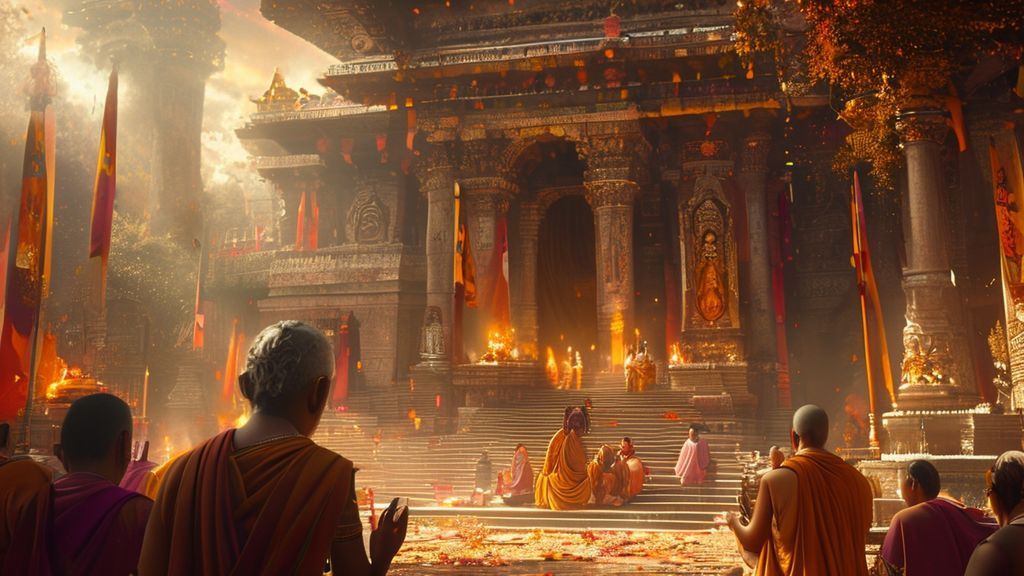
Ramana Maharshi’s “Who Am I” method, or *Atma-Vichara*, is a direct path to Self-realization, urging the aspirant to incessantly inquire into the source of the “I-thought.” By turning the mind inward and discerning the true nature of one’s being beyond ego and intellect, this profound technique reveals the eternal, immutable Self (Atman) as the sole reality, aligning perfectly with the ultimate goal of Sanatan Dharma.
| Attribute | Details |
|---|---|
| Central Figure | Bhagavan Sri Ramana Maharshi (1879-1950) |
| Core Teaching | Self-Enquiry (*Atma-Vichara*), specifically “Who Am I?” (*Nan Yar?*) |
| Primary Scripture/Philosophy | Advaita Vedanta, Upanishadic wisdom |
| Key Practice Location | Arunachala Hill, Tiruvannamalai, Tamil Nadu |
| Purpose | Direct Realization of the Self (Moksha, Liberation) |
Unveiling the Self: The Timeless Wisdom of Ramana Maharshi
In the vast ocean of Sanatan Dharma, where countless paths lead to the Divine, the teachings of Bhagavan Sri Ramana Maharshi shine as a lighthouse guiding seekers directly to the Self. His method, primarily known as “Who Am I” (Tamil: *Nan Yar?*), is not merely a philosophical inquiry but a potent spiritual practice, a direct means to transcend the illusory ego and abide in one’s true, eternal nature. For those earnest in their quest for ultimate truth, Ramana Maharshi presented the quintessential Vedantic inquiry in its purest, most accessible form, free from complex rituals or intricate philosophical debates. It is a profound invitation to turn the gaze inward, to discover the changeless substratum of consciousness that is our inherent reality.
The Awakening: Bhagavan’s Journey to Self-Realization
The life of Ramana Maharshi, born Venkataraman Iyer in 1879, is itself a testament to the power of Self-enquiry. At the tender age of sixteen, a profound fear of death gripped him in his Madurai home. Instead of succumbing to panic, he instinctively turned inward, simulating the death process by lying down, holding his breath, and meditating on the inquiry: “What is it that dies?” This intense, spontaneous *Atma-Vichara* led to a direct, incontrovertible experience of his true, immortal Self. He realized that the body dies, but the “I,” the pure consciousness, persists. This profound awakening, a direct realization of the *Atman*, is akin to the spontaneous Brahman-realization recounted in various Upanishadic anecdotes, where great sages attained enlightenment not through years of study, but through a sudden, piercing insight into their own being. Following this, he was drawn irresistibly to the sacred hill of Arunachala in Tiruvannamalai, Tamil Nadu, where he remained for the rest of his life, radiating the silent teaching of Self-knowledge.
The Sacred Abode: Arunachala and the Maharshi’s Presence
While the “Who Am I” method is an internal practice, its external context is inextricably linked to the holy hill of Arunachala. Revered as the physical manifestation of Lord Shiva, particularly as the *Tejo Lingam* (Lingam of Light), Arunachala has been a magnet for saints and sages for millennia. Ramana Maharshi taught that Arunachala is not merely a place but the very heart of the universe, radiating divine grace that facilitates the inward journey. He rarely left its vicinity, declaring that the hill itself was his Guru. Devotees visit the Sri Ramanasramam at the foot of the hill, a place steeped in his silent presence, and perform *Girivalam* (circumambulation) around Arunachala, a spiritual practice believed to cleanse sins and bestow peace. This sacred geography provides an ideal setting for the practice of Self-enquiry, embodying the principle that the external sacred reflects and supports the internal spiritual quest. The simple, unadorned ashram architecture reflects the Maharshi’s emphasis on inner simplicity and truth over outward show, a timeless Vedantic principle.
The Sadhana of Self-Enquiry: A Path to Liberation
Ramana Maharshi’s method of “Who Am I” is a practical sadhana, a means to transcend the identification with the body, mind, and ego, and realize the true Self. It is not an intellectual exercise of finding an answer but a constant, vigilant turning of the attention back to the source of the “I-thought.”
- Identify the “I-thought”: Begin by observing the constant stream of thoughts. Within this stream, identify the most fundamental thought: “I.” This “I” is usually associated with the body, name, roles, and possessions.
- Trace the Source: When any thought arises, instead of following it, immediately ask: “To whom does this thought come?” The answer will invariably be: “It comes to me.”
- Inquire into the “I”: Then, pursue this “I” further. Ask: “Who am I?” Not intellectually, but by attempting to locate the source or origin of this “I-thought.”
- Persistent Return: As the mind tries to offer answers (e.g., “I am the body,” “I am my thoughts”), gently but firmly bring the attention back to the fundamental question, letting go of all conceptual answers. Do not allow the mind to wander.
- Abide in the Source: Through persistent inquiry, the mind’s tendency to externalize is gradually subdued. It eventually sinks back into its source, which is the heart, the Self. This is not the physical heart, but the spiritual heart-centre, the seat of pure consciousness. In this state, the “I-thought” vanishes, revealing the boundless, egoless “I-I” — the true Self, Brahman.
This process, when sustained, burns away the ignorance that obscures our true nature, leading to the experience of *Aham Brahmasmi* (I am Brahman), one of the Mahavakyas from the Hindutva.online repository of ancient wisdom.
Mantras and Profound Declarations for the Seeker
While Ramana Maharshi’s method is primarily a silent, direct inquiry, the ultimate truth it reveals resonates profoundly with the Mahavakyas (Great Utterances) of the Upanishads. These powerful declarations serve as guiding lights, encapsulating the essence of Advaita Vedanta, the non-dual truth that Self-enquiry seeks to uncover.
- Aham Brahmasmi (अहं ब्रह्मास्मि): “I am Brahman.” (Brihadaranyaka Upanishad 1.4.10) This mantra affirms the identity of the individual Self with the Universal Self.
- Tat Tvam Asi (तत् त्वम् असि): “Thou art That.” (Chandogya Upanishad 6.8.7) This declaration points to the essential unity of the individual consciousness with the ultimate reality, taught by a guru to a disciple.
- Prajnanam Brahma (प्रज्ञानं ब्रह्म): “Consciousness is Brahman.” (Aitareya Upanishad 3.1.3) This emphasizes that the ultimate reality is pure consciousness.
- Ayam Atma Brahma (अयम् आत्मा ब्रह्म): “This Self is Brahman.” (Mandukya Upanishad 1.2) This directly identifies the innermost Self as the supreme reality.
Chanting these mantras can purify the mind and instill the deep conviction required for successful *Atma-Vichara*, preparing the ground for the direct experience of the truth they proclaim.
Dos and Don’ts for the Earnest Practitioner
Engaging with Ramana Maharshi’s teachings and the practice of Self-enquiry requires a certain temperament and approach. Adherence to these guidelines can enhance the spiritual journey:
- Do Practice Consistently: Self-enquiry is not a one-time intellectual exercise but a continuous, vigilant practice, day and night.
- Do Cultivate Inner Silence: Strive to reduce mental chatter and distractions. The more silent the mind, the clearer the perception of the Self.
- Do Have Implicit Faith: Trust in the process and in the inherent reality of the Self, as taught by the Maharshi.
- Do Seek Satsang: Association with sincere seekers or a realized being (if available) can provide immense inspiration and support.
- Don’t Intellectually Analyze: Avoid getting caught in philosophical debates or trying to logically “solve” the “Who Am I” question. It is an experience, not a puzzle.
- Don’t Suppress Thoughts: When thoughts arise, don’t try to forcibly suppress them. Instead, immediately trace them back to their source, the “I-thought.”
- Don’t Expect Immediate Results: Patience and perseverance are crucial. The veils of ignorance accumulated over lifetimes take time to dissolve.
- Don’t Neglect Daily Duties: The practice can be integrated into daily life. It is not necessary to renounce the world, but to renounce the ego within it.
Is the “Who Am I” method a form of meditation?
While it involves focused attention and quieting the mind, Ramana Maharshi’s “Who Am I” method is distinct from traditional meditation where one focuses on an object, breath, or mantra. It is a process of intense, active inquiry and self-investigation, a turning inward to locate the subject (the “I”) itself, rather than meditating on something. It leads to a state of egoless awareness that is beyond the dualities of subject-object meditation.
What is the “I-thought” and how does it differ from the true Self?
The “I-thought” is the fundamental thought that gives rise to the sense of individual identity—the ego. It is the root of all other thoughts and creates the illusion of a separate “me.” The true Self, or Atman, is the pure, immutable, boundless consciousness that exists prior to and independent of the “I-thought.” It is the substratum upon which the “I-thought” appears. The method aims to dissolve the “I-thought” to reveal the true Self.
Can anyone practice this method, regardless of background?
Absolutely. Ramana Maharshi’s teachings are universal and transcend religious, cultural, or social boundaries. The inquiry into “Who Am I” addresses the fundamental human quest for identity and meaning. While a grounding in spiritual principles or a devotional bent can be helpful, the method itself is direct and accessible to anyone with a sincere desire for Self-knowledge and the discipline to practice it consistently.
Why This Matters for Every Hindu
The timeless wisdom embodied in Ramana Maharshi’s “Who Am I” method is not merely an esoteric practice for renunciates; it is the very heart of Sanatan Dharma. The pursuit of Self-knowledge (*Atma Jnana*) is the ultimate aim of all Vedic wisdom, as articulated in the Upanishads and the Bhagavad Gita. By guiding seekers to the direct experience of the Atman, the Maharshi reaffirms the core Vedantic truth that our essential nature is Brahman, the absolute reality. This realization liberates one from the cycle of birth and death (*samsara*), dispels suffering, and establishes one in unshakeable peace and bliss. In an age often distracted by external pursuits, Ramana Maharshi’s teachings serve as a vital reminder that the greatest treasure lies not outside, but within, waiting to be discovered through relentless self-inquiry, a message crucial for the preservation and revitalization of authentic spiritual practice for all devotees seeking guidance on Hindutva.online.