


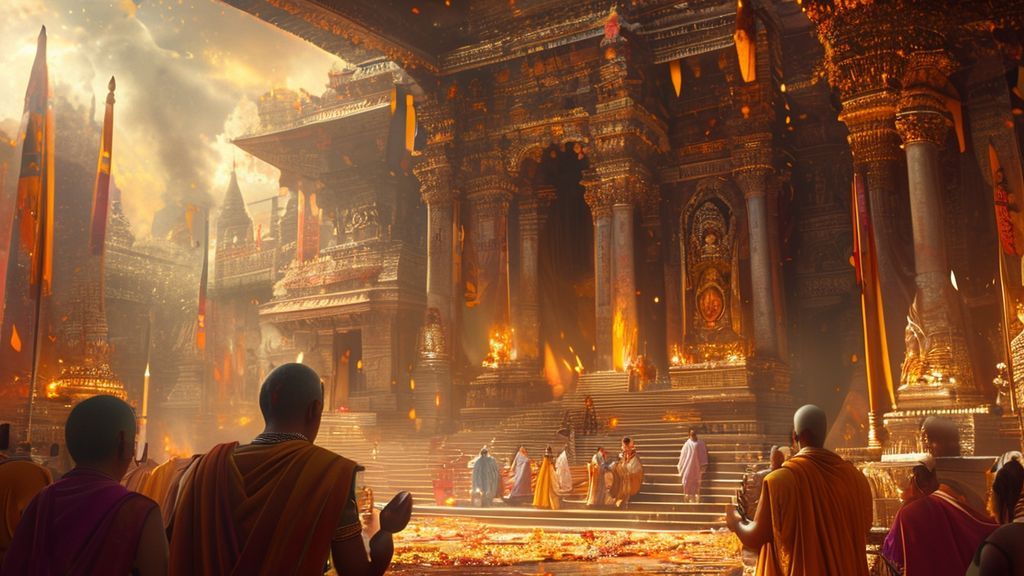
Ramanuja (c. 1017 – 1137 CE) was the pre-eminent Acharya and philosopher who systematized the Vishishtadvaita (qualified non-dualism) school of Vedanta, profoundly influencing Sanatan Dharma. His philosophy reconciles the oneness of Brahman with the reality and distinctness of individual souls and the material world, emphasizing devotion (Bhakti) to Saguna Brahman (Lord Narayana) as the path to liberation.
| Attribute | Details |
|---|---|
| Prominent Role | Founder of Vishishtadvaita philosophy |
| Born In | Sriperumbudur, Tamil Nadu, India |
| Key Festival | Ramanuja Jayanti (Chaitra Shukla Shashthi) |
| Core Teachings | Bhakti (devotion), Prapatti (surrender), Sarira-Sariri Bhava |
| Scripture References | Upanishads, Bhagavad Gita, Brahma Sutras, Divya Prabandham |
| Key Works | Sri Bhashya, Gita Bhashya, Vedartha Sangraha |
The Guiding Light of Vishishtadvaita: Sri Ramanujacharya
Sri Ramanujacharya stands as one of the most luminous stars in the firmament of Sanatan Dharma, revered as the principal expounder of the Vishishtadvaita school of Vedanta. His life and teachings represent a profound synthesis of ancient Vedic wisdom, the mystic devotion of the Alvars, and a powerful logical framework that redefined the understanding of Brahman, Jiva (individual soul), and Jagat (material world). For sincere seekers, Ramanuja offers not just intellectual satisfaction but a compassionate pathway to spiritual liberation, uniting devotion with rigorous philosophical inquiry. His legacy ensures that the path of Bhakti is seen not merely as an emotional outpouring, but as a sophisticated and effective means to experience the Divine.
The Puranic History and Illustrious Legend of Ramanuja
Born in Sriperumbudur, Tamil Nadu, in 1017 CE, Ramanuja’s advent was heralded by prophecies of a great spiritual leader who would revitalize Vaishnavism. His early life, as narrated in traditional hagiographies like the Ramanuja Divya Charitram and the Guruparamparai Prabhavam, reveals a brilliant mind and a deeply devotional spirit. He initially studied Advaita Vedanta under Yadavaprakasha, but his independent interpretations of scriptural passages, especially those from the Upanishads, led to fundamental disagreements. Ramanuja steadfastly maintained that the scriptures consistently describe Brahman as possessed of auspicious qualities (Saguna), rejecting the Nirguna (quality-less) interpretation of Advaita. This intellectual courage marked his early journey.
A pivotal moment in his life was his encounter, through Kanchipurna, with the teachings and spiritual lineage of Yamunacharya, the revered Acharya of Srirangam. Though Yamunacharya passed away before they could meet, Ramanuja was profoundly inspired by his vision. He took the vow to fulfill Yamunacharya’s three unfulfilled wishes: to propagate the Vishishtadvaita philosophy, to compose a commentary on the Brahma Sutras in the Vishishtadvaita tradition, and to honor the Alvars and their Divya Prabandham. Ramanuja went on to become the head of the Srirangam temple, a monumental center of Sri Vaishnavism, where he reformed temple administration and practices, making them more inclusive. His philosophical expositions, especially his monumental Sri Bhashya, a commentary on the Brahma Sutras, firmly established Vishishtadvaita as a distinct and powerful school of thought within Vedanta. He faced persecution from Shaivite Chola kings but continued his mission, spreading the message of devotion and surrender across India, particularly in Karnataka and Andhra Pradesh, before returning to Srirangam to live out his long and illustrious life.
The Architectural Marvel of Vishishtadvaita Philosophy
While Ramanuja is not associated with temple architecture in the literal sense, his philosophy of Vishishtadvaita can be understood as an exquisitely structured theological edifice, built upon the bedrock of the Vedas, Upanishads, Bhagavad Gita, and the intuitive insights of the Alvars. This philosophical “architecture” offers a nuanced understanding of reality:
- Brahman (God): Ramanuja posits Brahman (Lord Narayana/Vishnu) as the ultimate, all-pervading, and infinitely perfect Reality. Crucially, Brahman is Saguna, endowed with countless auspicious qualities (Kalyana Gunas) such as omnipotence, omniscience, compassion, and beauty. Brahman is the inner self (Antaryamin) of all existence.
- Chit (Souls): Individual souls (Jivas) are real, eternal, atomic, and distinct entities. They are conscious and depend entirely on Brahman, yet they retain their individual identity even in liberation. They are qualitatively similar to Brahman but quantitatively different, akin to sparks from a fire.
- Achit (Matter): The material world, comprised of insentient matter, is also real and eternal. It is not an illusion (Maya) but a manifestation of Brahman’s power, serving as the stage for souls to experience karma and eventually attain liberation.
- Sarira-Sariri Bhava: The defining feature of Vishishtadvaita is the “body-soul relationship.” Brahman is the Sariri (soul) and the entire universe, comprising all Chit and Achit, is His Sarira (body). Just as a soul pervades and controls a body, Brahman pervades and controls all existence. This qualified non-dualism means the universe is non-different from Brahman because it is His body, yet distinct in its attributes.
- Moksha (Liberation): Liberation is not the dissolution of individual identity into an impersonal Brahman, but rather the attainment of the blissful direct experience and loving service (Kainkaryam) of the Lord in Vaikuntha. It is achieved through Bhakti Yoga (devotion) and ultimately perfected through Prapatti (unconditional surrender).
Rituals and Philosophical Puja Vidhi in Vishishtadvaita
The practice of Vishishtadvaita, as guided by Ramanuja, emphasizes Bhakti and Prapatti. While traditional temple worship and home pujas are central, the philosophical “puja” extends to every aspect of life. For Sri Vaishnavites, the following practices are key:
- Pancha Samskara: This is an initiatory ritual for sincere seekers, comprising five purificatory rites:
- Tapam: Branding of the chakra and shankha symbols on the shoulders, signifying dedication to Lord Vishnu.
- Pundram: Adorning the Urdhva Pundra (vertical Vaishnava tilak) on the forehead, symbolizing the lotus feet of the Lord.
- Nama: Receiving a new name, signifying servitorship to God (e.g., Ramanuja Dasa).
- Mantra: Initiation into the sacred mantras, particularly the Ashtakshara (Om Namo Narayanaya).
- Ijya: Learning to perform formal worship (Archana) of the Lord at home or in the temple.
- Bhakti Yoga: Cultivating unwavering love and devotion for Lord Narayana through prayer, Kirtan, Seva (service), and contemplation of His divine qualities.
- Prapatti (Saranagati): Total and unconditional surrender to the Lord, believing that He alone is the means and the end. This is considered the ultimate and most accessible path to Moksha.
- Kainkaryam: Selfless service to the Lord and His devotees, a hallmark of Sri Vaishnava practice, extending to temple service, helping fellow Bhagavatas, and even mundane tasks performed with a devotional attitude.
- Acharya Abhimanam: Reverence and surrender to one’s Guru or Acharya, who guides the devotee on the path.
Mantras and Sacred Chants
The chanting of sacred mantras is fundamental in Vishishtadvaita, leading the devotee closer to the Divine. Key mantras include:
- Ashtakshara Mantra: ॐ नमो नारायणाय (Om Namo Narayanaya) – The eight-syllable mantra, revered as the essence of all Vedic wisdom, invoking Lord Narayana.
- Dwayamantra: श्रीमान् नारायण चरणौ शरणं प्रपद्ये। श्रीमते नारायणाय नमः॥ (Shrīman Nārāyaṇa Charaṇau Sharaṇaṁ Prapadye. Shrīmate Nārāyaṇāya Namaḥ.) – “I take refuge at the lotus feet of Shriman Narayana. Salutations to Shriman Narayana.” This mantra encapsulates the essence of Prapatti.
- Charama Shloka: Ramanuja gives profound importance to Bhagavad Gita 18.66: सर्वधर्मान् परित्यज्य मामेकं शरणं व्रज। अहं त्वा सर्वपापेभ्यो मोक्षयिष्यामि मा शुचः॥ (Sarvadharmān parityajya māmekaṁ śaraṇaṁ vraja. Ahaṁ tvā sarvapāpebhyo mokṣayiṣyāmi mā śucaḥ.) – “Abandon all varieties of dharma and simply surrender unto Me. I shall deliver you from all sinful reactions; do not fear.” This is the ultimate call to surrender.
- Sri Ramanujaya Namah: A simple yet powerful mantra for remembering and honoring the Acharya, invoking his grace.
Dos and Don’ts for the Sincere Devotee
- Dos:
- Cultivate unwavering devotion (Bhakti) to Lord Narayana/Vishnu.
- Practice unconditional surrender (Prapatti) to the Lord.
- Serve the Lord and His devotees (Kainkaryam) with humility.
- Study the scriptures, especially the Bhagavad Gita, Upanishads, Brahma Sutras, and Divya Prabandham.
- Maintain spiritual cleanliness and purity in thought, word, and deed.
- Show reverence for one’s Guru/Acharya and the Vaishnava tradition.
- Embrace compassion and kindness towards all beings.
- Don’ts:
- Develop arrogance or intellectual pride in one’s knowledge.
- Disrespect other deities or spiritual paths, while remaining firm in one’s own chosen path.
- Engage in gossip, slander, or uncharitable speech.
- Seek material rewards for spiritual practices.
- Neglect one’s duties (Dharma) in the material world.
- Be skeptical of the Lord’s Saguna (with qualities) nature or His divine forms.
Frequently Asked Questions About Ramanuja and Vishishtadvaita
What is the main difference between Vishishtadvaita and Advaita?
The core distinction lies in the nature of Brahman and liberation. Advaita (Shankara) posits Brahman as ultimately Nirguna (quality-less) and attributeless, with the individual soul (Atman) being identical with Brahman, and the world as an illusion (Maya). Vishishtadvaita (Ramanuja) asserts Brahman as Saguna (full of auspicious qualities), with individual souls being parts of Brahman but distinct, and the world being real as Brahman’s body. For Ramanuja, liberation is achieving loving communion with God, not absorption into an impersonal Absolute.
What does “Sarira-Sariri Bhava” mean in Ramanuja’s philosophy?
“Sarira-Sariri Bhava” means the “body-soul relationship.” Ramanuja explains that just as an individual soul (Sariri) pervades and controls its physical body (Sarira), Lord Narayana (the Supreme Sariri) pervades and controls the entire cosmos, including all individual souls (Chit) and the material world (Achit). The universe is thus the body of God, entirely dependent on Him and existing for His purpose.
How did Ramanuja impact the Bhakti movement?
Ramanuja provided the Bhakti movement with a robust philosophical foundation, demonstrating that devotion was not merely an emotional or unthinking path but a highly sophisticated and effective means to spiritual realization, fully aligned with Vedic wisdom. He integrated the passionate devotion of the Tamil Alvars into mainstream Vedanta, making it accessible to all, irrespective of caste or social status. His teachings fostered inclusivity and inspired a devotional renaissance that deeply influenced subsequent Bhakti saints across India, solidifying the idea that liberation is achievable through divine grace and sincere surrender.
Dharmic Significance: The Enduring Legacy of Sri Ramanuja
The teachings of Sri Ramanuja are not mere academic dissertations; they are a living testament to the eternal truths of Sanatan Dharma. His Vishishtadvaita philosophy provides a harmonious synthesis, reconciling the often-perceived dichotomy between divine transcendence and immanence, between intellect and devotion. By positing a personal, loving God (Saguna Brahman) and an accessible path of Bhakti and Prapatti, Ramanuja offered solace and direction to countless souls. He championed the cause of spiritual inclusivity, demonstrating that the highest spiritual truths and practices were open to all, regardless of birth. His monumental commentaries continue to illuminate the scriptures, providing a clear and compassionate roadmap for human existence and liberation. Ramanuja’s legacy is a beacon of hope and devotion, ensuring that the rich tapestry of Vaishnava thought remains vibrant and relevant for every sincere seeker on Hindutva.online and beyond. His life exemplifies how profound wisdom, unyielding faith, and boundless compassion can transform not just individuals, but entire traditions, forging a path that leads directly to the lotus feet of the Supreme Lord, upholding the eternal values of Sanatan Dharma for generations.