

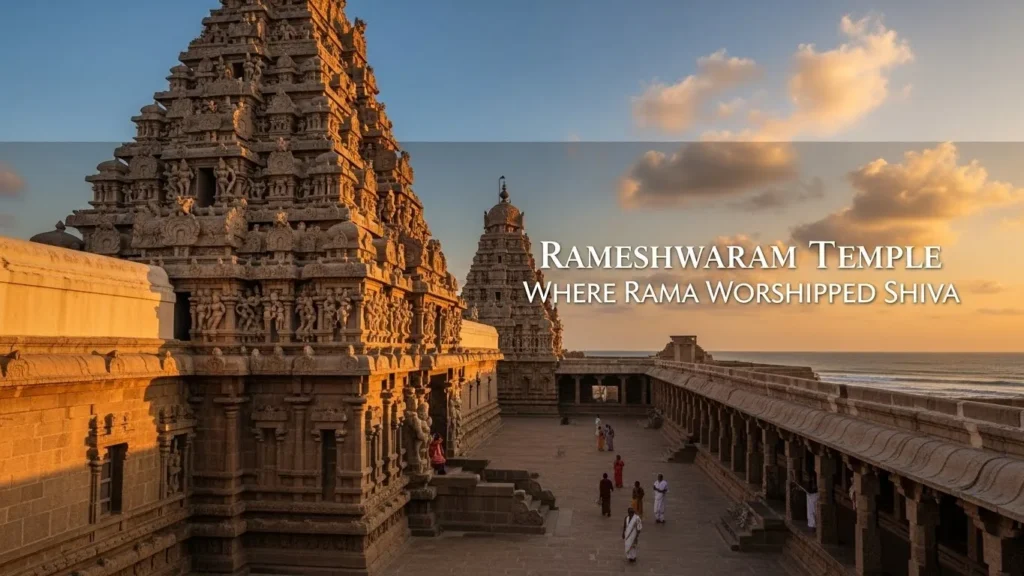
Rameshwaram Temple Ramanathaswamy in Tamil Nadu—the twelfth and southernmost among all Jyotirlingas, located on a sacred island between peninsular India and Sri Lanka—represents Hinduism’s unique convergence where even Lord Rama, seventh avatar of Vishnu, worshipped Lord Shiva seeking purification, with Wikipedia’s authoritative documentation confirming that according to Ramayana’s Yuddha Kanda, after defeating demon king Ravana in Lanka, Lord Rama narrated to Sita the necessity of establishing and worshipping Shiva in lingam form on Rameshwaram island to expiate the grave sin of Brahmahatya (killing a Brahmin,

since Ravana despite being demon was learned scholar and great Shiva devotee), and when Hanuman sent to Mount Kailash couldn’t return before the auspicious muhurat, Sita fashioned a small lingam from seashore sand which Rama worshipped as “Ramalingam”—but when Hanuman returned with “Vishwalingam” from Kashi upset at seeing worship completed, childlike devotee tried destroying sand linga with his mighty tail yet couldn’t, prompting compassionate Rama to apply kumkum and ghee all over Hanuman’s body to pacify him and ordain that Vishwalingam be worshipped first, the tradition continuing today [web:902][web:904][web:905][web:906][web:909]. According to the spiritual significance documented in Shiva Purana and temple tradition,
Rama’s intense propitiation through mantra repetition, meditation, and dancing pleased Shiva who appeared granting the boon of victory over Ravana, and when Rama requested the deity remain on the island to sanctify the world and offer grace to all people, Shiva agreed—thus establishing Rameshwaram as supremely sacred site capable of expiating even major sins, with the temple becoming one of four Char Dham pilgrimage sites (Badrinath North, Puri East, Dwarka West, Rameshwaram South) instituted by Adi Shankaracharya through Hindu monastic institutions across India’s four cardinal directions, making it essential pilgrimage for both Shaivites and Vaishnavites [web:902][web:906].
The extraordinary architectural and spiritual convergence validates profound significance: Wikipedia’s architectural analysis reveals that the magnificent temple spreading 15 acres showcases Dravidian architecture with world’s longest corridor measuring total 3,850 feet (1,173 m) featuring 1,212 brilliantly carved granite pillars 30 feet high in outer corridor alone (outer set: 6.9 m height, 400 ft east-west, 640 ft north-south; inner set: 224 ft east-west, 352 ft north-south), 53-meter (174 ft) tall nine-level Rajagopuram eastern tower, Chess Board Chokkatan Mandapam
where third corridor meets western gopuram path, massive 12 ft × 9 ft Nandi statue, and intricate Virabhadra composite columns added by Vijayanagara kings during 1500s—built through centuries starting 12th century thatched shed, expanded by Pandya Dynasty, principal sanctum renovated by Jaffna kingdom’s Jeyaveera and Gunaveera Cinkaiariyan who shipped stones from Koneswaram Trincomalee, 17th century major construction by Setupati rulers of Ramanathapuram, and 18th century third corridor by Muthuramalinga Setupati (ruled 1763-1795) with his statue at western entrance [web:902][web:906][web:907].
The transformative 22 Theerthams bathing ritual documented by devotees represents unique spiritual purification where 22 sacred wells within temple corridor (plus Agni Theertham sea as first) represent Lord Rama’s 22 arrows, each well possessing different water taste, temperature, salinity, and healing properties despite close proximity—with bathing believed equivalent to bathing in all sacred rivers of India, releasing karma from past actions, and the final Kodi Theertham removing sins from past births, requiring approximately 1 hour for complete ritual starting Agni Theertham sea bath then proceeding through all 22 temple wells including Mahalakshmi (washes poverty), Savitri (grants wisdom), Gayatri (clears negative energies), Saraswati (blesses learning) [web:907][web:912][web:913][web:916].
As millions undertake pilgrimage to experience Rameshwaram’s dual Vaishnavite-Shaivite sanctity and Ram Setu’s sacred geography—with modern infrastructure including Madurai International Airport 179 km away, Rameshwaram Railway Station 2 km from temple, crossing iconic Pamban Bridge (India’s first sea bridge connecting mainland to island), temple operating 5 AM-1 PM and 3-9 PM with 8 daily aartis starting Palliyarai wake-up at 5 AM, 22 Theerthams bathing facilities, Dhanushkodi beach 20 km offering boat rides to Ram Setu (Adam’s Bridge—30 km limestone causeway built by Rama’s vanara army visible underwater between India-Sri Lanka), and complete Char Dham circuit combining with Badrinath-Puri-Dwarka—understanding
the complete Rama-Hanuman sand linga legend, world’s longest corridor marvel, 22 sacred wells purification ritual, Ram Setu geological-mythological significance, and practical visiting guide becomes essential for meaningful Hindu pilgrimage [web:902][web:911][web:917][web:919][web:920]https://hindutva.online. This comprehensive article presents Rameshwaram’s sacred Rama worship of Shiva story, twelfth Jyotirlinga and Char Dham significance, world-record 3,850-foot corridor with 1,212 pillars, 22 Theerthams bathing ritual guide, Ram Setu pilgrimage to Dhanushkodi, complete darshan timings and aarti schedule, how to reach from major cities, and pilgrimage preparation tips.
The Legend: Rama’s Worship of Shiva
Return from Lanka After Defeating Ravana
Legend has it that Lord Rama worshipped Lord Shiva in this spot on his way back from Lanka – after defeating the demon king, Ravana [web:904][web:909].
The victorious return [web:904][web:906]:
- Lord Rama defeated demon king Ravana in epic battle
- Rescued Goddess Sita from captivity
- Returning to Ayodhya with Sita and Lakshmana
- Journey back via Rameshwaram island
Brahmahatya Sin: Killing a Brahmin
The spiritual dilemma [web:904][web:906][web:909]:
- Ravana, though demon, was learned Brahmin scholar
- Great devotee of Lord Shiva
- Killing him constituted Brahmahatya—gravest sin
- Sages counseled Rama to install and worship Shivalingam
- Necessary to compensate sin and achieve purification
Hanuman Sent to Mount Kailash
Since there was no shrine for Shiva there, he sent Hanuman to Mount Kailash, Lord Shiva’s abode, to bring the linga [web:904][web:905].
The mission [web:904][web:905][web:906]:
- Rama fixed auspicious time (muhurat) for Shivalinga installation
- Sent Lord Hanuman to Varanasi (Kashi)
- Mission: Bring sacred linga from Mount Kailash region
- Hanuman departed immediately with great speed
Sita Creates Sand Lingam
The urgent solution [web:905][web:906][web:909]:
- Hanuman couldn’t return before muhurat
- Auspicious time approaching, worship couldn’t be delayed
- Goddess Sita fashioned small lingam from seashore sand
- Lord Rama installed and worshipped sand lingam
- Called “Ramalingam” (Rama’s lingam)
- The sand structure soon hardened and turned into stone [web:905]
Hanuman’s Anger and Failed Attempt
The devoted servant’s disappointment [web:905]:
- Hanuman returned with “Vishwalingam” (Universal Lingam) from Kashi
- Deeply upset seeing worship already completed
- Felt his efforts went in vain
- In childlike fit of rage, tried to destroy sand linga
- Used his mighty tail with tremendous force
Divine Strength: Immovable Ramalingam
Shiva’s protection:
- Hanuman’s legendary strength proved futile
- Shiva invoked by Rama protected the lingam
- Sand had hardened into indestructible stone
- Hanuman fell back from recoil force
Rama Pacifies Hanuman
Compassionate resolution [web:905]:
- Rama applied kumkum (sindoor) and ghee all over Hanuman’s body
- Showed immense love and compassion
- Hanuman cooled down witnessing Rama’s affection
Both Lingams Worshipped: Vishwalingam First
The eternal ordinance [web:902][web:905][web:906]:
- Rama ordained special honor for Vishwalingam
- Vishwalingam brought by Hanuman to be worshipped FIRST
- Then Ramalingam (main deity)
- Tradition continues even today after 5,000+ years
- Both lingams side by side in inner sanctum
- Vishwalingam worship honors Hanuman’s devotion
Twelfth and Southernmost Jyotirlinga
Jyotirlinga Manifestation
The infinite light:
- Endless pillar of light establishing Shiva’s supremacy
- Rameshwaram: Twelfth and southernmost Jyotirlinga
- Other 11: Somnath, Mallikarjuna, Mahakaleswar, Omkareshwar, Kedarnath, Bhimashankar, Viswanath, Trimbakeshwar, Vaidyanath, Nageshwar, Grishneshwar
Unique Vaishnavite-Shaivite Convergence
Dual sanctity:
- Lord Rama (Vishnu avatar) worshipped Lord Shiva here
- Sacred for both Vaishnavites and Shaivites
- Also revered by Smartas (followers of Shankaracharya’s Advaita)
- Rare temple where Vishnu devotee established Shiva shrine
Char Dham: Four Divine Sites
Adi Shankaracharya’s Establishment
The four cardinal temples [web:902][web:906]:
- Badrinath Temple (North)—Uttarakhand, Lord Vishnu
- Jagannath Temple at Puri (East)—Odisha, Lord Jagannath
- Dwarakadheesh Temple at Dwarka (West)—Gujarat, Lord Krishna
- Ramanathaswamy Temple at Rameshwaram (South)—Tamil Nadu, Lord Shiva
The Sacred Circuit
Pilgrimage tradition:
- Visit all four corners of India
- Traditionally starts from Puri (East)
- Proceeds clockwise: Puri → Rameshwaram → Dwarka → Badrinath
- Considered life’s ultimate spiritual goal
- Grants moksha and spiritual fulfillment
World’s Longest Temple Corridor
Record-Breaking Dimensions
Corridor specifications [web:902][web:907][web:910]:
| Feature | Measurement |
|---|---|
| Total Length | 3,850 feet (1,173 meters / 1.2 km) |
| Outer Corridor Height | 6.9 meters (23 feet) |
| Outer East-West | 400 feet each |
| Outer North-South | 640 feet each |
| Inner East-West | 224 feet each |
| Inner North-South | 352 feet each |
| Total Pillars | 4,000+ pillars |
| Outer Corridor Pillars | 1,212 carved pillars |
| Pillar Height | 30 feet (floor to roof center) |
The Magnificent Pillars
Architectural marvel [web:902][web:906][web:907]:
- 1,212 brilliantly carved granite pillars in outer corridor
- Each pillar individually composed carvings
- Erected on platforms 5 feet high
- Intricately carved with beautiful images
- Rock not indigenous to island—imported across sea
- Virabhadra composite columns added by Vijayanagara kings (early 1500s)
Historical Construction
Building timeline [web:902][web:905][web:906]:
- 12th century: Temple expanded by Pandya Dynasty
- 1380-1410 CE: Jaffna king Jeyaveera Cinkaiariyan shipped stones from Koneswaram Trincomalee
- 17th century: Major structure by Setupati rulers
- 1763-1795: Third corridor by Muthuramalinga Setupati
- Setupati’s statue visible at western entrance
Other Architectural Features
The main tower or rajagopuram is 53 m tall [web:902].
Temple highlights [web:902][web:906]:
- Rajagopuram: 53 meters (174 feet) tall, nine levels
- Chokkatan Mandapam: Chess board pattern where third corridor meets western gopuram
- Nandi statue: Colossal 12 feet long × 9 feet high
- Temple area: 15 acres
- Gopurams: Towering spires on all four sides
The 22 Sacred Theerthams (Wells)
Rama’s 22 Arrows
Spiritual symbolism:
- 22 sacred wells inside temple corridor
- Represent 22 arrows in Lord Rama’s quiver
- Plus Agni Theertham (Bay of Bengal) as first bath
Unique Properties of Each Well
Miraculous characteristics [web:912][web:913][web:916]:
- Each well has different water taste
- Different temperature despite close proximity
- Different salinity levels
- All freshwater, hardly saline
- Possess medicinal and healing properties
Bathing Ritual Significance
Spiritual benefits [web:912][web:916]:
- Purifies body and soul
- Releases karma from past actions
- Equivalent to bathing in all sacred rivers of India
- Final Kodi Theertham removes sins from past births
The 22 Theerthams List
Complete list of 22 wells with significance [web:912][web:915]:
| Well | Name | Spiritual Benefit |
|---|---|---|
| 1 | Mahalakshmi Theertham | Washes away poverty |
| 2 | Savitri Theertham | Grants wisdom |
| 3 | Gayatri Theertham | Clears negative energies |
| 4 | Saraswati Theertham | Blesses with learning |
| 5 | Ganga Theertham | Purification |
| 6 | Yamuna Theertham | Spiritual cleansing |
| … | (22 wells total) | Various blessings |
Bathing Procedure
The ritual of bathing starts from Agni Theertham (sea) then proceeding through each well. Keep an hour aside to complete this ritual [web:915][web:916].
Guidelines [web:916]:
- First: Bath in Agni Theertham (Bay of Bengal sea)
- Enter temple for 22 Theerthams bathing
- Duration: 1 hour for complete ritual
- Dress code: Traditional attire, carry extra clothes
- Temple provides bathing facilities
Ram Setu: Adam’s Bridge to Sri Lanka
The Mythological Bridge
The construction legend [web:917][web:919]:
- Lord Rama’s vanara (monkey) army built bridge
- To reach Lanka and rescue Sita from Ravana
- Called “Sethubanthan” in Valmiki’s Ramayana
- Bridge of faith and devotion
Geological Structure
Physical features [web:917][web:919]:
- Length: 30 kilometers (18.6 miles)
- Material: Limestone shoals, sand spits, coral reefs
- Connects: Dhanushkodi (India) to Mannar Island (Sri Lanka)
- Depth: 3-30 feet underwater (submerged after 1480 cyclone)
- Until 1480, used as connecting passage between countries
Visiting Ram Setu
How to visit [web:917][web:919]:
- Starting point: Dhanushkodi (20 km from Rameshwaram)
- Transportation: Jeeps to Dhanushkodi (no concrete road after 1964 cyclone)
- Boat rides: From Dhanushkodi Beach to sand dunes
- Timings: 6 AM – 6 PM
- Entry: Free
Temple Timings and Darshan
Daily Temple Timings
Rameshwaram Temple darshan timings [web:918][web:920]:
| Session | Timings |
|---|---|
| Morning Darshan | 5:00 AM – 1:00 PM |
| Afternoon Break | 1:00 PM – 3:00 PM |
| Evening Darshan | 3:00 PM – 9:00 PM |
Daily Aarti and Pooja Schedule
Complete ritual schedule [web:918]:
| Ritual | Timings |
|---|---|
| Palliyarai Deepa Arathana (Wake-up Aarti) | 5:00 AM |
| Spadigalinga Deepa Arathana | 5:10 AM |
| Thiruvananthal Deepa Arathana | 5:45 AM |
| Arthajama Pooja (Before Close) | 8:30 PM |
| Palliyarai Pooja (Shayan & Close) | 8:45 PM |
Entry Fee
Free entry to temple
Pooja Pricing
Approximate costs: ₹1,500 for special poojas [web:918]
How to Reach Rameshwaram
By Air
Madurai International Airport is the nearest airport to Rameshwaram, about 179 km away [web:920].
Nearest Airport: Madurai [web:911][web:920]:
- Distance: 179 kilometers (111 miles)
- Flight connections: Chennai, Bangalore, Delhi, Mumbai
- Travel time: 3.5-4 hours by taxi/bus
- Hire taxi or take bus from Madurai to Rameshwaram
By Train
Rameshwaram Railway Station is about 2 km away from the Rameshwaram Temple [web:920].
Rameshwaram Railway Station:
- Distance: 2 km from temple
- Well-connected to Chennai, Madurai, Trichy, Coimbatore
- Auto-rickshaws and taxis available
By Road: Crossing Pamban Bridge
Road connectivity [web:911][web:920]:
- Must cross iconic Pamban Bridge (India’s first sea bridge)
- Buses available from: Madurai, Chennai, Trichy, Ramanathapuram
- Distance from Madurai: 163 km
- Rameshwaram Bus Station: 2 km from temple
Best Time to Visit
Ideal Season
October to March offers pleasant weather [web:911]:
| Season | Experience |
|---|---|
| October-March | Pleasant weather, best time |
| April-June | Hot and humid, challenging |
| July-September | Rainy, fewer crowds, wet roads/beaches |
Special Festivals
- Maha Shivaratri: Huge celebrations
- Rama Navami: Lord Rama’s birthday (major)
- Thai Amavasai: Special rituals
- Shravan month: Sacred for Shiva worship
Pilgrimage Tips
Essential Tips
- Start with Agni Theertham sea bath before 22 Theerthams
- Allocate 1 hour for 22 Theerthams bathing ritual
- Carry extra traditional clothes for bathing
- Visit both Ramalingam and Vishwalingam (Vishwalingam worshipped first)
- Explore world’s longest corridor (1.2 km walking)
- Visit Dhanushkodi (20 km) for Ram Setu experience
- Book accommodation in advance during festivals
- Dress modestly: Remove leather items
What to Experience
- Ramalingam-Vishwalingam darshan: Both sacred lingams side by side
- 22 Theerthams bathing: Unique purification ritual
- World’s longest corridor: 1,212 carved pillars
- Agni Theertham sea bath: Bay of Bengal
- Ram Setu at Dhanushkodi: Boat ride to sand dunes
- Pamban Bridge: Iconic sea bridge crossing
- Chess Board Chokkatan Mandapam: Unique structure
Frequently Asked Questions
Where is Rameshwaram Temple located?
Rameshwaram Temple is on Rameshwaram island in Ramanathapuram district, Tamil Nadu, 2 km from railway station, accessible via Pamban Bridge [web:902][web:920].
What is the legend of Rameshwaram Temple?
After defeating Ravana, Rama sought forgiveness for Brahmahatya sin; sent Hanuman to Kashi for linga but auspicious time approaching so Sita made sand Ramalingam; upset returning Hanuman couldn’t destroy it; Rama worshipped Vishwalingam first to honor Hanuman [web:904][web:905][web:906].
What is the world’s longest temple corridor?
Rameshwaram’s corridor measures total 3,850 feet (1.2 km) with 1,212 carved pillars 30 feet high in outer corridor alone; outer set 6.9 m height, 400 ft east-west, 640 ft north-south [web:902][web:907][web:910].
What are the 22 Theerthams?
What are temple timings?
Temple opens 5 AM-1 PM (morning), 3 PM-9 PM (evening); Palliyarai wake-up aarti 5 AM, Shayan Pooja 8:45 PM; free entry [web:918][web:920].
What is Ram Setu?
How to reach from Madurai?
Madurai International Airport 179 km (3.5-4 hours by taxi/bus); Rameshwaram Railway Station 2 km from temple; frequent buses from Madurai; cross Pamban Bridge to reach island [web:911][web:920].
What is Char Dham significance?
Conclusion
Rameshwaram’s Ramanathaswamy Temple in Tamil Nadu—the sacred twelfth and southernmost Jyotirlinga on an island between India and Sri Lanka where Lord Rama, seventh avatar of Vishnu, after defeating demon king Ravana sought purification from Brahmahatya sin of killing learned Brahmin scholar by establishing and worshipping Shiva, with Sita fashioning the Ramalingam from seashore sand when Hanuman sent to Kailash couldn’t return before auspicious muhurat, and compassionate Rama ordaining that the Vishwalingam brought by disappointed Hanuman be worshipped first (tradition continuing today)—represents
Hinduism‘s unique Vaishnavite-Shaivite convergence and one of four Char Dham pilgrimage sites, with Wikipedia’s documentation confirming extraordinary Dravidian architecture spreading 15 acres featuring world’s longest corridor measuring 3,850 feet (1.2 km) with 1,212 brilliantly carved 30-foot granite pillars in outer corridor (6.9 m height, 400 ft east-west, 640 ft north-south) built through centuries by Pandya Dynasty, Jaffna kings, and 18th century Muthuramalinga Setupati, 53-meter nine-level Rajagopuram, and 22 sacred Theerthams (wells) representing Rama’s 22 arrows with each possessing different water taste-temperature-healing properties despite proximity—bathing equivalent to all sacred rivers with final Kodi Theertham removing past birth sins [web:902][web:912]https://hindutva.online.
What distinguishes Rameshwaram’s extraordinary significance is its convergence of legendary devotion (even Lord Rama worshipped Shiva demonstrating supreme humility, with both Ramalingam and Vishwalingam worshipped together honoring Hanuman’s service), architectural supremacy (world-record 3,850-foot corridor with 4,000 total pillars including 1,212 individually carved masterpieces, imported granite demonstrating ancient engineering, Chess Board Chokkatan Mandapam, colossal 12×9 ft Nandi), unique purification ritual (22 Theerthams bathing taking 1 hour starting Agni Theertham sea
then proceeding through all wells with miraculous different tastes-temperatures releasing karma), geographical-mythological wonder (Ram Setu 30 km limestone causeway to Sri Lanka built by vanara army visible underwater 3-30 ft at Dhanushkodi 20 km away with boat rides 6 AM-6 PM), and complete modern infrastructure (Madurai Airport 179 km with 3.5-hour connectivity, Rameshwaram Station 2 km, crossing iconic Pamban Bridge India’s first sea bridge, temple timings 5 AM-1 PM/3-9 PM with 8 daily aartis, Char Dham circuit with Badrinath-Puri-Dwarka) [web:902][web:911][web:917][web:918][web:920].
By understanding this southernmost Jyotirlinga pilgrimage—combining Ramalingam-Vishwalingam dual darshan witnessing Rama-Hanuman devotion legend, transformative 22 Theerthams bathing purification equivalent to all sacred rivers, walking world’s longest temple corridor marveling at 1,212 carved pillars, experiencing Agni Theertham Bay of Bengal sea bath, visiting Dhanushkodi’s Ram Setu where Rama’s vanara army built 30 km bridge to Lanka, and completing Adi Shankaracharya’s Char Dham four-corner circuit—devotees access the profound journey that ancient Hindu wisdom established as supremely sacred site where even avatar of Vishnu worshipped Shiva seeking purification [web:902][web:906][web:916]https://hindutva.online.
About the Author
Arvind Mehta – Certified Yoga Therapist & Spiritual Wellness Expert
Arvind Mehta is a certified yoga therapist with over 18 years of experience specializing in Hatha Yoga, pranayama, meditation, and traditional shatkarma purification practices. He holds advanced certifications in yoga therapy and has trained extensively in classical yogic texts including the Hatha Yoga Pradipika and Gheranda Samhita. Arvind Mehta integrates ancient yogic wisdom with Ayurvedic principles to help students achieve optimal physical health and spiritual growth through authentic practices. His teaching focuses on making traditional techniques accessible to modern practitioners while maintaining the depth and transformative power of the original methods. He has guided thousands of students through systematic yoga sadhana at leading institutions and retreat centers across India and internationally.