


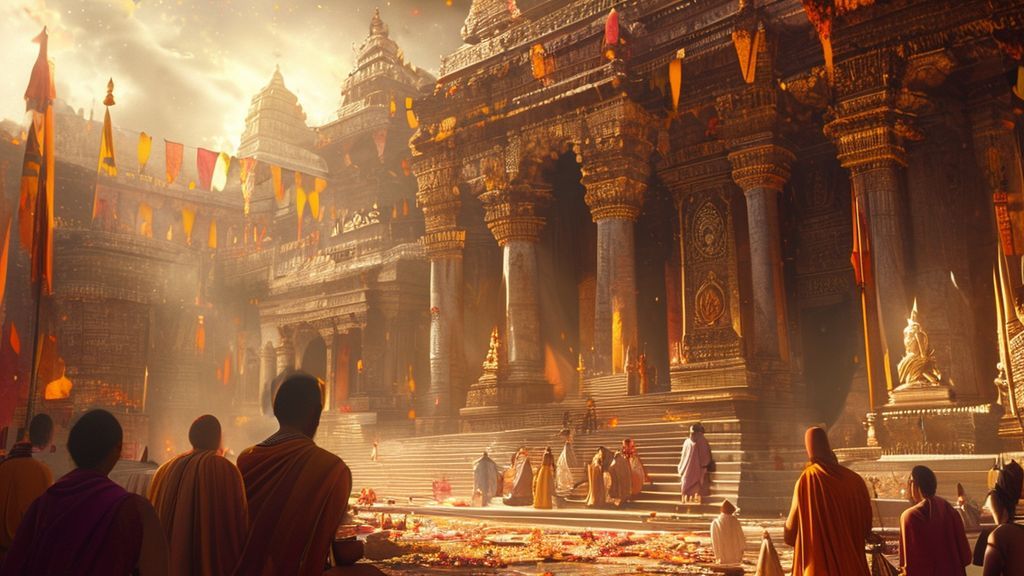
The Rigveda, the oldest extant Hindu scripture, is a foundational collection of 1,028 hymns (Suktas) comprising over 10,600 verses (Riks) arranged into ten Mandalas, serving as the primordial revelation (Shruti) of Sanatan Dharma. It venerates various Devas like Agni, Indra, and Surya, establishing core cosmological principles and ritualistic practices that underpin Vedic tradition.
| Attribute | Details |
|---|---|
| Primary Deities Invoked | Agni (Fire), Indra (Warrior God), Soma (Divine Nectar), Surya (Sun), Vayu (Wind), Usha (Dawn), Varuna (Cosmic Order) |
| Probable Region of Origin | Sapta-Sindhu region (North-Western Indian subcontinent) |
| Core Theme | Invocation of Devas, cosmic order (Rta), Dharma, profound philosophical insights, and the efficacy of Yajna (ritual sacrifice) |
| Scripture Reference Format | RV X.YY.Z (Rigveda, Mandala X, Sukta YY, Verse Z) |
The Eternal Resonance of the Rigveda: Foundation of Sanatan Dharma
The Rigveda, more than just an ancient text, is the very breath of Sanatan Dharma, an eternal spring of spiritual wisdom that has nourished Hindu civilization for millennia. It is the primal utterance (Shruti), heard by exalted Rishis in deep states of meditation, and meticulously preserved through an unbroken oral tradition for countless generations before being committed to writing. This sacred compendium is not merely a collection of prayers; it is a profound philosophical treatise, a guide to ritualistic harmony, and a vibrant record of humanity’s earliest documented quest for cosmic understanding. Its verses illuminate the intricate relationship between humanity, the Devas, and the fundamental principles governing the universe, making it an indispensable cornerstone for any sincere seeker on the path of Dharma. The hymns, or Mantras, contained within the Rigveda are believed to possess inherent power, capable of invoking divine presence and aligning the individual consciousness with the universal rhythm (Rta).
Ancient Origins & Rishic Revelation: The Unbroken Chain of Shruti
Unlike historical documents penned by human hands, the Rigveda is revered as *Apaurusheya* – not of human authorship – a divine revelation heard by Rishis such as Gritsamada, Vishvamitra, Vamadeva, Atri, Bharadvaja, and Vasishtha, whose names are intrinsically linked to specific Mandalas. The tradition holds that these enlightened seers did not compose the hymns but rather perceived them in their meditative states, acting as conduits for eternal truths. This process of divine hearing is known as Shruti (what is heard), distinguishing it from *Smriti* (what is remembered), which includes texts like the Puranas and Itihasas. While specific Puranic legends about its “origin” are not directly part of the Rigveda itself, later Vedic and Puranic literature consistently refer to its primordial nature and its role in creation. For instance, the Brahmanas, later Vedic texts, elaborate extensively on the ritual application and profound significance of Rigvedic hymns, confirming its central status from antiquity. The Vishnu Purana and Bhagavata Purana also acknowledge the Rigveda as a fundamental component of Vedic knowledge, passed down through a succession of spiritual teachers (Guru-Shishya Parampara) from Brahma himself.
The Cosmic Architecture of Rigvedic Thought & Its Scientific Resonance
The Rigveda is organized into ten books, or Mandalas (मंडला), each attributed to a particular family of Rishis (except Mandalas 1 and 10, which are composite). Within these Mandalas are Suktas (सूक्तम्), or hymns, and each Sukta comprises several individual verses, or Riks (ऋक्). This intricate structure is a testament to the highly developed intellectual and spiritual culture of the Vedic age. Mandalas 2 through 7 are considered the “family books,” being the oldest and most cohesive. Mandala 9 is unique, dedicated entirely to Soma. Mandala 10 contains hymns that explore profound philosophical questions, including the famous Purusha Sukta (RV 10.90) describing cosmic creation and the Nasadiya Sukta (RV 10.129), which probes the origins of the universe, questioning even the Devas’ knowledge of creation. The Rigveda’s understanding of cosmology, astronomy, and phonetics demonstrates a sophisticated scientific outlook, not merely poetic fancy. The precise meter and accentuation of the hymns (e.g., Gayatri, Anushtubh, Trishtubh) were critical for preserving their sonic power, a phonetic science unparalleled in its time. The concept of Rta (ऋत), cosmic order, permeates the Rigveda, suggesting an early understanding of universal laws governing both the physical and moral realms, a concept that resonates with modern scientific principles of natural law.
Rituals & Puja Vidhi: The Yajna and the Power of Sound
The primary purpose of many Rigvedic hymns is their application in Yajnas (यज्ञ), elaborate fire sacrifices performed by qualified priests (ऋत्विज् – Ritvij). The Rigveda provides the foundational mantras chanted by the Hotri priest, whose role is to invoke the Devas and praise them. The Adhvaryu priest, who conducts the physical ritual, and the Udgatri priest, who sings the Samaveda hymns, also play crucial roles, but the Rigveda forms the bedrock of the invocations. A typical Rigvedic ritual involves:
- Sankalpa (Intention): The sacrificer (Yajamana) declares the purpose of the Yajna.
- Agni Pratisthapana (Installation of Fire): Sacred fire, the messenger to the Devas, is kindled, often with Rigvedic mantras to Agni (e.g., RV 1.1.1: “अग्निमीळे पुरोहितं यज्ञस्य देवमृत्विजम्। होतारं रत्नधातमम्॥” – I laud Agni, the household priest, the divine ministrant of sacrifice, the invoker, bestowing wealth).
- Deva Ahvanam (Invocation of Devas): The Hotri priest chants specific Rigvedic Suktas to invite the desired Devas (e.g., Indra for strength, Surya for illumination).
- Homa (Offerings): Oblations of ghee, grains, and other sacred materials are offered into the fire with accompanying mantras, conveying prayers and gratitude to the Devas.
- Stuti and Prarthana (Praise and Prayer): Further hymns of praise and specific prayers for well-being, prosperity, and spiritual growth are recited.
- Purnahuti (Final Offering): A culminating offering signifying completion and surrender.
- Ashirvada (Blessings): The priests bestow blessings upon the Yajamana.
The precise pronunciation (Uchcharan) and intonation are paramount, as the sound (Shabda) itself is considered divine and potent. These rituals are not merely symbolic; they are believed to maintain cosmic balance and foster individual and collective welfare, reflecting a profound understanding of the interconnectedness of all existence.
Mantras & Chants: Echoes of Eternity
The Rigveda is a treasury of powerful mantras, each a condensed package of spiritual energy and meaning. Among the most revered is the Gayatri Mantra, found in RV 3.62.10:
ॐ भूर्भुवः स्वः। तत् सवितुर्वरेण्यं भर्गो देवस्य धीमहि। धियो यो नः प्रचोदयात्॥
(Om Bhur Bhuvah Svah | Tat Savitur Varenyam Bhargo Devasya Dheemahi | Dhiyo Yo Nah Prachodayat ||)
This mantra invokes Savitr, the solar deity, for spiritual illumination and wisdom. Another fundamental hymn is to Agni, the divine fire, central to all Vedic rituals (RV 1.1.1-9). The Mrityunjaya Mantra, while often associated with the Yajurveda, has roots in Rigvedic hymns to Rudra (RV 7.59.12), seeking protection from death and illness. Chanting these mantras with devotion and correct pronunciation is believed to purify the mind, invoke divine grace, and align the devotee with the cosmic consciousness. For deeper understanding, Hindutva.online offers extensive resources on Vedic chants.
Dos and Don’ts: Reverence for the Sacred Word
Approaching the Rigveda, whether for study or ritual, demands profound reverence and discipline.
- Do: Approach with a clean body and mind, having bathed and purified oneself.
- Do: Study under a qualified Guru or teacher (Acharya) who can guide on proper pronunciation and meaning.
- Do: Maintain utmost respect for the physical text if studying from a manuscript or printed edition.
- Do: Practice memorization and recitation, as the oral tradition is central to its preservation.
- Don’t: Treat the Rigveda as mere literature or historical text without acknowledging its sacred nature.
- Don’t: Recite mantras without understanding their context and proper intonation, as this can diminish their efficacy.
- Don’t: Engage in frivolous or disrespectful discussion of its profound truths.
- Don’t: Access or handle the text in an impure state or with casual disregard.
What is the meaning of “Rigveda”?
The term “Rigveda” is a compound of two Sanskrit words: “Rig” (ऋक्), meaning praise or verse, and “Veda” (वेद), meaning knowledge. Thus, Rigveda literally translates to “Knowledge of Praises” or “Knowledge of Verses,” referring to its collection of hymns dedicated to various deities.
How many Mandalas are there in the Rigveda?
The Rigveda is structurally organized into ten books, known as Mandalas (मंडला). Each Mandala, while having a distinct identity often associated with a particular Rishi family, contributes to the overall profound tapestry of Rigvedic wisdom.
What is the significance of the Purusha Sukta?
The Purusha Sukta (RV 10.90) is one of the most significant hymns in the Rigveda, describing the cosmic creation through the sacrifice of the primordial being, Purusha. It is foundational to understanding the concept of cosmic unity, the origin of the social order (Varnas), and the interconnectedness of the universe, laying philosophical groundwork for later Hindu thought.
Preserving Sanatan Dharma: The Eternal Light of the Rigveda
The Rigveda is not a relic of the past but a living, breathing testament to the eternal truths of Sanatan Dharma. Its hymns resonate with timeless wisdom, guiding humanity towards self-realization and cosmic harmony. By upholding its study, preserving its oral tradition, and understanding its profound philosophical and ritualistic implications, we ensure the continuity of our ancient heritage. It teaches us the power of sound, the sanctity of nature, the importance of Dharma, and the ultimate unity of existence. Engaging with the Rigveda is to connect with the very source of Hindu spirituality, revitalizing our connection to the divine and ensuring that this sacred knowledge continues to illuminate the path for future generations. The principles enshrined in the Rigveda are as relevant today as they were millennia ago, offering profound insights into the human condition and the workings of the universe. To truly understand Sanatan Dharma is to deeply revere and diligently study the Rigveda, a task that Hindutva.online is dedicated to facilitating for all sincere seekers.