


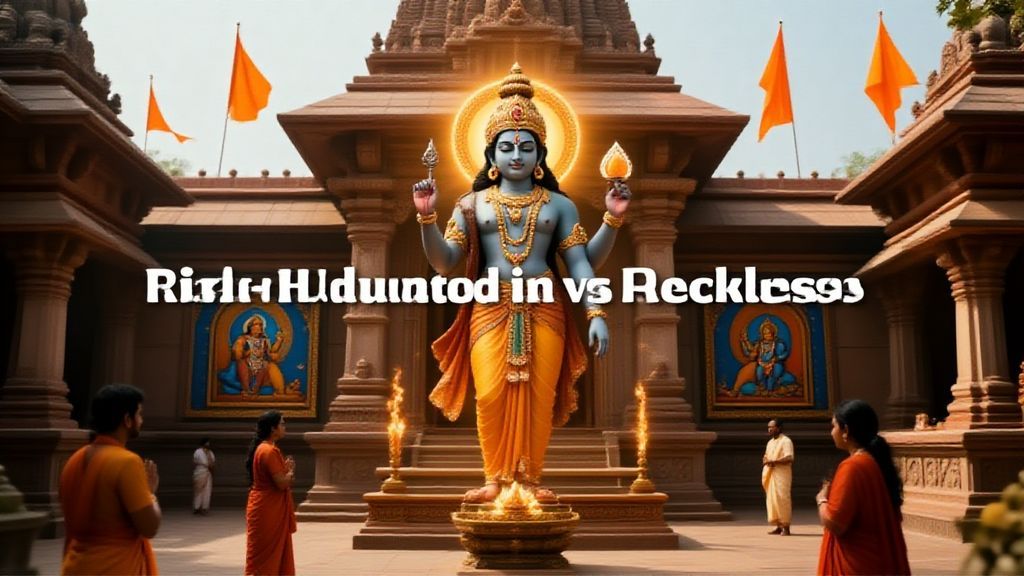
Risk-taking in Hinduism, guided by the profound principles of Dharma and Viveka (discernment), is a calculated act undertaken with purified intellect, contrasting sharply with reckless abandonment driven by ego or ignorance. Sanatan Dharma encourages purposeful action (Pravritti Marga) aimed at upholding righteousness and achieving Purusharthas (life’s legitimate goals), but strictly advises against actions that invite Adharma (unrighteousness) or harm.
| Attribute | Details |
|---|---|
| Core Principle for Calculated Risk | Viveka (Discernment), Dharma (Righteousness), Buddhi Yoga (Yoga of Intellect) |
| Guiding Scriptures | Bhagavad Gita, Upanishads, Dharma Shastras (e.g., Manu Smriti), Itihasas (Ramayana, Mahabharata) |
| Key Virtues for Prudence | Satyam (Truth), Ahimsa (Non-violence), Asteya (Non-stealing), Tapas (Austerity), Shraddha (Faith) |
| Consequence of Reckless Action | Accumulation of negative Karma, suffering, moral decay, deviation from Moksha |
The Dharma of Decision: Navigating Life’s Uncertainties
In the vast tapestry of Sanatan Dharma, life is viewed as a continuous journey of choices and actions, each bearing karmic fruits. The concept of “risk-taking,” therefore, is not about mere chance or impulsive ventures, but about navigating these choices with profound wisdom and ethical grounding. Hinduism offers a nuanced framework for understanding when an action, despite its inherent uncertainty, aligns with Dharma, and when it devolves into reckless self-sabotage. It is a profound exploration of intent, consequence, and the guiding light of spiritual principles. For a devotee, every significant decision is an opportunity to either advance their spiritual journey or create obstacles, making the distinction between calculated and reckless action paramount.
The scriptures do not advocate for a life of passive inaction; rather, they champion a dynamic engagement with the world (Pravritti Marga) guided by righteousness. However, this engagement must be calibrated by a sharp intellect (Buddhi) and unwavering adherence to moral codes (Dharma). This balance is essential for individual well-being and the collective harmony of society, as elaborated throughout the Vedas and subsequent philosophical treatises. Understanding this balance is critical for sincere seekers engaging with Hindutva.online‘s mission to articulate Sanatan values in contemporary contexts.
Itihasa and the Dharma of Decision
The great Itihasas, the Ramayana and Mahabharata, are replete with instances that illuminate the Hindu perspective on calculated versus reckless risk. These epics serve not merely as stories but as profound guides to Dharmic living.
-
Lord Rama’s Calculated Risks
In the Ramayana, Lord Rama’s actions, though fraught with immense challenges, are consistently rooted in Dharma. His decision to cross the vast ocean to Lanka, building the Setu (bridge) with the help of Vanaras, was an undertaking of colossal risk. Yet, it was a calculated risk driven by the sacred duty to rescue Sita and uphold righteousness against the Adharmic forces of Ravana. As depicted in the Yuddha Kanda, this was not an impulsive act but a meticulously planned campaign, utilizing intelligence from Hanuman and divine blessings. Rama’s intent was pure, his strategy well-considered, and his resolve unshakable, making it a prime example of calculated risk.
-
Arjuna’s Dilemma and the Bhagavad Gita
Perhaps the most celebrated discourse on action and inaction comes from the Bhagavad Gita, nestled within the Mahabharata. Arjuna, overwhelmed by the prospect of fighting his kin, wished to renounce battle. Lord Krishna, his charioteer and divine guide, instructed him on Karma Yoga and Sva-dharma. Arjuna’s initial desire to retreat could be seen as a form of reckless emotional decision-making, driven by grief (Moha), even if seemingly virtuous. Krishna’s counsel to fight, despite the grave consequences, was to undertake a calculated risk – a Dharmic war (Dharma-yuddha) – essential for the restoration of righteousness. Krishna emphasizes the importance of performing one’s duty without attachment to results (Karmaṇy-evādhikāras te mā phaleṣu kadācana – Bhagavad Gita 2.47), guiding Arjuna towards a righteous, albeit dangerous, path.
-
Duryodhana’s Reckless Abandon
In stark contrast, the actions of Duryodhana exemplify reckless risk-taking. His insistence on depriving the Pandavas of their rightful share, his pride (Ahamkara), and his refusal to heed wise counsel from elders like Bhishma and Drona led to the devastating Kurukshetra war. The dice game (Dyuta-krida), orchestrated by Shakuni, was a reckless gamble born of envy and greed, leading to the humiliation of Draupadi and sowing the seeds of destruction for the Kaurava lineage. His intellect was clouded by Rajasic (passionate) and Tamasic (ignorant) qualities, leading him down a path of Adharma, as described in the Udyoga Parva and other sections of the Mahabharata.
The Inner Architecture of Prudence: Yogic Principles for Calculated Action
Unlike physical structures, the “architecture” for prudent decision-making in Hinduism resides within the individual’s consciousness, cultivated through spiritual practice and adherence to Yogic principles. It is about building an inner framework that supports wise choices.
The foundation for calculated risk-taking is a purified intellect (Buddhi) and deep discernment (Viveka). The Yoga Sutras of Patanjali emphasize practices like Pratyahara (withdrawal of senses), Dharana (concentration), and Dhyana (meditation) to calm the mind and sharpen intuition. A mind free from the turbulence of desires (Kama), anger (Krodha), and greed (Lobha) is better equipped to assess situations objectively. The Bhagavad Gita (18.30) speaks of Satvika Buddhi, the intellect that discerns right from wrong, action from inaction, and liberation from bondage. This Sattvic intellect is the internal marvel that allows a devotee to take risks that align with Dharma, knowing that even if external outcomes are uncertain, the internal alignment with truth is secure.
Furthermore, the concept of Sankalpa (a firm, righteous resolve or intention) is crucial. Before embarking on any significant action, a clear, dharmic Sankalpa provides a moral compass. This inner architecture is not static; it is built and refined through consistent Sadhana (spiritual practice), self-reflection, and adherence to Yamas and Niyamas, the ethical guidelines of Yoga.
The Sadhana of Sagacious Action: A Dharmic Framework
Undertaking a “calculated risk” in a Dharmic sense is a spiritual practice in itself, requiring several steps:
- Introspection and Intent (Sankalpa Shuddhi): Begin by examining the true motivation behind the action. Is it driven by Dharma, societal good, personal growth, or is it by ego, greed, or fear? The scriptures emphasize purity of intent.
- Discernment and Deliberation (Viveka and Vichara): Engage the intellect (Buddhi) to analyze the situation thoroughly. Consider all possible outcomes, both positive and negative. Seek counsel from wise elders or spiritual teachers (Gurus). The Upanishads often stress the importance of reflective thought.
- Alignment with Dharma (Dharma Anusandhana): Evaluate if the potential action aligns with universal ethical principles (e.g., Ahimsa, Satyam, Asteya) and one’s personal Sva-dharma (duty). An action that violates Dharma, regardless of potential gain, is to be avoided.
- Detachment from Outcome (Karma Yoga): Once the decision is made and the action initiated with a clear, dharmic intent, cultivate detachment from the specific results. Focus on the quality of the effort, not the fruit. “Yogaḥ karmasu kauśalam” (Bhagavad Gita 2.50) – Yoga is skill in action.
- Surrender and Faith (Sharanagati and Shraddha): After taking all prudent steps, surrender the outcome to the Divine. This is not passive resignation but an active faith that righteous effort, combined with divine will, will lead to the most appropriate result.
Mantras for Viveka and Dharmic Courage
Chanting specific mantras can help cultivate the inner qualities necessary for wise decision-making and courage in the face of calculated risks:
- Gayatri Mantra:
ॐ भूर्भुवः स्वः तत्सवितुर्वरेण्यं भर्गो देवस्य धीमहि धियो यो नः प्रचोदयात् ॥
Om Bhur Bhuvah Svah Tat Savitur Varenyam Bhargo Devasya Dhimahi Dhiyo Yo Nah Prachodayat.
This universal prayer to Savitr (the Divine Sun) invokes spiritual light and wisdom, particularly for the purification and guidance of the intellect (Dhiyo Yo Nah Prachodayat – “May He enlighten our intellects”). It is paramount for developing Viveka.
- Om Namo Bhagavate Vasudevaya:
A simple yet powerful mantra dedicated to Lord Vishnu/Krishna, who embodies Dharma and provides guidance. Chanting this can bring clarity, resolve, and a sense of divine protection when facing critical choices.
- Asato Ma Sadgamaya:
असतो मा सद्गमय । तमसो मा ज्योतिर्गमय । मृत्योर् मा अमृतं गमय ॥
Asato Ma Sadgamaya | Tamaso Ma Jyotirgamaya | Mrityor Ma Amritam Gamaya ||
(“From untruth lead me to truth, from darkness lead me to light, from death lead me to immortality.”) This mantra from the Brihadaranyaka Upanishad is a prayer for moving from ignorance and illusion to truth and wisdom, essential for sagacious decision-making.
Guidelines for Dharmic Action: Cultivating Prudence
- Do:
- Cultivate a strong sense of Dharma through scriptural study and association with virtuous individuals.
- Practice self-restraint and discipline (Tapas) to strengthen your will and intellect.
- Seek counsel from experienced and wise individuals (Sat-sanga).
- Prioritize long-term Dharmic well-being over short-term gains.
- Act with pure intention (Shuddha Sankalpa).
- Don’t:
- Act impulsively out of anger, greed, fear, or ego (Ahamkara).
- Engage in actions that knowingly cause harm (Himsa) to oneself or others.
- Betray trust or compromise ethical principles for material gain.
- Ignore the advice of conscience or the warnings of wise counsel.
- Take risks driven purely by a desire for power, fame, or uncontrolled sense gratification.
Common Inquiries on Karma and Courage
Is avoiding all risk considered Dharmic?
No. Sanatan Dharma encourages active engagement with the world (Pravritti Marga) and fulfilling one’s Sva-dharma. Avoiding all action due to fear of failure or outcome can be seen as tamasic (inert) and a dereliction of duty, preventing personal and spiritual growth. The Gita champions courageous, righteous action.
How does intuition fit into calculated risk?
Intuition, when developed through spiritual practice and a purified mind (Chitta Shuddhi), is a valuable component of calculated risk. It is not mere impulse but a deeper knowing that transcends purely logical analysis. However, it must be cross-referenced with Dharmic principles and rational deliberation, not blindly followed.
Can a reckless act ever lead to a positive outcome?
While external outcomes can sometimes appear positive even from reckless actions (due to past good Karma or the intricate play of destiny), the underlying karmic consequence for the individual who acted recklessly will still be accumulated. The scriptures emphasize the purity of the action itself, not just the result.
Why This Matters for Sanatan Dharma’s Perpetuity
The distinction between calculated and reckless risk-taking is fundamental to the perpetuation of Sanatan Dharma. A society where individuals consistently engage in reckless actions, driven by personal greed or ignorance, inevitably spirals into Adharma, leading to chaos and suffering. Conversely, a society built on calculated, Dharmic actions fosters harmony, prosperity (Artha aligned with Dharma), and spiritual evolution. For devotees accessing Hindutva.online, understanding this principle is not just academic; it is a practical guide for living a life that reflects the timeless wisdom of the Rishis. By cultivating Viveka and courage, each Hindu becomes a living testament to the eternal values of righteousness, ensuring that the light of Sanatan Dharma continues to shine brightly for generations to come, guiding humanity towards truth and liberation.