

The Sabarimala Temple in Kerala traditionally prohibited women between the ages of 10 and 50 from entering the shrine based on the belief that Lord Ayyappa, the presiding deity, is a Naishtika Brahmachari (eternal celibate) who has taken a lifelong vow of celibacy, and the presence of women in their “menstruating years” would be incompatible with this sacred vow. This centuries-old custom was rooted in the theological understanding that Lord Ayyappa was born from the divine union of Lord Shiva and Lord Vishnu (in his Mohini form) specifically to destroy the demoness Mahishi, and after fulfilling this purpose, he chose to remain an eternal bachelor devoted exclusively to spiritual practice and his devotees’ welfare.

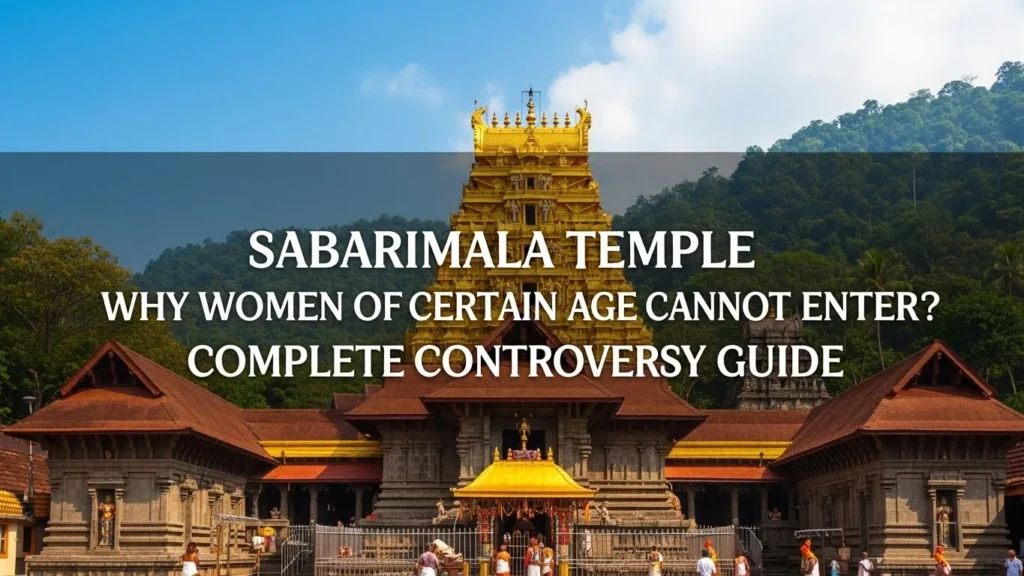
The tradition held that allowing women of reproductive age would disturb the deity’s celibate nature and violate the unique spiritual character of Sabarimala, which required devotees to undergo a rigorous 41-day vratham (penance) involving strict brahmacharya (celibacy), vegetarian diet, daily prayers, and ascetic practices before being permitted darshan. However, on September 28, 2018, the Supreme Court of India in a landmark 4:1 majority verdict overturned this restriction, declaring it unconstitutional and discriminatory, ruling that “any exception placed on women because of biological differences violates the Constitution” and specifically violated women’s fundamental rights to equality (Article 14) and freedom of religion (Article 25).
The Supreme Court judgment sparked unprecedented protests and violent confrontations in Kerala, with hundreds of thousands of devotees—including many women—blocking highways, staging demonstrations, and physically preventing women from entering the temple, arguing that the Court had violated religious autonomy and disrespected sacred traditions. The chief priest threatened to close the temple permanently if menstruating women entered, and multiple women who attempted entry after the verdict were stopped by massive crowds of protestors.
The controversy revealed deep divisions within Hindu society between those advocating constitutional rights and gender equality versus those defending traditional practices and religious freedom, with the Travancore Devaswom Board (temple administration) filing review petitions against the verdict.
This comprehensive guide explores Lord Ayyappa’s unique birth story and celibate nature, the historical origins and theological rationale of the restriction, the rigorous pilgrimage requirements demanding brahmacharya, the 2018 Supreme Court case and constitutional arguments, the massive protests and implementation challenges, different perspectives on tradition versus rights, the current status as of 2026, and how this controversy illuminates fundamental tensions in Hindu philosophy between devotional autonomy and constitutional governance.
Lord Ayyappa: The Celibate Deity
The Divine Birth: Union of Shiva and Vishnu
Lord Ayyappa’s unique origin story explains his special status:
The Mahishi Problem: A demoness named Mahishi, sister of the demon king Mahishasura (slain by Goddess Durga), performed severe penance to earn a boon from Lord Brahma:
- She requested invincibility from all beings
- Brahma granted that only a child born from the union of Lord Shiva and Lord Vishnu could kill her
- Believing this impossible (since both deities are male), Mahishi considered herself indestructible
- She began terrorizing the three worlds, oppressing gods and humans
Vishnu’s Mohini Avatar: To fulfill the divine purpose, Lord Vishnu transformed into Mohini, his enchanting female form:
- Mohini had previously appeared during the churning of the cosmic ocean (Samudra Manthan) to retrieve the elixir of immortality from demons
- Vishnu also took this form to destroy the demon Bhasmasura who threatened Lord Shiva
- Lord Shiva, captivated by Mohini’s beauty, united with her
HariHara Putra: From this extraordinary divine union, a child was born combining the powers of both Vishnu (Hari) and Shiva (Hara):
- The child embodied Shiva’s fierce asceticism and Vishnu’s ethereal charm
- He possessed supernatural strength and divine weapons
- His sole purpose was to destroy Mahishi and restore cosmic balance
Abandonment in Forest: The divine child was placed in the forest with only a bell around his neck
Adoption by King Rajashekhara
The infant’s earthly journey began in Pandalam kingdom:
Discovery: King Rajashekhara of Pandalam, who was childless and had long yearned for an heir, discovered the infant while hunting in the forest
Divine Recognition: The king immediately recognized the child’s divine nature and adopted him with great joy
Named Manikandan: The prince was named “Manikandan” meaning “one with a bell around his neck”
Royal Upbringing: Manikandan grew up in the palace as the crown prince:
- Excelled in martial arts and weapons training
- Demonstrated profound spiritual wisdom and compassion
- Displayed supernatural abilities hinting at his divine origin
- Combined warrior prowess with ascetic discipline
The Mahishi Battle and Celibacy Declaration
Manikandan’s divine purpose soon manifested:
The Mission: Upon reaching maturity, Manikandan learned of his true mission to destroy Mahishi
The Battle: Manikandan confronted Mahishi in fierce combat and ultimately vanquished her, fulfilling the prophecy
Mahishi’s Liberation: According to legend, Mahishi had been cursed to live as a demon and actually desired liberation:
- After being defeated by Manikandan/Ayyappa, she was freed from her curse
- Upon liberation, she wanted to marry Lord Ayyappa out of gratitude and love
- She expressed her desire to become his consort
Ayyappa’s Refusal and Promise: Lord Ayyappa declined marriage, choosing instead eternal celibacy:
- He declared he would remain a Naishtika Brahmachari (permanent celibate) devoted to spiritual pursuits
- He promised Mahishi (now transformed into the goddess Malikapurathamma) that he would marry her on the day when “no first-time devotee comes to Sabarimala”
- Since new devotees (Kanni Ayyappans) continue visiting every year, the marriage perpetually awaits
Waiting at Malikapurathamma Temple: The transformed Mahishi still waits near Sabarimala Temple as Malikapurathamma, with a shrine dedicated to her approximately 5 kilometers from the main Sabarimala shrine
Establishment of Sabarimala Temple
After fulfilling his earthly mission, Ayyappa chose his abode:
Location Selection: Acting upon the advice of Sage Agastya, King Rajashekhara laid the foundation of the temple at Sabarimala
Ayyappa’s Conditions: Lord Ayyappa stated emphatically that he would grant darshan only to devotees who:
- Observed 41 days of penance (vratham) before visiting
- Maintained strict abstinence from family desires and tastes
- Adhered to a way of life akin to that of a brahmachari (celibate student)
- Constantly reflected on the goodness of life with spiritual focus
Celibate Sanctuary: Sabarimala thus became established as the abode of an eternal celibate deity with unique worship requirements reflecting this character
The Traditional Restriction: Theological Rationale
Naishtika Brahmacharya Concept
Understanding the restriction requires understanding Naishtika Brahmacharya:
Definition: A Naishtika Brahmachari is one who undertakes a vow to remain celibate until death, never marrying or engaging in worldly family life
Different from Temporary Celibacy: Hindu tradition recognizes multiple forms of brahmacharya:
- Brahmacharya Ashrama: Temporary celibate student stage (age ~8-25)
- Grihastha: Householder stage allowing marriage
- Vanaprastha: Retired forest-dweller stage
- Sannyasa: Renunciate stage
- Naishtika Brahmacharya: Permanent celibacy transcending all life stages
Highest Form of Renunciation: While temporary celibacy prepares for eventual marriage, Naishtika Brahmacharya represents complete and eternal renunciation of sexual and marital life
Spiritual Purity: This vow maintains:
- Absolute detachment from desire
- Complete spiritual focus
- Preservation of vital spiritual energy (ojas)
- Ultimate dedication to divine consciousness
Sabarimala’s Uniqueness: While several Hindu temples have celibate deities, Sabarimala specifically enshrines a Naishtika Brahmachari as evidenced by the temple’s sthalapuranam (origin legend) Sri Bhoothanatha Upakhyanam
The Five Sastha Temples
The restriction’s theological basis comes from understanding Ayyappa’s manifestations:
Pancha Sastha Temples: Five temples in Kerala represent Ayyappa/Sastha at different life stages:
- Kulathupuzha: Bala Sastha (Child form)
- Aryankavu: Brahmachari Sastha (Celibate student)
- Sabarimala: Vanaprastha Sastha (Renunciate in forest)
- Achankovil: Grihastha Sastha (Householder – married form)
- Ponnambalamedu: Yogi Sastha (Ultimate spiritual attainment)
Critical Distinction: While the deity at Aryankavu is also celibate, women ARE allowed to visit that shrine
Sabarimala’s Special Status: Sabarimala represents the Vanaprastha stage—the renunciate who has moved away from civilization into forest in pursuit of Brahman (ultimate reality)
This unique combination of celibate nature AND forest renunciation created the theological basis for women’s exclusion at Sabarimala specifically, distinguishing it from other Ayyappa temples
Age Range Rationale (10-50 Years)
The specific age restriction had biological and cultural reasoning:
Menstruating Years: Women between ages 10 and 50 were assumed to be in their reproductive years with menstrual cycles
Biological Development:
- Age 10: Approximate onset of puberty and menstruation in many girls
- Age 50: Approximate menopause when menstruation typically ceases
- The range encompassed potential reproductive capacity
Pre-pubertal and Post-menopausal Exemption: Girls under 10 and women over 50 were permitted entry as they:
- Were not menstruating
- Did not represent reproductive femininity
- Were considered spiritually equivalent to celibate males in this context
Devotee Interpretation: Devotees believed that restricting menstruating women was:
- A way to honor Lord Ayyappa’s celibacy vow
- Maintaining the spiritual purity of a celibate sanctuary
- Preventing situations that might conflict with the deity’s ascetic nature
- Following what they interpreted as the lord’s last wish
Menstrual Taboo Context
The restriction also reflected broader Hindu concepts about menstruation:
Temporary Ritual Impurity: Traditional Hindu practices often treated menstruation as a period of temporary ritual impurity (ashoucha) requiring:
- Abstention from temple worship
- Separation from cooking and sacred spaces
- Special bathing rituals after the period ends
- Temporary withdrawal from normal religious activities
Biological Explanation: Some apologists argued this served health purposes:
- Giving women rest during physically demanding periods
- Preventing exertion during menstruation
- Protecting women in era before modern sanitary products
- Ensuring comfort in challenging pilgrimage conditions
Sabarimala’s Permanent Application: Unlike general menstrual restrictions (temporary for 3-5 days), Sabarimala banned women of menstruating age entirely, not just during actual menstruation
This permanent blanket exclusion distinguished Sabarimala from most Hindu temples which allow women during non-menstruating days
The Rigorous Pilgrimage: 41-Day Vratham
Prerequisites for All Devotees
Sabarimala requires extraordinary preparation reflecting the deity’s ascetic nature:
Mandatory 41-Day Penance: Lord Ayyappa himself declared that only devotees who observe 41 continuous days of vratham may receive his darshan
Brahmacharya Lifestyle: During these 41 days, devotees must adopt a way of life akin to a brahmachari:
- Complete celibacy – abstaining from sexual relations even with spouses
- No shaving or hair cutting throughout the period
- Sleeping on mats spread on the floor instead of comfortable beds
- Maintaining constant spiritual focus and reflection
Behavioral Restraints: Devotees must avoid:
- Anger, lust, greed, and negative emotions
- Gossip and idle talk
- Entertainment and worldly pleasures
- Ego and pride
Dietary and Physical Disciplines
Strict Vegetarianism: Only pure vegetarian food permitted:
- No meat, fish, eggs, or animal products
- Avoiding onions, garlic, and tamasic foods believed to excite passions
- No alcohol, tobacco, or intoxicants of any kind
- Simple, sattvic meals promoting spiritual clarity
Fasting Requirements: Many devotees observe additional fasting on specific days
Barefoot Walking: Most devotees undertake the forest trek barefoot, demonstrating humility and penance
Physical Austerities: The preparation builds physical and spiritual endurance for the challenging pilgrimage
Daily Rituals and Practices
Mala Wearing Ceremony: The vratham begins with wearing the sacred mala (garland) of Rudraksha or Tulsi beads signifying commitment
Daily Puja: Devotees perform regular daily worship at home or local temples
Mantra Chanting: Chanting “Swamiye Saranam Ayyappa” (Lord Ayyappa, You are my refuge) at least 108 times daily
Community Service: Encouraged to serve others as spiritual practice
Spiritual Study: Reading scriptures and reflecting on dharma
Pilgrimage Journey
After 41 Days: Devotees travel to Sabarimala for darshan
Irumudi Kettu: Carrying the sacred two-compartment bundle containing:
- Offerings for the deity (coconut filled with ghee, rice, incense)
- Personal provisions for the journey
Forest Trek: The journey through dense forest represents spiritual journey from worldly to divine realms
Pamba River Bathing: Ritual purification before final ascent
18 Sacred Steps: Climbing the 18 golden steps representing various spiritual concepts and life principles
Darshan: The culminating moment of seeing Lord Ayyappa after 41 days of preparation
Why Such Rigorous Requirements?
The 41-day vratham served multiple purposes:
Equalizing Devotees: Whether rich or poor, high caste or low caste, all must follow identical austere practices—Sabarimala is famous for radical egalitarianism
Spiritual Preparation: Transforming consciousness from worldly to spiritual focus
Testing Commitment: Ensuring only serious devotees undertake the pilgrimage
Mirroring Deity’s Nature: By practicing brahmacharya, devotees align themselves with Ayyappa’s celibate character
Physical Conditioning: Preparing bodies for challenging forest trek and high-altitude conditions
This rigorous preparation is why many devotees viewed the women’s restriction as part of the temple’s overall ascetic character rather than isolated discrimination
The 2018 Supreme Court Case
Legal Challenges and Progression
The First Challenge (1991): S. Mahendran v. The Secretary, Travancore:
- Women’s exclusion was first challenged in the Kerala High Court
- The Court ruled the exclusion was constitutional and justified because it was a long-standing custom
- The practice continued based on this precedent
The 2018 Case: Indian Young Lawyers Association v. State of Kerala:
- A public interest litigation challenged the constitutionality of the restriction
- The Supreme Court accepted the petition and constituted a 5-Judge Constitution Bench headed by then-Chief Justice Dipak Misra
- Arguments spanned several months examining religious freedom versus equality rights
The September 28, 2018 Verdict
Historic 4:1 Majority Decision:
Constitutional Violations Identified:
- Article 14: Right to equality violated by discriminating against women based on biological sex
- Article 25(1): Right to freedom of religion violated by denying women’s fundamental right to worship
- The Supreme Court declared that “any exception placed on women because of biological differences violates the Constitution”
- The practice of excluding women was unconstitutional and discriminatory
- The ban “effectively rendered the right under Article 25 meaningless” for women aged 10-50
- Banning entry based on menstruation constituted gender discrimination
Rule 3(b) Struck Down: The Court struck down Rule 3(b) of the Kerala Hindu Places of Public Worship Rules, 1965, which had allowed exclusion of women based on custom, declaring it unconstitutional
Immediate Effect: The judgment meant women of all ages could immediately enter the temple with the state government obligated to facilitate and protect their entry
Arguments Against Women’s Entry (Rejected)
- Travancore Devaswom Board argued the temple has its own traditions and customs that should be followed
- Excluding women was claimed to be a necessary religious practice
- The ban didn’t apply to ALL women, only those aged 10-50 given the deity’s celibacy
Religious Autonomy:
- Argued that religious institutions should have autonomy to maintain their own practices
- The deity’s celibate nature required respecting the specific character of worship
- State interference violated religious freedom
Essential Religious Practice Test:
- Defenders claimed the exclusion was an “essential religious practice” protected under Article 25
- Breaking celibacy would fundamentally alter the deity’s nature and temple’s spiritual purpose
Supreme Court Rejection: The Court found these arguments insufficient to override constitutional guarantees of equality and religious freedom for women
The Dissenting Opinion
Justice Indu Malhotra’s Dissent (the sole woman on the bench):
- Argued that the Court should not interfere in matters of faith and religious practice
- Emphasized religious diversity and autonomy of religious denominations
- Suggested the exclusion was part of the temple’s unique character that should be respected
- Warned against imposing majoritarian or rationalist views on diverse religious traditions
Dissent’s Core: Religious freedom includes the right of religious communities to maintain their distinct practices even if they appear discriminatory from external perspectives
The Protests and Implementation Crisis
Immediate Aftermath: Violent Protests
October 2018 Protests: Hundreds of thousands of Ayyappa devotees, including many women, launched widespread protests:
- Blocking state and national highways throughout Kerala
- Staging massive demonstrations in various parts of the state
- Women devotees prominently participated in protests AGAINST women’s entry
- Organizations like Antarrashtriya Hindu Parishad mobilized supporters
- Two women—a journalist and an activist—trekked to Pamba seeking entry to the temple
- The Kerala government decided it wouldn’t take them to the central temple complex (Sannidhanam) at the cost of using force against protesters
- Massive crowds physically blocked their path
- The women had to return without visiting
- Two more women were stopped from entering Sabarimala
- Situation remained extremely tense at Pamba and Nilakkal (base camps)
- Violent confrontations between police and protesters
- The temple’s chief priest declared support for the devotees
- Threatened to close the temple permanently and hand over the keys if any menstruating woman entered
- Stated he would abandon his sacred duties rather than allow what he considered desecration
Political and Social Divisions
Kerala Government Position:
- Chief Minister Pinarayi Vijayan maintained the government would implement the Supreme Court order
- Promised to provide security to women wishing to worship at Sabarimala
- Attempted to balance constitutional duty with managing violent protests
- The temple administration filed review petitions against the Supreme Court verdict
- Sought reversal of the decision
- Argued for reconsideration based on religious autonomy
Divided Hindu Community:
- Progressive/modernist Hindus: Supported the verdict as advancing gender equality and constitutional rights
- Traditional/conservative Hindus: Opposed it as violation of religious autonomy and sacred traditions
- Many women devotees: Sided with tradition, arguing they didn’t want entry that violated their deity’s character
The Women Who Entered (January 2, 2019)
Historic Entry:
- On January 2, 2019, two women in their 40s—Bindu Ammini and Kanakadurga—successfully entered the Sabarimala temple under heavy police protection in pre-dawn hours
- They became the first women of menstruating age to enter the shrine in centuries following the Supreme Court verdict
Violent Aftermath:
- Their entry triggered massive state-wide protests and violence
- Hartal (strikes) paralyzed Kerala
- Both women faced death threats and had to go into hiding
- Kanakadurga was physically attacked by her mother-in-law after entering the temple
- The incident deepened societal divisions
Temple Closure:
- Following their entry, the temple underwent “purification rituals” as protesters demanded
- The chief priest performed cleansing ceremonies
Different Perspectives on the Controversy
The Constitutional Rights Perspective
Gender Equality Arguments:
- No biological difference justifies religious discrimination
- Menstruation is a natural biological function, not pollution or sin
- Barring women based on reproductive capacity perpetuates patriarchal control
- Constitutional rights supersede customary practices when practices violate fundamental rights
- Women have equal right to worship as fundamental religious freedom
Modernization of Hindu Practice:
- Hinduism has evolved throughout history; harmful practices should be reformed
- Many temples previously barring lower castes now allow entry—similarly, gender barriers should fall
- Religious freedom includes women’s freedom to practice religion, not just male authorities’ freedom to exclude
Precedent from Other Temples:
- Most Hindu temples allow women of all ages
- Even other Ayyappa temples (like Aryankavu) with celibate deities permit women
- The restriction was Sabarimala-specific, not universal Hindu practice
The Religious Autonomy Perspective
Tradition and Faith:
- Sabarimala’s unique character as eternal celibate’s abode should be respected
- Not all religious practices need conform to rational modern standards
- Diversity of worship forms is valuable; standardization destroys richness
- Women’s voluntary non-attendance honored the deity they loved
Not About Patriarchy:
- Women devotees themselves defended the restriction (many female protesters)
- Women worship Ayyappa at other temples and can visit Sabarimala after age 50
- The restriction wasn’t about women being inferior but about matching worship to deity’s specific nature
- Comparable to how only men can become Catholic priests—gender-specific roles within religious contexts
State Overreach:
- The Supreme Court imposed external rationalist standards on internal religious matters
- Religious communities should have autonomy over their own practices
- Secular courts shouldn’t dictate theological matters or interpret religious doctrines
- The verdict set dangerous precedent for state interference in religious affairs
Emotional and Spiritual Harm:
- Devotees experienced genuine spiritual distress at what they perceived as violation of their deity
- The psychological trauma to believers shouldn’t be dismissed
- For many, the Supreme Court essentially told them their deepest religious convictions were illegitimate
The Middle Ground Perspective
Complexity Acknowledgment:
- Both constitutional rights AND religious autonomy are important values
- Neither pure legalism nor pure traditionalism fully addresses the complexity
- The case reveals fundamental tensions in secular democratic governance of religiously diverse societies
Gradual Social Change:
- Perhaps the practice should change, but court-imposed sudden change created backlash
- Internal reform driven by changing devotee attitudes might have been more sustainable
- Forcing entry through police protection while millions opposed created untenable situations
Questioning the Tradition’s Age:
- Some scholars argue the “eternal celibate” characterization is relatively recent
- Evidence suggests Dharma Sastha (Ayyappa) was worshipped with his wife and son historically
- The mantra “Snigdhaaraala…” used at Sabarimala addresses a married deity
- The restriction may be modern invention, not ancient practice
Alternative Solutions:
- Perhaps designated times when the deity is in “meditation” (women’s entry allowed at other times)
- Creating separate Ayyappa temples without restrictions
- Education campaigns addressing menstrual taboos while respecting voluntary devotion
Current Status as of 2026
Legal Developments
Review Petitions:
- Multiple review petitions were filed challenging the 2018 verdict
- In November 2019, the Supreme Court referred the case to a larger 7-judge bench to reconsider essential religious practices doctrine
- As of 2026, the larger bench has not yet delivered its judgment
- The legal status remains somewhat uncertain pending final resolution
Practical Implementation:
- While the 2018 verdict technically allows women’s entry, practical implementation remains challenging
- Security concerns due to protests make it difficult for women to enter safely
- Few women have successfully entered since the initial attempts
Social and Religious Landscape
Continuing Divisions:
- Kerala society remains deeply divided on the issue
- Periodic tensions flare during pilgrimage seasons
- The controversy has become politically charged with different parties taking opposing stances
Devotee Practices:
- Many traditional devotees continue following the restriction voluntarily
- Women devotees aged 10-50 largely choose not to visit out of respect for tradition
- The temple continues functioning with traditional customs mostly intact despite the legal verdict
Broader Hindu Temple Debates:
- The Sabarimala controversy has inspired similar challenges to gender restrictions at other temples
- Increased scrutiny of temple practices regarding women’s access
- Growing debates about religious autonomy versus constitutional rights across India
Visiting Sabarimala in 2026
Legal Right:
- Women of all ages have constitutional and legal right to enter following the 2018 Supreme Court verdict
- The state government is obligated to facilitate entry and provide security
Practical Reality:
- Women aged 10-50 considering visiting should be aware of:
- Potential protests and hostile reactions from traditional devotees
- Security concerns and possible confrontations
- Emotional and spiritual controversy surrounding their presence
- The temple administration’s continuing opposition
The 41-Day Vratham:
- All devotees regardless of gender must still complete the rigorous 41-day penance before visiting
- The ascetic preparation, celibacy requirements, and physical disciplines remain mandatory
- First-time pilgrims (Kanni Ayyappans) receive special recognition
Pilgrimage Season:
- The temple opens during specific periods:
- Mandalam season (November-December)
- Makaravilakku season (January)
- Vishu season (April)
- Monsoon closure from June-October
Frequently Asked Questions
Why were women aged 10-50 not allowed in Sabarimala?
Women aged 10-50 were traditionally barred because Lord Ayyappa is a Naishtika Brahmachari (eternal celibate) who vowed lifelong celibacy. Devotees believed that the presence of women in their “menstruating years” would be incompatible with this sacred vow of perpetual celibacy. The age range 10-50 encompassed reproductive years when women menstruate, while pre-pubertal girls and post-menopausal women were permitted entry as they didn’t represent reproductive femininity.
What did the 2018 Supreme Court verdict say?
On September 28, 2018, the Supreme Court in a 4:1 majority verdict overturned the restriction, declaring it unconstitutional and discriminatory. The Court ruled that “any exception placed on women because of biological differences violates the Constitution,” specifically violating women’s right to equality (Article 14) and freedom of religion (Article 25). The verdict struck down Rule 3(b) of Kerala Hindu Places of Public Worship Rules, 1965, allowing women of all ages to enter.
What is Naishtika Brahmacharya?
Naishtika Brahmacharya means taking a vow to remain celibate until death, never marrying or engaging in worldly family life. This differs from temporary celibacy during the student stage (Brahmacharya Ashrama) which precedes eventual marriage. Lord Ayyappa is considered a Naishtika Brahmachari—an eternal celibate deity who chose permanent renunciation of sexual and marital life, devoting himself exclusively to spiritual pursuits and his devotees’ welfare.
What is the 41-day vratham for Sabarimala?
The 41-day vratham is mandatory penance Lord Ayyappa himself prescribed for all devotees seeking his darshan. Devotees must observe strict brahmacharya (celibacy), follow a vegetarian diet avoiding onions/garlic, abstain from alcohol and tobacco, avoid shaving, sleep on floor mats, chant “Swamiye Saranam Ayyappa” 108 times daily, avoid negative emotions, and maintain constant spiritual reflection. This rigorous preparation mirrors the deity’s ascetic celibate nature.
Why did devotees protest the Supreme Court verdict?
Hundreds of thousands of devotees—including many women—protested violently because they believed the verdict violated religious autonomy and disrespected their sacred traditions. Devotees felt the Court imposed external rationalist standards on internal religious matters, that Sabarimala’s unique character as a celibate deity’s abode should be respected, and that forcing women’s entry through police protection violated genuine spiritual beliefs. Many women devotees argued they voluntarily chose not to enter out of love and respect for Lord Ayyappa’s celibate nature.
Who is Lord Ayyappa and how was he born?
Lord Ayyappa was born from the divine union of Lord Shiva and Lord Vishnu (in his Mohini female form). Vishnu took the Mohini avatar to enable the birth of a child who could destroy the demoness Mahishi, who had a boon that only a Shiva-Vishnu offspring could kill her. The divine child, called HariHara Putra (son of Hari/Vishnu and Hara/Shiva), was found by King Rajashekhara of Pandalam and named Manikandan. After defeating Mahishi, he chose eternal celibacy and established Sabarimala.
Can women visit Sabarimala in 2026?
Legally yes—women of all ages have constitutional right to enter following the 2018 Supreme Court verdict. However, practically, implementation remains extremely challenging due to continuing protests, temple administration opposition, and security concerns. While few women have successfully entered since 2018, most women devotees aged 10-50 continue voluntarily choosing not to visit out of respect for tradition and to avoid confrontations. All devotees regardless of gender must still complete the mandatory 41-day vratham before visiting.
Did women always want to enter Sabarimala?
No—many women devotees actively defended the restriction and participated in protests against women’s entry. These women argued they voluntarily respected Lord Ayyappa’s celibate nature and didn’t view the restriction as discrimination but as honoring their deity’s unique character. They could visit other Ayyappa temples and Sabarimala after age 50. The controversy wasn’t women demanding entry versus men denying it; rather, it divided Hindu society between those prioritizing constitutional rights versus those defending religious autonomy, with women on both sides.
Conclusion
The Sabarimala controversy represents one of contemporary India’s most complex intersections of constitutional law, religious freedom, gender equality, traditional practice, and devotional autonomy—a case where neither pure legalism nor pure traditionalism provides fully satisfying resolution to questions that touch the deepest wells of faith, identity, and rights. The traditional restriction on women aged 10-50 emerged from centuries of devotion to Lord Ayyappa as a Naishtika Brahmachari whose eternal celibacy defined Sabarimala’s unique spiritual character, creating a sanctuary where rigorous ascetic preparation and celibate discipline distinguished this shrine from thousands of other Hindu temples welcoming all devotees regardless of age or gender.
The 2018 Supreme Court verdict privileging constitutional rights to equality and religious freedom over customary practices reflected modern democratic India’s commitment to gender justice and biological non-discrimination, yet the violent protests by hundreds of thousands of devotees—including many women voluntarily defending the restriction—demonstrated that court-imposed sudden change upon millions of believers created untenable situations where legal rights and lived religious experiences stood in irreconcilable tension. The sight of women devotees themselves blocking other women from entering, the chief priest threatening temple closure, and the need for pre-dawn police-protected secret entry all revealed that some victories on paper become defeats in practice when they fundamentally violate communities’ deepest spiritual convictions.
The question of whether Lord Ayyappa’s celibate characterization is ancient tradition or relatively recent invention adds another layer of complexity—if the Naishtika Brahmachari narrative emerged recently rather than being primordial, the restriction may lack the antiquity defenders claim, yet even recently constructed traditions carry profound meaning for contemporary practitioners whose faith doesn’t depend on historical verification. The controversy ultimately reveals fundamental tensions in secular democratic governance of religiously diverse societies: Should courts enforce constitutional rights even against sincere religious objections? Should religious communities maintain autonomy over practices outsiders find discriminatory? Can tradition and modernity coexist, or must one triumph over the other?
Sabarimala teaches that Hindu philosophy contains multitudes—both the egalitarian impulse that welcomes all seekers regardless of birth or biology, and the recognition that different deities, different temples, and different spiritual paths may have different requirements, restrictions, and characters that devotees voluntarily accept as part of devotional relationship.
Whether one views the restriction as patriarchal oppression requiring constitutional elimination or as sacred boundary deserving respect, the controversy reminds us that the most difficult questions aren’t those with clear right answers but those where genuine values—equality and autonomy, rights and traditions, law and faith—stand in tragic conflict, requiring not victory but wisdom, not enforcement but understanding, and perhaps acceptance that some tensions must be lived with rather than resolved through judicial decree.
About the Author
Arvind Mehta – Cultural Heritage & Temple Architecture Specialist
Arvind Mehta is an accomplished writer and researcher specializing in Hindu festivals, temple architecture, and India’s rich cultural traditions. With a Master’s degree in Indian Art History from Maharaja Sayajirao University, she has extensively documented pilgrimage sites, temple iconography, and folk traditions across India. Her work focuses on making India’s spiritual heritage accessible to contemporary audiences while preserving authentic cultural narratives.