


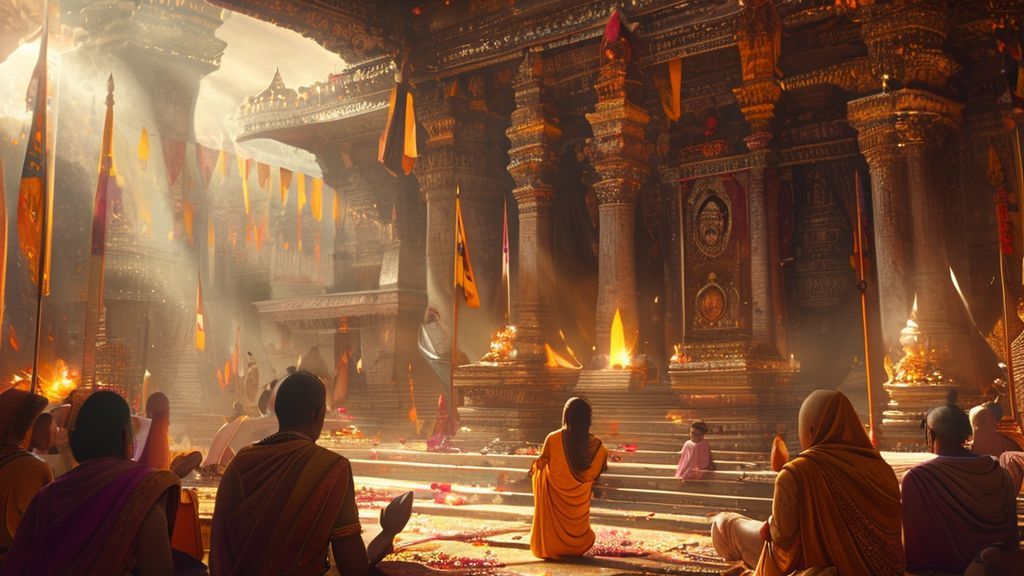
Samaveda, the “Veda of Melodies,” is one of the four principal Vedas of Sanatan Dharma, revered for its profound musicality and the precise art of Vedic chanting. It is a compilation of hymns, primarily from the Rigveda, meticulously set to musical notations (Saman) and sung during solemn Soma sacrifices and other elaborate Vedic rituals by specialist priests called Udgatri, aiming to invoke deities and elevate consciousness.
| Attribute | Details |
|---|---|
| Primary Deity/Focus | Agni, Indra, Soma; Brahman as pure sound (Nada Brahman) |
| Origin/Period | Vedic Period (c. 1500-500 BCE), Ancient India |
| Key Festival | Shravana Purnima (Upakarma/Veda Purnima) – Day for renewing Vedic studies |
| Scripture Reference | Samaveda Samhita, Chandogya Upanishad, Brihadaranyaka Upanishad |
| Associated Priest | Udgatri (Chanter of Saman) |
| Number of Hymns/Stanzas | Approx. 1,875 stanzas, mostly from Rigveda, arranged for musical performance |
The Divine Symphony: Introduction to Samaveda
The Hindutva.online tradition reveres the Vedas as apauruṣeya – not of human origin, but eternal truths revealed to ancient Rishis. Among these four fundamental texts, the Samaveda (सामवेद) holds a unique and revered position as the very essence of musical expression within Sanatan Dharma. It is not merely a collection of verses, but a profound science of sound, where Rigvedic mantras are transformed into powerful, soul-stirstirring melodies known as Saman (सामन्). These intricate chants are not meant for recitation, but for melodic singing, designed to evoke specific vibrations that connect the practitioner and the environment to the cosmic rhythm. The spiritual significance of Samaveda lies in its capacity to purify the mind, invoke divine presence, and facilitate profound meditative states, making it a cornerstone of Vedic spiritual practice.
Puranic History and Origin of Samaveda
The genesis of the Samaveda, like all Vedas, is traced back to the primordial sound, Om (ॐ), emanating from Brahman itself. As mentioned in the Vishnu Purana (Book 3, Chapter 4), Vyasa Maharishi, in the Dvapara Yuga, recognized the decline of human intellect and piety, and for the preservation of Dharma, he systematically organized the single, vast Veda into four distinct branches. He entrusted the Samaveda to his disciple, Jaimini Rishi, who then propagated its knowledge. The Bhagavata Purana (Skandha 12, Chapter 6) also corroborates this division, emphasizing the divine origin and the meticulous transmission through generations of Rishis and their schools (शखा). The Samaveda is intrinsically linked to the Rigveda, as its melodies are applied to Rigvedic hymns. This transformation from spoken verse to musical chant underscores a profound understanding of sound’s vibrational power in ancient India, indicating that the musical aspect of spiritual practice was as old as the hymns themselves.
The Scientific Marvel of Samavedic Musicology
While the concept of “architecture” might typically refer to structures, the Samaveda embodies an architectural marvel of sound itself. Its structure is a testament to the profound scientific and mathematical understanding of ancient Vedic sages regarding acoustics, rhythm, and the psychology of sound. The principal part of the Samaveda is the Saman-Samhita, which is essentially a musical adaptation of Rigvedic mantras. These chants utilize seven basic notes, analogous to the modern saptaswara (सा रे ग म प ध नि), though their precise ancient intonation and intervals might differ. The system employs various accents (स्वर), pauses (विराम), and prolongations (प्लुत) that are meticulously preserved through oral tradition. The Chandogya Upanishad (Chapter 1, Section 7) elaborates on the cosmic significance of these musical notes, connecting them to elements, deities, and aspects of the universe, illustrating that Samavedic chanting is not merely aesthetic but a precise, vibrational science. The *Gandharva Veda*, an Upaveda of Samaveda, further delves into the intricacies of music, dance, and drama, highlighting the sophisticated cultural and scientific framework surrounding this sacred musical tradition.
Rituals and Puja Vidhi: The Role of Saman Gana
The chanting of the Samaveda, known as Saman Gana (सामन् गान), is central to numerous Vedic rituals, especially the elaborate Soma Yagnas (सोम यज्ञ). The priest responsible for these musical recitations is the Udgatri (उद्गात्री), who, along with his assistants (Prastotri and Pratihartri), sings the Samans. The purpose of Saman Gana is manifold:
- Devata-Ahvana (Invocation): The melodious vibrations are believed to effectively invoke the presence of specific deities like Indra, Agni, and Soma, making them receptive to the offerings.
- Atmospheric Purification: The sacred sounds are thought to purify the environment, creating a conducive atmosphere for spiritual practices.
- Mind Purification: For the listener and chanter, the intricate melodies and rhythmic patterns help to quiet the mind, remove distractions, and facilitate deep meditation.
- Energizing Offerings: The chants imbue the sacrificial offerings with spiritual potency.
The performance of Saman Gana requires immense discipline and years of dedicated study, adhering to strict rules of pronunciation (स्वर), modulation (उद्गातृ), and timing (मात्रा). Each Saman is a specific melody applied to a Rigvedic stanza, transforming the verbal into a powerful sonic experience essential for the efficacy of the ritual.
Mantras and Chants: The Heart of Samaveda
The Samaveda is rich with beautiful and potent chants. Many of its melodies are applied to the verses of the Rigveda. One of the most iconic Samans is the Gayatri Saman, a melodic rendition of the revered Gayatri Mantra. While the basic mantra is “Om Bhur Bhuvah Swah, Tat Savitur Varenyam, Bhargo Devasya Dhimahi, Dhiyo Yo Nah Prachodayat” (ॐ भूर् भुवः स्वः तत् सवितुर्वरेण्यं भर्गो देवस्य धीमहि धियो यो नः प्रचोदयात्), its Samavedic rendering involves specific melodic contours and elongations that infuse it with extraordinary power. For instance, a simple Rigvedic verse like “अग्निमायामि वो देवान्” (Agnim āyāmi vo devān – I approach Agni, the gods) would be transformed into a prolonged, intricate melody during a Saman Gana, each syllable stretched and ornamented with specific musical notes (सामस्वराः). These precise musical forms are believed to awaken dormant spiritual energies and align the chanter with cosmic harmony.
Dos and Don’ts for Engaging with Samaveda
Approaching the sacred traditions of Samaveda requires reverence and adherence to certain etiquette:
- Do maintain Purity: Before listening to or attempting to learn Vedic chants, ensure physical and mental purity. A bath and a calm mind are recommended.
- Do listen attentively: Samavedic chants are intricate. Listen with full focus, allowing the vibrations to resonate within you.
- Do show Respect: Treat the chants and those who perform them with utmost reverence, recognizing their divine origin and the immense dedication involved in their preservation.
- Do seek Qualified Teachers: If you wish to learn, always seek a traditional Guru (आचार्य) from an unbroken lineage (गुरु-शिष्य परंपरा) to ensure correct pronunciation and intonation.
- Don’t misuse or commercialize: Vedic chants are sacred tools for spiritual elevation, not for entertainment or commercial exploitation without proper understanding and intent.
- Don’t interrupt: During a live chanting session or ritual, avoid making noise or interrupting the flow of the sacred sound.
- Don’t alter: The precision of Samavedic chants is paramount. Do not attempt to alter the melodies or pronunciations without expert guidance.
What is the main difference between Rigveda and Samaveda?
The Rigveda is primarily a collection of hymns (ऋचाः), or stanzas, meant for recitation (शस्त्र). Its focus is on the textual content and the praise of deities. The Samaveda, on the other hand, is almost entirely derived from the Rigveda’s hymns, but its unique characteristic is the transformation of these verses into melodies (सामन्). Its purpose is for singing (स्तोत्र) during rituals, with specific musical notations and structures designed to create a powerful vibrational experience. While the Rigveda provides the words, the Samaveda provides the musical form and spirit of those words in ritual context.
Who is an Udgatri priest?
An Udgatri (उद्गात्री) is one of the four principal types of priests in Vedic sacrifices, specifically associated with the Samaveda. Their primary role is to chant the Samans – the melodious hymns of the Samaveda – during Soma Yagnas and other elaborate Vedic rituals. The Udgatri leads a team of assistant priests (Prastotri, Pratihartri, Subrahmanya) who support the chanting. Their function is crucial for invoking the deities through the power of sacred sound and ensuring the proper execution of the musical aspects of the sacrifice.
Can anyone learn Samaveda chanting?
While the spiritual benefits of listening to Samaveda chants are accessible to all, the rigorous study and accurate performance of Samaveda chanting (Saman Gana) traditionally require immense dedication, strict discipline, and guidance from a qualified Guru within an unbroken oral tradition. It involves mastering complex phonetics, precise intonations, and specific melodic patterns. While recordings and some simplified lessons exist, true mastery and the ability to perform it ritually are reserved for those who undertake a full traditional Vedic education, often from a young age.
What is the spiritual benefit of Samaveda?
The spiritual benefit of Samaveda is profound. Its meticulously crafted melodies are believed to harmonize the mind, body, and spirit, leading to inner peace and higher states of consciousness. As the Brihadaranyaka Upanishad (1.3.28) implies, the sound of the Vedas, particularly the Samaveda, is a pathway to transcend the material world and connect with the eternal Brahman. It purifies the atmosphere, invokes divine grace, and helps the devotee realize the inherent divinity within. Chanting or listening to Samaveda is a powerful form of spiritual discipline (साधना) that aligns the individual with the cosmic rhythm, fostering both individual and collective well-being, integral to the principles found at Hindutva.online.
Dharmic Significance: Preserving Cosmic Sound
The Samaveda stands as a living testament to the unparalleled spiritual and intellectual heritage of Sanatan Dharma. Its preservation over millennia, through an unbroken chain of oral transmission, is a miracle in itself, showcasing the extraordinary mnemonic techniques and unwavering devotion of our ancestors. Beyond its ritualistic application, the Samaveda reminds us that the universe itself is a symphony, and through its sacred sounds, we can attune ourselves to the cosmic law (ऋत) and the divine. In an increasingly discordant world, the melodic vibrations of the Samaveda offer a timeless sanctuary, a profound spiritual technology that continues to uplift, purify, and guide humanity towards truth, harmony, and liberation. It is the very breath of the divine, manifesting as sacred sound, continuing to nourish the spiritual core of every Hindu.