


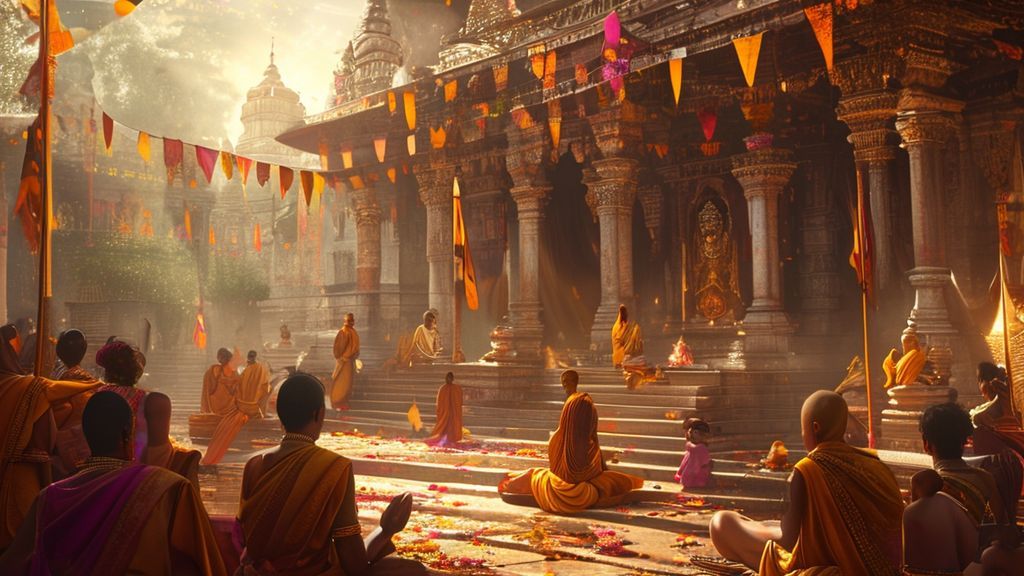
Sandhya Vandanam is a fundamental Vedic ritual performed thrice daily by *Dvija* (twice-born) Hindus, particularly Brahmins, at the junctions of day and night – dawn, noon, and dusk. It involves purification, *Pranayama*, *Arghyapradaana*, and meditation on the *Gayatri Mantra*, serving as a profound spiritual anchor and a daily reconnection with the Divine, maintaining cosmic harmony.
| Attribute | Details |
|---|---|
| Primary Deity/Focus | Surya (Sun God) and Gayatri Devi (Savitr) |
| Origin | Ancient Vedic traditions, predating Puranas |
| Key Scripture Reference | Taittiriya Aranyaka, Manusmriti, Yajnavalkya Smriti |
| Frequency | Thrice daily (dawn, noon, dusk) |
| Primary Practitioners | *Dvija* (especially Brahmin) males initiated with *Upanayana* |
The Spiritual Anchor: Understanding Sandhya Vandanam
In the grand tapestry of Sanatan Dharma, certain rituals stand as unshakeable pillars, guiding the individual’s spiritual journey and upholding the cosmic order. Among these, Sandhya Vandanam holds a paramount position, especially for those initiated into the sacred thread ceremony (*Upanayana*). Far from being a mere routine, Sandhya Vandanam is a profound act of spiritual discipline, a daily recommitment to Dharma, and a direct communion with the Divine energies that permeate our existence. It is not just a ritual; it is a way of life, an essential practice that purifies the body, mind, and soul, aligning the individual consciousness with the universal consciousness.
The term ‘Sandhya’ itself signifies the auspicious junctions of the day – Pratah Sandhya (dawn), Madhyahnik Sandhya (noon), and Sayam Sandhya (dusk). These are not arbitrary times but moments of significant energy transition, when the subtle forces of creation, sustenance, and dissolution are most potent. By performing Sandhya Vandanam at these precise junctures, the devotee harmonizes their personal energy with these cosmic rhythms, ensuring mental clarity, physical vitality, and spiritual progress. It is through such consistent adherence that the timeless wisdom of our Rshis is preserved and transmitted across generations.
Vedic Roots and Smriti Injunctions
The origins of Sandhya Vandanam are deeply embedded in the most ancient strata of Vedic literature. While not explicitly detailed as a singular ritual in the Samhitas, its constituent elements – such as purification, water offerings to Surya, and Gayatri Japa – are extensively referenced. The Taittiriya Aranyaka (Prashna 2, Anuvaka 2) clearly mentions the significance of worshipping Surya at the Sandhyas, stating: “He who offers water at the Sandhyas, by that he propitiates the Sun.” This establishes the antiquity and Vedic imperative of the ritual.
Later, the *Smriti* texts, which codify Dharmic laws and practices, provide exhaustive details and injunctions for Sandhya Vandanam. The Manusmriti, considered a foundational text for Hindu law, unequivocally declares its obligatory nature for a *Dvija*. In Chapter 2, Verse 101, it states: “A Brahmana who does not perform Sandhya daily, whether by day or by night, is to be excluded from all duties of a twice-born.” Similarly, the Yajnavalkya Smriti and Parashara Smriti elaborate on the *Prayaschitta* (atonement) for missing the ritual and emphasize its role in maintaining ritual purity and spiritual potency. These scriptural mandates underscore that Sandhya Vandanam is not optional but a fundamental *Nitya Karma* (daily obligatory duty) for a Brahmin boy after *Upanayana*, crucial for spiritual evolution and upholding the Dharma.
The Science and Structure of Sandhya Vandanam
While Sandhya Vandanam is a spiritual practice, it is also a meticulously designed system rooted in ancient Indian understanding of physiology, psychology, and astronomy. The various components of the ritual are not arbitrary but possess profound scientific implications for wellbeing.
- Achamana (Sipping Water): This purification step, involving sipping water with specific Mantras like “Om Keshavaya Namah,” “Om Narayanaya Namah,” purifies the inner system and activates specific energy points in the mouth and throat, preparing the practitioner for deeper spiritual engagement.
- Pranayama (Breath Control): The regulated breathing exercises are central. By chanting the *Pranayama Mantra* (“Om Bhuh, Om Bhuvah, Om Svah…”) while holding breath, the practitioner not only calms the mind and enhances focus but also circulates vital life force (*Prana*) throughout the body. This is a foundational practice in Yoga, known to improve respiratory health, reduce stress, and increase mental clarity.
- Marjana (Sprinkling Water): Sprinkling water on oneself with specific Mantras is a symbolic and energetic purification, washing away sins and negative energies. The Mantras often invoke water deities, harnessing their purifying power.
- Arghyapradaana (Offering Water to Surya): This is perhaps the most iconic part, where water is offered to the rising, mid-day, or setting sun. Facing the sun and offering water through joined palms is an act of gratitude and reverence. Scientifically, exposing the body to the morning sun’s rays is beneficial for Vitamin D synthesis, and the act of focusing on the sun’s energy is believed to energize the chakras, particularly the Manipura and Ajna chakras. The water acts as a medium to transmit these subtle energies.
- Gayatri Japa (Recitation of Gayatri Mantra): The ultimate spiritual powerhouse of the ritual. The rhythmic chanting of the Gayatri Mantra (“Om Bhur Bhuvah Svah, Tat Savitur Varenyam, Bhargo Devasya Dhimahi, Dhiyo Yo Nah Prachodayat”) with devotion stimulates the pineal gland, enhances cognitive functions, and promotes inner wisdom and discernment. This Mantra, addressed to Savitr (the radiant aspect of the Sun), invokes divine intelligence and spiritual illumination.
The precise timing of Sandhya Vandanam aligns with the sun’s position, demonstrating an acute awareness of astronomical cycles and their impact on terrestrial life. These junctions are moments when the electromagnetic field of the Earth is in transition, making them ideal for spiritual practices that harness subtle energies for purification and transformation. Further insights into these practices can be found at Hindutva.online.
Rituals & Puja Vidhi: A Step-by-Step Guide
While regional variations exist, the core components of Sandhya Vandanam remain consistent. The following outlines a traditional procedure:
- Achamana (Purification): Sit facing East (Pratah Sandhya) or West (Sayam Sandhya), or North (Madhyahnik Sandhya). Take a spoonful of water, recite “Om Keshavaya Namah” and sip. Repeat for Narayanaya, Madhavaya. Then purify hands, eyes, etc., with other specific Mantras.
- Pranayama (Breath Control): Close the right nostril with the thumb, inhale through the left while chanting the *Pranayama Mantra* (Om Bhuh, Om Bhuvah, Om Svah…) mentally. Hold breath, chant the Mantra again. Exhale through the right, chant again. Repeat reversing nostrils.
- Sankalpa (Intention): State your resolve to perform the ritual for the purification of sins and attainment of righteousness.
- Marjana (Sprinkling Water): Take water in the right palm, sprinkle it over the head with the *Marjana Mantra* (e.g., “Apah Punantu Prithiveem…” from the Taittiriya Aranyaka), purifying oneself.
- Papa Purusha Visarjana (Dissolution of Sins): Imagine one’s sins as a small figure, expel it through the left nostril, and visualize it burning.
- Arghyapradaana (Water Offering): Stand, hold water in cupped palms, look towards the sun, and offer the water three times with the *Arghya Mantra* (e.g., “Om Bhur Bhuvah Svah, Tat Savitur Varenyam… Ghrinim Suryam Adityom”). For Sayam Sandhya, an additional *Pariharārghyam* is offered to absolve the sin of non-worship during day.
- Pradakshina (Circumambulation): Turn around oneself clockwise, symbolizing circumambulation of the sun.
- Gayatri Japa (Recitation): Sit, perform *Nyasa* (touching body parts with Mantras), then chant the Gayatri Mantra 10, 28, 32, 108, or 1008 times, counting with a *Japa Mala*. This is the core meditation.
- Upasthana (Adoration): Stand and offer prayers to Surya, Mitra, Varuna, and other deities with specific *Upasthana Mantras*.
- Digbandhana (Directional Protection): Offer water to the eight directions, invoking protection.
- Abhivadana (Salutation): Prostrate before the elders and touch their feet, seeking blessings.
- Ishwara Samarpanam (Dedication): Conclude by dedicating the fruits of the ritual to the Supreme Lord, reciting “Kayena Vacha Manasendriyairva…”
Mantras and Chants for Devotees
The power of Sandhya Vandanam lies significantly in the vibrational energy of its Mantras. Here are some key chants:
- Achamana Mantras:
- Om Keshavaya Namah
- Om Narayanaya Namah
- Om Madhavaya Namah
- Pranayama Mantra:
“Om Bhuh, Om Bhuvah, Om Svah, Om Mahah, Om Janah, Om Tapah, Om Satyam. Om Tat Savitur Varenyam Bhargo Devasya Dhimahi Dhiyo Yo Nah Prachodayat. Om Apo Jyoti Raso Amritam Brahma Bhur Bhuvah Svar Om.”
- Gayatri Mantra: (The heart of Sandhya Vandanam)
“Om Bhur Bhuvah Svah, Tat Savitur Varenyam, Bhargo Devasya Dhimahi, Dhiyo Yo Nah Prachodayat.”
This translates to: “We meditate on the adorable glory of the resplendent Vivifier, Savitr; may He Himself inspire our intellects.”
- Arghya Mantra: (Recited during water offering)
“Om Bhur Bhuvah Svah. Om Tat Savitur Varenyam Bhargo Devasya Dhimahi Dhiyo Yo Nah Prachodayat. Om Ghrinim Suryam Adityom.”
- Upasthana Mantras: (Variations depending on tradition, e.g., for Pratah Sandhya)
“Udyannam Adya Mitramaha Arohannuttaram Divam. Hridrogam Mama Surya Hariman Cha Nashaya. Sukeshu Me Harimanam Ropanasu Dadmasi. Atho Haridraveshu Me Hariman Nikshipamasu.”
Meaning: “O Mitra, of glorious light, rising today and ascending to the sky, O Surya, destroy the diseases of my heart and pallor. We place my pallor into the yellow birds and into the green trees.”
Dos and Don’ts for Sandhya Vandanam
Adherence to proper etiquette and discipline is crucial for deriving the full spiritual benefits of this sacred practice.
- Do:
- Perform the ritual at the precise junctions of dawn, noon, and dusk.
- Maintain absolute physical and mental purity; take a bath before performing.
- Wear clean, traditionally specified attire (e.g., *dhoti*).
- Understand the meaning of the Mantras for deeper absorption.
- Perform with full devotion (*Shraddha*) and concentration.
- Be consistent and regular in practice.
- Maintain a clean and sacred space for the ritual.
- Don’t:
- Skip the ritual unless absolutely unavoidable (e.g., extreme illness).
- Perform in a state of impurity or mental agitation.
- Alter the prescribed Mantras or procedures without proper guidance.
- Perform for show or merely as a mechanical chore.
- Engage in conversation or distractions during the ritual.
- Perform with a full stomach; it is generally done before meals.
Why is Sandhya Vandanam mandatory for Brahmins?
Sandhya Vandanam is a *Nitya Karma*, an obligatory daily duty for a Brahmin, prescribed by the Vedas and Smritis. It is seen as essential for maintaining the purity of the *Brahmin Varna*, enabling them to perform other sacred duties, and serving as a bridge between humanity and the divine. Neglecting it is considered a transgression that diminishes spiritual merit and can lead to a fall from one’s Dharmic duties, as explicitly stated in Manusmriti.
What is the significance of the Gayatri Mantra within Sandhya Vandanam?
The Gayatri Mantra is the most sacred Mantra in the Vedas, considered the essence of all Vedic wisdom. In Sandhya Vandanam, its recitation (Japa) is the most powerful component. It invokes *Savitr*, the solar deity, representing the supreme illuminating consciousness, to enlighten the intellect and guide one towards righteousness and spiritual wisdom. It purifies the mind, strengthens intuition, and confers divine grace, making it a pivotal practice for inner transformation.
What happens if one misses Sandhya Vandanam?
Missing Sandhya Vandanam, particularly intentionally, incurs *Pratyavāya Dosha* (the fault of omission). To atone for this, the Smritis prescribe *Prayaschitta* (penance), which often involves specific additional Mantras, extra rounds of Gayatri Japa, or other purification rituals before resuming regular practice. The emphasis is on diligence and sincerity, as consistency is key to accumulating spiritual benefits.
Upholding Dharma: The Enduring Legacy of Sandhya Vandanam
In an age increasingly characterized by spiritual amnesia and the erosion of traditional values, the practice of Sandhya Vandanam stands as a beacon of unwavering faith and discipline. It is more than an ancient rite; it is a vital practice for every Brahmin boy, imbuing him with a profound sense of identity, purpose, and connection to his rich spiritual heritage. By meticulously performing this daily ritual, individuals not only purify themselves but also contribute to the collective spiritual reservoir of the planet. They become conduits for cosmic energies, ensuring the continuity of Vedic culture and the preservation of Sanatan Dharma.
The discipline cultivated through Sandhya Vandanam – punctuality, purity, concentration, and devotion – translates into all aspects of life, fostering a righteous and harmonious existence. It reminds us that spiritual growth is a continuous journey, sustained by consistent effort and unwavering faith. As torchbearers of Sanatan Dharma, it is our sacred duty to revive and propagate these timeless practices for the welfare of all humanity. Explore more about ancient rituals and their significance at Hindutva.online.