

The Sankashti Chaturthi vrat – literally meaning “deliverance from troubles” from Sanskrit sankat (crisis/trouble) and nashana (removal) – represents one of Hinduism’s most beloved monthly devotional practices dedicated to Lord Ganesha in His supreme role as Vighnaharta (obstacle remover), observed on the fourth lunar day (Chaturthi tithi) of Krishna Paksha (waning moon fortnight) in every Hindu lunar month, creating twelve annual opportunities (thirteen in leap years with extra month Adhik Maas) to invoke the elephant-headed deity’s grace for removing persistent obstacles blocking progress in career, relationships, health, or spiritual advancement while simultaneously building cumulative devotional merit through regular monthly discipline that proves more sustainable than sporadic elaborate worship during major festivals alone.

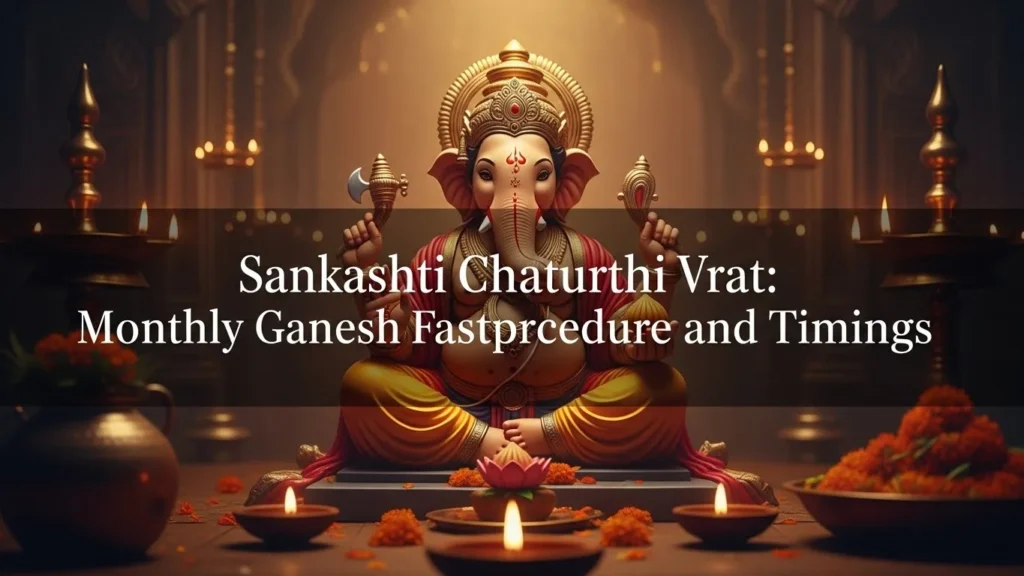
This sacred fast, particularly popular in Maharashtra, Gujarat, Tamil Nadu, and Karnataka though increasingly observed nationwide and throughout global Hindu diaspora, requires devotees to abstain from food from sunrise until moonrise – a unique timing calculation distinguishing it from most Hindu fasts that break at sunrise next day – then perform evening puja worshipping specific Ganesha manifestation associated with that calendar month (Vinayaka in Chaitra, Gajanan in Vaishakha, etc.), read month-specific vrat katha explaining how devotees overcame troubles through Ganesha worship, sight the moon (chandra darshan) while offering water and prayers, and finally break fast with prasad, typically modak (sweet dumplings) Lord Ganesha especially loves.
Among twelve monthly Sankashti occurrences, those falling on Tuesday earn special designation as Angarak Chaturthi or Angaraki Chaturthi – astronomically when Mars (Mangal/Angaraka) rules the weekday while Chaturthi tithi prevails – considered extraordinarily powerful for removing even severe karmic obstacles, attracting prosperity, ensuring marriage success, and destroying enemies’ negative influences, making devotees especially keen to observe these amplified-potency fasting days that occur 2-3 times annually.
For Hindu practitioners in 2025, whether continuing family traditions or newly discovering Ganesha bhakti paths, understanding complete Sankashti procedure proves essential: precise timing calculations determining which day qualifies as fasting day based on complex interaction between Chaturthi tithi duration and local moonrise time that varies by geographical location making generic pan-India date lists potentially inaccurate for your specific city, proper fasting foods permitted during daytime (typically fruits, roots like potatoes, sabudana, peanuts – a more lenient restriction than Ekadashi), the complete evening puja sequence including.
Ganesha’s 108 names chanting and month-specific stotra, understanding why moon sighting proves ritually essential rather than optional courtesy, and appreciating the profound theological significance recognizing Ganesha not merely as elephant-headed deity solving mundane problems but as cosmic principle of intelligence (buddhi) that when invoked transforms how consciousness perceives and navigates life’s inevitable challenges, converting apparent obstacles into opportunities for growth and deeper spiritual realization.
Understanding Sankashti Chaturthi: Spiritual Significance
Before examining procedural details and timing calculations, grasping why monthly Sankashti observance holds such importance in Ganesha bhakti tradition and what distinguishes this vrata from other Hindu fasting practices provides essential theological and philosophical context transforming mechanical ritual into conscious spiritual discipline.
The Nature of Obstacles (Vigna):
Hindu philosophy recognizes that obstacles constitute inevitable features of embodied existence in material world characterized by constant change, competing desires, karmic influences from past actions, and fundamental ignorance (avidya) about one’s true nature. Rather than viewing obstacles as random misfortunes requiring only physical solutions, tradition identifies them as:
External Obstacles (Bahya Vigna): Physical impediments – poverty, illness, enemies, natural disasters, institutional barriers
Internal Obstacles (Antara Vigna): Psychological barriers – fear, doubt, confusion, anger, attachment, ego, limiting beliefs
Karmic Obstacles (Prarabdha): Results of past life actions manifesting as current life challenges that must be worked through or mitigated through spiritual practice
Spiritual Obstacles (Adhyatmika Vigna): Impediments to spiritual progress – distractions, false teachings, spiritual pride, stagnation in practice
Lord Ganesha as Vighnaharta:
According to Ganesha Purana and related texts, Lord Ganesha’s primary cosmic function involves managing the flow of obstacles in devotees’ lives – not eliminating all difficulties (which would prevent necessary growth) but removing those obstacles that serve no constructive purpose while helping navigate inevitable challenges intelligently. Theologically, Ganesha represents:
Buddhi (Intelligence/Wisdom): The discriminating faculty that distinguishes real from unreal, beneficial from harmful, timely from premature
Siddhi (Success/Accomplishment): The power to manifest intentions effectively in material world
Riddhi (Prosperity/Abundance): Material and spiritual richness flowing naturally when one’s actions align with cosmic order (rta)
When devotees worship Ganesha, they’re not merely petitioning external deity to magically fix problems but invoking and strengthening their own inner Ganesha – the wisdom faculty that can perceive solutions, the intelligence that navigates complexity, and the clarity that transforms obstacles into stepping stones.
Why Monthly Observance Matters:
Sankashti Chaturthi’s monthly frequency offers several advantages over annual-only worship:
Regular Discipline: Monthly practice builds sustainable devotional habit rather than sporadic intensity that flames out
Cumulative Merit: Each observance accumulates spiritual benefit, with tradition teaching that twelve consecutive Sankashti vratas (one full year) grant powerful obstacle-removing blessings
Adaptability: Monthly rhythm allows addressing new obstacles as they arise throughout year rather than waiting for next Ganesha Chaturthi
Family Bonding: Regular monthly observance creates predictable family ritual time strengthening cultural transmission across generations
Spiritual Momentum: Monthly engagement prevents stagnation, maintaining devotional consciousness active throughout year
The Krishna Paksha Significance:
Sankashti occurs during waning moon (Krishna Paksha) when lunar light decreases, symbolically representing diminishment and removal – perfect for removing obstacles, dissolving karmic debts, and eliminating negativity. This contrasts with Shukla Paksha Ganesha Chaturthi (Vinayaka Chaturthi) during waxing moon associated with growth, new beginnings, and accumulation of positive qualities.
Monthly Ganesha Manifestations:
Each month’s Sankashti honors specific Ganesha form with unique name, vehicle (vahana), iconography, and associated mantra. This sophisticated system recognizes that divine power manifests differently through different temporal cycles, and devotees can access specific qualities by worshipping appropriate form:
| Month (Purnimanta) | Ganesha Name | Vahana (Vehicle) | Special Quality |
|---|---|---|---|
| Chaitra | Vakratunda | Lion | Removes pride, grants humility |
| Vaishakha | Ekadanta | Mouse | Grants wisdom, removes ignorance |
| Jyeshtha | Mahodara | Mouse | Provides abundance, satisfaction |
| Ashadha | Gajakarna | Mouse | Grants patience, removes arrogance |
| Shravana | Lambodara | Mouse | Brings prosperity, contentment |
| Bhadrapada | Vikata | Peacock | Removes fear, grants courage |
| Ashwina | Vighnaraja | Serpent | Destroys all obstacles |
| Kartika | Dhumravarna | Horse | Purifies consciousness |
| Margashirsha | Bhalchandra | Mouse | Grants mental peace |
| Pausha | Gajanan | Mouse | Grants intelligence, success |
| Magha | Vikatamukha | Peacock | Most powerful – destroys greatest obstacles |
| Phalguna | Ganapati | Mouse | Grants leadership, authority |
Note: Month names follow Purnimanta (full moon ending) system prevalent in North India. South Indian Amanta (new moon ending) system shifts month boundaries by 15 days but Sankashti still occurs 12 times annually.
Angarak/Angaraki Chaturthi – The Most Powerful:
When Sankashti falls on Tuesday, it becomes Angarak Chaturthi (named for Mars/Mangal which rules Tuesday). This combination proves extraordinarily auspicious because:
Mars Energy: Mars represents courage, determination, destroying enemies – qualities amplifying Ganesha’s obstacle-removing power
Double Removal Force: Tuesday naturally removes negativity (Mars cuts through obstacles) + Chaturthi removes specific blockages = doubled efficacy
Rare Occurrence: Angarak Chaturthi occurs only 2-3 times yearly, making it special opportunity for maximum benefit
Traditional Benefits: Especially powerful for marriage obstacles, enemy destruction, litigation victory, debt removal, property issues
2025 Angarak Chaturthi Dates:
- August 12, 2025 (Lambodara Chaturthi – Shravana month)
- September 9, 2025 (Vikata Chaturthi – Bhadrapada month)
- November 4, 2025 (Dhumravarna Chaturthi – Kartika month)
These three dates deserve special observance for maximum obstacle-removing power.
Modern Relevance:
In 2025’s context of rapid change, economic uncertainty, competitive pressures, and complex life challenges, Sankashti Chaturthi offers:
Practical Problem-Solving: Regular check-in with divine intelligence guiding solutions
Psychological Resilience: Monthly reminder that obstacles are temporary and navigable with wisdom
Community Connection: Shared observance in temples and homes strengthens support networks
Cultural Continuity: Transmits Ganesha bhakti tradition to younger generations through experiential participation
Mindfulness Practice: Monthly fasting and worship creates intentional pause in rushed modern life
2025 Sankashti Chaturthi Complete Calendar
Understanding precise dates for Sankashti Chaturthi in 2025 requires recognizing that fasting day depends on when moonrise occurs during Chaturthi tithi – a calculation varying by geographical location. Generic all-India date lists may be incorrect for your specific city.
2025 Sankashti Chaturthi Dates (New Delhi):
| Month | Date | Day | Ganesha Name | Moonrise (approx) | Special Notes |
|---|---|---|---|---|---|
| Magha | Jan 28, 2025 | Tuesday | Vikatamukha | 7:42 PM | ANGARAK CHATURTHI – Most powerful of year |
| Phalguna | Feb 26, 2025 | Wednesday | Ganapati | 8:13 PM | – |
| Chaitra | Mar 28, 2025 | Friday | Vakratunda | 8:45 PM | First of new Hindu year cycle |
| Vaishakha | Apr 26, 2025 | Saturday | Ekadanta | 9:24 PM | – |
| Jyeshtha | May 25, 2025 | Sunday | Mahodara | 10:15 PM | Late moonrise |
| Ashadha | Jun 24, 2025 | Tuesday | Gajakarna | 11:17 PM | ANGARAK CHATURTHI |
| Shravana | Aug 12, 2025 | Tuesday | Lambodara | 10:34 PM | ANGARAK CHATURTHI |
| Bhadrapada | Sep 9, 2025 | Tuesday | Vikata | 9:40 PM | ANGARAK CHATURTHI |
| Ashwina | Oct 8, 2025 | Wednesday | Vighnaraja | 8:45 PM | – |
| Kartika | Nov 4, 2025 | Tuesday | Dhumravarna | 7:42 PM | ANGARAK CHATURTHI |
| Margashirsha | Dec 3, 2025 | Wednesday | Bhalchandra | 7:01 PM | – |
| Pausha | Jan 2, 2026 | Friday | Gajanan | 6:52 PM | – |
Important Notes:
Location Matters: These dates and moonrise times are for New Delhi. Other cities will have slightly different timings:
- Cities east of Delhi (Kolkata, Guwahati) – moonrise earlier
- Cities west of Delhi (Mumbai, Ahmedabad) – moonrise later
- Always check location-specific panchang for your city
Tithi-Moonrise Intersection: The fasting day is determined by when moonrise occurs while Chaturthi tithi prevails. Sometimes this means fasting on Tritiya (3rd tithi) if Chaturthi begins after moonrise.
Amanta vs Purnimanta: South Indian calendars (Amanta system) may show different month names but Sankashti still occurs 12 times with same gap between observances.
Critical Timing Principle:
According to traditional calculations:
Fast on Day X if:
- Chaturthi tithi is prevailing during moonrise on Day X
- Even if Chaturthi begins late on Day X-1, if moonrise Day X-1 occurred before Chaturthi started, then fast on Day X
Example Scenario:
- Chaturthi tithi begins: 8:00 PM Jan 27
- Moonrise Jan 27: 7:30 PM (before Chaturthi began)
- Moonrise Jan 28: 7:42 PM (after Chaturthi began)
- Correct fasting day: Jan 28
This complexity explains why accurate local panchang consultation proves essential rather than using generic online lists.
How to Find Accurate Dates for Your City:
- Drik Panchang Website: Enter your city name, shows location-specific dates
- Local Temple: Check with priests who calculate for local community
- Panchang Apps: Ensure app allows city selection for calculations
- Astronomy Software: Calculate moonrise for your exact latitude/longitude
Five Angarak Chaturthi in 2025:
The year 2025 proves exceptionally auspicious with FIVE Angarak Chaturthi occurrences (including January 2026 which falls within typical 12-month cycle):
- January 28, 2025 – Magha month (most powerful of all)
- June 24, 2025 – Ashadha month
- August 12, 2025 – Shravana month
- September 9, 2025 – Bhadrapada month
- November 4, 2025 – Kartika month
Devotees seeking maximum obstacle-removing benefits should especially observe these five dates with complete fasting, elaborate puja, and sincere devotion.
Complete Sankashti Vrat Procedure
The proper observance of Sankashti Chaturthi involves systematic progression from morning preparation through evening puja to moonrise darshan and fast-breaking, each step carrying specific spiritual significance enhancing the practice’s efficacy.
Morning Preparation:
Upon Waking (Early Morning):
- Bath and Purification: Take complete bath, preferably before sunrise. Some devotees use turmeric or sandalwood paste for purification.
- Clean Clothes: Wear fresh clean clothes, preferably yellow, red, or saffron (colors associated with Ganesha).
- Sankalpa (Sacred Vow): Stand before Ganesha idol/picture, take water in right palm with flower and tulsi leaf, state your intention:
[अद्य date, nakshatra, tithi शुभदिने, श्रीगणेशप्रीत्यर्थं संकष्टी चतुर्थी व्रतं करिष्ये।]
“On this auspicious day, for pleasing Lord Ganesha, I shall observe Sankashti Chaturthi vrata.”
Fasting Guidelines:
Unlike stricter fasts like Nirjala Ekadashi, Sankashti allows more flexibility:
Option 1: Complete Fast (Nirjala)
- No food or water from sunrise to moonrise
- Most austere, suitable for very healthy devotees
- Rare practice for Sankashti – usually reserved for Ekadashi
Option 2: Fruits and Milk (Phalahari)
- Fruits, milk, nuts allowed throughout day
- Most common practice
- Sustains energy for evening puja
Option 3: Root Vegetables and Specific Foods
- Permitted: Potatoes, sweet potatoes, raw banana, yam, colocasia (arbi)
- Permitted: Sabudana (tapioca pearls), peanuts, cashews, almonds
- Permitted: Milk, yogurt, buttermilk
- Permitted: Rock salt (sendha namak) – regular salt prohibited
- Avoid: Regular grains (rice, wheat), lentils, regular salt, onion, garlic
- Most practical option for working professionals
Daytime Activities:
Recommended:
- Chant Om Gam Ganapataye Namah throughout day (108, 1008, or continuous)
- Read Ganesha Purana, Mudgala Purana, or Ganesha Sahasranama
- Listen to Ganesha bhajans and stotras
- Meditate on Ganesha’s form
- Maintain sattvic consciousness – avoid anger, arguments, negative thoughts
- Limit worldly activities if possible
Puja Preparation (Afternoon):
Assemble Puja Materials:
| Category | Items |
|---|---|
| Deity | Ganesha idol/photo, preferably month-specific form |
| Offerings | Fresh flowers (red hibiscus especially favored), tulsi leaves, durva grass (21 blades essential for Ganesha) |
| Naivedya | Modak (sweet dumplings – Ganesha’s favorite), laddoos, fruits, coconut |
| Puja Items | Incense, camphor, cotton wicks, ghee/oil for lamp, bell |
| Sacred Substances | Sandalwood paste, kumkum, turmeric, unbroken rice (akshat), betel leaves and nuts |
| Special | Month-specific vrat katha book/printout, Ganesha Ashtottara (108 names), Sankashti stotra |
Evening Puja Sequence (Before Moonrise):
Step 1: Ganesha Installation and Invocation (5 minutes)
Clean the altar area. Place Ganesha idol on raised platform with new cloth.
Avahana (Invocation):
आगच्छ देव गणेश! सिद्धिबुद्धिसहित।
तव पूजां करिष्यामि तां गृहाण विनायक॥
“Come, O Lord Ganesha, with Siddhi and Buddhi (your consorts). I shall worship You, please accept, O Vinayaka.”
Step 2: Panchopachar Puja (10 minutes)
Offer the five primary offerings:
- Gandha (Sandalwood Paste):
ॐ गं गणपतये नमः गन्धं समर्पयामि - Pushpa (Flowers):
Offer 21 blades of durva grass and red flowers
ॐ गं गणपतये नमः पुष्पाणि समर्पयामि - Dhupa (Incense):
ॐ गं गणपतये नमः धूपं समर्पयामि - Deepa (Lamp):
Light ghee lamp
ॐ गं गणपतये नमः दीपं समर्पयामि - Naivedya (Food):
Offer modak, laddoos, fruits
ॐ गं गणपतये नमः नैवेद्यं समर्पयामि
Step 3: Ganesha Ashtottara (15-20 minutes)
Chant the 108 names of Ganesha (select names):
॥ ॐ गणाधिपतये नमः। ॐ उमापुत्राय नमः। ॐ गजाननाय नमः।
ॐ लम्बोदराय नमः। ॐ मूषकवाहनाय नमः। ॐ विघ्नराजाय नमः।
ॐ एकदन्ताय नमः। ॐ वक्रतुण्डाय नमः…॥
Continue through all 108 names, offering flower or akshat (rice) with each name.
Step 4: Month-Specific Mantra and Stotra (10 minutes)
Chant the mantra specific to that month’s Ganesha form. For example:
Vakratunda (Chaitra):
वक्रतुण्ड महाकाय सूर्यकोटि समप्रभ।
निर्विघ्नं कुरु मे देव सर्वकार्येषु सर्वदा॥
Also chant Sankashti Nashana Ganesha Stotra (dedicated to obstacle removal):
संकष्टनाशन गणेश स्तोत्रम्
Step 5: Vrat Katha Reading (10-15 minutes)
Read or listen to the month-specific Sankashti vrat katha. Each month has different story illustrating how devotees overcame troubles through Ganesha worship. This is essential component – the katha’s hearing/reading activates the vrata’s spiritual power.
Step 6: Aarti (5 minutes)
Light camphor in aarti plate. Wave before Ganesha while singing:
जय गणेश जय गणेश जय गणेश देवा।
माता जाकी पार्वती पिता महादेवा॥
Or the longer Sukhkarta Dukhharta aarti.
Ring bell continuously during aarti.
Step 7: Moon Sighting (Chandra Darshan) – CRITICAL
Wait for Moonrise:
After puja concludes, you must wait for moon to actually rise above horizon and become visible. Check local moonrise time in panchang.
Moon Worship Procedure:
Once moon is visible:
- Go to location with clear view of moon (terrace, balcony, outdoors)
- Fill small vessel with water
- Face the moon
- Offer water to moon while chanting:
चन्द्रमा मनसो जातः चक्षोः सूर्यो अजायत।
शंभो: चन्द्रार्क निर्माणं तस्मै सोमाय ते नमः॥
“The Moon was born from Lord’s mind, the Sun from His eyes. I bow to that Moon from which Shambhu (Shiva) created Sun and Moon.”
- Sprinkle water toward moon three times
- Offer akshat (rice), flowers in moon’s direction
- Chant:
ॐ श्रीं ह्रीं क्लीं ग्लौं गं गणपतये वर-वरद सर्वजन्मे वशमानय ठः ठः॥
- Make your specific prayer to Ganesha, asking for obstacle removal
Why Moon Sighting is Essential:
This isn’t optional courtesy. Sankashti literally means seeking refuge during troubled times, and moon represents mind (manas) in Vedic astrology. Offering water to moon while moon is in Ganesha’s tithi (Chaturthi) symbolizes purifying and cooling the troubled mind so divine wisdom (Ganesha) can shine through clearly. Breaking fast before moon sighting technically invalidates the vrata according to strict interpretation.
Step 8: Prasad Distribution and Fast Breaking
After moon sighting, return inside and:
- Offer final prayers to Ganesha
- Distribute prasad (modak, laddoos, fruits) to all family members
- Break your fast by first consuming prasad
- Follow with regular dinner (simple, sattvic food preferred)
Simplified Version for Beginners:
If full procedure seems overwhelming, minimum essentials include:
- Fast from sunrise to moonrise (at least fruits and milk)
- Evening: Light lamp before Ganesha idol/photo
- Offer flowers, durva grass, modak
- Chant Om Gam Ganapataye Namah 108 times
- Read that month’s vrat katha
- Perform brief aarti
- Sight moon and offer water
- Break fast with prasad
Even this simplified version, done with sincere devotion, brings Ganesha’s blessings.
Benefits and Spiritual Significance
Observing Sankashti Chaturthi regularly brings both material and spiritual benefits, with tradition teaching that twelve consecutive monthly observances (one complete year) prove especially powerful.
Material Benefits:
Obstacle Removal: Primary benefit – persistent barriers in career, business, relationships, health gradually dissolve
Financial Prosperity: Ganesha as lord of wisdom guides better financial decisions; attracts opportunities
Success in Endeavors: New projects, business ventures, examinations protected from failures
Marriage Blessings: Especially on Angarak Chaturthi – removes marriage obstacles, brings suitable partners
Enemy Neutralization: Negative influences from competitors, ill-wishers lose power
Debt Relief: Financial obligations gradually resolve through wise management and unexpected resources
Property Issues: Land disputes, housing problems find solutions
Child Blessings: Couples seeking children often observe Sankashti for Ganesha’s grace
Spiritual Benefits:
Buddhi (Intelligence) Enhancement: Ganesha worship strengthens discriminating wisdom
Mental Clarity: Regular practice reduces confusion, indecision, mental fog
Spiritual Progress: Obstacles in meditation, sadhana, guru relationship dissolve
Devotional Growth: Monthly discipline builds sustainable bhakti rather than sporadic intensity
Karmic Purification: Regular fasting and worship burn negative samskaras
Protection: Ganesha’s grace creates spiritual shield against negative energies
Liberation Path: Consistent Ganesha worship traditional path toward moksha
Psychological Benefits:
Resilience: Monthly reminder that obstacles are temporary and manageable
Proactivity: Rather than passive victim mentality, active invoking solutions through worship
Mindfulness: Fasting creates pause for conscious reflection amid rushed life
Community: Shared observance builds support networks
Cultural Continuity: Transmits tradition to next generation experientially
Twelve-Month Observance Benefits:
Tradition emphasizes special power in completing twelve consecutive Sankashti vratas:
According to Ganesha Purana, one who completes twelve-month cycle:
- Attains release from all obstacles permanently
- Gains Ganesha’s direct darshan (vision)
- Receives boons for righteous desires
- Earns liberation (moksha) in this lifetime or assured in next
Success Stories (Traditional Accounts):
The various monthly vrat kathas narrate how devotees overcome troubles:
- King regaining lost kingdom through Vakratunda worship
- Merchant saved from bankruptcy through Ekadanta devotion
- Woman finding husband through Angarak Chaturthi observance
- Student gaining knowledge through Gajakarna worship
- Sick person healing through Lambodara vrata
While literal historical accuracy may be questionable, these narratives convey deeper truth: sincere devotion combined with intelligent action attracts grace that manifests as practical solutions.
Modern Scientific Perspective:
Beyond religious faith, fasting benefits include:
- Digestive system rest and repair
- Enhanced mental clarity during fasting state
- Discipline strengthening willpower applicable beyond religious context
- Community bonding through shared ritual
- Monthly reset breaking unconscious consumption patterns
The moonrise timing adds circadian/lunar cycle awareness increasingly recognized in chronobiology.
Frequently Asked Questions
What if I cannot sight the moon due to clouds or bad weather?
If moon isn’t visible due to weather conditions despite your sincere effort to sight it: break fast at the calculated moonrise time for your location. The astronomical moonrise occurred even if clouds blocked visibility. Make mental offering to moon while chanting moon mantra. Lord Ganesha understands natural circumstances beyond your control. Don’t extend fast indefinitely waiting for clouds to clear – this creates health risks without spiritual benefit. The sincere effort and devotion matter most.
Can I observe Sankashti while menstruating?
Traditional restrictions discouraged temple visits and elaborate puja during menstruation, but fasting and personal prayers remain acceptable in most traditions. Modern perspective recognizes menstruation as natural biological process, not spiritual impurity. During menstruation: maintain the fast if comfortable, chant Ganesha mantras, read vrat katha, but perhaps skip elaborate puja with kalash establishment. Sight moon and break fast normally. Focus on internal devotion rather than external ritual. Goddess Parvati (Ganesha’s mother) surely understands female bodies. Listen to your body – if menstrual symptoms make fasting difficult, modify or skip.
Is Sankashti Chaturthi different from Vinayaka Chaturthi?
Yes, they’re distinct observances. Vinayaka Chaturthi occurs during Shukla Paksha (waxing moon) on 4th day after new moon, celebrated as Ganesha’s birth-related day emphasizing new beginnings. Sankashti Chaturthi occurs during Krishna Paksha (waning moon) on 4th day after full moon, dedicated to obstacle removal. Both honor Ganesha but with different emphases. Most devotees observe both monthly. The major Ganesha Chaturthi festival in Bhadrapada month is Vinayaka Chaturthi (Shukla Paksha), different from that month’s Sankashti which occurs 15 days later during Krishna Paksha.
What should I do if I miss the exact moonrise time?
If you miss seeing moon exactly at moonrise: break fast as soon as you sight moon, even if 30-60 minutes after official moonrise. Don’t continue fasting till next day – this serves no purpose and risks health. If you completely miss moonrise window (moon rose hours ago, now late night): break fast immediately after performing brief Ganesha prayer and mentally apologizing for timing lapse. Sincere devotion matters more than mechanical precision. Consider it partial observance earning reduced but still meaningful merit. Resolve to be more attentive next month.
Can children observe Sankashti Chaturthi?
Yes, with age-appropriate modifications. Young children (under 8): No fasting required; participate through prayers, helping with puja decorations, learning Ganesha stories. Older children (8-12): Can try modified fast (fruits, milk, one small meal) for few hours, especially in evening before puja. Teenagers (13+): Can attempt full fast with parental supervision, ensuring adequate nutrition. Never force children – make it enjoyable experience teaching devotion joyfully rather than burden creating resentment. Many families have children observe just Angarak Chaturthi or Magha Sankashti rather than monthly.
How long should I continue observing Sankashti Chaturthi?
No fixed duration. Options include: 1) Twelve consecutive months (one complete cycle) – traditional recommendation for significant obstacle removal, 2) Until specific wish fulfilled (marriage, job, health recovery), then either continue or stop, 3) Lifelong practice – many devotees observe every month throughout life as ongoing Ganesha devotion, 4) Only Angarak Chaturthi – observe only special Tuesday occurrences (2-3 times yearly). Choose sustainable pattern for your circumstances. Better consistent annual Angarak Chaturthi observance than starting ambitious monthly plan that burns out after 3 months.
What if I’m traveling on Sankashti Chaturthi?
Observe modified version. If traveling: maintain fast with whatever appropriate food available (fruits at minimum), perform brief mental puja visualizing Ganesha rather than elaborate ritual, sight moon wherever you are (airplane window, hotel balcony, roadside – moon travels with you!), chant Om Gam Ganapataye Namah 108 times, read vrat katha on phone/tablet if carrying physical book impractical. Lord Ganesha, as Vighnaharta, surely understands travel circumstances. The devotional consciousness matters more than perfect ritual execution. Many devotees keep travel-friendly Ganesha idol or laminated photo specifically for such situations.
Are there specific colors to wear on Sankashti Chaturthi?
Yellow, red, orange, and saffron are traditionally associated with Ganesha and considered auspicious for Sankashti observance. Yellow particularly favored as Ganesha’s primary color. However, any clean, decent clothing acceptable – color is secondary to cleanliness and devotional attitude. If you have Ganesha-colored clothing, wear it; if not, don’t stress. Avoid black (traditionally inauspicious for most Hindu worship, though some modern practitioners question this restriction). The inner purity matters more than outer appearance.
Conclusion
The Sankashti Chaturthi vrat represents far more than monthly fasting ritual or mechanical deity petition for problem-solving – it embodies systematic spiritual discipline that transforms relationship with life’s inevitable obstacles from reactive frustration into proactive wisdom, recognizing that Lord Ganesha’s grace manifests not as magical external intervention erasing difficulties but as enhanced internal intelligence (buddhi) that perceives creative solutions, makes wise decisions, and navigates complexity with clarity and confidence while simultaneously building cumulative devotional merit through regular monthly practice proving more sustainable than sporadic intense worship during major annual festivals alone.
Understanding complete procedure from morning sankalpa through daytime fasting to evening puja sequence culminating in essential moon sighting and final fast-breaking with prasad, combined with accurate timing calculations recognizing that Sankashti day depends on complex interaction between Chaturthi tithi duration and local moonrise time varying by geographical location, enables authentic observance honoring both traditional precision and practical adaptability required for maintaining this powerful practice throughout busy modern life.
As you observe Sankashti Chaturthi in 2025, especially on five Angarak Chaturthi dates offering amplified obstacle-removing power, remember that Lord Ganesha ultimately responds to purity of devotional consciousness rather than mechanical ritual perfection. Sincere effort within your genuine capacity – whether complete twelve-month cycle or selective Angarak observance combined with daily Ganesha mantra practice – proves infinitely more valuable than ambitious commitments followed grudgingly or abandoned after few months creating guilt instead of grace.
Approach each monthly Sankashti with fresh devotion, recognizing that you’re not merely requesting external deity’s favor but invoking and strengthening your own inner Ganesha – that discriminating wisdom distinguishing beneficial paths from harmful ones, that intelligence transforming apparent obstacles into growth opportunities, and that loving consciousness recognizing divine presence guiding every step of your journey through this complex, challenging, beautiful material existence toward ultimate spiritual realization.
॥ ॐ गं गणपतये नमः। वक्रतुण्ड महाकाय सूर्यकोटि समप्रभ।
निर्विघ्नं कुरु मे देव सर्वकार्येषु सर्वदा॥
(Om Gam Ganapataye Namah. O Lord of curved trunk and massive body, brilliant as million suns, make all my endeavors free of obstacles, always.)
About the Author
Dr. Aryan Mishra – Hindu Philosophy and Comparative Religion Scholar
Dr. Aryan Mishra is a distinguished academic specializing in Hindu philosophy, comparative religion, theological interpretations, and the philosophical foundations underlying Hindu ritual practices. Holding a doctorate in Religious Studies with focus on Ganapatya traditions and Puranic theology, his research examines how deity worship systems like Ganesha bhakti encode sophisticated philosophical principles accessible through both intellectual study and devotional practice.
Dr. Mishra has published extensively on the theological significance of various vratas and their role in Hindu spiritual life, demonstrating that practices like Sankashti Chaturthi represent not mere superstition but systematic methods for consciousness transformation grounded in philosophical understanding of divine manifestation, karmic law, and human psychology. His teaching emphasizes that authentic Hindu practice combines proper knowledge of scriptural teachings and ritual procedures with sincere devotional engagement and intelligent application of principles to contemporary life circumstances, creating integrated approach where philosophy informs practice and practice deepens philosophical understanding in mutually reinforcing cycle leading toward ultimate spiritual realization.