


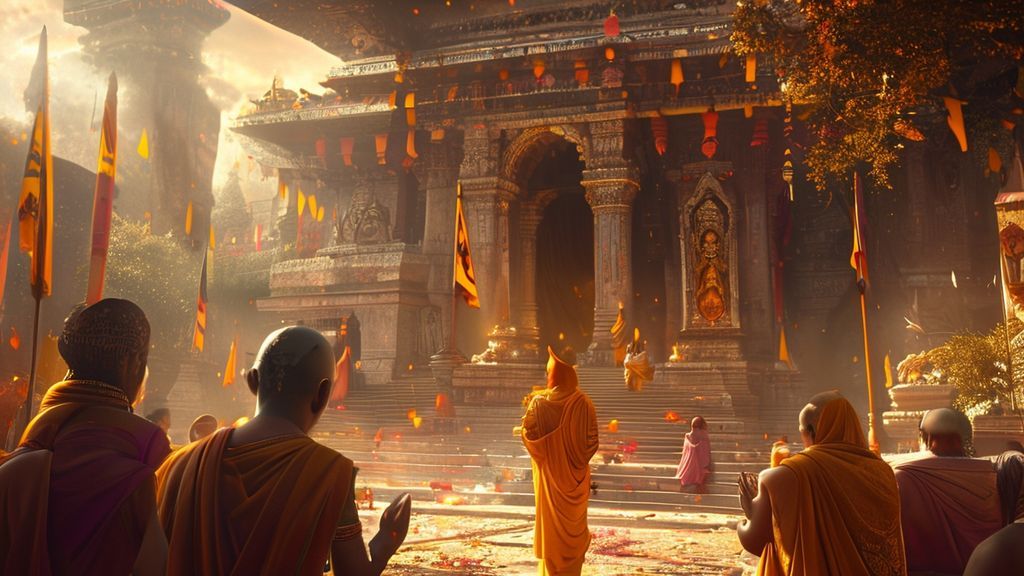
Sannyasa, the fourth and final Ashrama in Hindu life, is the stage of complete renunciation, marked by profound detachment from worldly desires, material possessions, and ego, dedicated solely to the pursuit of Moksha (liberation) through intense spiritual discipline, meditation, and a life of selfless service and introspection, transcending all societal bonds to realize the ultimate truth.
| Attribute | Details |
|---|---|
| Concept | The fourth and final stage of Ashrama Dharma, signifying complete renunciation. |
| Primary Goal | Moksha (liberation), Atma-jnana (self-realization), God-realization. |
| Key Practices | Tapasya (austerity), Dhyana (meditation), Japa (mantra chanting), Bhiksha (living on alms), Swadhyaya (scriptural study), Vairagya (detachment). |
| Scriptural Basis | Vedas (e.g., Brihadaranyaka Upanishad), Principal Upanishads (e.g., Jabala Upanishad), Smritis (e.g., Manusmriti Chapter VI), Bhagavad Gita. |
Introduction: The Pinnacle of Ashrama Dharma
In the profound tapestry of Sanatan Dharma, human life is structured into four progressive stages, or Ashramas: Brahmacharya (student life), Grihastha (household life), Vanaprastha (forest dweller, retired life), and finally, Sannyasa (renunciation). This systematic progression is not merely a societal convention but a divinely inspired framework designed to guide the soul towards its ultimate purpose: Moksha, or liberation from the cycle of birth and death. Sannyasa represents the zenith of this spiritual journey, a stage where the individual consciously transcends all material attachments and egoistic pursuits, dedicating their very existence to the realization of the absolute truth. It is a path of profound courage, unwavering faith, and ultimate surrender, embodying the timeless wisdom of the Rishis.
The embrace of Sannyasa signifies a complete withdrawal from worldly concerns, societal obligations, and the pursuit of the three Purusharthas (Dharma, Artha, Kama), to singularly focus on the fourth and supreme goal: Moksha. It is a life lived beyond dualities, beyond praise and blame, gain and loss, seeking only the supreme bliss of Brahman. A Sannyasi becomes a living embodiment of spiritual ideals, a beacon of truth, and a guide for humanity, reminding us of the transient nature of material existence and the eternal reality of the Divine Self.
Puranic History & Legend: The Tradition of Renunciation
The tradition of Sannyasa is as ancient as the Vedas themselves, deeply woven into the spiritual fabric of Bharatavarsha. The Brihadaranyaka Upanishad (IV.4.22) speaks of Brahmins who, “desiring the Self, renounce the world.” The Jabala Upanishad explicitly details the process of Sannyasa, stating, “One may renounce at any stage of life – Brahmacharya, Grihastha, or Vanaprastha – the moment detachment arises.” This scripture, in particular, is seminal in formalizing the concept of Sannyasa without strict age restrictions, emphasizing readiness of mind over chronological age.
Throughout Itihasa and the Puranas, we find countless exemplars of the Sannyasi ideal. The great sages like Rishi Dattatreya, considered an Avatara of the Trinity, lived a life of supreme detachment and profound wisdom. The Sanatkumāras, mind-born sons of Brahma, were primordial Sannyasis who chose eternal celibacy and spiritual seeking. Bhagavan Shiva Himself, as the Adi Yogi, is the ultimate prototype of a Sannyasi, adorned with ashes, dwelling in cremation grounds, embodying ultimate detachment and austerity.
In more historical times, the advent of Adi Shankaracharya (8th century CE) revitalized the Sannyasa tradition, establishing the Dashanami Sampradaya and monastic orders that continue to flourish today. His own life, from taking Sannyasa at a young age, to his relentless philosophical debates and establishment of the four cardinal Mathas (monasteries), serves as an eternal inspiration for seekers of truth. His teachings, particularly those emphasizing Advaita Vedanta, underpin the philosophical basis for many Sannyasi orders, stressing the non-duality of the individual soul (Atman) and the Universal Spirit (Brahman).
Rituals & Puja Vidhi: The Path to Holy Orders
The formal initiation into Sannyasa is a deeply symbolic and transformative ritual, often known as Viraja Homa. This fire sacrifice signifies the aspirant’s spiritual rebirth and the ceremonial severing of all previous worldly ties.
- Preparatory Rites (Purva Anga): The aspirant performs Shraddha for their ancestors, offering water and oblations, symbolically fulfilling their filial duties for the last time. They may also perform a Prajapatya Ishti (a sacrifice to Prajapati) to seek blessings for their new life.
- Viraja Homa: This is the central rite where offerings are made into the sacred fire, signifying the renunciation of all worldly desires (Kama), actions (Karma), and attachments. The aspirant chants powerful Vedic mantras, affirming their decision to pursue Moksha alone.
- Prana Homa: A symbolic offering of the five life-breaths into the fire, indicating the giving up of the individual ego and surrender to the cosmic life force.
- Self-oblation (Atma-Agnihotra): The aspirant mentally offers their own self into the fire, symbolizing death to the old identity and birth into a new, spiritual one. This is often accompanied by chanting the mantra, “Sarvam Svanushtham Pravachana Agni Hotram Juhomi” (I offer all my performed actions and sacred duties into the fire of self-knowledge).
- Giving up the Sacred Thread (Yajnopavita Tyaga): The sacred thread, worn by Brahmins as a symbol of their Dvija (twice-born) status and responsibilities, is removed and offered into the fire or water, signifying the transcendence of caste, gender, and societal roles.
- Shaving of the Head (Mundana): The head is fully shaved, representing purity, detachment from physical appearance, and the shedding of ego.
- Donning the Ochre Robes (Kashaya Vastra Dharanam): The aspirant discards their old clothes and wears simple ochre (saffron) robes, symbolizing purity, fire, and the rejection of material possessions.
- Acceptance of Danda and Kamandalu: The Sannyasi accepts a staff (Danda), representing moral authority, self-control, and the support for their spiritual journey, and a water pot (Kamandalu), symbolizing simplicity and self-sufficiency.
- Praisha Mantra: The Sannyasi recites the Praisha Mantra, proclaiming their renunciation and their resolve to seek Brahman. This is typically “Bhuh Sannyastam Maya, Bhuvah Sannyastam Maya, Suvah Sannyastam Maya” (Earth is renounced by me, Sky is renounced by me, Heaven is renounced by me), signifying renunciation of all three worlds.
The daily life of a Sannyasi is marked by strict adherence to spiritual disciplines: early morning bathing, extensive meditation (Dhyana), chanting of mantras (Japa), study of scriptures (Swadhyaya), living on alms (Bhiksha), and constant introspection. They are often Parivrajakas, wandering mendicants, who do not stay in one place for long, embodying non-attachment even to dwelling.
Mantras & Chants for the Seeker of Renunciation
For a Sannyasi, every breath can be a mantra, every moment an act of contemplation. However, certain powerful utterances form the core of their spiritual practice:
- Om (AUM): The Pranava Mantra, the primordial sound of the universe. It is the essence of all Vedas and represents Brahman itself. Constant chanting and meditation on Om lead to profound states of realization.
“ओम्” (Om)
- Maha Vakyas: The “Great Sayings” from the Upanishads, which encapsulate the essence of Advaita Vedanta. These are not merely chanted but meditated upon deeply for direct experience of the truth they convey.
- Aham Brahmasmi: “I am Brahman.” (Brihadaranyaka Upanishad)
“अहं ब्रह्मास्मि”
- Tat Tvam Asi: “That Thou Art.” (Chandogya Upanishad)
“तत्त्वमसि”
- Prajnanam Brahma: “Consciousness is Brahman.” (Aitareya Upanishad)
“प्रज्ञानं ब्रह्म”
- Ayam Atma Brahma: “This Self is Brahman.” (Mandukya Upanishad)
“अयमात्मा ब्रह्म”
- Aham Brahmasmi: “I am Brahman.” (Brihadaranyaka Upanishad)
- Gayatri Mantra: While a Sannyasi gives up the sacred thread, the essence of the Gayatri Mantra, seeking illumination and wisdom from the Divine, remains a powerful tool for inner purification and spiritual advancement.
“ॐ भूर्भुवः स्वः तत्सवितुर्वरेण्यं भर्गो देवस्य धीमहि धियो यो नः प्रचोदयात्।”
- Shivoham: “I am Shiva.” A powerful affirmation of one’s true divine nature, transcending all limitations.
“शिवोहम्”
These mantras are not mere words but pathways to ultimate reality, guiding the Sannyasi deeper into the silent realization of their true Self.
Dos and Don’ts: The Code of Conduct for a Sannyasi
The life of a Sannyasi is governed by a strict spiritual code, enabling them to maintain their detachment and focus on liberation.
- Dos (Niyamas and Yamas):
- Practice Ahimsa (non-violence) in thought, word, and deed.
- Uphold Satya (truthfulness) rigorously.
- Adhere to Asteya (non-stealing).
- Maintain absolute Brahmacharya (celibacy and control of senses).
- Cultivate Aparigraha (non-possession, non-covetousness).
- Practice Shaucha (purity, internal and external).
- Embrace Santosha (contentment).
- Engage in regular Tapasya (austerity, self-discipline).
- Commit to daily Swadhyaya (study of scriptures and self-reflection).
- Maintain Ishwara Pranidhana (surrender to the Divine).
- Live solely on Bhiksha (alms) obtained without begging, accepting whatever is offered.
- Maintain profound Vairagya (detachment) from all worldly pleasures and pains.
- Serve as a spiritual guide and a living example of Dharma.
- Don’ts (Prohibitions):
- Do not accumulate wealth or possessions.
- Do not engage in backbiting, gossip, or criticism.
- Do not exhibit anger, hatred, greed, lust, or pride.
- Do not seek fame, recognition, or honor.
- Do not engage in worldly disputes or politics.
- Do not become attached to any place, person, or object.
- Do not lament or rejoice over worldly matters.
- Do not indulge in sensory pleasures.
- Do not harbor ill-will or desire for revenge.
Who is eligible for Sannyasa?
Traditionally, Sannyasa is taken after fulfilling the duties of Grihastha and Vanaprastha. However, the Jabala Upanishad allows for immediate renunciation at any stage if profound Vairagya (detachment) arises. Eligibility primarily rests on spiritual maturity, a deep understanding of life’s impermanence, and an unshakeable desire for Moksha. While historically more common for men, women have also embraced this path.
Can women embrace Sannyasa?
Absolutely. While certain orthodox traditions may have historically been more restrictive, the scriptures themselves do not prohibit women from Sannyasa. Many revered women saints and mystics, known as Sannyasinis or Sadhvis, have embraced renunciation throughout history, such as Akka Mahadevi in the Lingayat tradition, and numerous women disciples of modern Gurus. Their contributions to Sanatan Dharma are invaluable.
Is Sannyasa the only path to Moksha?
No, Sannyasa is a direct and powerful path, but not the only one. Sanatan Dharma offers multiple yogic paths (Karma Yoga, Bhakti Yoga, Jnana Yoga, Raja Yoga) that can lead to Moksha, even while living in the world. Sannyasa is suitable for those with an intense inclination towards complete renunciation, while a householder can achieve liberation through selfless action, devotion, and wisdom, as exemplified by King Janaka in the Hindutva.online archives on Raja Yoga.
Dharmic Significance: The Eternal Custodians of Truth
The stage of Sannyasa is of paramount importance for the preservation and propagation of Sanatan Dharma. Sannyasis are the living embodiments of spiritual ideals, walking libraries of Vedic wisdom, and unwavering guides for society. By dedicating their lives entirely to the pursuit of truth, they provide a constant reminder to the world of the ultimate goal of human existence beyond transient material pursuits.
They act as spiritual mentors, uphold scriptural integrity, and often serve as a moral compass for communities. Their very existence inspires faith, detachment, and devotion. Through their tireless efforts in meditation, self-study, and sometimes teaching, they maintain the unbroken lineage of spiritual knowledge, ensuring that the eternal truths of the Vedas and Upanishads remain vibrant and accessible to all sincere seekers. The Sannyasi order thus safeguards the spiritual heritage of Bharatavarsha, offering a timeless example of selfless dedication to the Divine. Explore more such profound topics on Hindutva.online.