

The Saptapadi ceremony – Seven Wedding Vows in Hindu Marriage from Sanskrit sapta (seven) and padi (steps) – represents the most sacred and legally binding moment in Hindu marriage, when bride and groom take seven circumambulations around sacred fire (Agni) while reciting seven distinct vows that collectively establish comprehensive framework for their lifelong partnership addressing practical necessities like food and shelter, emotional dimensions including love and companionship, spiritual aspirations toward dharmic living and moksha, social responsibilities toward children and extended family, and philosophical commitment to growing together through life’s inevitable changes creating union that transcends mere legal contract or romantic attraction to become sacred bond witnessed by fire deity and blessed by assembled community.

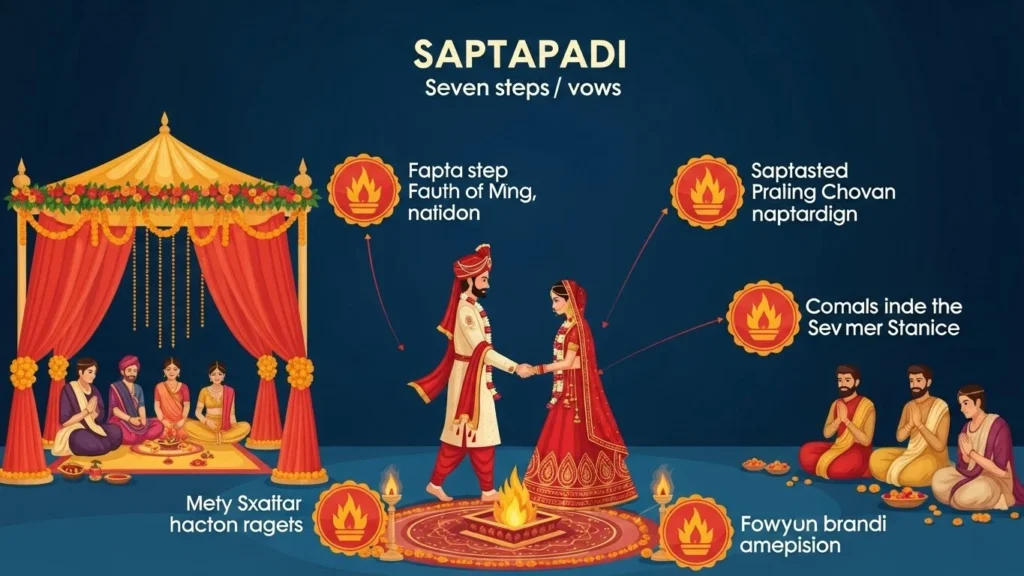
Unlike Western “I do” exchange where couple speaks personal vows they’ve composed, Hindu Saptapadi follows time-tested scriptural template refined across millennia to encompass universal marital needs and aspirations – the seven vows systematically cover sustenance and prosperity (first step), health and strength (second step), wealth accumulation through righteous means (third step), happiness through mutual love and respect (fourth step), progeny and family welfare (fifth step), longevity (sixth step), and lifelong friendship and fidelity (seventh step) – creating beautifully balanced progression from material security through emotional fulfillment toward spiritual realization while never losing sight of practical household management and parental responsibilities that ground marital relationship in lived reality rather than purely idealistic fantasy.
For couples marrying in 2025, whether planning traditional elaborate wedding with complete Vedic ceremonies or simplified modern versions adapting core elements to contemporary sensibilities and interfaith contexts, understanding Saptapadi’s profound significance – that Indian law recognizes completion of these seven steps as legally valid marriage requiring no additional registration, that regional variations exist in whether couple walks seven steps or takes seven circles and whether bride leads certain rounds symbolizing partnership equality.
that each step’s specific vow carries deep meaning deserving conscious reflection rather than mechanical recitation, and that modern couples increasingly request English translations or personalized additions honoring tradition while making vows personally meaningful – enables approaching this pivotal moment with proper reverence and understanding, transforming what might otherwise seem like lengthy incomprehensible Sanskrit ritual into deeply moving experience establishing spiritual foundation for marriage built on conscious commitment to supporting partner’s growth across all life dimensions from mundane daily needs through ultimate spiritual liberation.
The Sacred Significance of Saptapadi
Before examining specific vows and procedures, understanding why Saptapadi holds such profound importance in Hindu marriage tradition reveals sophisticated philosophy underlying this deceptively simple ritual of walking seven steps together.
The Scriptural Foundation:
Saptapadi appears in ancient Hindu marriage texts as the definitive moment when couple becomes legally and spiritually married.
Grihya Sutras (household ritual manuals) including Ashvalayana, Paraskara, and Gobhila Grihya Sutras all prescribe Saptapadi as essential marriage component.
The Crucial Statement:
सप्तपदी तु सम्पूर्णा भवेत् पत्नी तदा स्मृता
“Upon completion of seven steps, she becomes the wife” – establishing that marriage is complete only after Saptapadi, regardless of other ceremonies performed.
Legal Recognition:
Section 7(2) of the Hindu Marriage Act, 1955 explicitly states:
“A Hindu marriage may be solemnized in accordance with the customary rites and ceremonies of either party thereto…The marriage becomes complete and binding when the seventh step is taken.”
This means:
- Indian courts recognize Saptapadi completion as valid marriage
- No registration certificate legally required (though practically advisable)
- Marriage dissolution requires formal divorce regardless of ceremony type
- Seven steps create legally enforceable marital rights and obligations
The Symbolism of Fire and Seven:
Agni (Fire) as Witness:
Fire serves as primary witness because:
- Purifying element: Burns impurities, sanctifies vows
- Divine presence: Agni is Vedic deity, messenger between humans and gods
- Eternal witness: Fire’s presence ensures vows can never be denied or forgotten
- Transformative power: Marriage transforms two individuals into one unit; fire symbolizes this alchemy
- Source of life: Fire represents digestive fire sustaining life, paralleling couple sustaining household
The Number Seven:
Seven holds special significance in Hindu cosmology:
- Seven chakras in yogic system
- Seven sages (Saptarishi)
- Seven sacred rivers
- Seven colors in rainbow (representing completeness)
- Seven musical notes (saptaswara)
- Seven days creating complete week cycle
Seven steps thus represent:
- Completeness and wholeness
- Covering all life dimensions
- Sacred, auspicious number ensuring divine blessing
- Sufficient commitment (the legend of Savitri-Satyavan – explained later)
The Philosophical Framework:
Saptapadi embodies Hindu marriage’s unique understanding:
Marriage as Partnership, Not Ownership:
Unlike patriarchal systems treating wife as property, Hindu marriage (ideally) recognizes equal partnership:
- Some traditions have bride lead final steps (symbolizing her equal or superior spiritual power)
- Vows are mutual – both promise same commitments
- Neither subordinated to other; both serving shared purpose
Seven Wedding Vows in Hindu Marriage
This Life and Beyond:
Hindu belief in reincarnation extends to marriage:
- Seven steps bind couple for seven lifetimes (some interpretations)
- Current partnership has roots in past lives
- Will continue future incarnations until moksha
- Creates profound long-term perspective transcending current life’s temporary troubles
Purushartha Integration:
The seven vows systematically address all four life goals (purusharthas):
- Dharma (righteous living) – vows about moral conduct, family duty
- Artha (prosperity) – vows about wealth creation, material security
- Kama (legitimate pleasure) – vows about love, companionship, progeny
- Moksha (liberation) – vows about spiritual development together
This comprehensive framework acknowledges that marriage isn’t purely spiritual escape from world OR purely material arrangement, but integrated path engaging all life dimensions.
The Gender Symbolism:
Traditional interpretation views marriage as union of:
- Purusha (masculine principle) – consciousness, stability, dharma
- Prakriti (feminine principle) – energy, creativity, shakti
Neither complete alone; marriage creates wholeness through complementary union (though modern progressive interpretations question rigid gender binaries).
The Divine Parallel:
During marriage ceremony, bride and groom considered manifestations of:
- Lakshmi and Vishnu (Vaishnavism)
- Parvati and Shiva (Shaivism)
- Sita and Rama (devotional traditions)
This elevates marriage from merely human transaction to sacred union mirroring divine partnerships, demanding corresponding reverence and commitment.
Modern Relevance:
Even for contemporary couples, Saptapadi offers:
- Comprehensive framework: Addresses practical, emotional, spiritual dimensions systematically
- Equal partnership model: When properly understood, promotes mutual respect
- Long-term perspective: Seven-lifetime commitment encourages patience through difficulties
- Community witness: Public vows create accountability and support network
- Sacred dimension: Elevates marriage beyond legal contract to spiritual sacrament
- Shared values: Creates common foundation for navigating modern challenges
Understanding this rich significance transforms Saptapadi from incomprehensible foreign ritual into profound universal wisdom about what makes marriages thrive across lifetimes.
The Seven Vows: Detailed Meanings
Each of the seven steps carries specific meaning, with priest chanting Sanskrit mantras while couple takes corresponding step, creating systematic progression through marital commitments from material foundation through spiritual culmination.
Note on Variations:
The exact wording and sequence vary by:
- Regional tradition (North vs. South Indian)
- Family lineage
- Specific Grihya Sutra followed
- Priest’s interpretation
Below presents common North Indian version with meanings explained:
First Step – Food and Nourishment (Anna)
Sanskrit Mantra:
ॐ एष एको विष्णुस्त्वामन्ववातु।
यथा विष्णुः सर्वभूतानाम् अन्नदाता भवति तथैव भव॥
“Om, may Lord Vishnu follow you (to provide nourishment). As Vishnu nourishes all beings, so shall we nourish each other and our family.”
Vow/Promise:
“Together we will provide for our household, ensuring adequate food, clothing, and shelter. We commit to supporting each other’s basic material needs and maintaining our home.”
Deeper Meaning:
- Foundation first: Marriage begins with practical necessities, not just romance
- Joint responsibility: Both partners commit to contributing economically
- Beyond minimums: “Adequate” implies comfortable living, not mere survival
- Hospitality: Hindu tradition values feeding guests; vow includes welcoming others
- Annapurna principle: Recognizing food as sacred, never to be wasted
Modern Application:
- Dual-income families or single breadwinner – both valid
- Budgeting, financial planning together
- Creating comfortable home environment
- Hospitality toward family and friends
Second Step – Physical and Mental Strength (Bala)
Sanskrit Mantra:
ॐ ऊर्जे त्वानुअव्रातां ऊर्जा स्वाहा।
यथा ऊर्जस्वन्ति देवाः तथा भवाव॥
“Om, may you be united with strength and vigor. As the devas possess strength, so shall we.”
Vow/Promise:
“We will support each other in maintaining good health – physical, mental, and emotional. We will develop our inner strengths and help each other through weaknesses.”
Deeper Meaning:
- Holistic health: Not just physical but mental wellbeing
- Mutual support: Caring for each other during illness
- Preventive care: Maintaining healthy lifestyles together
- Emotional strength: Building psychological resilience as couple
- Interdependence: Drawing strength from partnership
Modern Application:
- Encouraging healthy habits (exercise, nutrition)
- Supporting during illness, surgery, mental health challenges
- Respecting each other’s need for rest, self-care
- Building emotional intimacy and trust
- Strength training, yoga, meditation together
Third Step – Prosperity and Wealth (Raya Poshanam)
Sanskrit Mantra:
ॐ रायस्पोषाय त्वानुअव्रातां रायस्पोषः स्वाहा।
यथा रायस्पोषम् देवेभ्यः तथा भवाव॥
“Om, may you be together in the increase of wealth. As wealth increases for the devas, so shall it for us.”
Vow/Promise:
“We will acquire wealth and resources through righteous and ethical means. Together we will build prosperity while maintaining our values and integrity.”
Deeper Meaning:
- “Righteous means”: Critical qualifier – not wealth at any cost
- Joint accumulation: Both contributing to family prosperity
- Ethical boundaries: Dharma (righteousness) must guide wealth pursuit
- Sharing: Prosperity for generous giving, not just hoarding
- Material foundation: Acknowledging that spiritual life requires material security
Modern Application:
- Career development, business ventures
- Investments, savings, property acquisition
- Living within means, avoiding debt traps
- Charitable giving, supporting worthy causes
- Honest tax payment, ethical business practices
Fourth Step – Happiness and Harmony (Sukha)
Sanskrit Mantra:
ॐ मायो भवाय त्वानुअव्रातां मायोभूः स्वाहा।
यथा मायोभूः देवेभ्यः तथा भवाव॥
“Om, may you be united in happiness. As happiness pervades the devas, so shall it pervade us.”
Vow/Promise:
“We will cultivate mutual love, respect, trust, and understanding. We will strive for happiness and harmony in our relationship, treating each other with kindness and consideration.”
Deeper Meaning:
- Emotional core: This vow addresses love and companionship
- Active cultivation: Happiness requires effort, not just happens
- Mutual respect: Foundation for lasting relationship
- Communication: Trust built through honesty and openness
- Romance and affection: Keeping love alive through years
Modern Application:
- Date nights, quality time together
- Effective communication and conflict resolution
- Expressing appreciation and affection regularly
- Respecting each other’s autonomy and individuality
- Maintaining friendship alongside romance
- Adapting to each other’s changing needs
Fifth Step – Children and Family (Prajaa)
Sanskrit Mantra:
ॐ प्रजाभ्यः त्वानुअव्रातां प्रजाः स्वाहा।
यथा प्रजाभ्यः देवेभ्यः तथा भवाव॥
“Om, may you be blessed with progeny. As the devas are blessed with offspring, so shall we be.”
Vow/Promise:
“We pray to be blessed with children and commit to raising them with love, values, and wisdom. We will nurture our family and future generations.”
Deeper Meaning:
- Progeny: Traditional emphasis on having children
- Raising, not just bearing: Commitment to parenting responsibility
- Values transmission: Passing dharma to next generation
- Extended family: Includes caring for parents, relatives
- Lineage continuation: Fulfilling ancestor debt through descendants
Modern Application:
- Children if couple desires (not mandatory despite traditional emphasis)
- Adoption equally valid expression of parenting commitment
- Childless couples interpreting broadly: nurturing students, community, creative projects
- Parenting partnership – sharing responsibilities equally
- Extended family care – aging parents, nieces/nephews
Sixth Step – Longevity (Rutubhyah)
Sanskrit Mantra:
ॐ ऋतुभ्यः त्वानुअव्रातां ऋतवः स्वाहा।
यथा ऋतवः देवेभ्यः तथा भवाव॥
“Om, may we be blessed with long life through all seasons. As the devas experience eternal time, may we have longevity together.”
Vow/Promise:
“We pray for long life together. May we support each other through all seasons and stages of life, growing old together in health and happiness.”
Deeper Meaning:
- Lifetime commitment: Not dissolving marriage when difficulties arise
- Through all seasons: Youth, middle age, old age; prosperity and adversity
- Growing old together: Romantic ideal of lifelong companionship
- Health in old age: Caring for each other during declining years
- Quality of years: Not just length but vitality and purpose
Modern Application:
- Healthy lifestyle choices supporting longevity
- Life insurance, retirement planning
- Commitment to working through marital challenges
- Accepting physical aging gracefully together
- Planning for elder years (housing, care, finances)
- Maintaining companionship and intimacy through decades
Seventh Step – Friendship and Fidelity (Sakhaa)
Sanskrit Mantra:
ॐ सखे त्वानुअव्रातां सखा स्वाहा।
यथा सख्यं देवेभ्यः तथा भवाव॥
“Om, may we remain true friends and companions. As the devas share eternal friendship, so shall we.”
Vow/Promise:
“We vow to remain lifelong friends, companions, and partners. We commit to fidelity, loyalty, and unwavering support. We promise to be true only to each other.”
Deeper Meaning:
- Friendship foundation: Marriage built on companionship, not just passion
- Fidelity: Sexual and emotional faithfulness
- Loyalty: Standing by partner through all circumstances
- Companions: Sharing life’s journey together
- Culmination: This final vow brings together all previous commitments
Modern Application:
- Maintaining friendship amid parenting/career pressures
- Emotional intimacy, sharing thoughts and feelings
- Sexual fidelity and exclusive commitment
- Being each other’s confidant and support
- Choosing partner above all others (within healthy boundaries)
- Friendship that survives after romantic passion evolves
The Beautiful Progression:
Notice the systematic development:
- Material security (food, shelter)
- Physical/mental health
- Economic prosperity
- Emotional happiness
- Family and progeny
- Longevity together
- Eternal friendship and fidelity
This mirrors Maslow’s hierarchy – addressing basic needs first, then emotional and self-actualization dimensions, while adding spiritual and generational perspectives Western psychology often lacks.
Regional and Denominational Variations:
South Indian Tradition:
- Couple takes seven actual steps (not circles)
- Typically stepping on seven betel nuts or small piles of rice
- Bride often leads all seven steps (Dravidian traditions emphasize female power)
Bengali Tradition:
- Incorporates more elaborate rituals between each step
- Specific offerings to fire with each vow
Gujarati Tradition:
- Four pheras instead of seven
- Representing four purusharthas (dharma, artha, kama, moksha)
Modern Personalized Vows:
Contemporary couples sometimes add personalized English vows before/after Sanskrit mantras, addressing modern concerns:
- Gender equality and shared domestic labor
- Career support and individual growth
- Environmental responsibility
- Interfaith respect (if applicable)
- Modern family structures
While additions acceptable, the seven traditional vows remain core, connecting couple to millennia of tradition.
The Saptapadi Ritual: Step-by-Step Procedure
The actual Saptapadi ceremony follows specific sequence within larger wedding ritual, typically occurring after Kanyadaan (giving away of bride) and Mangalsutra/Sindoor application, representing marriage’s culminating moment.
Pre-Saptapadi Setup:
The Sacred Fire (Agni):
- Havan Kund (fire pit) established at mandap center
- Fire lit using sacred procedures with ghee, camphor, specific woods
- Priest maintains fire throughout ceremony
- Offerings made to fire invoking deities
Tying Together (Granthi Bandhan):
Before Saptapadi begins:
- Bride’s pallu (sari end) or dupatta tied to groom’s scarf/uttariya
- Creates physical connection symbolizing unbreakable bond
- Knot remains throughout seven steps
- Sometimes includes sacred thread or flowers in knot
The Seven Steps – North Indian Style:
Direction: Couple walks clockwise around fire (keeping fire on right – auspicious direction)
Leading:
- Traditional: Groom leads first four steps, bride leads final three (symbolizing her ultimate spiritual authority)
- Alternative: Groom leads all seven (more patriarchal interpretation)
- Modern egalitarian: Bride and groom walk side-by-side
With Each Step:
- Priest chants Sanskrit mantra for that specific vow
- Couple takes one complete circumambulation around fire
- Family members shower flower petals and rice blessing couple
- Some traditions: Bride touches betelnut or small rice pile with toe at each step
- Pause between steps for mantra completion and offerings
Detailed Procedure:
Step 1:
- Priest: Chants Anna (nourishment) mantra
- Action: Couple takes first complete circle around fire
- Symbolism: Establishing household together
- Family: Showers blessings
Step 2:
- Priest: Chants Bala (strength) mantra
- Action: Second circumambulation
- Symbolism: Supporting each other’s wellbeing
- Family: Continues showering petals
Step 3:
- Priest: Chants Raya Poshanam (wealth) mantra
- Action: Third circle around fire
- Symbolism: Building prosperity together
- Family: Blessings intensify
Step 4:
- Priest: Chants Sukha (happiness) mantra
- Action: Fourth circumambulation
- Transition point: Bride now takes lead (in traditions following this practice)
- Symbolism: Partnership equality, bride’s spiritual power
Step 5:
- Priest: Chants Prajaa (progeny) mantra
- Action: Fifth circle with bride leading
- Symbolism: Creating and nurturing family
- Family: Special blessings for future children
Step 6:
- Priest: Chants Rutubhyah (longevity) mantra
- Action: Sixth circumambulation
- Symbolism: Lifelong commitment
- Family: Blessings for long married life
Step 7:
- Priest: Chants Sakhaa (friendship) mantra
- Action: Final, most important circle
- Symbolism: Eternal companionship
- Family: Loudest cheers and blessings
- Marriage complete upon seventh step completion
Post-Saptapadi:
Dhruva Darshan (Pole Star Sighting):
After seven steps completed:
- Priest directs couple to sight Dhruva (Pole Star) if visible
- Symbolizes constancy, stability in marriage
- Bride prays to remain as constant in husband’s life as Pole Star in sky
- (Modern note: Pole Star rarely visible during daytime weddings!)
Ashirvad (Blessings):
- Elders formally bless newly married couple
- Touching couple’s heads, offering good wishes
- Often giving gifts (gold, money, blessings)
- Couple touches elders’ feet showing respect
The Sacred Knot:
The granthi bandhan knot:
- Left tied until ceremony completely concludes
- Some traditions: Kept permanently as keepsake
- Symbolizes inseparable bond created through Saptapadi
Regional Variations:
South Indian (Tamil, Telugu, Kannada, Malayalam):
Major Difference: Seven steps in straight line (usually facing east), not circular
- Priest places seven betelnut or small piles of rice in row
- Bride steps on each with right foot while groom supports her
- With each step, corresponding mantra chanted
- After seven steps, couple considered married
Why different: Dravidian traditions predate Vedic influence, maintain distinct customs while incorporating Sanskrit mantras
Gujarati/Marwari:
- Only four circles around fire
- Each representing one purushartha
- Fuller, longer mantras for each circle
- Additional rituals between circles
Bengali:
- Seven circles maintained
- More elaborate offerings to fire between each step
- Bride traditionally covers face with betel leaves during ceremony
- Extensive ululation (women’s celebratory calls)
Contemporary Adaptations:
English Translation Included:
Modern priests often provide:
- English translation after Sanskrit mantras
- Allows couple and non-Hindi-speaking guests to understand
- Makes ceremony more meaningful for diaspora weddings
Personalized Elements:
- Couple writes own vows read in addition to traditional
- Musical accompaniment during circles
- Special songs sung by family
- Video screens displaying mantra translations for guests
Interfaith Weddings:
When one partner non-Hindu:
- Core Saptapadi often retained
- Additional elements from other faith tradition incorporated
- Priest explains significance ensuring understanding
- Respectful blending honoring both backgrounds
Time Considerations:
- Traditional: 45-60 minutes for complete ceremony with all rituals
- Abbreviated: 20-30 minutes focusing on essential Saptapadi
- Ultra-short: 10-15 minutes with simplified mantras
Photography:
- Saptapadi is most photographed wedding moment
- Families want perfect shots of each circle
- Sometimes couple pauses between steps for photographers
- Beautiful visual documentation of sacred commitment
The Legend of Savitri and Satyavan
Understanding the legendary origin story behind seven steps’ significance deepens appreciation for this tradition’s profound wisdom about commitment’s power.
The Story:
Background:
- Savitri, a princess, chooses to marry Satyavan despite knowing he’s fated to die within one year
- Her father warns her, but she refuses other suitors
- They marry and live happily in forest hermitage
- Exactly one year later, Satyavan dies as prophesied
The Critical Moment:
When Yama (God of Death) comes to take Satyavan’s soul:
- Savitri follows Yama as he carries away her husband’s soul
- Yama tells her to turn back – no mortal can follow him
- Savitri: “I have walked seven steps with you. According to sacred tradition, one who walks seven steps with another becomes their friend. As your friend, allow me to accompany you.”
Yama’s Response:
Impressed by her:
- Devotion to husband
- Knowledge of dharma
- Clever invocation of seven-step friendship rule
Yama grants her boons:
- First boon: Her blind father-in-law regains sight and kingdom
- Second boon: Her father gets sons (progeny)
- Third boon: She cleverly asks for sons from her own womb
The Twist:
Since she’s married to Satyavan, having sons requires his being alive!
Yama, bound by his word and impressed by her devotion and wit, restores Satyavan’s life.
The Lesson:
Power of Seven Steps:
Even Death himself recognizes that seven steps create unbreakable bond:
- Walking seven steps = friendship/relationship established
- Bond so sacred even gods must honor it
- Commitment’s power transcends death itself
Implications for Marriage:
- Seven steps in Saptapadi create bond stronger than death
- Partners bound for seven lifetimes
- Commitment isn’t casual – it’s eternal
- Divine forces witness and honor this sacred bond
Modern Meaning:
While contemporary couples may not literally believe in seven-lifetime bonds:
- Story emphasizes marriage’s sacred seriousness
- Commitment should be unbreakable except in extraordinary circumstances
- Partnership’s strength helps overcome life’s greatest challenges
- Walking through difficulties together creates profound connection
The story beautifully encapsulates why Saptapadi represents marriage’s ultimate moment – it’s when couple commits to walking together through all life brings, even death itself cannot dissolve that sacred bond.
Modern Relevance and Practical Applications
How do ancient seven vows remain relevant for contemporary couples navigating 21st-century marriages with dual careers, evolving gender roles, and modern challenges unknown to Vedic sages?
Universal Wisdom:
The seven vows’ genius lies in addressing timeless marital dimensions:
Material Security (Steps 1 & 3):
- Every era requires economic foundation
- Contemporary: Dual incomes, shared finances, retirement planning
- Principle unchanged: Partners must support household together
Physical/Mental Wellbeing (Step 2):
- Health concerns universal across time
- Modern additions: Mental health awareness, work-life balance
- Principle unchanged: Supporting each other’s complete wellness
Emotional Connection (Step 4):
- Love and companionship eternally important
- Modern context: Maintaining intimacy amid busy schedules
- Principle unchanged: Cultivating happiness through mutual respect
Family and Legacy (Step 5):
- Generational continuity valued across cultures
- Modern interpretation: Children, adopted family, mentoring, creative legacy
- Principle unchanged: Creating something beyond yourselves
Longevity and Commitment (Steps 6 & 7):
- Every era values lasting partnership
- Modern challenge: Higher divorce rates requiring intentional commitment
- Principle unchanged: Choosing partner daily through all life stages
Adapting to Modern Relationships:
Career Women:
Traditional vows don’t preclude female careers:
- Step 1 (household provision): Both contribute financially
- Step 3 (wealth): Both pursue careers, share economic growth
- Step 4 (happiness): Supporting each other’s professional fulfillment
- Modern couples: Explicitly discussing career priorities, relocation, parenting leaves
Gender Equality:
While some traditional interpretations patriarchal:
- Core vows are actually mutual commitments
- Bride leading final steps (some traditions): Acknowledges female power
- Modern adaptation: Ensuring equal domestic labor, decision-making
- Vows naturally support partnership model when properly understood
Childless by Choice:
Step 5 (progeny) reinterpreted:
- Nurturing community, students, causes instead of biological children
- “Family” includes chosen family, close friends
- Creating meaningful legacy through work, art, service
- Some couples modify vow language with priest’s approval
Interfaith Marriages:
Saptapadi adapted for:
- Hindu-Christian couples: Adding Christian vows alongside
- Hindu-Muslim: Incorporating Nikah elements
- Hindu-Jewish: Chuppah + Saptapadi combined ceremonies
- Core principle: Both traditions honored respectfully
Long-Distance Marriages:
Modern technology enables:
- Career couples in different cities
- International assignments
- Step 4 (happiness) requires creativity: Video calls, regular visits
- Step 7 (fidelity) demands extra trust
- Vows’ wisdom: Emphasizing communication, commitment despite distance
Second Marriages:
Older couples remarrying:
- Step 5 (children): Focus on adult children, grandchildren, blended families
- Step 6 (longevity): Particularly poignant for elder marriages
- All vows retain relevance with life-stage appropriate interpretation
Practical Applications for Married Life:
Annual Vow Renewal:
Some couples practice:
- Anniversary ritual revisiting seven vows
- Discussing which vow needs attention this year
- Recommitting to promises made years prior
- Adapting vows as life circumstances change
Marriage Counseling Framework:
Therapists can use seven vows:
- Assessing which vow-areas experiencing problems
- Economic stress = vows 1 & 3
- Emotional distance = vow 4
- Parenting conflicts = vow 5
- Creating action plans addressing each vow systematically
Conflict Resolution:
During disagreements:
- Remembering sacred vows made before fire and witnesses
- Which vow does this conflict violate?
- Realigning behavior with original commitments
- Long-term perspective: Will this matter in seven lifetimes?
Daily Practice:
Living vows daily:
- Vow 1: Sharing household chores, meal planning
- Vow 2: Encouraging exercise, managing stress together
- Vow 3: Financial transparency, budget meetings
- Vow 4: Date nights, expressing appreciation
- Vow 5: Quality time with children/family
- Vow 6: Healthy habits supporting longevity
- Vow 7: Maintaining friendship, fidelity
Teaching Children:
Parents modeling vows shows next generation:
- What healthy marriage looks like
- Sacred commitment’s importance
- Practical partnership in action
- Values worth seeking in their own future relationships
The Enduring Power:
Despite modern challenges, Saptapadi’s wisdom persists because:
- Addresses universal human needs in partnership
- Provides comprehensive framework, not just romantic ideals
- Balances material and spiritual dimensions
- Creates public accountability through witnessed vows
- Connects individual couples to timeless tradition
- Offers practical guidance alongside philosophical ideals
For 2025 couples, these ancient vows remain profoundly relevant – the specific manifestations change (dual careers vs. single breadwinner, modern medicine vs. Ayurvedic herbs, video calls vs. letter-writing), but the fundamental commitment to supporting each other across all life dimensions remains eternally applicable wisdom for successful, fulfilling marriages.
Frequently Asked Questions
Do the seven vows differ for arranged vs. love marriages?
No, the same Saptapadi ceremony applies regardless of how couple met. The seven vows address universal marital dimensions equally relevant whether partners chose each other or families arranged match. Love marriages may feel more emotionally resonant during ceremony since couple already bonded, while arranged marriages use Saptapadi as formal beginning of getting-to-know-you process. Either way, vows establish same commitments. Modern reality: Most marriages fall on spectrum between “pure arranged” and “pure love,” with families involved to varying degrees.
What if we’re having interfaith wedding – can we still do Saptapadi?
Absolutely! Many interfaith couples include Saptapadi as Hindu tradition component. Options: 1) Full Hindu ceremony with Saptapadi, plus elements from partner’s tradition, 2) Simplified Saptapadi with English explanations for non-Hindu family, 3) Seven steps retained but additional vows from other faith added, 4) Two separate ceremonies honoring both faiths fully. Discuss with priest/officiant – most accommodate interfaith needs respectfully. Key: Ensuring both partners and families comfortable, understanding significance, feeling honored.
Can same-sex couples have Saptapadi ceremony?
Traditionally: Hindu texts assume heterosexual marriage. Modern reality: Progressive priests and Hindu communities increasingly accommodate LGBTQ+ couples, performing full Saptapadi with appropriate adaptations. Some priests won’t officiate (find inclusive priest through LGBTQ+ Hindu organizations). The seven vows themselves gender-neutral in meaning – all about partnership, not specifically man-woman. Legal recognition varies by country. Growing number of Hindu same-sex couples having beautiful Saptapadi ceremonies honoring tradition while affirming their love. As society evolves, religious practices adapt.
What happens if someone objects during Saptapadi?
Very rare in Hindu weddings (unlike movie drama!). If someone genuinely objects: Ceremony pauses, objection heard, families confer. Valid objections (hidden marriage, legal impediments) require addressing before proceeding. Invalid objections (disapproval of match) typically overruled – couple’s choice respected. Legal note: After seventh step completed, marriage binding regardless of objections. Indian courts ruled Saptapadi completion = valid marriage even if formal registration incomplete. Practical reality: Family disputes usually resolved before wedding day; ceremony-interruptions almost never happen in real Hindu weddings.
Do we need priest or can family member lead Saptapadi?
Ideally: Qualified priest ensures proper mantras, procedures, timing. Alternatives: 1) Family elder familiar with procedures can officiate (grandfather, uncle), 2) Online resources provide phonetic Sanskrit for DIY ceremony, 3) Recorded mantras played while couple performs steps, 4) Simplified English version maintaining seven-step structure. Legal validity: Indian law recognizes Saptapadi completion regardless of who officiates – no ordained clergy requirement like some religions. Practical: Priest adds authenticity, handles complexity, commands respect. Family/DIY acceptable when budget/location constraints, though less traditional.
Can Saptapadi be performed after civil/court marriage?
Yes! Some couples do legal registration first, then traditional Saptapadi later (or vice versa). Reasons: Timing constraints, family coordination, visa requirements, etc. Both valid: Court marriage provides legal recognition; Saptapadi provides spiritual/cultural fulfillment. Many couples have civil ceremony first (especially if one partner foreign national needing spouse visa), then full Hindu wedding with Saptapadi later when families can gather. Or Saptapadi wedding first (legally valid in India), formal registration afterward for documentation. Order doesn’t diminish either ceremony’s significance.
What if bride is pregnant during wedding?
No prohibition in Hindu tradition against pregnant bride. Saptapadi proceeds normally. Some considerations: Physical comfort (walking seven circles while pregnant), timing (not too close to due date for travel safety), health (doctor clearance if complications). Traditional concern about unmarried pregnancy largely disappeared in modern context; many couples already living together before formal wedding. Focus on joy of celebrating marriage and upcoming baby together. Family elders may have opinions, but no scriptural objection. Bride’s and baby’s health take priority over all other concerns.
Can we personalize the seven vows with modern additions?
Yes, increasingly common! Approaches: 1) Traditional Sanskrit vows chanted, then couple recites personalized English vows addressing modern concerns, 2) Keep seven-step structure but entirely new language, 3) Hybrid – traditional vows plus additional eighth/ninth promise about specific values. Modern additions might address: Gender equality, shared domestic labor, career support, environmental responsibility, interfaith respect, mental health support. Important: Discuss with priest beforehand – some traditional priests object, progressive ones welcome meaningful personalization. Ensure additions honor tradition’s spirit while making ceremony personally meaningful.
Conclusion
The Saptapadi ceremony represents Hinduism’s profound wisdom about marriage as sacred partnership requiring comprehensive commitment across all life dimensions – from ensuring basic material security through providing food and shelter, through building emotional intimacy via mutual love and respect, to creating generational legacy through children and family, toward ultimate spiritual realization achieved together through lifelong friendship and fidelity extending beyond single lifetime into eternal bond connecting souls across multiple incarnations until moksha liberates both from cyclical rebirth.
The seven vows’ systematic progression from practical necessities through emotional fulfillment to spiritual culmination demonstrates sophisticated understanding that successful marriages require balanced attention to material, psychological, social, and transcendent dimensions simultaneously, rejecting both purely romantic idealism ignoring economic realities and purely pragmatic arrangements lacking emotional depth or spiritual meaning.
Whether contemporary couples approach these ancient vows through traditional elaborate Vedic ceremonies with complete Sanskrit mantras and ritual procedures, or through simplified modern adaptations incorporating English translations and personalized additions while maintaining core seven-step structure, the essential wisdom remains eternally relevant: marriage succeeds when partners consciously commit to supporting each other’s growth across all life areas, maintaining that commitment through inevitable challenges and changes, recognizing partnership as sacred bond witnessed by divine forces and blessed by community creating accountability and support network transcending individual couple’s private relationship.
As you approach or reflect upon your Saptapadi in 2025, remember that these seven steps represent more than beautiful ritual or legal formality – they constitute conscious choice to walk life’s journey together, accepting both joys and challenges that partnership entails, committing to friend and lover who sees you at your worst yet chooses you anyway, promising to reciprocate that unconditional acceptance while simultaneously inspiring each other toward highest potential across material prosperity, emotional fulfillment, family creation, and spiritual evolution.
The vows’ power lies not in magical Sanskrit syllables but in sincere intention behind promises, in daily choice to honor commitments made before sacred fire and assembled witnesses, in patient working through difficulties remembering that bond created through seven steps connects you across seven lifetimes making present conflicts temporary obstacles on eternal journey together toward ultimate realization that the divine presence you sought in fire’s witness actually resides within your partner and yourself, merely needing conscious recognition and reverent honoring through small daily acts of love, service, and mutual support transforming ordinary marriage into sacred union mirroring cosmic partnerships between divine masculine and feminine principles creating, sustaining, and ultimately liberating all existence.
॥ ॐ सहनाववतु। सह नौ भुनक्तु। सह वीर्यं करवावहै।
तेजस्विनावधीतमस्तु मा विद्विषावहै॥ ॐ शान्तिः शान्तिः शान्तिः॥
(Om. May we be protected together. May we be nourished together. May we work together with great vigor. May our study be enlightening. May we not hate each other. Om Peace, Peace, Peace.)
About the Author
Priya Sharma – Women’s Issues, Marriage, and Family Life Expert
Priya Sharma is a respected voice on women’s experiences in Hindu tradition, marriage customs, family dynamics, and the intersection of traditional values with modern women’s empowerment. Drawing from personal experience navigating arranged marriage that blossomed into deep partnership, raising children while maintaining career, and observing marriages across generations in extended family, her work focuses on making Hindu marriage traditions meaningful and relevant for contemporary couples while honoring their profound wisdom.
Priya has extensively researched the Saptapadi ceremony’s evolution from ancient scriptural origins through regional variations to modern adaptations, demonstrating that core seven-vow framework remains remarkably applicable to 21st-century relationships despite dramatic changes in gender roles, family structures, and social contexts. She regularly guides engaged couples through understanding Hindu wedding ceremonies beyond superficial ritual performance toward conscious participation in traditions carrying deep psychological and spiritual wisdom about successful partnership.
Her teaching emphasizes that Hindu marriage ideals, when freed from patriarchal distortions, actually support egalitarian partnerships where both spouses support each other’s complete flourishing, that the seven vows provide comprehensive framework addressing universal marital dimensions relevant across cultures and eras, and that ancient traditions deserve respectful examination and thoughtful adaptation rather than wholesale rejection or uncritical blind adherence, creating living wisdom serving contemporary couples while maintaining authentic connection to timeless truths about love, commitment, and sacred partnership’s transformative power.