


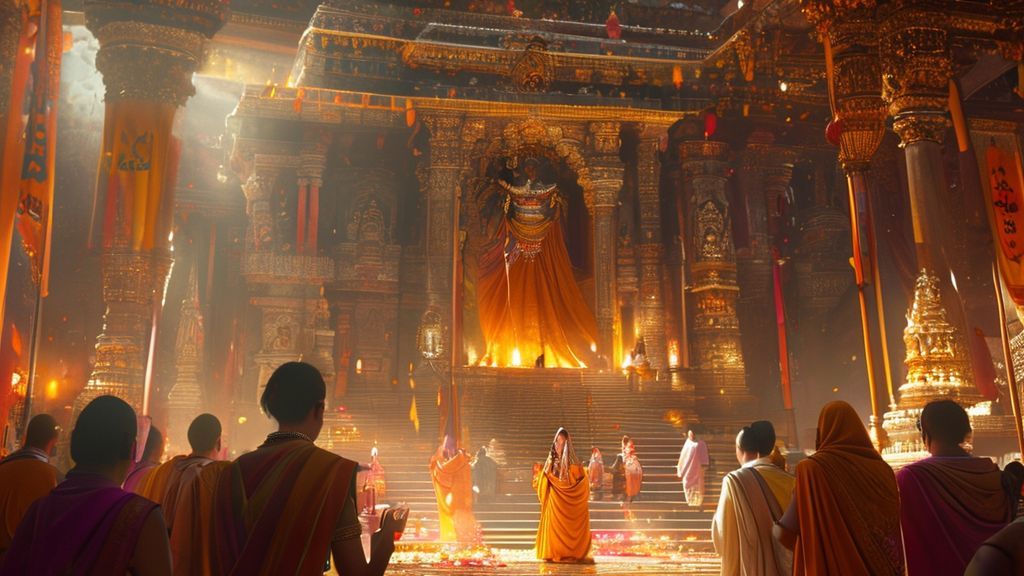
Sarada Devi, revered as the Holy Mother, is the spiritual consort of Sri Ramakrishna Paramahamsa and a pivotal figure in modern Sanatan Dharma. Her life embodies divine motherhood, universal love, and practical spirituality, establishing her as the spiritual head of the Ramakrishna Order and a living embodiment of the Divine Mother for countless devotees worldwide.
| Attribute | Details |
|---|---|
| Venerated Figure | Sri Saradamani Devi (Holy Mother) |
| Birthplace | Jayrambati, Bankura District, West Bengal, Bharat |
| Spouse & Guru | Sri Ramakrishna Paramahamsa |
| Key Role | Spiritual Head of the Ramakrishna Order, Embodiment of Divine Motherhood |
| Key Festival | Holy Mother’s Birthday (celebrated widely by Ramakrishna Math and Mission) |
| Primary Biographical Sources | “Sri Sarada Devi: The Holy Mother” by Swami Tapasyananda, “The Gospel of Holy Mother Sri Sarada Devi” |
| Mahasamadhi | July 21, 1920, Calcutta |
The Epitome of Divine Motherhood: Sri Sarada Devi
In the illustrious lineage of Sanatan Dharma’s spiritual giants, Hindutva.online reverently presents the sacred life and teachings of Sri Sarada Devi, universally adored as the Holy Mother. Her very existence was a sublime commentary on the highest ideals of spiritual realization interwoven with the simplest virtues of human life. Born into a devout Brahmin family in the remote village of Jayrambati, her life unfolded as a continuous act of self-surrender, unwavering devotion, and boundless compassion. While Sri Ramakrishna Paramahamsa ignited the spiritual renaissance of the 19th century, it was Sarada Devi who nurtured its flame, becoming the living embodiment of universal motherhood for a nascent global spiritual movement. She demonstrated that divine consciousness is not confined to asceticism but can be perfectly expressed through daily duties, selfless service, and unconditional love for all beings, irrespective of their faith, caste, or background.
The Divine Lila and Sacred Journey
The life of Sarada Devi (1853-1920) is not merely a biography but a divine Lila, a sacred play enacted for the spiritual upliftment of humanity. From her tender years, she exhibited extraordinary spiritual inclinations, often experiencing profound visions and remaining absorbed in divine contemplation amidst household chores. Her marriage to Sri Ramakrishna at the age of five (a customary practice of the time) was a union not of worldly attachment but of supreme spiritual partnership, ordained by the Divine Will. When she came to Dakshineswar to live with her husband, she found him absorbed in intense spiritual practices, often oblivious to worldly concerns. Far from being dismayed, she embraced her role with profound understanding and dedication.
Their relationship transcended conventional marital bonds. Sri Ramakrishna himself performed the Shodashi Puja, worshipping Sarada Devi as the living manifestation of the Divine Mother, thereby elevating her to the highest pedestal of spiritual veneration. This sacred ritual, performed on 25th May 1872, solidified her spiritual identity and laid the foundation for her role as the Holy Mother. As recorded in various biographies, including “Sri Sarada Devi: The Holy Mother” by Swami Tapasyananda, Sri Ramakrishna himself declared, “She is Sarada, Saraswati, pure knowledge. She has come to give knowledge to the world.”
After Sri Ramakrishna’s Mahasamadhi in 1886, Sarada Devi assumed the mantle of spiritual leadership. She became the guiding light for the monastic order, including Swami Vivekananda and other direct disciples, who looked to her as their mother and guru. Her life was a continuous saga of self-sacrifice, tending to devotees’ spiritual and physical needs, often cooking for hundreds, listening to their problems, and offering solace and guidance. Her presence alone was a benediction, her words profound in their simplicity.
Sacred Abodes & Memorials
While Sarada Devi’s spiritual presence permeated every space she graced, certain locations hold profound significance for devotees, serving as powerful centers of her divine vibrations.
- Jayrambati: Her ancestral home, the birthplace of the Holy Mother, remains a sacred pilgrimage site. Here, devotees can visit her original humble dwelling, the Punya Pukur (sacred pond) where she bathed, and the Sri Sarada Devi Temple, consecrated in 1923 by Swami Saradananda. The temple complex preserves her personal artifacts and provides a tranquil atmosphere for spiritual contemplation, reflecting the simple, unadorned life she lived.
- Udbodhan House (Mother’s House) in Baghbazar, Kolkata: This house served as her primary residence in Kolkata during her later years. It was here that she interacted extensively with a multitude of devotees, offering spiritual instruction and solace. Many of her profound teachings, collected in “The Gospel of Holy Mother Sri Sarada Devi,” were spoken within these very walls. The Mother’s House is a vibrant spiritual center, a tangible link to her daily life and profound teachings.
- Belur Math: The global headquarters of the Ramakrishna Math and Mission, founded by Swami Vivekananda. While Belur Math houses the Samadhi Shrine of Sri Ramakrishna, it also reveres the Holy Mother, with her shrine and a temple dedicated to her (built later). The entire campus exudes the spiritual energy of the Holy Trio (Sri Ramakrishna, Sarada Devi, and Swami Vivekananda).
Rituals & Puja Vidhi for Holy Mother
Worship of Sri Sarada Devi is an integral part of the devotional practices within the Ramakrishna Order and among her devotees. The Puja Vidhi (method of worship) often follows traditional Hindu practices, adapted to honor her unique role as the Divine Mother incarnate. Devotees offer her the same reverence accorded to the great Goddesses.
- Sankalpa: The devotee begins by taking a vow (Sankalpa) for the purpose of the worship.
- Avahana: Invocation of the Holy Mother, meditating upon her form and divine attributes.
- Asana: Offering a mental seat.
- Padya & Arghya: Offering water for washing her feet and hands.
- Snana: Offering water for bathing (symbolically).
- Vastra: Offering garments.
- Gandha & Pushpa: Offering fragrant paste (sandalwood) and flowers, chanting her holy names.
- Dhupa & Dipa: Offering incense and lamps (Arati).
- Naivedya: Offering sacred food, often simple items like fruits, sweets, and Kheer, which she loved.
- Pranama & Stuti: Offering salutations and chanting hymns of praise.
- Japa: Recitation of her Mantras.
- Arati & Pradakshina: Waving of lamps and circumambulation, concluding with silent meditation.
The essence of Sarada Devi’s worship lies not just in external rituals but in cultivating purity, love, and service in one’s heart, mirroring her own life.
Mantras & Chants for the Holy Mother
Devotees invoke Sri Sarada Devi through potent mantras and prayers that encapsulate her divine essence:
-
The Universal Mother Mantra: Often, the classical mantra for the Divine Mother is offered to Sarada Devi, recognizing her as a manifestation of the ultimate Shakti.
सर्वमङ्गलमाङ्गल्ये शिवे सर्वार्थसाधिके । शरण्ये त्र्यम्बके गौरि नारायणि नमोऽस्तु ते ॥
Om Sarva Mangala Mangalye, Shive Sarvartha Sadhike. Sharanye Tryambake Gauri, Narayani Namo ‘stu Te.
(Salutations to You, O Narayani, who are the auspiciousness of all auspiciousness, the consort of Shiva, the fulfiller of all desires, the refuge, the three-eyed one, the fair-complexioned one.) -
Holy Mother Specific Mantra: This powerful mantra is chanted specifically to invoke the blessings of Sri Sarada Devi, linking her with Sri Ramakrishna and Swami Vivekananda.
जननीं सारदां देवीं रामकृष्नं जगद्गुरुम् । पादपद्मे तयोः श्रीत्वा प्रणमामि मुहुर्मुहुः ॥
Jananim Saradam Devim Ramakrishnam Jagadgurum. Padapadme Tayoḥ Shritva Pranamami Muhurmuhuh.
(I bow again and again at the lotus feet of Holy Mother Sarada Devi and Sri Ramakrishna, the World Teacher.) -
Gayatri Mantra (for purity and wisdom) is also often mentally offered, recognizing her embodiment of wisdom and purity.
Dos and Don’ts for Devotees
Approaching the life and teachings of Sri Sarada Devi requires reverence and sincerity:
- Do approach her image and teachings with profound respect, recognizing her as the Divine Mother.
- Do strive to embody her teachings of universal love, selfless service, and acceptance of all faiths.
- Do practice introspection and seek purity in thought, word, and deed, as she constantly emphasized.
- Do treat everyone you encounter as a manifestation of the Divine, remembering her instruction: “If you want peace, my child, do not find fault with others.”
- Don’t engage in gossip, criticism, or negativity, especially about other spiritual paths or individuals.
- Don’t harbor sectarian views; Holy Mother exemplified the harmony of religions.
- Don’t mistake her simple life for a lack of spiritual power; her simplicity was her greatest strength.
- Don’t neglect your worldly duties, but perform them with a spiritual outlook, offering them to the Divine.
Frequently Asked Questions About Holy Mother Sarada Devi
Was Sarada Devi an Incarnation of a Goddess?
Devotees firmly believe Sarada Devi was an incarnation of the Divine Mother, an embodiment of Adi Shakti. Sri Ramakrishna himself worshipped her as the Shodashi, the youthful form of the Divine Mother. Her life, marked by immense spiritual power, universal love, and countless miracles of grace, supports this profound spiritual conviction. She revealed her true nature to numerous disciples, guiding them beyond the limitations of human perception.
What is the Significance of Her “Living with Ramakrishna” in Dakshineswar?
Her dwelling with Sri Ramakrishna in Dakshineswar was a unique spiritual experiment. While legally married, they maintained a purely spiritual relationship, both taking vows of celibacy. This demonstrated that the highest spiritual union is one of absolute purity and divine love, transcending physical planes. It also proved that a woman, while engaged in household duties, could attain the highest spiritual realization and serve as a perfect spiritual partner.
What is Her Most Famous Teaching?
Among her many profound teachings, one that resonates deeply and is often quoted is: “If you want peace, my child, do not find fault with others. Rather see your own faults. Learn to make the whole world your own. No one is a stranger, my child, the whole world is your own.” This teaching beautifully encapsulates her universal outlook, self-introspection, and boundless compassion.
How Did She Influence the Ramakrishna Mission?
Sarada Devi was the spiritual bedrock of the Ramakrishna Mission. After Sri Ramakrishna’s passing, she was the unifying force that held the fledgling monastic order together. Swami Vivekananda and the other direct disciples sought her blessings and guidance at every crucial juncture. She nurtured the monastic ideals, approved the foundational structure of the Mission, and blessed its universal message. Her spiritual authority and loving acceptance provided the essential spiritual sustenance for the movement’s global expansion, ensuring its adherence to the core tenets of Sanatan Dharma.
Preserving Sanatan Dharma Through Holy Mother’s Legacy
The life and teachings of Sri Sarada Devi are not confined to history; they are a living testament to the eternal truths of Sanatan Dharma, offering practical guidance for the modern age. Her embodiment of purity, patience, and unconditional love shows humanity how to navigate the complexities of life with spiritual grace. She stands as an exemplary figure, demonstrating that spirituality is not an escape from life but an embrace of it with divine consciousness. By accepting everyone as her own child, regardless of their background, she truly lived the Vedantic principle of Ekam Sat Vipra Bahudha Vadanti (Truth is one, the wise call it by many names). Her influence continues to inspire millions globally, proving that the highest spiritual wisdom is found not only in scriptures but also in a life lived in complete harmony with divine will. Her legacy ensures that the flame of universal dharma continues to burn brightly, illuminating the path for sincere seekers and enriching the spiritual tapestry of Hindutva.online for generations to come.