


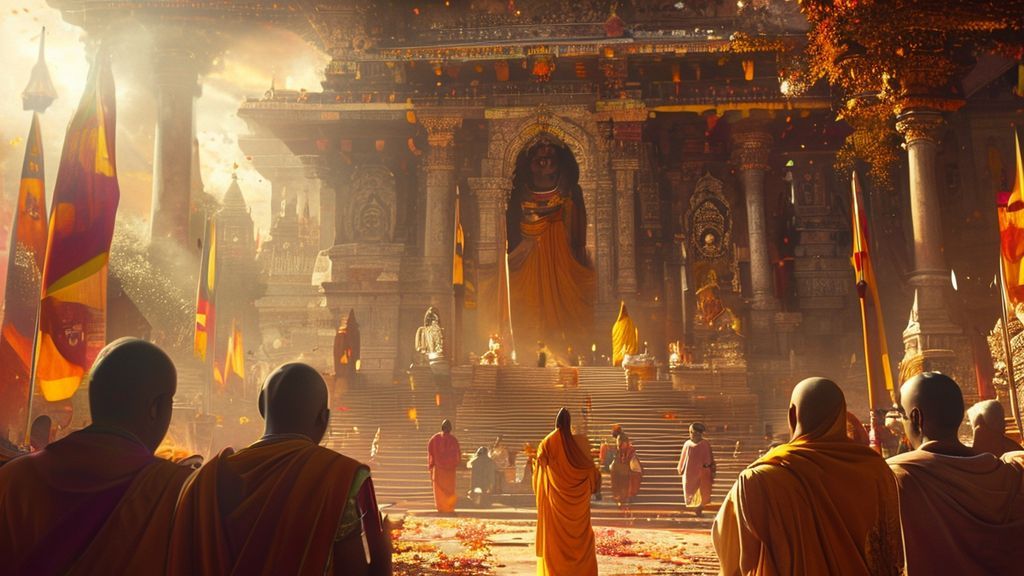
Sathya Sai Baba: Modern Avatar Controversy centers on the claims by devotees that he was a Purna Avatara of Shiva-Shakti and the skepticism from traditional Hindu scholars and rationalists regarding the authenticity of his miracles, teachings, and personal conduct, sparking extensive debate within contemporary Sanatana Dharma regarding the nature of divine manifestation.
| Attribute | Details |
|---|---|
| Claimed Manifestation | Purna Avatara (complete incarnation) of Shiva-Shakti, spiritual successor to Shirdi Sai Baba. |
| Location/Origin | Puttaparthi, Andhra Pradesh, India. Born (as Sathyanarayana Raju) in 1926. |
| Key Festival | Birthday (November 23rd), Mahashivaratri, Guru Purnima. |
| Scripture Reference (Avatara Concept) | Bhagavad Gita (Chapter 4, Verses 7-8), Srimad Bhagavatam (Dasavatara descriptions), various Puranas. |
Introduction: The Enigma of Modern Incarnations
Sanatana Dharma, the Eternal Way, has always acknowledged the periodic descent of the Divine into the human realm as an Avatara (अवतार). These sacred manifestations, from Sri Rama to Sri Krishna, serve to uphold Dharma, protect the virtuous, and annihilate evil, as eloquently stated in the Bhagavad Gita: “Yada yada hi dharmasya glanirbhavati Bharata, abhyutthanamadharmasya tadatmanam srijamyaham.” (Whenever righteousness declines and unrighteousness arises, I manifest Myself.) The modern era, characterized by unprecedented material progress alongside spiritual bewilderment, has witnessed the emergence of numerous spiritual leaders, some of whom have been revered by millions as divine incarnations. Among these, the figure of Sathya Sai Baba stands as a colossal yet controversial phenomenon, whose life and claims sparked both unwavering devotion and profound scrutiny, fundamentally challenging contemporary understanding of an Avatara.
His story began in the humble village of Puttaparthi, blossoming into a global spiritual movement. His followers unequivocally believed him to be a Purna Avatara, an embodiment of the divine without any residual trace of the original being in the spiritual realm, drawing parallels to Krishna. However, this claim, coupled with his famous materializations (leelas) and the later allegations against him, ignited a multifaceted debate that continues to shape discussions on faith, evidence, and the very definition of divinity in our times. This guide, drawing from scriptural tenets and dharmic principles, aims to navigate this complex landscape with reverence and intellectual rigor, offering a framework for understanding the Sathya Sai Baba: Modern Avatar Controversy.
Puranic Understanding of Avatara vs. Modern Claims
To properly contextualize the claims surrounding Sathya Sai Baba, it is imperative to first understand the traditional Puranic and Vedantic conception of an Avatara. The Srimad Bhagavatam and Vishnu Purana meticulously enumerate the twenty-two (or more) Avataras of Vishnu, describing their divine birth, extraordinary childhood, the specific cosmic purpose they fulfilled (dharma sansthapanarthaya), and their impeccable adherence to Dharma. An Avatara’s identity is typically revealed through universally acknowledged prophecies, unparalleled wisdom from childhood, inherent divine powers (siddhis) that serve a higher cosmic purpose rather than personal glorification, and absolute moral integrity.
Traditional scriptures emphasize that an Avatara’s actions are always aligned with the highest Dharma, serving as an exemplar for humanity. Their miracles (leelas) are not mere magic tricks but demonstrations of divine will, intended to uplift, teach, or protect. For instance, Sri Krishna’s lifting of Govardhan Hill was to protect the villagers and humble Indra; His display of the Vishwaroopa was to impart the highest spiritual truth to Arjuna. The Puranas detail the rigorous criteria for recognizing a divine being, often involving profound scriptural knowledge, detachment from worldly desires, and unwavering compassion for all beings.
The controversy surrounding Sathya Sai Baba largely stems from this juxtaposition. While his devotees cited his profound teachings, philanthropic works, and alleged materializations as evidence of his divinity, traditional scholars often questioned whether these phenomena truly aligned with the scriptural definition and conduct of a Purna Avatara. The emergence of spiritual leaders who claim Avatara status is not new in Kali Yuga, but the intense scrutiny, especially in the age of media and scientific inquiry, brought the Sathya Sai Baba: Modern Avatar Controversy to the forefront of inter-Dharmic discourse.
Architectural & Humanitarian Marvels: Prasanthi Nilayam
Beyond the spiritual claims, Sathya Sai Baba’s legacy includes an extraordinary range of humanitarian and architectural achievements. His main ashram, Prasanthi Nilayam (Abode of Supreme Peace), in Puttaparthi, is a testament to the devotion he inspired and the vision he propagated. The architectural style here is eclectic, drawing elements from traditional Indian temple architecture, yet adapted to accommodate large congregations for devotional singing (bhajans) and discourses (pravachanams). The central Mandir, with its distinctive dome and spacious prayer halls, stands as a beacon for devotees worldwide.
However, the scope of his organization extended far beyond a spiritual retreat. Under his guidance, the Sri Sathya Sai Central Trust established world-class educational institutions, from primary schools to universities, emphasizing character development and spiritual values alongside academic excellence. The Sri Sathya Sai Institute of Higher Medical Sciences, with its advanced hospitals offering free medical care to millions, irrespective of caste, creed, or financial status, represents a monumental humanitarian endeavor. These facilities, built with state-of-the-art technology and modern design principles, stand as scientific marvels, demonstrating a practical application of his teaching of ‘Seva’ (selfless service). These institutions underscore a powerful aspect of his mission: the practical embodiment of compassion and upliftment, which even critics acknowledge as significant contributions to society.
Rituals & Puja Vidhi in Sai Centres
While Sathya Sai Baba did not prescribe entirely new ritual systems, the practices within his centers and for his devotees typically combine elements of traditional Sanatana Dharma with a focus on devotional singing and selfless service. The core of worship revolves around Nama Smarana (remembrance of the Divine Name) and Bhajan (devotional singing).
A typical daily routine or puja vidhi in a Sathya Sai organization might include:
- Suprabhatam: Morning chanting to awaken the divine consciousness.
- Omkaram & Gayatri Mantra: Chanting of the primordial sound Om and the powerful Gayatri Mantra (ॐ भूर्भुवः स्वः तत् सवितुर्वरेण्यं भर्गो देवस्य धीमहि धियो यो नः प्रचोदयात्).
- Nagarasankirtana: Processional group singing of devotional songs, often early in the morning.
- Bhajans: Group singing of devotional songs praising various Hindu deities and Sathya Sai Baba himself. This is a central practice, often accompanied by musical instruments.
- Vedic Chanting: Recitation of selected Vedic hymns, particularly during special occasions.
- Arati: Waving of lamps before the image or altar, symbolizing the offering of light to the Divine.
- Satsang/Discourse: Listening to spiritual talks, often based on Sathya Sai Baba’s teachings or excerpts from scriptures.
- Seva (Selfless Service): Engaging in humanitarian activities, which he emphasized as the highest form of worship.
Devotees often maintain a personal altar with Sai Baba’s image, offering flowers, incense, and performing personal prayers, meditating on his form and teachings. The emphasis is less on elaborate scriptural rituals and more on heart-felt devotion, moral conduct, and service to humanity.
Mantras & Chants for Devotion and Discernment
For those drawn to Sathya Sai Baba’s path, or for any seeker discerning divine truth, chanting plays a vital role in purification and connection. Common mantras include universal chants and those specific to Sai Baba:
- Om Sri Sai Ram: A widely used chant by his devotees.
- Gayatri Mantra: (ॐ भूर्भुवः स्वः तत् सवितुर्वरेण्यं भर्गो देवस्य धीमहि धियो यो नः प्रचोदयात्) – Considered a universal prayer for enlightenment, frequently chanted in Sai centers.
- Sarva Dharma Bhajans: Songs that invoke and celebrate deities from various religions, reflecting his teaching of the unity of faiths.
- Pranama Mantra (for a Guru/Avatar): While specific mantras exist for Sai Baba, a general reverence for a spiritual master often includes: Gururbrahma Gururvishnu Gururdevo Maheshwaraha | Guruh Saakshaat Parabrahma Tasmai Shri Guruve Namaha || (The Guru is Brahma, the Guru is Vishnu, the Guru is Shiva. The Guru is verily the Supreme Brahman. Salutations to that revered Guru.)
For those navigating the complexities of modern Avatara claims, reflection on core Vedantic verses can be beneficial:
- From Bhagavad Gita (Chapter 2, Verse 69): “Ya nisha sarvabhutaanaam tasyaam jaagarti samyami; yasyaam jaagrati bhutaani saa nishaa pashyato muneh.” (What is night for all beings is the time of waking for the self-controlled; and what is the time of waking for all beings is night for the introspective sage.) This verse reminds us that spiritual truth is often perceived differently from worldly reality, requiring discernment.
Dos and Don’ts for Spiritual Seekers and Ashram Visitors
Visiting any spiritual institution, especially one as prominent as Prasanthi Nilayam, requires adherence to certain cultural and spiritual etiquettes. These guidelines ensure a respectful and conducive environment for all seekers.
- Do dress modestly: Wear conservative clothing that covers shoulders and knees. This applies to both men and women.
- Do maintain silence: Especially in prayer halls, meditation areas, and during discourses. Engage in spiritual reflection.
- Do respect local customs: Remove footwear before entering temples or specific ashram buildings.
- Do participate respectfully: Join bhajans and prayers with an open heart, but do not disrupt others.
- Do offer Seva: If possible, participate in selfless service activities, which is highly encouraged.
- Don’t engage in loud conversations: Keep noise to a minimum, particularly in sacred spaces.
- Don’t photograph or film without permission: Especially during active rituals or darshan.
- Don’t bring outside food or drinks: Many ashrams have their own communal kitchens or dining facilities.
- Don’t beg or give alms directly: Ashrams usually have systems in place for charity to maintain order.
- Don’t question or debate during official sessions: Save questions for designated Q&A sessions or personal reflection. Respect the sanctity of the moment.
Such decorum reflects the foundational principle of Shraddha (faith and reverence), essential for any spiritual journey, as emphasized on Hindutva.online.
Frequently Asked Questions on Sathya Sai Baba
What does ‘Purna Avatara’ mean in Sanatana Dharma?
A Purna Avatara (पूर्ण अवतार) denotes a complete incarnation of the Divine, where the Lord descends with all His attributes and powers, without any part of His essence remaining in the spiritual realm. Unlike Amsa Avataras (partial incarnations), a Purna Avatara is believed to embody the totality of the divine consciousness and power, as exemplified by Lord Krishna, who is considered a Purna Avatara of Vishnu in the Srimad Bhagavatam.
What were the main controversies surrounding Sathya Sai Baba?
The main controversies surrounding Sathya Sai Baba included: 1) The authenticity of his materialization leelas (miracles), with critics often accusing them of being conjuring tricks. 2) Allegations of sexual abuse and misconduct, which were strongly denied by his organization but led to significant public and media scrutiny. 3) The debate over his claims of divinity and Avatara status, with traditional Hindu scholars questioning the scriptural basis and the conduct associated with such claims.
How does Sanatana Dharma typically identify a true Avatara?
Sanatana Dharma identifies a true Avatara based on several criteria: 1) Birth in a divine lineage or with auspicious signs. 2) Unparalleled knowledge of Vedas and spiritual truths from an early age. 3) Actions that uphold Dharma and demonstrate supreme compassion and selflessness. 4) Miracles or leelas that serve a cosmic purpose and are not performed for personal gain or exhibition. 5) Absolute adherence to moral and ethical conduct (dharma-acharan) that sets an example for humanity. The Bhagavad Gita and various Puranas provide detailed characteristics. Ultimately, the discernment often rests upon spiritual realization and collective recognition over time.
Dharmic Significance: Faith, Scrutiny, and the Enduring Quest for Truth
The phenomenon of Sathya Sai Baba: Modern Avatar Controversy holds profound Dharmic significance, compelling every sincere seeker to reflect on the nature of faith, the role of miracles, and the timeless process of spiritual discernment. In an age where information proliferates and skepticism vies with fervent belief, such discussions serve not to diminish devotion but to refine it, guiding devotees towards a deeper, more informed understanding of Sanatana Dharma. The teachings of ancient Rishis consistently remind us that true divinity is reflected not just in extraordinary powers, but in absolute purity of character, unwavering commitment to Dharma, and boundless love for all creation. While millions found solace and spiritual upliftment in Sathya Sai Baba’s presence and teachings, the controversies underscore the importance of intellectual honesty and ethical integrity in the spiritual path.
Ultimately, the divine manifests in myriad forms and at various levels. Whether one perceives Sathya Sai Baba as a Purna Avatara, a great spiritual teacher, or a controversial figure, his life and mission have undeniably impacted global spiritual discourse. The enduring lesson from this complex narrative is the call for individuals to cultivate inner wisdom (viveka) and spiritual discernment (vichara), to test all claims against the bedrock of scriptural truth and the highest principles of Dharma. This rigorous yet devotional approach ensures that Sanatana Dharma continues to be a living, evolving tradition, capable of embracing genuine spiritual awakenings while upholding its eternal values, a principle consistently echoed in the resources found on Hindutva.online.