


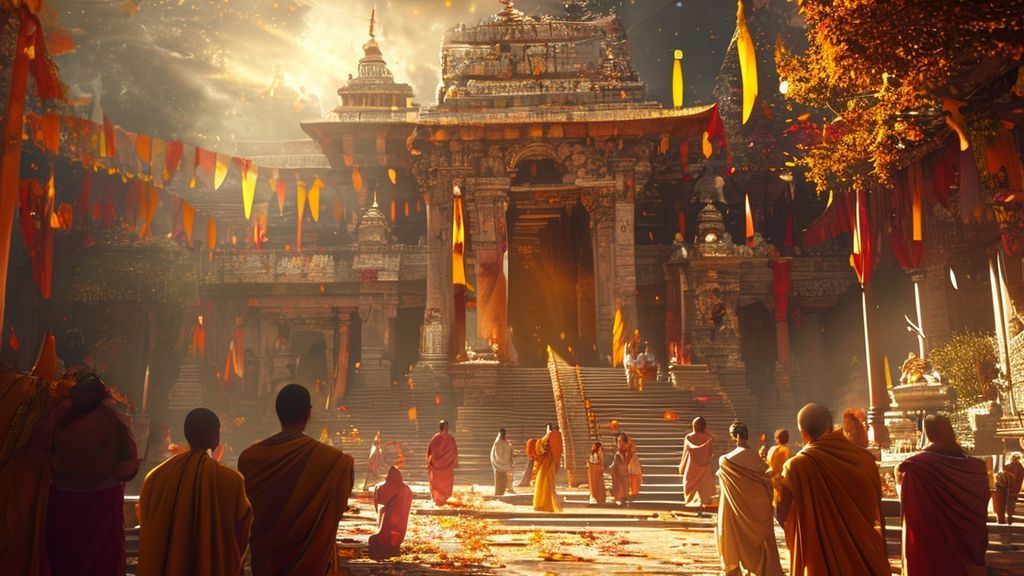
Sattriya is a profound classical dance-drama form originating from the monastic tradition of Assam, India, established by the great Vaishnava saint and reformer Srimanta Sankardeva in the 15th century. It embodies a rich spiritual legacy, serving as a powerful medium for propagating the Eka Sarana Nama Dharma, devoted to Lord Vishnu, particularly in His form as Krishna, through its intricate movements, devotional music, and dramatic narratives.
| Attribute | Details |
|---|---|
| Origin | Assam, India (15th Century CE) |
| Founder | Mahapurusha Srimanta Sankardeva (1449-1568 CE) |
| Key Texts/Inspiration | Bhagavata Purana, Kirtan Ghosha, Dasama Skandha, Ankiya Nat |
| Primary Deity | Lord Vishnu (especially Krishna/Rama) |
| Traditional Setting | Sattras (Vaishnava monasteries) and Namghars (prayer houses) |
| Key Musical Forms | Borgeet (devotional songs), Ankiya Geet |
| Recognition | Classical Dance status by Sangeet Natak Akademi (2000 CE) |
The Spiritual Essence of Sattriya: A Living Tradition of Bhakti
The venerable art form of Sattriya Nritya, pronounced “Shot-tree-ya Nrit-tya,” is far more than mere performance; it is a profound spiritual discipline, a vibrant expression of Sanatan Dharma, and a direct conduit to the divine. Born from the crucible of the 15th-century Bhakti movement in Assam, it stands as a testament to the transformative power of devotion, meticulously crafted by the polymathic saint Srimanta Sankardeva. This dance embodies the very philosophy of Eka Sarana Nama Dharma, which advocates for devotion to one God, Vishnu, primarily through the chanting of His holy names. Each gesture, every step, and all musical notes in Sattriya are imbued with devotional fervor, aiming to transport both performer and audience into a state of spiritual communion with the Supreme Lord.
The traditional home of Sattriya is the Sattra, the Vaishnava monastery unique to Assam, where the dance was preserved, refined, and practiced exclusively by male celibate monks (Bhokots) for centuries. These Sattras served not just as spiritual centers but as epicenters of culture, learning, and artistic endeavor, ensuring the continuity of this sacred tradition. The dance form is a holistic art, integrating elements of dance, drama (Bhaona), music (Borgeet), and lyrical poetry, all geared towards the singular goal of divine glorification.
The Puranic Narrative and Historical Genesis of Sattriya
While Sattriya as a codified classical form emerged in the 15th century, its philosophical underpinnings are deeply rooted in ancient Vedic and Puranic traditions, especially the Bhagavata Purana. Srimanta Sankardeva, a towering figure of spiritual and cultural renaissance, drew inspiration directly from the Bhagavatam to propagate the Vaishnava faith in Assam. He meticulously created the Ankiya Nat, a one-act play often performed as Bhaona, to make complex Puranic narratives accessible to the common populace. These plays were primarily based on the life and exploits of Lord Krishna, drawing extensively from the tenth canto (Dasama Skandha) of the Bhagavata Purana.
Sankardeva’s genius lay in his ability to synthesize diverse indigenous performing arts, existing dramatic traditions, and classical Indian dance principles into a coherent, devotional system. He codified the movement vocabulary, the musical structure, and the dramatic presentation, ensuring that every component served the ultimate purpose of conveying Vaishnava philosophy. For instance, the concept of the Dashavatara, the ten incarnations of Vishnu, is a recurring theme, beautifully articulated through specific dance sequences. The stories of Prahlada, Harishchandra, and the countless Lilas of Krishna find vivid expression, making abstract spiritual truths tangible and relatable. The dance was initially a part of the daily rituals and festive celebrations within the Sattras, a sacred offering to the presiding deity, typically a murti of Krishna or Vishnu.
Sattra Architecture and the Art’s Scientific Precision
The unique architectural design of the Assamese Sattra played a pivotal role in the evolution and preservation of Sattriya. At the heart of every Sattra is the Namghar (prayer hall), characterized by its expansive open space and a central altar, the Monikut, where the holy scriptures (like the Bhagavat Purana) are enshrined. The Namghar is specifically designed for congregational prayers, discussions, and the performance of Bhaona and Sattriya Nritya, allowing for unobstructed viewing by devotees seated around the performance area.
The very structure of Sattriya is a marvel of artistic and scientific precision, echoing the meticulousness found in classical Indian arts. It adheres to the fundamental tenets of Natya Shastra, integrating Nritta (pure dance), Nritya (expressive dance), and Natya (drama). The movements are characterized by grace, fluidity, and dynamic vigor, encompassing masculine (Paurashiki) and feminine (Stree) styles. The *mudras* (hand gestures), derived from classical texts, are precise and extensive, used to convey specific meanings and narratives. The footwork (*pada-karma*) is intricate, executed with rhythmic clarity, often accompanied by the resonance of the *khol* (percussion drum) and *taal* (cymbals). This synthesis of sound, movement, and emotion is scientifically structured to evoke bhava (emotion) and lead to rasa (aesthetic delight and spiritual realization) in the devotee.
Rituals and Puja Vidhi in Sattriya Performance
A Sattriya performance, especially within the Sattra tradition, is considered a sacred ritual. It typically commences with the Gayan-Bayan, an orchestral prelude featuring male dancers playing the *khol* and *taal* in various rhythmic cycles, setting a devotional ambiance. This is followed by the core dance item. Traditionally, performances were part of larger *Bhaonas* (dramatic presentations). The entire process is a form of Nama-kirtan, the chanting of the Lord’s names through art.
The steps of a traditional Sattriya presentation often follow a structured progression:
- Guru Vandana: An invocation to the Guru (Srimanta Sankardeva) and the Divine, seeking blessings.
- Ramdani: Pure dance sequences (nritta) that establish the basic movements and rhythmic patterns.
- Geet-Nritya: Expressive dance (nritya) set to Borgeets, conveying the lyrical meaning through mudras and abhinaya.
- Varnana: Narrative sections, often depicting episodes from the Puranas or Sankardeva’s compositions.
- Abhinaya: Expressive facial movements and body language to portray emotions (bhava) related to the devotional theme.
- Oja-Pali: While Oja-pali is a distinct traditional Assamese folk performance, its narrative and musical elements often influenced the development of Sattriya’s dramatic aspects, with a leader (Oja) and followers (Pali) narrating stories through song and gesture.
The entire performance is considered a spiritual offering, fostering an environment of devotion and introspection.
Mantras and Chants in Sattriya
The heart of Sattriya’s spiritual power lies in its accompanying music and chants, primarily the Borgeets (great songs) composed by Srimanta Sankardeva and his chief disciple Madhavdeva. These are not merely songs but profound poetic compositions, embodying deep Vaishnava philosophy. A common refrain, echoing the core tenet of Eka Sarana Nama Dharma, is often heard:
श्री राम जय राम जय जय राम (Shri Rama Jaya Rama Jaya Jaya Rama) – While Sankardeva emphasized Krishna, Rama’s name also finds its place as another form of Vishnu.
More specifically, the Borgeets invoke various aspects of Krishna’s life, virtues, and divine pastimes. For instance, a typical Borgeet might begin with an invocation:
पाहि माम् पाहि माम् मुरारी, दयामय जन हितकारी (Pahi mam pahi mam Murari, dayamay jana hitakari)
Meaning: “Protect me, protect me, O Murari (Krishna), benevolent one, benefactor of humanity.”
These lyrical verses, sung to specific ragas and talas, form the emotional and narrative backbone of the dance, guiding the dancer’s *abhinaya* and the audience’s meditative focus.
Dos and Don’ts for Experiencing Sattriya
- DO dress modestly and respectfully, especially when visiting a Sattra or Namghar.
- DO maintain silence and reverence during performances, treating it as a sacred event.
- DO remove your footwear before entering the Namghar or performance area, a traditional mark of respect.
- DO observe the intricate hand gestures (*mudras*) and facial expressions (*abhinaya*) to grasp the narrative.
- DON’T interrupt the performance with applause or talk loudly.
- DON’T use flash photography during the performance, as it can be distracting.
- DON’T consume non-vegetarian food or alcohol before entering a Sattra.
- DON’T turn your back to the Monikut or the altar where scriptures are placed.
What is the primary spiritual goal of Sattriya?
The primary spiritual goal of Sattriya is to propagate and embody the tenets of Eka Sarana Nama Dharma, a monotheistic Vaishnava tradition. Through its devotional dance-drama, it aims to foster Bhakti (devotion) towards Lord Vishnu (especially Krishna), facilitating spiritual awakening and a connection with the divine for both performers and the audience.
How does Sattriya differ from other classical Indian dance forms?
While sharing common roots in Natya Shastra, Sattriya is uniquely distinguished by its strong monastic tradition, its direct lineage to Srimanta Sankardeva’s Vaishnava movement, and its exclusive focus on Vaishnava narratives. Its music, particularly the Borgeets, and its specific rhythmic patterns (maatras) and costume elements (like the pag turbans for male dancers) are distinct to Assam’s cultural landscape, differentiating it from forms like Bharatanatyam or Kathak.
Can women perform Sattriya?
Historically, Sattriya was performed exclusively by male monks (Bhokots) within the Sattras. However, in the modern era, particularly after its recognition as a classical dance form in 2000, women have increasingly taken up Sattriya, developing and popularizing the feminine (Stree Paksha) style, while still preserving its spiritual essence and classical rigor. Both male and female artists now contribute significantly to its growth and propagation.
The Dharmic Significance: Preserving Sanatan Dharma through Sattriya
Sattriya stands as a living testament to the enduring power and adaptability of Sanatan Dharma. It is not merely an aesthetic marvel but a profound spiritual vehicle that has, for over five centuries, preserved and transmitted the timeless wisdom of the Puranas and the Bhakti tradition. Through its devotional narratives, intricate movements, and soul-stirring music, Sattriya brings the divine stories of Krishna and Vishnu to life, inspiring devotion and ethical conduct.
In an age increasingly detached from spiritual roots, Sattriya serves as a powerful reminder of the importance of art as a medium for spiritual growth and cultural preservation. It teaches discipline, surrender, and the joy of divine love. The rigorous training, the adherence to tradition, and the emphasis on devotion over mere spectacle ensure that Sattriya continues to be a vibrant conduit for transmitting the profound philosophical and spiritual truths of Hinduism, securing its place as an invaluable legacy of Bharatvarsha.