

The Satyanarayan Vrat Katha represents one of Hinduism’s most beloved devotional narratives – a sacred story recited during worship of Lord Satyanarayan (benevolent form of Lord Vishnu embodying absolute truth and righteousness) that teaches profound spiritual lessons through five sequential chapters chronicling how different devotees’ faith, gratitude, and truthfulness brought divine blessings while negligence, doubt, and broken promises led to immediate suffering until proper devotion restored harmony, creating powerful testament to [translate:Satya] (truth) as fundamental cosmic principle governing prosperity, happiness, and ultimate liberation.

Unlike complex philosophical treatises requiring scholarly interpretation, Satyanarayan Katha’s accessible narratives make profound spiritual truths comprehensible to everyone regardless of education or social status – simple woodcutter achieving wealth through sincere devotion, wealthy merchant losing everything through forgetting gratitude then recovering through renewed worship, king’s daughter suffering separation from husband due to father’s disrespect toward ritual yet reuniting through proper puja performance, creating democratic spiritual framework where divine grace flows freely to all who maintain truthfulness, faith, and proper acknowledgment of blessings’ true source rather than egoistic attribution to personal cleverness or luck.
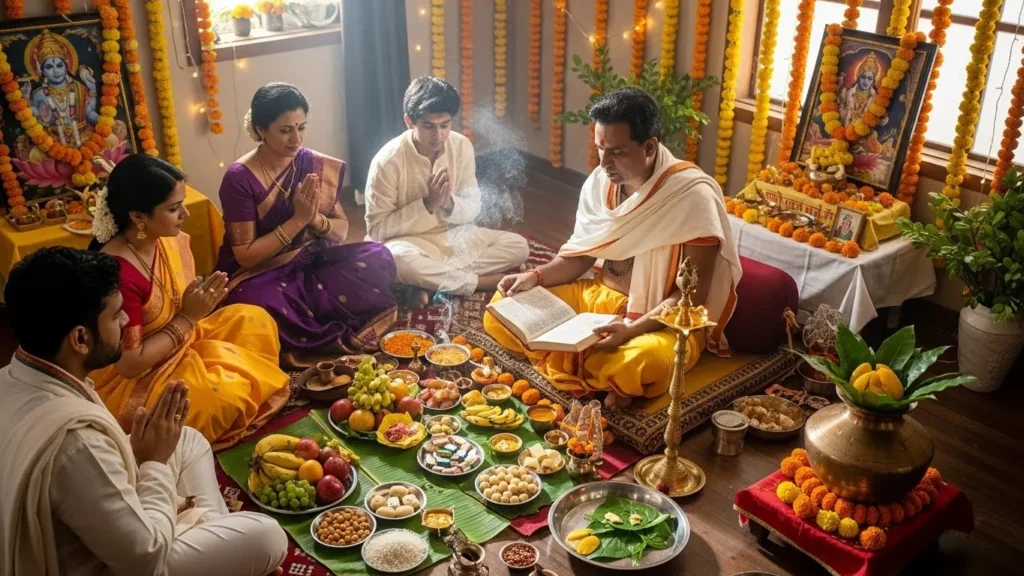
The complete Satyanarayan puja ceremony traditionally performed on auspicious occasions like Purnima (full moon), Ekadashi (11th lunar day), after wish fulfillment, during major life transitions (new home, marriage, childbirth, business opening), or simply as regular monthly practice for ongoing protection and prosperity, follows systematic procedure from preliminary Ganesh puja removing obstacles through kalash installation invoking divine presence to main worship with sixteen traditional offerings (flowers, incense, fruits, sweets, sacred water) culminating in katha recitation where family.
gathers around altar listening with rapt attention as priest or family member reads all five chapters spanning Narada’s initial inquiry about this powerful vrat, poor Brahmin’s transformation through devotion, wealthy merchant Sadhu’s downfall and redemption, King Ulkamukha’s trials teaching humility, and final story demonstrating equal divine grace for all regardless of social status, concluded by distribution of prasad (blessed sweet wheat preparation) that participants must consume before leaving ensuring blessings internalized rather than neglected.
For families in 2025, whether observing this cherished tradition inherited from grandparents or discovering it newly through spiritual seeking, understanding complete framework proves essential – recognizing five core spiritual principles embedded in sequential chapters (devotion/Sadbhakti, good company/Satsang, promise-keeping/Satya Graha, true austerity/Satya Tapas, universal equality/Satya Atma), gathering complete samagri list including specific items like banana leaves, special prasad ingredients, katha booklet, performing ceremony with proper
consciousness recognizing ritual’s deeper meaning beyond mechanical recitation, and maintaining ongoing practice since benefits manifest not through single perfunctory performance but sustained relationship with Satyanarayan’s truth-upholding divine grace transforming consciousness from ego-driven grasping toward grateful recognition that all prosperity flows from divine source requiring humble acknowledgment and righteous living rather than cleverness or manipulation.
Understanding Lord Satyanarayan and His Significance
Before diving into the katha itself, grasping who Satyanarayan is and why worship proves so powerful reveals profound theological wisdom underlying this beloved practice.
Lord Satyanarayan: The Truthful One
Lord Satyanarayan represents a specific form or manifestation of Lord Vishnu, the preserver deity in Hindu trinity.
The Name’s Meaning:
[translate:सत्य + नारायण = Satya + Narayana]
- Satya = Truth, Reality, Absolute principle
- Narayana = Vishnu, the all-pervading supreme being
- Combined: “The Lord who is Truth itself” or “The Divine embodying absolute reality”
Not Separate Deity:
Important clarification: Satyanarayan isn’t different god from Vishnu but rather Vishnu in his aspect as protector of truth and righteous living. Like Vishnu has ten avatars (Rama, Krishna, etc.) for different purposes, Satyanarayan represents Vishnu’s truth-upholding manifestation accessible to common householders.
Why This Form is Special:
Democratic Accessibility:
Unlike elaborate Vishnu worship requiring extensive rituals, priest, and temple visits, Satyanarayan puja can be performed at home by anyone – no caste restrictions, no mandatory priest, simple procedure making divine grace accessible to all.
Household Focus:
Satyanarayan specifically protects families and households, making this ideal domestic deity for:
- Harmonious family relationships
- Prosperity and financial security
- Health and wellbeing
- Children’s welfare and education
- Protection from negative forces
Immediate Responsiveness:
Traditional belief holds Satyanarayan responds quickly to sincere devotion – stories in katha consistently show rapid divine intervention when devotees remember and worship properly.
Forgiveness and Compassion:
Even when devotees forget or disrespect, Satyanarayan doesn’t permanently punish but creates circumstances prompting remembrance, then immediately restores blessings upon proper worship resumption.
The Iconography:
When depicted visually, Satyanarayan shown as:
- Four-armed Vishnu form
- Yellow/Golden complexion (some depictions)
- Holding conch, discus, lotus, mace (standard Vishnu symbols)
- Sometimes shown seated on throne receiving worship
- Benevolent, smiling countenance (emphasizing merciful nature)
Often Worshipped Alongside:
- Lakshmi (consort, wealth goddess)
- Ganesha (obstacle remover – worshipped first)
- Sometimes Saraswati (knowledge goddess)
Philosophical Significance:
Truth as Foundation:
Hindu philosophy recognizes Satya (truth) as one of highest virtues:
In Yamas (Ethical Restraints):
[translate:सत्यम्] (Satya) appears as second yama in Patanjali’s Yoga Sutras – truthfulness in thought, word, and deed.
In Vedantic Philosophy:
[translate:सत्यम् ज्ञानम् अनन्तम् ब्रह्म]
“Brahman (ultimate reality) is Truth, Knowledge, Infinite”
In Mundaka Upanishad:
[translate:सत्यमेव जयते नानृतम्]
“Truth alone triumphs, not falsehood” – India’s national motto!
Satyanarayan Embodies This:
As personification of truth-principle, worshipping Satyanarayan means:
- Aligning oneself with fundamental cosmic law
- Seeking divine support for truthful living
- Recognizing that prosperity rooted in truth proves sustainable while deception ultimately fails
Universal Appeal:
Why Millions Observe:
Satyanarayan vrat transcends regional, linguistic, sectarian boundaries:
Geographic Spread:
- North India: Popular across Hindi belt
- South India: Extremely widespread (called Satyanarayana Vratham)
- East India: Common in Bengal, Odisha
- West India: Regular practice in Gujarat, Maharashtra
- Diaspora: Maintained by Hindu communities globally
Cross-Community:
- All castes observe (no restrictions)
- Both traditional and modern families
- Urban and rural practitioners
- Rich and poor alike
Occasion Flexibility:
Performed for:
- Gratitude: After wish fulfillment (job, marriage, childbirth, exam success)
- Petition: When seeking specific blessings
- Regular practice: Monthly on Purnima
- Life transitions: New home, business opening, starting ventures
- Crisis: During difficulties seeking divine intervention
The Central Promise:
Lord Satyanarayan promises devotees:
- Prosperity – both material and spiritual
- Protection – from obstacles, enemies, negative forces
- Health – physical, mental, familial wellbeing
- Happiness – contentment, harmonious relationships
- Liberation – ultimately, spiritual progress toward moksha
Conditions:
- Sincere devotion and faith
- Truthful living
- Gratitude and acknowledgment of blessings
- Sharing prasad and story with others
- Regular practice, not one-time perfunctory performance
This simple yet profound framework explains why Satyanarayan worship remains one of Hinduism’s most widely observed domestic rituals generation after generation.
The Five Chapters: Complete Satyanarayan Vrat Katha
The sacred narrative consists of five distinct chapters (adhyayas), each teaching specific spiritual principle through engaging storytelling.
Symbolic Structure:
Before exploring each chapter, note the beautiful symbolism:
The five chapters resemble five fingers of hand with palm representing Brahman (Eternal Truth):
- Thumb (shortest): Chapter 1 – Foundation
- Index finger (longer): Chapter 2 – Guidance
- Middle finger (longest): Chapter 3 – Central teaching
- Ring finger (long): Chapter 4 – Commitment
- Little finger (short): Chapter 5 – Conclusion
Each chapter progressively teaches:
- Sadbhakti – True devotion
- Satsang – Good company/guidance
- Satya Graha – Holding to truth/promises
- Satya Tapas – True austerity/humility
- Satya Atma – Universal soul/equality
Chapter 1: Sage Narada’s Inquiry (The Shortest Story)
Setting: Celestial realm (Devaloka)
Characters: Sage Narada (divine traveler and devotee), Lord Narayana (Vishnu)
The Story:
Sage Narada, traveling through different worlds and witnessing human suffering, approaches Lord Narayana with compassionate inquiry:
Narada: “O Lord, I see countless beings suffering from poverty, disease, sorrow, and obstacles. Is there a simple way for ordinary people to overcome these difficulties and attain prosperity, happiness, and ultimately liberation?”
Lord Narayana’s Response:
“Dear Narada, there exists a powerful yet accessible vrat (vow/observance) that common householders can easily perform. Worship me in my Satyanarayan form – the embodiment of truth. This puja requires minimal resources, no elaborate ceremonies, and brings immediate and long-lasting benefits.”
The Instructions:
Lord Narayana provides Narada with complete procedure:
- Perform puja on auspicious days (Purnima, Ekadashi, or any day with devotion)
- Make simple offerings (fruits, flowers, incense, sweets)
- Prepare special prasad from wheat flour, jaggery/sugar, ghee, and bananas
- Most importantly: Recite or listen to the five stories (katha) with faith
- Share prasad with all present before anyone leaves
The Promise:
“Whoever performs this vrat with sincere faith, maintains truthfulness, and shares the katha will receive:
- Relief from sorrows
- Prosperity and wealth
- Healthy progeny
- Family harmony
- Protection from enemies and obstacles
- Ultimately, moksha (liberation)”
Lesson – Sadbhakti (True Devotion):
The first chapter establishes foundation: Simple, sincere devotion to truth-embodying divine proves accessible to everyone regardless of learning, wealth, or social status. Divine grace isn’t reserved for scholarly Brahmins or wealthy patrons but flows freely to all with faithful hearts.
Chapter 2: The Poor Brahmin’s Transformation (Longer Story)
Setting: Ancient India, a village
Characters: Poor elderly Brahmin, Satyanarayan (disguised as old sage)
The Story:
Part 1: The Suffering Brahmin
An old, poor Brahmin barely survives by begging for food daily. Despite knowledge of scriptures and pious nature, he lives in extreme poverty, barely feeding himself and his wife. Daily he wanders village begging, receiving minimal alms, returning home exhausted and despondent.
Part 2: Divine Encounter
One day, while begging, he encounters an old sage (Satyanarayan in disguise) who asks:
Sage: “O Brahmin, you appear distressed and impoverished. What is the cause of your suffering?”
Brahmin: (with tears) “I am old, poor, and despite daily begging, barely survive. I have no means to improve my condition. My wife and I suffer constantly from hunger and hardship.”
Sage: “Do not despair. I will teach you a simple remedy. Observe Satyanarayan vrat with devotion. Perform the puja, listen to the katha, prepare and distribute prasad. Your suffering will end, and prosperity will come.”
The sage then provides complete instructions and disappears.
Part 3: First Observance and Transformation
Though poor, the Brahmin gathers whatever meager resources possible:
- Borrows items for puja
- Prepares simple prasad with borrowed ingredients
- Performs puja with utmost faith and devotion
- Shares prasad with neighbors and family
- Listens to katha with rapt attention
The Immediate Result:
Very next day, the Brahmin finds precious gems while walking. A wealthy merchant, impressed by his honesty when he returns found items, rewards him generously. His circumstances completely transform:
- Becomes prosperous
- Builds nice house
- No longer suffers poverty
- Lives happily with wife
Part 4: The Crucial Commitment
Grateful for transformation, the Brahmin vows: “I will perform Satyanarayan puja regularly every month on Purnima as long as I live.”
He faithfully maintains this practice, and his prosperity continues growing.
Lesson – Satsang (Good Company/Guidance):
The second chapter teaches that seeking and following guidance from wise beings (satsang) proves essential for spiritual progress. The Brahmin’s transformation came not from his own knowledge but from humbly accepting and implementing sage’s advice. Good company (sat = truth, sang = company) points us toward truth.
Chapter 3: The Wealthy Merchant Sadhu and King Ulkamukha (Longest Story)
Setting: Ancient kingdom
Main Characters: Sadhu (wealthy merchant), King Ulkamukha, Kalavati (Sadhu’s daughter), various townspeople
The Story – Part 1: Sadhu’s Prosperity Through Devotion
Sadhu, a prosperous merchant in the city of Ratnapur, regularly performs Satyanarayan puja with great devotion. His wealth, success in trade, and happiness directly result from this faithful practice.
He has beautiful daughter Kalavati whom he plans to marry appropriately.
Part 2: The Fateful Journey
Sadhu undertakes business journey to another city. His wife and daughter continue Satyanarayan puja in his absence, praying for his safe return.
Meanwhile: King Ulkamukha’s Parallel Story
King Ulkamukha, righteous but currently childless ruler, also devotedly observes Satyanarayan vrat seeking progeny. Through divine grace, his queen becomes pregnant with daughter.
Part 3: The Critical Mistake – Negligence
Sadhu’s Error:
On return journey, while passing through kingdom, Sadhu’s caravan stops near river where he sees King Ulkamukha performing grand Satyanarayan puja with elaborate arrangements.
King’s minister approaches Sadhu’s impressive caravan: “What goods do you carry, merchant?”
Sadhu, arrogant in his temporary success and wanting to avoid tax/inspection, lies: “Just dry leaves and grass, nothing valuable.”
Minister reports to king. King, having divine vision during puja, knows the lie but says nothing.
Immediate Divine Response:
Satyanarayan, witnessing the lie and disrespect (Sadhu neither stopped to pay respects to puja nor truthfully declared goods), instantly transforms Sadhu’s actual merchandise into dry leaves and grass!
When Sadhu opens his cargo after departing, discovering the transformation, he’s shocked and devastated. All his wealth – gone!
Part 4: Meanwhile – Family’s Suffering
Simultaneously, back home:
Sadhu’s wife and daughter, mid-puja, hear false rumor: “Sadhu drowned in river; his boat capsized!”
Kalavati’s Reaction:
Devastated by grief, she rushes from house abandoning puja mid-ceremony, prasad un-taken, katha unfinished – grave disrespect to Satyanarayan.
Immediate Consequence:
The boat carrying Kalavati’s fiancé (whom she was to marry) actually capsizes! He barely survives but loses all possessions and gets arrested on false theft charges in distant land.
Part 5: Realization and Redemption
Sadhu, now destitute, realizes his mistakes:
- Lying during sacred puja
- Showing disrespect to king’s worship
- Forgetting humility
- Attributing success to own cleverness rather than divine grace
He performs sincere penance:
- Fasts several days
- Prays with genuine repentance
- Promises never to forget Satyanarayan’s grace again
- Vows regular worship with truthfulness
Divine Forgiveness:
Satyanarayan, pleased with genuine repentance, restores everything:
- Dry leaves become precious goods again
- Sadhu returns home wealthy
- False rumors about drowning proven wrong
Part 6: Kalavati’s Redemption
When Sadhu returns, he learns of daughter’s abandoned puja. Family performs complete Satyanarayan puja properly:
- With full devotion
- Complete katha
- Proper prasad distribution
- Sincere prayers for son-in-law’s safety
Result:
The imprisoned son-in-law:
- Proven innocent miraculously
- Released from jail
- Finds Sadhu’s lost goods (which had been stolen from him)
- Returns home safely
Reunion and Continued Devotion:
Kalavati marries her fiancé as planned. Both families continue regular Satyanarayan worship with:
- Gratitude
- Humility
- Truthfulness
- Never forgetting divine grace
Lesson – Satya Graha (Holding to Truth/Promises):
The longest chapter teaches most critical lesson: Keeping one’s word, maintaining truthfulness, and honoring commitments proves essential. The moment Sadhu lied and Kalavati abandoned puja, suffering came instantly. Restoration came equally quickly upon sincere repentance and proper observance. Truth isn’t negotiable convenience but cosmic law.
Chapter 4: The King’s Lesson in Humility (Long Story)
Setting: King Ulkamukha’s kingdom (continuing from Chapter 3)
Characters: King Ulkamukha, Queen, their daughter Chandrakala
The Story – Part 1: Blessed with Daughter
Through Satyanarayan’s grace, King Ulkamukha’s queen bears beautiful daughter Chandrakala. Grateful king performs grand thanksgiving puja.
He vows: “I will perform Satyanarayan puja every year on this date with great devotion.”
Daughter grows into beautiful, virtuous young woman.
Part 2: The Marriage
King arranges Chandrakala’s marriage to suitable prince from neighboring kingdom. Grand wedding celebrations planned.
Part 3: The Critical Error – Arrogance
On wedding day morning, king scheduled to perform his annual Satyanarayan puja as vowed. However:
The Mistake:
Overwhelmed by wedding preparations, caught up in royal pomp, and filled with pride about alliances and celebrations, king postpones puja: “Too busy today with wedding. I’ll do puja tomorrow.”
He considers wedding more important than divine worship that blessed him with daughter in first place!
Immediate Consequence:
During wedding ceremony itself, bridegroom suddenly disappears! Mid-ritual, prince vanishes without trace.
Chaos ensues:
- Wedding halted
- Guests confused
- King devastated
- Chandrakala grief-stricken
- Kingdom in turmoil
Part 4: Search and Suffering
King sends soldiers everywhere searching for missing prince – no trace found.
Chandrakala refuses food, weeps constantly, blames herself though innocent.
Days pass with no resolution.
Part 5: Divine Intervention
Wise minister approaches troubled king: “Your Majesty, recall – you postponed Satyanarayan puja vowed for today. Could this be divine displeasure at broken promise?”
King realizes: “Oh! In my arrogance and preoccupation, I forgot the very deity who blessed me with my daughter! I prioritized worldly celebration over sacred obligation!”
Part 6: Repentance and Redemption
King immediately:
- Performs elaborate Satyanarayan puja with utmost devotion
- Confesses his error humbly
- Completes full katha
- Distributes prasad
- Prays for prince’s return
Divine Forgiveness:
Satyanarayan, pleased with sincere repentance and understanding of error, restores bridegroom:
- Prince reappears exactly where he disappeared
- No memory of where he went (divine mystery)
- Wedding completed successfully
- Kingdom rejoices
Part 7: Continued Devotion
King learns profound humility:
- Never again postpones puja
- Maintains regular worship regardless of worldly affairs
- Teaches subjects about Satyanarayan’s power
- Lives righteously acknowledging divine grace
Lesson – Satya Tapas (True Austerity/Humility):
Fourth chapter teaches that true austerity means humility and priority-alignment: Worldly achievements, celebrations, and status must never supersede devotion and gratitude to divine source. Arrogance – thinking “I’m too important/busy for worship” or “My plans matter more than divine obligations” – brings immediate correction. True tapas (austerity) isn’t physical hardship but ego-control and priority-clarity.
Chapter 5: The Merchant’s Boat (Short Conclusion)
Setting: Riverbank/Port city
Characters: Wealthy merchant, poor woodcutter, boatman
The Story – Part 1: The Merchant’s Goods
Wealthy merchant loading valuable cargo onto boat for trade voyage. Poor woodcutter also present, selling his meager wood collection hoping to board same boat heading to city market.
Part 2: Satyanarayan Devotee Approaches
Elderly Brahmin performing Satyanarayan puja nearby approaches both:
To Merchant: “Please accept this sacred prasad from Satyanarayan puja and listen to brief katha.”
Merchant’s Response:
Arrogant and dismissive: “I don’t have time for your religious nonsense. I’m engaged in important business. Don’t bother me!”
Refuses prasad, shows complete disrespect.
To Woodcutter: Same offer.
Woodcutter’s Response:
Humble and grateful: “I am poor and ignorant, but I honor all divine offerings. Please give me prasad and share the katha.”
Accepts prasad reverently, listens to katha with folded hands though comprehending little due to simplicity.
Part 3: The Voyage
Both board boat:
- Merchant with valuable cargo
- Woodcutter with humble wood bundles
Boat sails.
Part 4: The Storm
Terrible storm strikes mid-voyage! Boat tossed violently, about to capsize.
Merchant’s Cargo: Despite being securely tied, swept away by waves – complete loss!
Woodcutter’s Bundle: Though barely tied, remains perfectly intact – protected!
Part 5: Safe Arrival
Storm passes. Boat reaches shore safely.
Merchant: Lost all goods, returns home broke, suffering from arrogance.
Woodcutter: Sells wood, earns modest but honest income, lives happily with divine grace.
Part 6: The Teaching
Later, merchant inquires why everything went so differently. Wise person explains:
“You disrespected Satyanarayan’s prasad and devotee. Your wealth, earned through righteous or unrighteous means, couldn’t save you when divine protection withdrawn.
The poor woodcutter, with nothing material, had divine grace through simple acceptance and respect. His humble possessions remained protected.
Wealth means nothing without divine blessing. Poverty means nothing with divine grace.“
Merchant repents, begins Satyanarayan worship, regains prosperity through honest trade and devotion.
Lesson – Satya Atma (Universal Soul/Equality):
Final chapter teaches that divine grace operates equally for all: Rich merchant’s arrogance brings loss while poor woodcutter’s humility brings protection. In God’s eyes, external status means nothing; internal devotion means everything. The universal soul (atma) resides equally in all beings – respecting divine offerings, devotees, and truth matters infinitely more than worldly position.
Conclusion of Katha:
Sage Narada, having heard all five stories from Lord Narayana, spreads this teaching throughout worlds. Countless beings benefit from this simple yet powerful vrat, transforming lives through truth, devotion, and gratitude.
The promise: “Whoever hears or recites this katha with faith, observes the vrat sincerely, shares prasad properly, and maintains truthfulness will receive all worldly and spiritual blessings from Satyanarayan.”
How to Perform Satyanarayan Puja at Home
The complete ceremony procedure can be conducted by families themselves without mandatory priest, making it accessible domestic ritual.
When to Perform:
Most Auspicious Days:
- Purnima (Full Moon): Monthly full moon day most popular
- Ekadashi: 11th lunar day (twice monthly)
- After Wish Fulfillment: When prayer answered (job, pregnancy, exam success, recovery from illness)
- Major Life Events: New home, marriage, childbirth, business opening
- Any Day with Devotion: Genuinely, any day with sincere heart acceptable
Time of Day:
- Morning preferred (6 AM – 12 PM)
- Afternoon acceptable (12 PM – 3 PM)
- Avoid evening/night traditionally
Complete Samagri (Materials) List:
| Category | Items Required |
|---|---|
| Deities | Satyanarayan/Vishnu idol or picture, Ganesha idol, Lakshmi image |
| Kalash Setup | Copper/brass pot, Mango leaves, Coconut, Betel nuts, Coins, Sacred thread |
| Puja Plate | Kumkum, Turmeric, Sandalwood paste, Akshat (rice), Flowers (white, yellow preferred) |
| Incense & Light | Incense sticks, Camphor, Ghee, Cotton wicks, Lamp |
| Offerings | Fresh fruits (5-7 varieties), Betel leaves and nuts, Tulsi leaves |
| Prasad Ingredients | Wheat flour (2 cups), Jaggery or sugar (1 cup), Ghee (1/2 cup), Ripe bananas (4-5), Cardamom |
| Special Items | Katha book (Hindi/English/regional language), Yellow cloth, Panchamrit (milk, honey, yogurt, ghee, sugar) |
| Miscellaneous | Bell, Conch shell, Small bowls, Banana leaves (for serving prasad), Holy water (Ganga jal if available) |
Step-by-Step Procedure:
PHASE 1: Preparation (30 minutes before)
1. Personal Purification:
- Household members take bath
- Wear clean, preferably traditional clothes
- Light fast or at least avoid non-vegetarian food, alcohol, and onion/garlic that day
2. Space Preparation:
- Clean puja area thoroughly
- Spread yellow cloth on clean platform/table
- Arrange all samagri systematically
- Ensure proper seating for family members
3. Prasad Preparation (can be done beforehand):
Satyanarayan Prasad (Sheera/Halwa) Recipe:
Ingredients:
- Wheat flour: 2 cups
- Sugar or jaggery: 1 cup
- Ghee: 1/2 cup
- Water: 3 cups
- Ripe bananas: 4-5 (mashed)
- Cardamom powder: 1 teaspoon
- Optional: Cashews, raisins
Method:
- Heat ghee in heavy-bottomed pan
- Add wheat flour, roast until golden and fragrant (10-15 minutes)
- Add water carefully (it will splutter), stir continuously
- Add mashed bananas, sugar/jaggery
- Cook until mixture thickens and ghee separates
- Add cardamom, mix well
- Garnish with fried cashews and raisins
- Keep warm for offering
PHASE 2: Kalash Sthapana (15 minutes)
Setting Sacred Pot:
- Fill kalash with water
- Add turmeric, kumkum, betel nuts, coins, tulsi leaves
- Place mango leaves around rim
- Top with coconut (whole, with husk)
- Tie sacred thread around neck
- Place on rice mound
- Decorate with flowers
Invocation:
Chant while installing:
[translate:कलशस्य मुखे विष्णुः कण्ठे रुद्रः समाश्रितः।
मूले तत्र स्थितो ब्रह्मा मध्ये मातृगणाः स्मृताः॥
कुक्षौ तु सागराः सर्वे सप्तद्वीपा वसुन्धरा।
ऋग्वेदोऽथ यजुर्वेदः सामवेदो ह्यथर्वणः॥]
“Vishnu resides in kalash’s mouth, Rudra in neck, Brahma at base, Divine Mothers in middle. In its belly dwell all oceans, seven islands, earth. The four Vedas reside herein.”
PHASE 3: Ganesh Puja (10 minutes)
Always begin with Ganesha:
- Place Ganesha idol prominently
- Offer flowers, durva grass, modak/sweets
- Light incense before Ganesha
- Chant:
[translate:ॐ गं गणपतये नमः। वक्रतुण्ड महाकाय सूर्यकोटि समप्रभ।
निर्विघ्नं कुरु मे देव सर्वकार्येषु सर्वदा॥]
“Om Gam Ganapataye Namah. O Ganesha, make all my undertakings obstacle-free always.”
- Brief aarti with camphor
PHASE 4: Sankalp (Vow/Intention) (5 minutes)
Formal Statement of Intent:
Hold akshat (rice), flowers, and water in right hand. State:
In Sanskrit (priest may help) or your language:
“On this [date], [tithi], [nakshatra], I [name] residing at [place], perform this Satyanarayan vrat for [reason: gratitude for blessings received / seeking specific blessing / regular monthly observance / etc.]. May Lord Satyanarayan grace us with health, prosperity, peace, and spiritual growth.”
Release rice at deity’s feet.
PHASE 5: Main Puja – Shodashopachara (16 Offerings) (30-40 minutes)
Sequential Offerings to Satyanarayan:
- Dhyana (Meditation): Close eyes, visualize Satyanarayan’s benevolent form
- Avahana (Invocation): “Om Satya Narayanaya Namah – Please grace us with your presence”
- Asana (Seat): Offer flowers for divine seat
- Padya (Water for Feet): Sprinkle water at idol’s base
- Arghya (Water for Hands): Offer water for washing hands
- Achamana (Water for Sipping): Three small water offerings
- Snana (Bath): Panchamrit bath – pour milk, honey, yogurt, ghee, sugar mixture; then plain water; wipe gently
- Vastra (Cloth): Offer yellow cloth or sacred thread
- Yajnopavita (Sacred Thread): Offer new sacred thread if Vishnu idol
- Gandha (Sandalwood): Apply sandalwood paste to idol/picture
- Pushpa (Flowers): Offer white and yellow flowers abundantly
- Dhupa (Incense): Wave incense sticks in circular motion
- Deepa (Lamp): Wave ghee lamp in circular motion
- Naivedya (Food): Offer prepared prasad, fruits, sweets
- Tambula (Betel): Offer betel leaves and nuts
- Namaskara (Prostration): Bow fully with folded hands
Simplified Version:
If 16 offerings too elaborate, essential five:
- Flowers
- Incense
- Lamp
- Food offering
- Prostration with prayer
PHASE 6: Katha Recitation (45-60 minutes)
The Most Important Part:
Setup:
- Family sits comfortably around puja area
- Reader (priest or family member) sits near deity
- Katha book ready (print or phone okay if respectfully used)
- Others listen attentively
Proper Recitation:
- Read all five chapters without interruption
- Read clearly, with devotion (perfect pronunciation not mandatory)
- Family members should listen, not talk or do other activities
- Children can be present; explain stories simply if they ask
- No one should leave until katha completes and prasad distributed
If Time Constrained:
Some families read one or two chapters daily over several days, though single sitting preferred.
PHASE 7: Aarti (5-10 minutes)
Final Offering:
Light camphor on plate. Sing or play Satyanarayan aarti (recording acceptable):
Common Aarti:
[translate:जय लक्ष्मी रमणा, स्वामी जय लक्ष्मी रमणा।
सत्यनारायण स्वामी जन पातक हरणा॥]
Wave aarti in circular motion before deity.
Family members touch flame (carefully) and bring hands to forehead receiving blessings.
Ring bell throughout.
PHASE 8: Prasad Distribution (15 minutes)
Critical Final Step:
The Rule: No one may leave until receiving and consuming prasad.
Traditionally considered disrespectful to depart before accepting blessed food.
Distribution:
- First offer small portion back to deity
- Serve on banana leaves or small plates/bowls
- Everyone present must partake – even small amount
- Distribute while saying: “Satyanarayan Bhagwan ki jai!” (Glory to Lord Satyanarayan)
- Consume reverently, considering it divine blessing
Important:
- Save some prasad for absent family members
- Can share with neighbors (spreading blessings)
- Don’t waste or discard carelessly
Duration:
Total time: 2-3 hours for complete ceremony (including preparation)
Simplified version: 1-1.5 hours
Without Priest:
Perfectly acceptable for family to conduct themselves using:
- Printed/online procedure guides
- Recorded mantras (YouTube, apps)
- Katha booklets in your language
- Sincere devotion compensating technical imperfection
Frequently Asked Questions
Must we perform Satyanarayan puja every month or only once?
No fixed rule – flexibility allowed based on devotion and circumstances. Options: 1) Monthly on Purnima: Most common practice for regular devotees, 2) Annually: On specific auspicious day as yearly observance, 3) Occasional: After wish fulfillment or during major life events, 4) Once with vow: Some perform once with specific intention and don’t repeat unless making new sankalp. Key principle: Whatever frequency you commit to (monthly, yearly, etc.), maintain consistency. Breaking vowed regularity considered disrespectful. Better to commit to less frequent but sustainable practice than overcommit and discontinue.
What happens if someone leaves before prasad distribution?
Traditionally considered inauspicious and disrespectful to Satyanarayan. The stories warn against this – Kalavati’s rushing away mid-puja caused immediate problems. However: Genuine emergencies: Medical urgent, unavoidable circumstances – divine understanding exists. Deliberate disrespect: Leaving casually or out of laziness/impatience brings negative consequences according to tradition. Best practice: Inform all guests beforehand that no one should leave until prasad distributed and consumed. Make arrangements (shorter ceremony, timing) ensuring all can stay throughout. If must leave early, take prasad respectfully before departing rather than leaving without it.
Can menstruating women participate in Satyanarayan puja?
Traditional view: Many orthodox families ask menstruating women to abstain from puja participation. Progressive view: Menstruation is natural biological process, not spiritual impurity; participation acceptable. Practical middle path: 1) Main puja performance: May avoid leading ritual during menstruation if following traditional family customs, 2) Listening to katha: Perfectly acceptable – stories can be heard by anyone, 3) Prasad consumption: Always acceptable – receiving divine blessing not restricted. Family decision: Discuss respectfully within family based on beliefs and comfort levels. Divine perspective: Sincere devotion matters more than physical state.
Do we need priest or can family conduct puja themselves?
Priest absolutely NOT mandatory – this is Satyanarayan puja’s beautiful accessibility! DIY approach completely valid: 1) Family elder or any member can lead, 2) Read mantras from book (pronunciation effort matters, perfection doesn’t), 3) Follow procedure guides (online, printed), 4) Recorded mantras can be played, 5) Katha read in any language family understands. Priest advantages: Proper mantra pronunciation, ritual expertise, traditional authenticity, takes pressure off family. Cost: ₹500-3,000 typically depending on location. Recommendation: If budget comfortable, hire priest for enhanced experience. If constrained, DIY with devotion equally blessed.
What if we don’t have all puja items on samagri list?
Work with what’s available – divine grace responds to sincere heart, not material completeness. Essential minimum: 1) Deity image (even printed photo fine), 2) Incense, 3) Lamp, 4) Some flowers, 5) Prasad ingredients (wheat/sugar/ghee/banana), 6) Katha booklet. Everything else helpful but not absolutely mandatory. Can substitute: No kalash? Use any pot. No mango leaves? Skip. No specific flower? Use available ones. No betel? Omit. Improvise respectfully. Story emphasizes even poor Brahmin performed puja with borrowed items – effort and faith matter, not lavish arrangements.
Can Satyanarayan puja remove specific problems like job loss or health issues?
Yes, according to tradition and countless testimonials – but with proper understanding. Mechanism: 1) Puja invokes divine intervention removing obstacles, 2) Creates positive psychological shift reducing stress/anxiety, 3) Community prayer/family support strengthens resilience, 4) Conscious truthful living (puja’s teaching) naturally improves life circumstances. However: Not magic wand – puja won’t substitute for practical action (applying for jobs, seeking medical treatment, etc.). Works best when combined with: Honest effort in material realm + Faithful prayer in spiritual realm + Righteous living avoiding deception. Many families report dramatic positive changes after sincere Satyanarayan puja, but results vary based on karma, effort, and divine will.
How much does complete Satyanarayan puja cost?
Very affordable – accessible to all economic backgrounds: Minimum budget (DIY): ₹200-500 (basic samagri, prasad ingredients, katha booklet), Mid-range: ₹1,000-2,000 (includes priest dakshina, better quality items, more variety), Elaborate: ₹3,000-10,000 (professional priest, extensive decorations, large gathering). Breakdown: Samagri: ₹300-800, Prasad ingredients: ₹100-300, Priest fees: ₹500-3,000, Decorations (optional): ₹200-2,000, Katha book: ₹20-100. Can reduce costs: Borrow kalash and puja items, make homemade prasad, conduct yourself without priest, simple flowers. Remember: Poor Brahmin in story performed with minimal resources – sincerity matters more than expenditure.
Is there English version of Satyanarayan Katha for non-Hindi speakers?
Yes, widely available! Katha exists in: Languages: Hindi, English, Telugu, Tamil, Kannada, Marathi, Gujarati, Bengali, and more. Formats: Printed booklets (temples, online retailers), PDF downloads (free on many websites), YouTube videos with English narration, Mobile apps with multilingual options. Recommendations: Search “Satyanarayan Katha English” on Amazon, Flipkart, or Google. Temple gift shops often stock. Quality varies – some translations better than others. Preview before puja to ensure comfortable reading. Bilingual approach: Some families play English audio while following along in script. No shame in using translation – divine grace responds to understanding and devotion, not language!
Conclusion
The Satyanarayan Vrat Katha represents Hinduism’s profound democratization of divine grace through accessible narrative framework teaching universal spiritual truths – that prosperity flows from truthfulness and gratitude rather than cleverness or luck, that divine blessings freely available to all regardless of education or wealth when approached with sincere devotion, that broken promises and disrespect bring immediate correction while repentance brings instant forgiveness, that worldly status means nothing compared to humble faith, and that consistent, truthful living aligned with cosmic truth-principle (Satya) proves only sustainable foundation for lasting happiness transcending temporary material success or failure.
The five sequential chapters’ progressive teachings – from establishing devotional foundation through importance of good guidance and promise-keeping to humility before divine and universal equality – create comprehensive spiritual curriculum conveyed through engaging stories comprehensible to everyone from simple villagers to sophisticated urban professionals, making these timeless lessons perpetually relevant across changing historical contexts and cultural variations.
As you observe Satyanarayan vrat in 2025, whether continuing beloved family tradition inherited through generations or discovering this practice newly through spiritual seeking, remember that ceremony’s ultimate purpose transcends mechanical ritual performance or magical wish-fulfillment toward establishing conscious relationship with truth-embodying divine presence that transforms understanding from “I achieve through my efforts alone” toward grateful recognition that all prosperity, all joy, all success ultimately flows from divine grace requiring humble acknowledgment through regular worship, truthful living, and generous sharing with others – creating sustainable foundation for material prosperity and spiritual evolution simultaneously rather than false dichotomy treating worldly and divine as separate competing domains.
The beautiful promise remains constant: Whoever approaches Satyanarayan – the Lord who IS truth itself – with sincere heart, maintains truthfulness in daily life, and shares blessings gratefully with community will receive divine protection, prosperity, and ultimately liberation, making this simple yet profound practice worthy lifelong observance supporting complete flourishing across all life dimensions from household harmony through financial security to ultimate spiritual realization transcending cyclical existence itself.
[translate:॥ ॐ नमो भगवते सत्यनारायणाय। सत्यं परं धीमहि॥]
(Om, salutations to Lord Satyanarayan. We meditate on the Supreme Truth.)
About the Author
Neha Kulkarni – Festivals, Vratas, and Devotional Practices Expert
Neha Kulkarni is a passionate advocate for Hindu festivals, vrat observances, and devotional practices, specializing in making traditional worship accessible and meaningful for contemporary families navigating modern life’s complexities while seeking authentic spiritual connection. Drawing from personal experience growing up in traditional Maharashtrian family where grandmother’s monthly Satyanarayan pujas created cherished memories of family gathering around altar listening to sacred stories, combined with academic study of Hindu devotional literature and bhakti movement history, her work focuses on explaining vratkathas’ deeper significance beyond surface narratives while providing practical guidance for home observance without mandatory priestly mediation.
Neha has extensively researched various Hindu vrat traditions including Satyanarayan, Varalakshmi, Karva Chauth, and seasonal festivals, demonstrating how these practices address universal human needs for rhythm, meaning, community bonding, and tangible methods for consciously engaging divine forces while teaching important values through storytelling accessible to all ages and education levels. She regularly guides families through establishing sustainable devotional practices balancing authentic tradition with realistic modern constraints including work schedules, nuclear family structures, and diverse household compositions, emphasizing that sincere devotion with basic procedures proves more valuable than elaborate mechanical ritual lacking genuine spiritual consciousness.
Her teaching emphasizes that vratkatha traditions preserve profound wisdom in accessible narrative form making complex spiritual principles comprehensible to everyone, that regular devotional practice creates psychological structure supporting wellbeing alongside spiritual benefits, and that democratized worship like Satyanarayan puja where anyone can serve as priest and everyone can directly access divine grace represents Hinduism’s most beautiful expression of spiritual egalitarianism transcending social hierarchies to recognize truth and devotion as universal human capacities regardless of birth circumstances or material status.