


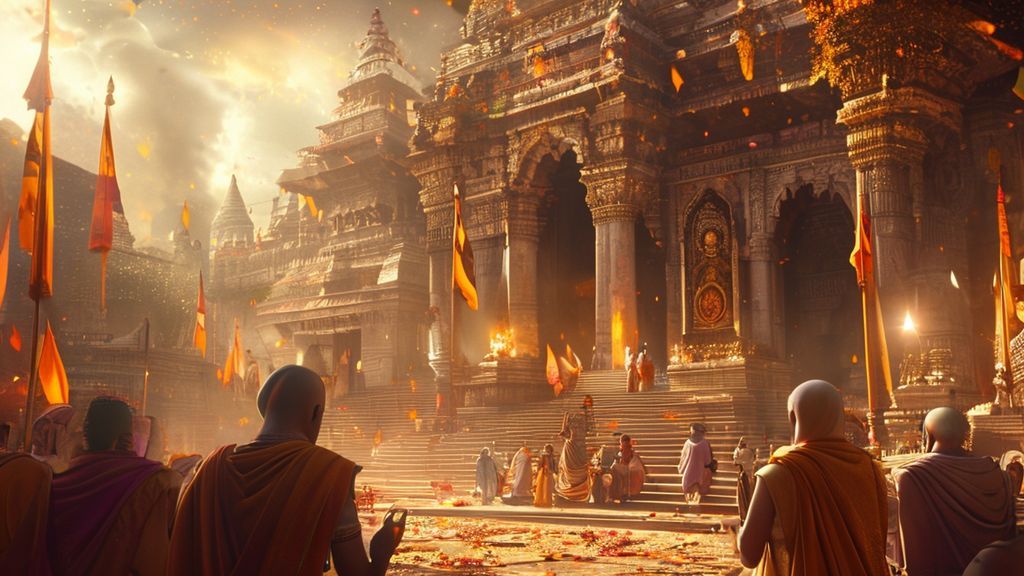
Secularism in India, from a Hindu perspective, is best understood not as strict separation of state and religion, but as ‘Sarva Dharma Sama Bhava’ – equal respect and protection for all paths, rooted in the inherent spiritual pluralism of Sanatan Dharma. The state, as per Dharmic principles, facilitates all traditions without partiality or intervention in their core tenets, upholding justice and order for all citizens.
| Attribute | Details from Hindu Perspective |
|---|---|
| Core Concept | Sarva Dharma Sama Bhava (Equal regard for all Dharmas); Dharma-Nirapekshata (State neutrality towards religious practice, not anti-religious). |
| Historical Basis | Ancient Indic Polity (Rajadharma), Kautilya’s Arthashastra, Ashokan Edicts, Vedic principles of Rta and Dharma upholding cosmic order and societal harmony. |
| Modern Interpretation | State’s duty to protect all faiths, non-discriminatory governance, freedom of conscience and practice, often termed ‘Positive Secularism’. |
| Key Concern | Misinterpretation leading to state intervention in Hindu institutions, perceived appeasement of specific groups, and neglect of genuine Hindu concerns. |
Introduction: The Dharmic Vision of a Pluralistic Society
The concept of “secularism” in India has been a subject of profound debate and introspection, particularly from a Hindu perspective. Unlike its Western counterpart, which typically signifies a strict separation of Church and State, the Indian understanding of secularism is often characterized by the Sanskrit phrase Sarva Dharma Sama Bhava (सर्व धर्म सम भाव), meaning “equal regard for all religions” or “all paths lead to the same truth.” This philosophy is not an imported ideology but an organic evolution from the ancient spiritual ethos of Sanatan Dharma itself, which inherently embraces pluralism and diversity. For the Hindu, the state’s role is not to be irreligious, but to be Dharma-Nirapekshata – neutral towards specific religious practices while upholding the overarching principles of Dharma for the welfare of all. This ancient wisdom, preserved and expounded on Hindutva.online, reveals that true secularism, in its Indian spirit, means universal respect and protection, fostering a society where every spiritual tradition can flourish without state favoritism or impediment.
Dharmic Roots of Statecraft and Pluralism
The notion of a pluralistic and just state is deeply embedded in ancient Hindu texts and historical governance models. The Vedic concept of Rta (ऋत) — the cosmic order and truth — and Dharma (धर्म) — righteous conduct and duty — formed the bedrock of ancient Indian polity. Kings (राजन्) were bound by Rajadharma (राजधर्म), their sacred duty to protect all citizens, irrespective of their beliefs, and ensure justice and prosperity. As elaborated in the Mahabharata’s Shanti Parva, a ruler’s legitimacy stemmed from adherence to Dharma, which mandated protection for ascetics, Brahmins, and all sections of society, including those following different spiritual paths. Kautilya’s Arthashastra, a treatise on statecraft from the 4th century BCE, also outlines a pragmatic and ethical state that manages diverse communities, collects taxes impartially, and maintains law and order, without endorsing a state religion or persecuting minority faiths. Emperor Ashoka’s edicts further exemplify this principle, advocating for tolerance and mutual respect among different religious groups, emphasizing the essence of Dhamma (righteousness) above sectarian differences. This historical continuum demonstrates that a pluralistic, non-discriminatory approach to governance is not alien but intrinsic to Indic civilization.
Philosophical Underpinnings & Dharmic Statecraft
The Hindu philosophical outlook profoundly influences the understanding of secularism. The idea that “truth is one, sages call it by various names” (एकं सद् विप्रा बहुधा वदन्ति – Rig Veda 1.164.46) underpins the acceptance of multiple spiritual paths. This inherent pluralism negates the need for a state to favor one religion over others, as all are seen as valid approaches to the Divine. The concept of Vasudhaiva Kutumbakam (वसुधैव कुटुम्बकम्) – “the world is one family” – further reinforces this universalistic worldview, where boundaries of faith, race, or nationality dissolve in the larger human family. From this perspective, a truly Dharmic state would not merely tolerate but actively foster an environment where every tradition can thrive, contributing to the collective spiritual and material well-being of the nation. It implies a state that is vigilant against fanaticism and ensures equitable application of laws, protecting the rights and practices of all without interference unless they violate universal moral order (Dharma). This differs fundamentally from Western secularism, which often arose from conflicts between Church and State, whereas Indian secularism is an affirmation of its diverse spiritual heritage.
Principles for Dharmic Governance in a Pluralistic Society
A Hindu perspective on secular governance proposes a proactive, protective role for the state, rather than a hands-off approach that can lead to neglect or discrimination. The following principles outline this approach:
- Equal Protection (समरक्षा): The state must guarantee security and freedom of worship for all religious communities, ensuring no group faces persecution or discrimination.
- Non-Intervention (अहस्तक्षेप): The state should refrain from interfering in the internal religious doctrines, rituals, and practices of any faith, respecting their autonomy and unique character. This is particularly relevant for Hindu institutions, which have historically been subject to state control unlike other religions.
- Equitable Support (समान सहायता): Where state support for religious activities is deemed necessary (e.g., preservation of heritage sites, maintenance of public order during festivals), it must be extended equitably to all traditions based on need and public interest, without favoritism.
- Dharma-based Justice (धर्म-न्याय): Laws should be formulated and applied based on universal principles of justice and righteousness (Dharma), transcending narrow sectarian interests, and ensuring that no community’s practices violate fundamental human rights or public order.
- Cultural Preservation (संस्कृति संरक्षण): The state has a duty to protect and promote India’s rich spiritual and cultural heritage, which includes all diverse traditions originating from or flourishing in the land, without diluting the indigenous Sanatan Dharma.
Mantras for Universal Harmony and State Welfare
While specific mantras for “secularism” as a political concept do not exist, the Hindu tradition offers profound prayers and affirmations that embody the spirit of universal welfare, peace, and pluralism that underpin a Dharmic, inclusive society. These reflect the aspiration for a state that fosters harmony:
ॐ सर्वे भवन्तु सुखिनः। सर्वे सन्तु निरामयाः। सर्वे भद्राणि पश्यन्तु। मा कश्चिद् दुःखभाग् भवेत्॥
(Om Sarve Bhavantu Sukhinah | Sarve Santu Niramayah | Sarve Bhadrani Pashyantu | Ma Kaschid Dukha Bhagh Bhavet ||)
Meaning: May all be happy. May all be free from illness. May all see what is auspicious. May no one suffer. This universal prayer encapsulates the vision of a benevolent state working for the happiness and well-being of every single being, regardless of their background.
Another profound affirmation is “Lokah Samastah Sukhino Bhavantu” (लोकाः समस्ताः सुखिनो भवन्तु), meaning “May all beings in all worlds be happy.” These expressions guide the Hindu approach to statecraft, emphasizing compassion, non-maleficence, and collective prosperity.
Dos and Don’ts for a Dharmic Secular State
To uphold true Dharmic secularism, a state must navigate its responsibilities with wisdom and balance. For a deeper understanding of these principles, visit Hindutva.online.
- Do: Protect the fundamental right to practice and propagate one’s religion for all citizens, equally.
- Do: Ensure law and order without bias, punishing those who incite hatred or violence against any religious group.
- Do: Provide financial aid for the preservation of cultural and religious heritage sites of all communities based on historical significance and public benefit.
- Do: Engage in constructive dialogue with leaders of all religious communities to understand their needs and concerns.
- Don’t: Interfere in the theological or ritualistic matters of any religion, especially those that are internal to a community’s faith and practice.
- Don’t: Pass laws that disproportionately affect one religious community while exempting others from similar regulations.
- Don’t: Use state power to undermine the autonomy or unique identity of any religious institution, including temples, mutts, and gurukuls.
- Don’t: Allow the concept of “secularism” to become a tool for historical revisionism or denigration of India’s indigenous Sanatan Dharma.
Is Hindu Dharma inherently secular?
Hindu Dharma, with its inherent pluralism, tolerance, and emphasis on Sarva Dharma Sama Bhava, embodies a deep-seated secular ethos, often termed “positive secularism.” It historically nurtured diverse spiritual traditions, philosophical schools, and indigenous faiths, demonstrating a profound capacity for co-existence without requiring state imposition of a single religion. This differs from Western secularism which mandates separation, whereas Hindu Dharma encourages respect for all paths while maintaining its own spiritual identity.
How does Indian secularism differ from Western secularism?
Western secularism, often a product of post-Reformation conflicts, typically advocates for a “wall of separation” between church and state, with the state maintaining strict neutrality and non-intervention. Indian secularism, conversely, aims for “equal respect for all religions” and often involves the state’s protective intervention to ensure fair treatment and prevent discrimination among religious groups. However, concerns arise when this intervention becomes intrusive, particularly into Hindu institutions, creating an imbalance.
What is “positive secularism” from a Hindu viewpoint?
“Positive secularism” aligns closely with the Dharmic ideal. It implies that the state should not be anti-religious, but rather act as a neutral facilitator and protector of all religions, upholding their freedom of practice, and preventing discrimination or persecution. It means treating all religious communities with equal regard (Sarva Dharma Sama Bhava), providing equitable support where necessary, and fostering an environment where spiritual diversity enriches the nation, rather than diminishing it.
Dharmic Significance: Preserving Sanatan Dharma and National Unity
The correct understanding and implementation of secularism, rooted in India’s own Dharmic traditions, is paramount for the preservation of Sanatan Dharma and the unity of the nation. When secularism is divorced from its indigenous philosophical moorings and interpreted as an imported anti-religious ideology, it risks alienating the majority community, interfering in their sacred institutions, and creating an imbalance in societal harmony. True Indian secularism, as articulated by the sages and demonstrated by centuries of pluralistic co-existence, emphasizes mutual respect, non-interference in matters of faith, and universal justice for all citizens. Upholding these Dharmic principles is not merely a political stance but a spiritual imperative that ensures a prosperous, harmonious, and truly integrated India, where every path finds its space to flourish. This is the enduring legacy and ongoing mission we champion at Hindutva.online.