

Among the Shiva vs Vishnu most enduring and passionate debates within Hindu tradition is the question of supremacy between Shiva, the cosmic destroyer and ascetic yogi, and Vishnu, the divine preserver who descends as avatars to protect dharma. This theological discussion has produced millennia of philosophical discourse, devotional poetry, sectarian differences, and countless scriptural narratives—each presenting compelling arguments for their chosen deity’s supremacy. Yet the very existence of this debate reveals a profound misunderstanding of Hindu theology’s non-dualistic foundation, which ultimately transcends all sectarian divisions through the principle articulated in the Rigveda: “Ekam Sat Viprah Bahudha Vadanti”—Truth is One, but the wise describe it in many ways.

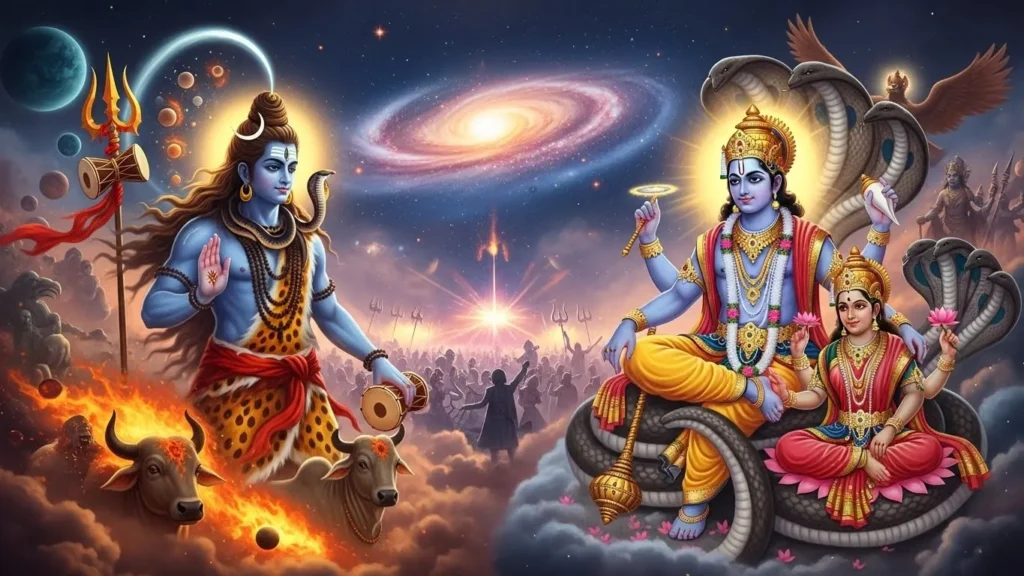
The answer to “who is supreme” depends entirely on which tradition one follows: Shaivism declares Shiva as the ultimate reality, Vaishnavism proclaims Vishnu/Krishna as supreme, while Shaktism elevates the Divine Mother above all. However, Hindu philosophy’s deeper wisdom—articulated by Adi Shankaracharya and embodied in the Smarta tradition—recognizes that these apparently different deities represent various aspects and names of the same infinite Brahman, the formless absolute consciousness underlying all existence. The famous Harihara form, which depicts Shiva and Vishnu as two halves of a single body, powerfully symbolizes this essential unity, teaching that destruction and preservation are complementary functions of one divine reality rather than competing claims to supremacy.
This comprehensive exploration examines the traditional arguments for each deity’s supremacy, the famous Jyotirlinga story revealing Shiva’s boundlessness, sectarian perspectives, mutual reverence between the deities, and ultimately, why the question itself misunderstands Hindu theology’s non-dual foundation.
The Trimurti: Understanding Cosmic Roles
Before examining supremacy claims, understanding the Trimurti (divine trinity) framework provides essential context for comprehending Shiva and Vishnu’s complementary cosmic functions.
The Three Primary Functions
Hindu cosmology recognizes three fundamental cosmic processes operating continuously throughout existence:
Creation (Srishti): The manifestation of the universe and all beings from unmanifest potential into material form. This function is attributed to Brahma, the creator deity who brings forth the cosmos at the beginning of each cosmic cycle (kalpa).
Preservation (Sthiti): The maintenance of cosmic order (dharma), protection of the righteous, and sustaining the universe throughout its existence. This function belongs to Vishnu, who descends as various avatars—Rama, Krishna, and others—whenever evil threatens dharmic balance.
Destruction/Transformation (Samhara): The dissolution of forms, transformation of existence, and ultimate return of manifestation to unmanifest potential at each cycle’s end. This function is assigned to Shiva, whose destructive power is not malevolent but necessary for renewal and transformation.
Beyond Functional Division
However, the Trimurti should not be understood as three separate gods competing for supremacy but as three aspects of one divine principle performing different cosmic functions. Just as water exists as ice, liquid, and vapor—three different forms of the same H₂O molecule—Brahma, Vishnu, and Shiva represent different functional manifestations of the same ultimate reality (Brahman).
The Puranas contain numerous statements emphasizing this unity:
- The Shiva Purana declares: “Vishnu is none other than Shiva, and Shiva is none other than Vishnu.”
- The Vishnu Purana states: “The one who realizes Vishnu knows Shiva, and the one who knows Shiva realizes Vishnu.”
- The Skanda Purana explains: “Shiva and Vishnu are one soul with two bodies.”
The Jyotirlinga Story: Shiva’s Boundless Form
One of Hinduism’s most famous narratives directly addresses the supremacy question through the appearance of the infinite pillar of light (Jyotirlinga).
The Debate Between Brahma and Vishnu
According to the Shiva Purana and Linga Purana, Brahma (the creator) and Vishnu (the preserver) once engaged in a fierce argument about who held greater cosmic authority and power. Their dispute grew so intense that it threatened universal stability, with each deity asserting superiority based on their respective functions and accomplishments.
The Appearance of the Infinite Pillar
To resolve this destructive conflict and reveal deeper truth about divine nature, Shiva manifested as an immense pillar of blazing light (Jyotirlinga)—a column of fire extending infinitely in both directions, with neither visible beginning nor end. This awe-inspiring manifestation appeared suddenly between the quarreling deities, arresting their attention completely.
A divine voice emanated from the pillar, challenging both Brahma and Vishnu: “Whoever discovers either the top or bottom of this pillar shall be acknowledged as supreme.”
The Search for Limits Shiva vs Vishnu
Vishnu’s Descent: Taking the form of Varaha (the boar avatar), Vishnu tunneled downward through layer after layer of the nether worlds—piercing through Patala, Mahatala, Talatala, Rasatala, Sutala, Vitala, and Atala—for thousands of years. He traveled through geological strata, underground oceans, and the very foundations of existence, yet found no bottom to the pillar. The light extended infinitely downward, defying measurement or comprehension.
Finally, exhausted and humbled, Vishnu acknowledged his failure. He returned to the surface and honestly admitted: “I searched for ages through countless realms but could not find the pillar’s base. This divine light is truly boundless, and I accept my inability to measure it.”
Brahma’s Ascent: Simultaneously, Brahma assumed the form of Hamsa (the swan) and flew upward through the successive celestial realms—soaring past Bhuvarloka, Svargaloka, Maharloka, Janaloka, Tapaloka, and even Satyaloka—searching for the pillar’s summit. He too traveled for thousands of years, yet the blazing column extended infinitely upward without any discernible peak.
Frustrated and exhausted, Brahma encountered a Ketaki flower (also called Kevda or Pandanus) falling from above. Desperate to claim victory, Brahma convinced the flower to falsely testify that it had come from the pillar’s top, which Brahma had supposedly reached. Together they returned to the pillar’s center, where Brahma boastfully proclaimed success.
Shiva’s Revelation and Judgment
At this moment, the central portion of the pillar split open, and Shiva emerged in his magnificent cosmic form—adorned with serpents, holding the trident, his third eye blazing with divine wisdom. The awesome presence immediately silenced both deities.
Shiva praised Vishnu’s honesty: “You truthfully acknowledged your limitation and demonstrated humility before the infinite. For this honesty and devotion, you shall be worshipped alongside me, and together we shall maintain cosmic order.”
However, Shiva condemned Brahma’s deception: “You resorted to falsehood and dishonesty, bribing a witness to claim what you did not achieve. For this lie, you shall receive no temples or regular worship. The Ketaki flower, complicit in deception, shall never be used in my worship.”
Shiva then revealed the profound teaching: “Both of you emerged from me as aspects of my being, separated to perform different cosmic functions. I am the formless absolute (Nirguna Brahman) that transcends all measurement, beyond creation and preservation, beyond all qualities and limitations. The infinite pillar represents ultimate reality that cannot be measured, comprehended, or contained by any being or concept.”
Theological Significance
This story serves multiple purposes in Shaivite theology:
- Establishes Shiva’s transcendence beyond even the other members of the Trimurti
- Emphasizes that ultimate reality is immeasurable and incomprehensible to rational mind
- Rewards honesty (Vishnu) while punishing deception (Brahma)
- Explains why Brahma receives minimal worship in Hindu practice
- Establishes the tradition of worshipping Shiva in Linga form, representing the infinite formless reality manifesting as form
Sectarian Perspectives: Shaivism vs Vaishnavism
Hindu tradition encompasses multiple sampradayas (philosophical schools), each emphasizing different aspects of divinity and presenting their chosen deity as supreme.
Shaivism: Shiva as Ultimate Reality
Shaivism, one of Hinduism’s oldest and most philosophically sophisticated traditions, worships Shiva as the supreme absolute consciousness (Parama Shiva) from which all existence emanates.
Philosophical Foundation: Shaivism typically aligns with Advaita Vedanta (non-dualism), emphasizing that Shiva represents Nirguna Brahman—the formless, attributeless absolute reality underlying all manifestation. Kashmir Shaivism, particularly sophisticated philosophically, presents elaborate metaphysics explaining how pure consciousness (Shiva) manifests the entire universe through its own power (Shakti).
Scriptural Authority: The Shiva Purana, Linga Purana, and numerous Agamas present Shiva as the source of both Brahma and Vishnu, who emerged from Shiva to perform specialized cosmic functions. These texts describe Shiva as:
- The unborn, eternal consciousness existing before creation
- The supreme yogi who mastered all spiritual disciplines
- The destroyer whose transformative power enables renewal
- The cosmic dancer (Nataraja) whose dance creates, preserves, and destroys universes
Spiritual Practice: Shaivite practice emphasizes yoga, meditation, asceticism, and direct realization of one’s identity with Shiva through self-inquiry (atma vichara). The path focuses on transcending ego, mastering senses, and awakening to one’s true nature as pure consciousness.
Geographical Spread: Shaivism predominates in Kashmir, Tamil Nadu (where the 63 Nayanars composed devotional poetry), Karnataka (Lingayatism), and various Himalayan regions. The twelve Jyotirlingas across India mark sites where Shiva manifested as infinite light.
Vaishnavism: Vishnu/Krishna as Supreme
Vaishnavism, arguably Hinduism’s largest and most widespread tradition, worships Vishnu and his avatars (particularly Rama and Krishna) as the supreme personality of Godhead.
Philosophical Foundation: Vaishnavism encompasses various philosophical schools including:
- Vishishtadvaita (qualified non-dualism) of Ramanuja: Brahman is personal God (Vishnu) with infinite auspicious qualities, and individual souls are real but depend entirely on Vishnu
- Dvaita (dualism) of Madhvacharya: Clear distinction exists between individual souls, material world, and supreme God (Vishnu), who remains eternally distinct and superior
- Achintya Bheda Abheda (inconceivable oneness and difference) of Chaitanya Mahaprabhu: Souls are simultaneously one with and different from Krishna
Scriptural Authority: The Bhagavata Purana, Vishnu Purana, and Bhagavad Gita present Krishna/Vishnu as the supreme reality. The Bhagavad Gita’s most famous verse has Krishna declaring: “I am the source of all spiritual and material worlds. Everything emanates from Me.” (10.8)
These texts describe Vishnu as:
- The supreme controller and master of all energies
- The source from whom Brahma and Shiva receive their powers
- The ultimate shelter and destination of all souls
- The repository of infinite compassion, beauty, and divine attributes
Spiritual Practice: Vaishnavite practice emphasizes bhakti yoga—devotional love, surrender, and personal relationship with God. The path focuses on:
- Chanting divine names (especially through kirtan and japa)
- Studying scriptures like Bhagavad Gita and Bhagavata Purana
- Deity worship and temple rituals
- Serving devotees and God’s mission in the world
Geographical Spread: Vaishnavism dominates in Uttar Pradesh, West Bengal (Gaudiya Vaishnavism), Andhra Pradesh, Tamil Nadu (Sri Vaishnavism), Odisha (Jagannath worship), and increasingly across the global diaspora through ISKCON and other movements.
The Reality of Sectarian Differences
While philosophical debates between Shaivism and Vaishnavism can be intellectually rigorous, they sometimes unfortunately devolve into sectarian hostility, mutual exclusion, and claims that the other tradition worships false or inferior deities. Such divisiveness contradicts Hindu tradition’s deeper wisdom about the ultimate unity underlying apparent multiplicity.
Stories of Mutual Reverence: Shiva and Vishnu Honor Each Other
Despite sectarian tensions, Hindu scriptures contain numerous narratives demonstrating profound mutual respect and devotion between Shiva and Vishnu.
Vishnu Worships Shiva
The Kurma Purana describes how Vishnu, seeking to propitiate Shiva, promised to offer 1,008 lotus flowers while chanting the Shiva Sahasranama (thousand names of Shiva). As Vishnu collected flowers for this elaborate worship, Shiva—desiring to test Vishnu’s devotion—hid one lotus.
When Vishnu discovered he was one flower short, he immediately plucked out one of his own lotus-like eyes and placed it before Shiva’s image, completing the offering. Moved by this extraordinary devotion and willingness to sacrifice even his own body, Shiva appeared and granted Vishnu the Sudarshan Chakra—the divine discus that became Vishnu’s most powerful weapon.
This story teaches that Vishnu himself recognizes Shiva’s greatness and worships him with supreme devotion.
Shiva Worships Vishnu
Reciprocally, the Shiva Purana describes Shiva eulogizing Vishnu through the Vishnu Sahasranama (thousand names of Vishnu), acknowledging Vishnu’s divine qualities and supreme status. In various Puranic accounts:
- Shiva declares that insulting Vishnu equals insulting himself
- Shiva states that those who distinguish between him and Vishnu fall into ignorance
- Shiva acknowledges Vishnu as his own heart and soul
- Shiva establishes that devotion to Vishnu automatically pleases him
The Vaishnava-Shaiva Unity Teachings
The Devi Mahatmya (Markandeya Purana) contains a profound teaching from the Divine Mother addressing sectarian division. When devotees argued about Vishnu versus Shiva supremacy, the Goddess declared:
“In Shiva’s heart, Vishnu dwells in my form. In Vishnu’s heart, Shiva dwells in my form. Those who see separation between them understand neither. The wise recognize that Shiva, Vishnu, and I are one reality expressed through different aspects.”
This teaching elevates understanding beyond sectarian debate to recognize the divine unity underlying all manifestations.
Harihara: The Unity Form
The theological principle of Shiva-Vishnu unity finds powerful visual expression in the Harihara iconography—a composite deity combining both gods in a single body.
Iconographic Features
Harihara images typically show the right half as Shiva and the left half as Vishnu:
Shiva’s Right Side:
- Matted locks (jata) with crescent moon
- Third eye on forehead
- Tiger skin or simple loincloth
- Trident (trishula) in hand
- Serpent ornaments
- Ash-smeared appearance
Vishnu’s Left Side:
- Ornate crown (kirita)
- Smooth, decorated skin
- Royal garments and jewelry
- Conch (shankha) or discus (chakra) in hand
- Garland of flowers
- Golden complexion
Theological Significance
The Harihara form teaches multiple profound truths:
Non-Duality: Apparent opposites (ascetic/householder, destroyer/preserver, fierce/gentle) ultimately merge in the absolute reality beyond all dualities.
Complementarity: Destruction and preservation are not opposing forces but complementary aspects of the same cosmic process—transformation requires both dissolution of old forms and maintenance of stable patterns.
Sectarian Unity: The form demonstrates that Shaivism and Vaishnavism need not compete but can recognize their chosen deity as aspects of one supreme reality.
Integrated Spirituality: Complete spiritual development requires both Shiva-like renunciation/meditation and Vishnu-like engagement/compassion—both withdrawal from and participation in the world.
The Smarta Tradition: Five Equal Deities
The Smarta sampradaya, established by Adi Shankaracharya in the 8th century CE, explicitly rejects sectarian supremacy claims through its Panchayatana Puja (worship of five deities).
The Five Deities
Smartas worship five deities as equal manifestations of Brahman:
- Shiva: Representing consciousness, transformation, and transcendence
- Vishnu: Representing preservation, dharma, and divine incarnation
- Shakti/Devi: Representing energy, power, and the divine feminine
- Ganesha: Representing wisdom, obstacle removal, and auspicious beginnings
- Surya: Representing illumination, vitality, and consciousness awakening
The Ishta Devata Concept
While honoring all five, Smartas choose one as their ishta devata (chosen deity) for primary worship, recognizing this as a personal affinity rather than objective supremacy. The chosen deity occupies the central position in the panchayatana arrangement, with the other four surrounding it, symbolizing that all paths ultimately lead to the same destination.
Philosophical Foundation
The Smarta approach rests on Advaita Vedanta’s non-dualistic philosophy, which teaches:
- Brahman alone is real—formless, infinite, eternal consciousness
- All deities are names and forms through which this formless absolute becomes accessible to devotees at various spiritual levels
- The ultimate goal is realizing one’s identity with Brahman, transcending all names and forms
- Different deities suit different temperaments, and none can claim exclusive supremacy
Ekam Sat Viprah Bahudha Vadanti: Truth Is One
The deepest answer to the supremacy question comes from the Rigveda’s famous verse (1.164.46):
“Ekam Sat Viprah Bahudha Vadanti”
Translation: “Truth is One, the wise call it by many names.”
The Profound Implications
This ancient statement establishes fundamental principles that dissolve sectarian supremacy claims:
Ultimate Reality is Singular: There is only one supreme truth, one absolute reality (Brahman), one ultimate consciousness underlying all existence.
Multiple Valid Descriptions: The infinite cannot be contained by any single name, form, or conception. Therefore, wise beings recognize the same truth can be validly described as Shiva, Vishnu, Brahma, Devi, Krishna, Rama, or countless other names.
Religious Pluralism: Different religious paths and deity conceptions are legitimate approaches to the same ultimate reality, not competing truth claims but varied perspectives on the infinite.
Transcendence of Sectarianism: Arguing about supremacy misses the point—like arguing whether the ocean should be called “Atlantic” or “Pacific” when discussing water’s fundamental nature.
Why the “Supremacy” Debate Misses the Point
From the highest philosophical perspective, the question “Who is supreme?” reflects incomplete understanding of Hindu theology’s non-dualistic foundation.
Levels of Spiritual Understanding
Hindu teachers recognize different levels of spiritual development requiring different approaches:
Dualistic Level (Dvaita): Beginners need personal deity with attributes to worship, creating devotional relationship. At this level, one’s chosen deity naturally feels supreme, which is spiritually appropriate for that stage.
Qualified Non-Dualistic Level (Vishishtadvaita): More advanced practitioners recognize all deities as manifestations of one divine reality, though maintaining distinctions between soul and God, worship and worshipped.
Non-Dualistic Level (Advaita): Realized beings transcend all deity forms, recognizing themselves as identical with the formless Brahman that manifests as all names and forms.
The Purpose of Different Deity Forms
Different manifestations serve specific purposes:
- Shiva: Appeals to those seeking liberation through renunciation, meditation, and transcendence
- Vishnu: Attracts those seeking liberation through devotion, relationship, and divine grace
- Devi: Draws those resonating with feminine divine power and Shakti worship
- Ganesha: Helps beginners and those needing obstacle removal
- Surya: Assists those connecting through vitality and illumination
None is “better” than others—they serve different spiritual temperaments and developmental stages.
Frequently Asked Questions
Who is supreme, Shiva or Vishnu?
The question has no single answer applicable to all Hindu traditions. Shaivism declares Shiva as supreme consciousness from which Vishnu emerged; Vaishnavism proclaims Vishnu/Krishna as the supreme personality of Godhead who empowers Shiva. However, Hindu philosophy’s deepest wisdom—articulated in the Rigveda’s “Ekam Sat Viprah Bahudha Vadanti” (Truth is One, sages describe it variously)—teaches that Shiva and Vishnu are names and forms of the same ultimate reality (Brahman). The Harihara form depicts them as two halves of one body, symbolizing their essential unity. Advanced practitioners recognize the supremacy debate as sectarian, transcending it through realization that all deities manifest the same infinite consciousness.
What is the story of Shiva’s infinite pillar of light?
When Brahma and Vishnu argued about supremacy, Shiva appeared as an infinite pillar of blazing light (Jyotirlinga) challenging them to find its top or bottom. Vishnu took boar form and tunneled downward through nether worlds for thousands of years but found no base, honestly admitting failure. Brahma flew upward as a swan but also failed, then falsely claimed success using a flower as false witness. Shiva emerged from the pillar, praising Vishnu’s honesty and granting him equal worship status, but condemned Brahma’s deception, decreeing he would receive no temples. This story teaches that ultimate reality transcends measurement and rewards truth over ego.
What is Harihara and what does it symbolize?
Harihara is a composite deity combining Shiva and Vishnu in one body—the right half showing Shiva (matted locks, trident, tiger skin, ash) and left half showing Vishnu (crown, discus, royal garments, jewelry). This form powerfully symbolizes that apparent opposites—destroyer and preserver, ascetic and householder, transcendence and immanence—ultimately merge in absolute reality beyond all dualities. Harihara teaches that Shaivite and Vaishnavite traditions worship the same supreme consciousness expressed differently, that destruction and preservation are complementary cosmic functions