


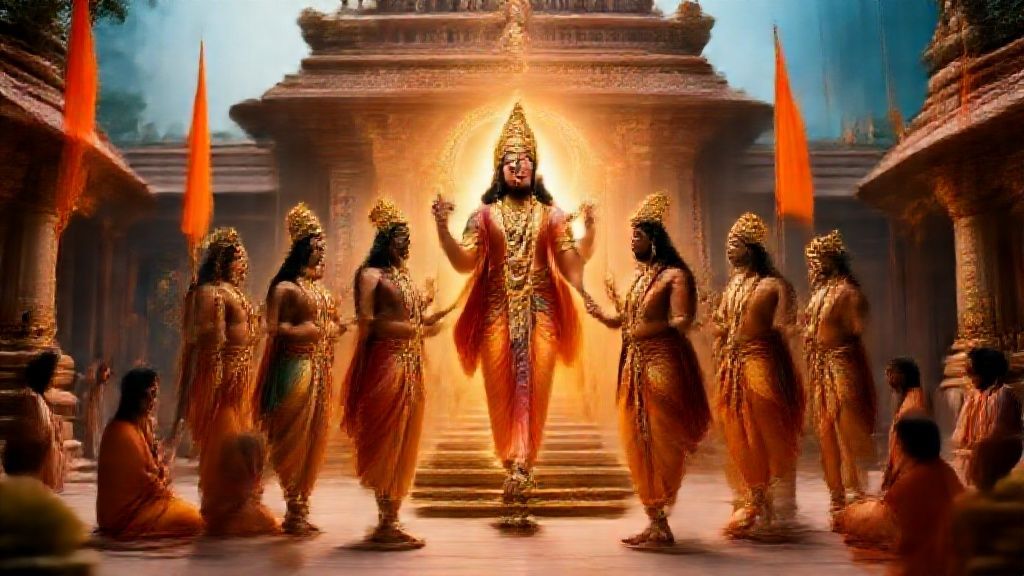
Teamwork in Mahabharata, as exemplified by the Pandavas, represents the profound synergy of individual strengths, unwavering mutual support, and a steadfast collective commitment to Dharma. Their saga illuminates how unity, strategic alignment under divine guidance, and resilience in adversity are paramount for upholding righteousness and achieving victory against overwhelming odds.
| Attribute | Details |
|---|---|
| Concept | Dharmic Teamwork, Collective Endeavor, Unity in Adversity |
| Primary Source | Mahabharata (Itihasa) |
| Key Figures | Yudhishthira, Bhima, Arjuna, Nakula, Sahadeva, Draupadi, Krishna, Vidura |
| Core Principle | Yato Dharmas Tato Jayaha (Where there is Dharma, there is Victory) |
| Significance | A timeless guide for human cooperation, leadership, and ethical action. |
Introduction: The Dharmic Symphony of the Pandavas
The Mahabharata, an unparalleled Itihasa, is not merely a chronicle of kings and kinsmen but a profound exposition on Dharma itself. At its heart lies the saga of the Pandavas, five brothers whose lives epitomize the spiritual and practical essence of teamwork. Their journey, fraught with treachery, exile, and the ultimate war, serves as a divine blueprint for how a collective, bound by righteousness and mutual affection, can overcome the most formidable challenges. For sincere seekers and devotees, the Pandavas’ unity is not just a historical account; it is a timeless lesson in Sanatan Dharma, illustrating that true strength lies not in individual prowess alone, but in a harmonious, dharma-centered collective endeavor.
In a world often fragmented by individualism, the Pandava narrative calls us back to the foundational Vedic principles of unity, selfless action (Seva), and shared purpose. Their life story, meticulously detailed across the eighteen Parvas, reveals how each brother, with his unique strengths and vulnerabilities, contributed indispensably to the collective mission of upholding Dharma. This guide delves into the profound lessons of teamwork gleaned from their trials and triumphs, offering insights relevant to every aspect of our spiritual and worldly lives.
Puranic History & Legend: Instances of Unwavering Unity
The Pandavas’ story is replete with moments where their survival and success hinged entirely on their ability to act as one cohesive unit, guided by an implicit understanding and an explicit commitment to their shared destiny. From their early childhood to the climactic war, their teamwork was their greatest weapon, honed through adversity and fortified by Dharma.
The Escape from Lakshagriha (House of Lac)
One of the earliest and most dramatic demonstrations of Pandava teamwork occurs in the Adi Parva of the Mahabharata. When Duryodhana, fueled by envy, conspired to burn them alive in the House of Lac, it was Vidura’s timely warning and Bhima’s incredible strength that ensured their escape. Yudhishthira’s calm leadership in a crisis, combined with Bhima’s execution of the escape plan – digging a tunnel and carrying his mother Kunti and his four brothers – showcased their perfect coordination. This act, born of a malevolent plot, paradoxically strengthened their bond, making them realize the constant threat they faced and the absolute necessity of relying on one another.
Draupadi’s Swayamvara
The winning of Draupadi, a pivotal moment described in the Adi Parva, was also a collective victory. While Arjuna, disguised as a Brahmin, was the only one capable of stringing the formidable bow and hitting the target, his success was contingent on the Pandavas’ collective presence and silent support. Bhima’s intimidating presence at the assembly prevented any immediate challenge from envious kings, ensuring Arjuna could perform the feat unhindered. Their decision to share Draupadi, though rooted in Kunti’s misunderstanding and Yudhishthira’s adherence to his mother’s word, solidified their familial unity, reinforcing the idea that what one Pandava achieved belonged to all.
The Aranya Vasa (Forest Exile)
The thirteen years of exile, detailed in the Vana Parva and Virata Parva, were a prolonged test of their unity. Despite the immense hardship, humiliation, and constant danger, the Pandavas remained an unbreakable unit. Yudhishthira’s unwavering adherence to Dharma provided moral guidance, Bhima’s protective strength shielded them from physical threats (e.g., Hidimba, Kichaka), Arjuna’s ascetic penance secured divine weapons (Pashupatastra from Lord Shiva), and Nakula and Sahadeva offered steadfast support, intelligence, and care for their animals. Draupadi, their shared Queen, served as a constant reminder of their honor and the injustice they faced, fueling their collective resolve.
The Incognito Year (Agyatavasa)
During their year of living incognito in the kingdom of Virata (Virata Parva), each brother assumed a distinct, humble role, yet their underlying unity and aristocratic bearing were never truly concealed from discerning eyes. Yudhishthira as Kanka (a dice player), Bhima as Vallabha (a cook), Arjuna as Brihannala (a eunuch dance teacher), Nakula as Granthika (a horse trainer), and Sahadeva as Tantripala (a cowherd) all maintained their disguised identities with discipline, protecting each other’s secrets while contributing their unique skills to the court.
The Kurukshetra War
The pinnacle of their teamwork was undoubtedly the eighteen-day Kurukshetra War. Under the divine guidance of Lord Krishna, the Pandavas operated as a perfectly oiled machine. Yudhishthira, despite his personal struggles, provided the moral compass and strategic overview. Arjuna, as the primary warrior, executed Krishna’s strategies with unmatched skill. Bhima, with his unparalleled strength, protected the flanks and engaged the most formidable warriors. Nakula and Sahadeva, though younger, were invaluable as charioteers and warriors, exhibiting courage and strategic insight on the battlefield. The entire Pandava army, though numerically inferior, was bound by a singular purpose: the re-establishment of Dharma. This collective resolve, often expressed through cries of “Dharma-kshetre Kurukshetre!”, was a testament to their unwavering teamwork.
Strategic Cohesion and Dharmic Principles
The Pandavas’ teamwork was not merely a matter of physical coordination; it was deeply rooted in strategic cohesion and robust Dharmic principles, making it a powerful template for leadership and collaboration.
- Shared Vision of Dharma: Their ultimate goal was never personal gain but the restoration of righteousness (Dharma). This higher purpose transcended individual ego and petty grievances, providing an unshakeable foundation for their unity. Yudhishthira, as Dharmaraja, continually reminded them of this sacred duty.
- Complementary Strengths: Each brother brought unique, invaluable skills to the table. Yudhishthira’s wisdom, patience, and unyielding adherence to truth; Bhima’s formidable physical strength and loyalty; Arjuna’s unparalleled archery and unwavering focus; Nakula’s expertise with horses and swordsmanship; and Sahadeva’s profound intellect, astrological knowledge, and administrative acumen. Their teamwork allowed these diverse talents to interweave seamlessly.
- Respect for Leadership and Roles: Despite their individual powers, there was a clear hierarchy and respect for Yudhishthira’s leadership. Even when they disagreed, particularly Bhima and Arjuna, they ultimately bowed to Yudhishthira’s decisions, understanding the importance of a unified command.
- Mutual Trust and Support: Through countless trials, the Pandavas developed an unbreakable trust. They knew that in any crisis, each brother would stand for the others, even at the cost of his own life. This deep bond fostered an environment of psychological security, allowing them to face formidable adversaries without fear.
- Divine Guidance and Humility: The presence of Lord Krishna as their charioteer and counsellor was crucial. The Pandavas, particularly Arjuna, humbly accepted His divine guidance, recognizing that their strength was amplified by aligning with the divine will. This humility prevented hubris and ensured their strategies were always aligned with Dharma.
Practicing Dharmic Teamwork in Daily Life
The lessons from the Pandavas are not confined to ancient battlefields; they offer profound guidance for fostering effective and ethical teamwork in contemporary society, whether in families, communities, or professional settings.
- Cultivate a Shared Purpose Rooted in Dharma: Define clear, ethical goals that benefit all stakeholders. When the collective mission is noble and aligned with universal values, individual contributions become more meaningful.
- Recognize and Value Complementary Roles: Understand that true strength lies in diversity. Appreciate and leverage the unique skills, perspectives, and experiences of each team member, rather than seeking uniformity.
- Foster Unwavering Trust and Open Communication: Build relationships based on transparency, honesty, and mutual respect. Encourage open dialogue, even when disagreements arise, and resolve conflicts through empathetic understanding.
- Support and Uphold Ethical Leadership: Respect and follow leaders who prioritize the collective good and adhere to Dharmic principles. Leaders, in turn, must cultivate humility, listen to their team, and act with integrity.
- Face Adversity with United Resolve: Challenges are inevitable. Emulate the Pandavas by standing together, offering unwavering support during difficult times, and drawing strength from the collective spirit.
- Prioritize Collective Good Over Individual Ego: The Pandavas often put their personal desires and discomfort aside for the larger cause. Learn to mitigate ego, celebrate collective achievements, and take responsibility for collective failures. This selfless approach is vital for any successful team.
Mantras & Chants for Unity and Strength
To invoke the spirit of unity and righteousness exemplified by the Pandavas, devotees can chant powerful Sanskrit mantras. These vibrations help internalize the lessons of teamwork and dharma.
- “Yato Dharmas Tato Jayaha” (यतो धर्मस्ततो जयः): This profound statement from the Mahabharata means “Where there is Dharma, there is Victory.” Chanting this affirms faith in righteousness as the ultimate path to success and unity.
- Gayatri Mantra (ॐ भूर्भुवः स्वः तत्सवितुर्वरेण्यं भर्गो देवस्य धीमहि धियो यो नः प्रचोदयात्): While a universal mantra for wisdom, its collective chanting fosters spiritual unity and enlightened thought, essential for effective teamwork.
- Shanti Mantra (ॐ सह नाववतु। सह नौ भुनक्तु। सह वीर्यं करवावहै। तेजस्वि नावधीतमस्तु मा विद्विषावहै। ॐ शान्तिः शान्तिः शान्तिः॥): “Om Saha Nau-Avatu | Saha Nau Bhunaktu | Saha Viiryam Karavaavahai | Tejasvi Nau-Adhiitam-Astu Maa Vidvisshaavahai | Om Shaantih Shaantih Shaantih ||” This prayer from the Katha Upanishad asks for collective protection, nourishment, vigor, brilliance in learning, and freedom from animosity, perfectly encapsulating the spirit of dharmic teamwork.
Dos and Don’ts of Dharmic Teamwork
Emulating the Pandavas requires conscious effort in cultivating certain virtues and avoiding detrimental behaviors.
Dos:
- Do Cultivate Mutual Respect: Honor each person’s unique contribution and presence.
- Do Communicate Transparently: Speak truthfully and listen actively to resolve issues collaboratively.
- Do Prioritize the Collective Good: Place the team’s mission and Dharma above personal gain or ego.
- Do Offer Unconditional Support: Stand by your team members in their successes and failures.
- Do Adhere to Dharma: Let righteousness be the guiding principle for all team decisions and actions.
- Do Trust Leadership: Once a decision is made by righteous leadership, execute it faithfully.
Don’ts:
- Don’t Harbor Envy or Jealousy: These emotions corrode team spirit and lead to discord.
- Don’t Undermine Authority: Criticizing leaders behind their back destroys trust and unity.
- Don’t Act Selfishly: Pursuing individual agendas at the expense of the team harms everyone.
- Don’t Betray Trust: Loyalty and confidentiality are paramount for a cohesive unit.
- Don’t Deviate from Dharma: Compromising ethical principles for temporary gains will ultimately lead to ruin.
How did the Pandavas manage disagreements within the team?
The Pandavas, being human, certainly had their disagreements. Bhima often chafed under Yudhishthira’s pacifism, and Arjuna questioned certain strategies. However, their management of these differences was exemplary. Yudhishthira, as the eldest and Dharmaraja, usually had the final say, and his brothers, despite initial protests, ultimately respected his judgment, understanding it was rooted in Dharma. Krishna often played the role of a mediator, offering divine counsel that realigned their perspectives. Their shared objective – the restoration of Dharma – always outweighed individual differences, ensuring unity prevailed.
What role did Krishna play in their teamwork?
Lord Krishna was the ultimate strategist, guide, and motivator for the Pandavas. As their charioteer, counsel, and divine friend (Sakha), He provided not just military strategy but also profound spiritual wisdom. His presence ensured that their efforts remained aligned with Dharma, and His unwavering support instilled in them the courage to face seemingly insurmountable odds. He was the divine glue that held their team together, transforming individual strengths into an invincible force. To understand more about divine guidance in Sanatan Dharma, visit Hindutva.online.
Can these lessons be applied to modern professional life?
Absolutely. The principles of the Pandavas’ teamwork – shared vision, complementary strengths, respectful leadership, mutual trust, and adherence to ethics – are universally applicable. In modern professional settings, fostering a culture where individual talents are valued, communication is open, leadership is ethical, and the team is united by a common, righteous objective can lead to extraordinary success and a more fulfilling work environment.
Was Draupadi a part of the Pandava team?
Draupadi was undeniably an integral and vital part of the Pandava team. More than just their wife, she was their conscience, their strength, and their inspiration. Her unwavering spirit during the darkest times, her dignified protests against injustice, and her constant encouragement fueled their resolve for Dharma. She was a silent, yet powerful, force in their collective journey, symbolizing the unwavering commitment to righteousness that defined their entire existence.
Why This Matters for Every Hindu: Preserving Sanatan Dharma Through Unity
The saga of the Pandavas is not just a story of triumph, but a timeless discourse on how Sanatan Dharma is preserved and propagated through collective action. Their teamwork exemplifies the essence of Hindu society: a tapestry woven with diverse individual threads, yet strong and beautiful when united by a common thread of Dharma. In a world grappling with fragmentation and individualism, the Pandavas remind us that our greatest strength lies in our ability to act as a cohesive unit – in our families, communities, and as a global Hindu fraternity. Their journey teaches us that when we align our individual efforts with a shared, righteous purpose, guided by wisdom and divine grace, we become an unstoppable force for good, capable of upholding Dharma and securing victory for generations to come. This eternal lesson is crucial for the continued flourishing of Sanatan Dharma.