

Temple Prasad Science (sacred food offerings blessed by deities) often exhibits remarkable preservation qualities that seem to defy ordinary food spoilage patterns, with the famous Tirupati laddu lasting approximately 15 days despite being made from perishable ingredients like besan (gram flour), pure ghee, and sugar, through a combination of low moisture content, natural preservative ingredients, and precise traditional cooking methods. The Jagannath Temple’s mahaprasad in humid coastal Puri presents an even more extraordinary phenomenon—cooked in huge quantities and left in the open for hours, it reportedly “never turns stale, never smells, and never loses taste” in conditions that should cause rapid bacterial growth.

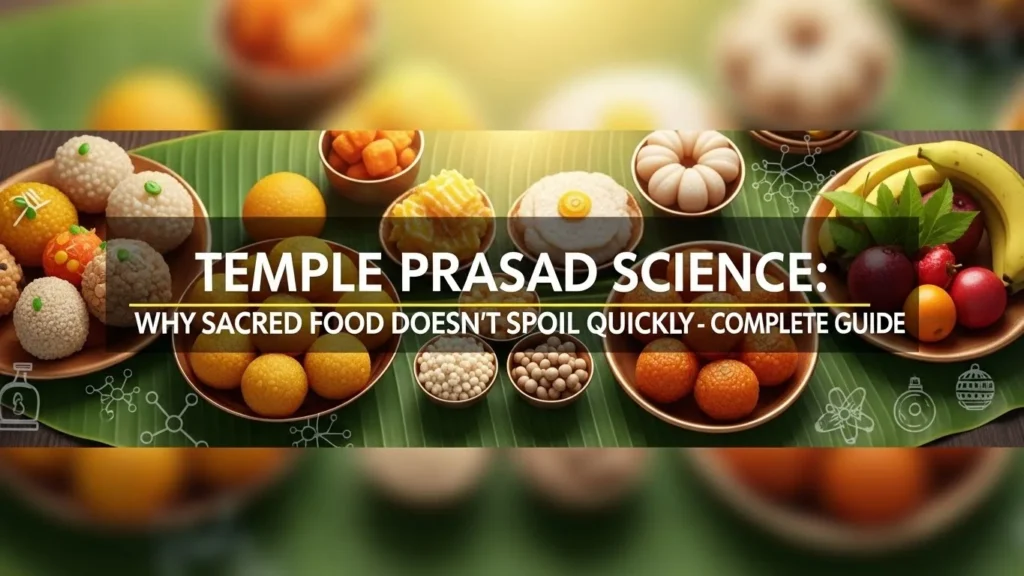
While devotees attribute prasad’s longevity to divine blessings and spiritual sanctity, rigorous food science reveals multiple factors working in concert: pure ghee acts as a natural barrier to oxygen and moisture with very low water activity levels, sugar functions as a powerful humectant binding water molecules making them unavailable for microbial growth, specific roasting processes drastically reduce initial moisture content, and ingredients like tulsi (holy basil), cardamom, and neem possess documented antimicrobial properties that inhibit bacterial proliferation.
The traditional preparation methods perfected over centuries incorporate food science principles long before modern microbiology existed: high-heat cooking creating sterile products, precise sugar syrup consistency preventing crystallization while maximizing preservation, combining ingredients while hot to seal in protective layers, and using earthenware pots that regulate temperature and moisture naturally. The spiritual dimension adds psychological and behavioral factors—prasad is handled with extreme cleanliness and reverence, consumed with gratitude rather than greed, and the very belief in its sacredness encourages proper storage and respectful treatment that prevent contamination.
However, modern storage still matters: dairy-based prasad requires refrigeration at 2-4°C, dry items need airtight containers to prevent moisture absorption, and even blessed offerings should be consumed within reasonable timeframes following food safety principles. This comprehensive guide explores the scientific principles behind prasad preservation (moisture control, natural preservatives, antimicrobial ingredients), specific examples like Tirupati laddu’s 15-day shelf life and Jagannath mahaprasad’s miraculous properties, traditional preparation wisdom, the spiritual-scientific intersection, proper modern storage techniques, and what prasad preservation reveals about Hindu philosophy‘s integration of divine grace with natural law.
The Science of Food Preservation in Prasad
Water Activity: The Key to Longevity
The single most important factor in prasad preservation is water activity (aw):
What is Water Activity?: Water activity measures the amount of “free” water available in food for microorganisms to use for growth, ranging from 0 (bone dry) to 1.0 (pure water)
Microbial Growth Thresholds:
- Most bacteria require aw above 0.90 to grow
- Molds and yeasts can survive at aw 0.80-0.85
- Below aw 0.60, virtually no microorganisms can proliferate
- Traditional prasad preparation achieves extremely low water activity levels
- Through specific cooking processes, moisture is systematically removed
- The final product reaches water activity so low that “bacteria and molds simply cannot thrive”
- The roasting process reduces moisture in the besan base
- Sugar syrup is cooked to precise consistency (low moisture)
- Pure ghee seals the laddu, preventing moisture absorption
- The combination creates a product with minimal free water
Natural Preservative Ingredients
Traditional prasad recipes incorporate powerful natural preservatives:
Temple Prasad Science Pure Ghee (Clarified Butter)
Ghee is the “hero of preservation” in many prasad items:
- Very low moisture content (almost zero water)
- Acts as a protective layer sealing food from air and moisture
- Creates a barrier preventing oxygen from reaching interior
- Has natural antioxidants preventing rancidity
- Very low water activity level contributing to overall preservation
Application in Prasad:
- Laddu: Binds ingredients while creating moisture barrier
- Payasam/kheer: Adds richness while extending shelf life
- Peda: Forms protective coating on sweets
- Halwa: Prevents drying and microbial growth
Sugar as Humectant
Sugar serves dual purposes in prasad preservation:
- Acts as a powerful humectant (substance that binds to water)
- Binds water molecules making them unavailable for microbial growth
- Creates osmotic pressure that dehydrates bacterial cells
- High sugar concentration prevents bacterial proliferation
Traditional Application:
- Precise sugar syrup consistency in laddus
- High sugar content in traditional sweets
- Balance between sweetness and preservation
Antimicrobial Spices and Herbs
Sacred ingredients possess documented antimicrobial properties:
- Rich in antimicrobial and anti-inflammatory properties
- Protects against seasonal allergies and infections
- Contains vitamins, minerals, calcium, and zinc
- Historically used in Ayurveda for medicinal purposes
- Added to prasad not just for ritual significance but health benefits
- Rich in antimicrobial properties
- Keeps body free from bacteria
- Stabilizes blood sugar and blood pressure
- Promotes oral health
- Used for centuries to ward off negative energy and invoke blessings
- Brings antimicrobial benefits
- “Ancient wisdom braided seamlessly with the body’s needs”
- Used in certain prasad preparations for purification
- Natural antimicrobial and anti-inflammatory agent
- Enhances preservation while adding health benefits
- Represent abundance symbolically
- Contain natural oils with preservative qualities
- Symbolizes completeness
- Cools the system and aids digestion
- Contains medium-chain fatty acids with antimicrobial properties
The Roasting and Cooking Process
Traditional high-heat preparation methods create sterile products:
- Flour is roasted to a specific point to reduce moisture
- The roasting process:
- Evaporates water content
- Develops flavors through Maillard reaction
- Kills any existing microorganisms
- Creates a dry, stable base
- Sugar syrup must reach exact consistency—”If it’s too thin, the laddu won’t hold shape. If it’s too thick, the laddu will be rock-hard.”
- Temple chefs (pachakas) have perfected this technique over generations
- The precision ensures optimal moisture levels for preservation
- Hot sugar syrup is combined with roasted flour while both are hot
- The mixture is shaped into laddus while still warm
- This heat helps create a sterile product
- Kills any microorganisms that might have been introduced
- Some temples use pot-over-pot cooking methods with earthen vessels
- Clay pots regulate temperature naturally
- Allow steam to escape while retaining heat
- Create ideal cooking environment for preservation
Tirupati Laddu: 15-Day Shelf Life Explained
The Sacred Recipe
Tirupati laddu is India’s most famous prasad with a protected Geographical Indication (GI) tag:
- Bengal gram flour (besan): The base
- Pure ghee: The preservative hero
- Sugar: Sweetener and humectant
- Cashew nuts: Richness and texture
- Cardamom: Flavor and antimicrobial properties
Protected Recipe: The exact recipe and proportions are guarded secrets of the Tirumala Tirupati Devasthanams (TTD), passed down through generations
The Preparation Process
Tirupati laddus are made through a meticulous process:
Step 1: Roasting the Besan
- Bengal gram flour is roasted to precise specifications
- Reduces moisture content significantly
- Creates the foundational dry base
Step 2: Preparing Sugar Syrup
- Sugar is dissolved and cooked to exact consistency
- The syrup concentration is critical for binding and preservation
- Temple chefs judge consistency through generations of experience
Step 3: Hot Combination
- The hot sugar syrup is combined with roasted flour
- Cashews and cardamom are added
- Pure ghee is incorporated throughout
- Everything is mixed while maintaining high temperature
Step 4: Shaping
- The mixture is shaped into spherical laddus while still warm
- The heat helps create sterility
- Ghee coating forms as the laddu cools
- Each laddu weighs approximately 175 grams
Why 15 Days Specifically?
The 15-day shelf life results from multiple scientific factors:
- The roasting process drastically reduces initial moisture
- Precise cooking creates minimal water activity
- Bacteria and molds cannot proliferate
- Acts as a natural barrier to oxygen and moisture
- Seals the laddu from environmental contamination
- Very low water activity level prevents microbial growth
- Binds water molecules making them unavailable for bacteria
- Creates hostile osmotic environment for microorganisms
- High-heat cooking kills existing bacteria
- Clean preparation environment
- Immediate packaging after preparation
- TTD has implemented advanced packaging systems
- Protects laddus from moisture, air, and contamination
- Extends shelf life to approximately 15 days
Storage Recommendations
To maximize the 15-day shelf life, proper storage is essential:
Keep in Original Packaging: The paper or box is designed for transport and initial protection
Transfer to Airtight Container:
- Once home, place laddus in clean, dry, airtight container
- This is the single most important step
- Prevents moisture absorption and oxidation
- Store in pantry or cupboard away from direct sunlight and heat
- Ideal temperature: Room temperature (not refrigerated)
- Refrigeration causes ghee to harden
- Sugar may crystallize, altering texture
- Won’t spoil faster, but won’t taste as it should
Consume Within 15 Days: While it may last longer under perfect conditions, 15 days is the guaranteed freshness period
Faith and Science Converge
The laddu’s longevity represents both spiritual blessing and scientific wisdom:
Devotional Perspective: Believers see the 15-day shelf life as a sign of Lord Venkateswara’s blessing
Scientific Reality: There is solid food science to back it up
Perfect Blend: “It’s a perfect blend of both” —faith and empirical knowledge working together
Culinary Miracle: Not supernatural miracle but “culinary miracle born from deep understanding of natural ingredients and sacred process honed over centuries”
Jagannath Mahaprasad: The Miraculous Preservation
The Puri Phenomenon
The mahaprasad at Jagannath Temple in Puri, Odisha exhibits extraordinary properties:
Challenging Conditions:
- Humid coastal town (Puri on Bay of Bengal)
- High temperatures and moisture-laden air
- Conditions ideal for rapid bacterial growth and spoilage
Massive Scale:
- Cooked in huge quantities daily
- Left in the open for hours before distribution
- Exposed to air, humidity, and environmental contaminants
- Never turns stale
- Never smells (no putrid odor develops)
- Never loses taste even after extended periods
Devotional Explanation: Attributed to divine blessing of Lord Jagannath, considered proof of the deity’s living presence and power
Scientific Hypotheses for Mahaprasad
While considered miraculous, several scientific factors may contribute:
Traditional Cooking Methods:
- Earthen pots used in preparation
- Natural clay regulates temperature and moisture
- Specific cooking processes creating sterile products
Ingredient Selection:
- Use of pure ghee, spices with antimicrobial properties
- Traditional recipes perfected over centuries
- High-heat cooking killing microorganisms
Temple Atmosphere:
- Constant incense smoke (antimicrobial properties)
- Specific temple architecture creating air circulation patterns
- Sacred environment maintained with extreme cleanliness
Psychological Factors:
- Immediate consumption by devoted pilgrims
- Reverent handling preventing contamination
- Belief in sanctity encouraging proper treatment
Unexplained Elements:
- Despite scientific hypotheses, some aspects remain mysterious
- Many devotees insist the preservation exceeds natural explanation
- The phenomenon continues to inspire faith and wonder
The Pot-Over-Pot Cooking Mystery
Jagannath Temple uses unique cooking method:
Stacking System:
- Earthen pots are stacked one above the other
- Multiple layers creating tower of cooking vessels
- Food in the topmost pot cooks first
- This defies normal thermodynamics (heat rises, bottom should cook first)
- Yet consistently, top pot finishes before lower pots
Possible Scientific Explanations:
- Steam pressure dynamics in stacked configuration
- Heat circulation patterns in specific arrangement
- Clay pot thermal properties creating unique cooking environment
Devotional Interpretation: Considered divine miracle demonstrating Lord Jagannath’s supernatural influence
Traditional Wisdom: Centuries of Food Science
Temple Kitchens as Laboratories
Hindu temple kitchens have functioned as empirical food science laboratories for millennia:
Experiential Knowledge:
- Generations of temple cooks (pachakas) testing and refining recipes
- Observing what ingredients, proportions, and methods preserve food longest
- Passing down precise techniques through apprenticeship
Seasonal Adaptation:
- Different prasad preparations for different seasons
- Summer offerings emphasizing cooling ingredients (coconut, sandalwood paste)
- Winter offerings providing warming energy
Cleanliness Standards:
- Ritual purity requirements ensuring extreme hygiene
- Bathing before cooking, clean clothes, sanctified spaces
- These spiritual practices coincidentally create ideal food safety conditions
Ayurvedic Principles in Prasad
Prasad recipes incorporate Ayurvedic food wisdom:
Tridosha Balance:
- Ingredients selected to balance Vata, Pitta, and Kapha doshas
- Ensuring prasad promotes health rather than imbalance
Digestive Considerations:
- Ghee as “sacred carrier of both flavor and nutrients”
- Easy-to-digest combinations
- Moderate quantities encouraging mindful consumption
- Tulsi protecting against infections
- Cardamom stabilizing blood sugar and blood pressure
- Turmeric providing anti-inflammatory benefits
- Coconut cooling the system
- “Beautiful convergence between devotion and health”
- Spiritual nourishment and physical nutrition integrated seamlessly
The Principle of Purity
Prasad is prepared with unique intentionality:
- “Prasad is not made to satisfy hunger or for good taste”
- “Made with the intention of the salvation of humankind”
Spiritual Purity Translating to Physical Purity:
- Extreme cleanliness during preparation
- Use of highest quality, uncontaminated ingredients
- Reverent handling preventing microbiological contamination
- The spiritual intention creates behavioral practices supporting preservation
Energy and Vibration:
- Traditional belief that cook’s mental state affects food
- Preparation with devotion, prayer, and positive consciousness
- Whether through subtle energetic influence or practical care, creates superior product
Modern Storage: Preserving Blessed Food
General Storage Principles
Even divinely blessed prasad benefits from proper storage:
Dry Prasad Storage
Items like laddus, besan sweets, dry fruits:
Problem: Tend to absorb moisture from air, making them soggy over time
Solution – Airtight Containers:
- Use airtight containers to maintain texture and taste
- Protects from odors and humidity
- Keeps dry prasad fresh longer
Proper Storage:
- Cool, dry place away from sunlight
- Pantry or cupboard (not refrigerator for most items)
- Avoid exposure to kitchen steam or moisture
Dairy-Based Prasad
Items like peda, rasgulla, milk cakes:
Challenge: Require precise temperature control
Without Proper Storage: These items can spoil quickly, leading to food wastage
- Store at 2°C to 4°C to keep fresh
- Place in sealed containers to prevent odor absorption
- Avoid frequent fridge openings to maintain stable cooling
Why This Works: Maintaining correct temperature prevents bacterial growth, ensuring dairy prasad remains fresh and safe to consume longer
Liquid Prasad
Items like kheer, panchamrit, chas:
- Store in glass jars with tight lids
- Keep on middle shelf for consistent cooling and freshness
- Avoid plastic containers to prevent chemical leaching and flavor alteration
- Prevents chemical reactions unlike plastic
- Ensures nutrients and flavors remain intact
- Reduces risk of spills and contamination
Organization and Labeling
Managing Multiple Prasad Items:
- Prevents contamination
- Avoids unwanted odors
- Makes tracking easier
- Ensures prasad remains fresh and ready
- Label each container with contents and date received
- Helps identify freshness
- Ensures consumption before expiry
- Prevents waste
- Store savory prasad (theplas, khichdi) separately from sweet offerings
- Prevents flavor mixing and odor transfer
- Preserves original taste
Temperature Management
Critical Error: Placing hot prasad directly into refrigerator
Problem: Rapid condensation can affect both texture and taste
Proper Method:
- Allow prasad to cool to room temperature first
- Then transfer to refrigerator if needed
- Prevents moisture accumulation
- Always use lids or cling wrap before refrigerating
- Transfer leftovers to airtight containers
- Avoid aluminum foil (doesn’t seal properly, can alter taste)
- Prevents prasad from drying out
- Prevents absorbing unwanted fridge odors
- Ensures taste and texture remain intact
Sacred Leaf Preservation
Tulsi Leaves:
- Wrap in dry paper towel before container
- Adjust fridge humidity control to medium/high
Betel Leaves:
- Store in damp cloth inside airtight box
- High humidity prevents drying out
- Keeps fresh for puja use for several days
Refrigerator Best Practices
- Overloaded refrigerator disrupts airflow
- Causes uneven cooling
- Essential to avoid stuffing beyond capacity
- Consider larger capacity refrigerator for festival periods
- Always use clean utensils when taking out prasad
- Prevents contamination
- Maintains hygiene
- Keeps prasad fresh longer during festive gatherings
The Spiritual-Scientific Intersection
Where Faith Meets Empiricism
Prasad preservation exemplifies the intersection of spiritual and material worlds:
Devotional Explanation:
- Divine blessing infuses food with protective spiritual energy
- God’s grace prevents spoilage as a sign of presence and power
- Consuming prasad transfers both physical nourishment and spiritual merit
Scientific Explanation:
- Natural preservatives, low moisture content, antimicrobial ingredients
- Precision cooking methods creating sterile, stable products
- Traditional wisdom encoding food science before modern microbiology
Integrated Understanding:
- Both perspectives contain truth and value
- Faith motivates the care and reverence that support preservation
- Science explains the mechanisms through which divine wisdom operates
- Neither explanation negates the other; they complement
The Role of Intention and Consciousness
Traditional belief holds that consciousness affects food quality:
Cook’s Mental State:
- Prasad prepared by cooks in purified, devotional consciousness
- Prayer, mantras, and positive intention during preparation
- Belief that subtle energies influence material substances
Scientific Correlate:
- Positive mental state correlates with careful, hygienic practices
- Devotional focus creates attention to detail preventing errors
- Reverent handling reduces contamination risk
- Whether through energy or behavior, consciousness matters
Recipient’s Attitude:
- Prasad consumed with gratitude and reverence
- Belief in blessing enhances psychological and possibly physiological benefits
- Mindful eating promotes better digestion and health
Purity as Multi-Dimensional Concept
Prasad embodies holistic purity:
Physical Purity:
- Highest quality ingredients
- Extreme hygiene during preparation
- Absence of contamination
Ritual Purity:
- Prepared in sanctified spaces
- By ritually purified individuals
- Following prescribed methods
- “Convergence between devotion and health”
- Ingredients chosen for health benefits
- Balanced, wholesome nutrition
- Made for “salvation of humankind”
- Transforming material food into divine grace
- Vehicle for spiritual transmission
Frequently Asked Questions
Why doesn’t temple prasad spoil quickly?
Temple prasad resists spoilage through multiple scientific factors: low moisture content achieved through precise roasting and cooking processes creating water activity levels where bacteria and molds cannot thrive, pure ghee acting as a natural barrier sealing food from air and moisture, sugar functioning as a powerful humectant binding water molecules making them unavailable for microbial growth, and antimicrobial ingredients like tulsi (holy basil), cardamom, neem, and turmeric inhibiting bacterial proliferation. Traditional high-heat cooking creates sterile products, while extreme cleanliness standards prevent contamination.
How long does Tirupati laddu last?
Tirupati laddu lasts approximately 15 days due to its unique preparation method combining roasted besan (low moisture), pure ghee (protective barrier), precise sugar syrup consistency (preservation), and advanced packaging systems implemented by Tirumala Tirupati Devasthanams (TTD). The low water activity prevents bacterial and mold growth, while ghee seals the laddu from environmental moisture and oxygen. For maximum freshness, store in airtight containers in a cool, dry place away from sunlight—do NOT refrigerate as this alters texture.
What are the antimicrobial ingredients in prasad?
Sacred prasad ingredients possess documented antimicrobial properties: tulsi (holy basil) is rich in antimicrobial and anti-inflammatory compounds protecting against infections, cardamom contains antimicrobial properties keeping the body free from bacteria while stabilizing blood sugar and blood pressure, neem brings antimicrobial benefits with ancient medicinal wisdom, turmeric provides natural antimicrobial and anti-inflammatory action, and coconut contains medium-chain fatty acids with antimicrobial properties. These ingredients were chosen not just for ritual significance but for tangible health benefits.
Why is pure ghee important in prasad preservation?
Pure ghee is the “hero of preservation” in prasad because it has very low moisture content (almost zero water), acts as a protective layer sealing food from air and moisture exposure, creates a barrier preventing oxygen from reaching the interior, contains natural antioxidants preventing rancidity, and has a very low water activity level that prevents microbial growth. In items like laddus, ghee binds ingredients while creating a moisture-resistant coating; in payasam and peda, it adds richness while extending shelf life by preventing bacterial proliferation.
What is the miracle of Jagannath mahaprasad?
Jagannath Temple mahaprasad in humid coastal Puri reportedly never turns stale, never smells, and never loses taste despite being cooked in huge quantities and left in the open for hours in conditions ideal for rapid bacterial growth. Additionally, the temple uses a pot-over-pot cooking method where earthen pots are stacked, and mysteriously, food in the topmost pot cooks first despite being farthest from the heat source. While devotees attribute this to Lord Jagannath’s divine blessing, possible scientific factors include traditional earthen pot thermal properties, antimicrobial ingredients, temple incense smoke, and immediate reverent consumption.
How should I store dairy-based prasad?
Dairy-based prasad like peda, rasgulla, and milk cakes require precise temperature control and can spoil quickly without proper storage. Store at 2°C to 4°C in the refrigerator, place in sealed containers to prevent odor absorption, and avoid frequent fridge openings to maintain stable cooling. This temperature range prevents bacterial growth, ensuring dairy prasad remains fresh and safe to consume longer. Use glass containers rather than plastic to prevent chemical leaching and flavor alteration.
Should prasad be refrigerated?
It depends on the type: dry prasad like laddus, besan sweets, and dry fruits should NOT be refrigerated as this can harden ghee and crystallize sugar, altering texture—store these in airtight containers in a cool, dry pantry instead. However, dairy-based prasad (peda, rasgulla, milk cakes) MUST be refrigerated at 2-4°C to prevent spoilage. Liquid prasad like kheer and panchamrit should be stored in glass jars with tight lids in the refrigerator’s middle shelf. Always allow hot prasad to cool before refrigerating to prevent condensation.
Is prasad preservation spiritual or scientific?
Prasad preservation represents a “perfect blend of both” faith and science. Devotees believe the longevity is a sign of divine blessing and the deity’s living presence, while solid food science backs up the preservation through low moisture content, natural preservatives, antimicrobial ingredients, and precision cooking methods. The tradition exemplifies a “beautiful convergence between devotion and health” where spiritual intention creates reverent handling and extreme cleanliness, while traditional wisdom encodes sophisticated food science principles developed over centuries before modern microbiology. Neither explanation negates the other; they complement and enrich understanding.
Conclusion
Temple prasad preservation stands as a profound testament to the integration of spiritual devotion and empirical wisdom—where centuries of observational food science created recipes and preparation methods that modern microbiology now validates, demonstrating that traditional Hindu temple kitchens functioned as empirical laboratories long before the germ theory of disease existed. The Tirupati laddu’s remarkable 15-day shelf life results not from supernatural intervention alone but from the brilliant application of natural preservatives (pure ghee’s moisture barrier, sugar’s water-binding properties), antimicrobial ingredients (tulsi, cardamom, turmeric, neem), precision cooking techniques creating low water activity and sterile products, and advanced packaging—a “culinary miracle born from deep understanding of natural ingredients and sacred process honed over centuries”.
The even more mysterious Jagannath mahaprasad that never turns stale in humid coastal conditions, and the pot-over-pot cooking where topmost pots finish first defying thermodynamics, reveal that some aspects of prasad may indeed transcend current scientific understanding—or perhaps simply await fuller investigation of the complex interactions between traditional earthen cookware, specific ingredient combinations, temple atmospheric conditions, and cooking processes perfected over millennia. Whether one attributes prasad’s preservation primarily to divine blessing or natural law, the phenomenon demonstrates Hindu philosophy‘s characteristic refusal to separate spiritual and material realms, recognizing instead that God’s grace often operates through natural principles, and that reverence for the sacred naturally produces practical benefits including food safety, nutritional wisdom, and community health.
Modern devotees can honor both dimensions—maintaining faith in prasad’s spiritual sanctity while applying scientific storage principles (airtight containers for dry items, refrigeration at 2-4°C for dairy-based offerings, glass containers for liquids, proper labeling and temperature management) that extend blessed food’s freshness, prevent waste, and ensure safety.
The convergence of devotion and health that ancient temple traditions exemplify offers contemporary wisdom: that the most profound spirituality doesn’t reject material reality but understands and works skillfully with natural law, that purity in intention naturally produces purity in practice, and that food prepared with consciousness, consumed with gratitude, and treated with reverence nourishes body and soul simultaneously—a lesson prasad has embodied for millennia, teaching that the divine and natural are not opposed but beautifully, mysteriously integrated in ways that modern science increasingly confirms while ancient faith has always known.
About the Author
Neha Kulkarni – Cultural Heritage & Temple Architecture Specialist
Neha Kulkarni is an accomplished writer and researcher specializing in Hindu festivals, temple architecture, and India’s rich cultural traditions. With a Master’s degree in Indian Art History from Maharaja Sayajirao University, she has extensively documented pilgrimage sites, temple iconography, and folk traditions across India. Her work focuses on making India’s spiritual heritage accessible to contemporary audiences while preserving authentic cultural narratives.