


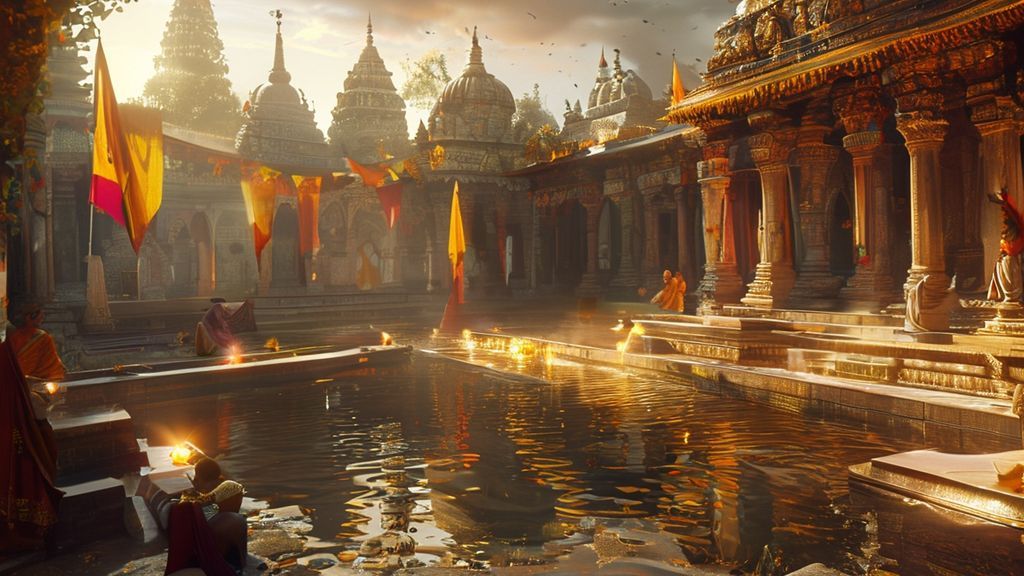
Temple Tanks, known as Pushkarini or Kalyani in Sanskrit, are sacred reservoirs meticulously integrated into Hindu temple complexes, serving as vital spaces for ritual purification, spiritual contemplation, and ecological balance. These holy ponds symbolize cosmic waters, facilitate devotees’ ablutions before darshan, and are integral to various Vedic ceremonies, embodying purity and divinity within Sanatan Dharma.
| Attribute | Details |
|---|---|
| Associated Deities | Lord Shiva (associated with Ganga), Lord Vishnu (Narayana as Jalashayi), Devi (manifesting as sacred springs), Varuna (God of Waters). |
| Location/Origin | Predominantly South India (Dravidian architecture), but also found in Nagara style temples. Scriptural origins in Vedic texts (Yajurveda, Atharvaveda) glorifying sacred waters and Puranas describing tirtha mahima. |
| Key Festivals | Mahamaham Festival (Kumbakonam), Pushkaram (river-specific), Teppotsavam (Float Festival), Snana Yatra, Karthika Purnima. |
| Scripture Reference | Skanda Purana (Kashi Khanda), Matsya Purana, Agni Purana, Padma Purana, Vastu Shastra texts like Mayamata and Manasara. |
The Sanctity of Sacred Ponds in Sanatan Dharma
In the vast tapestry of Sanatan Dharma, water holds an unparalleled position of reverence, considered the very source of life and purity. Temple tanks, known by various names such as Pushkarini, Kalyani, Sarovar, or Theertham, are not mere architectural adjuncts but living embodiments of this profound truth. These sacred reservoirs are meticulously planned and constructed within or adjacent to temple complexes, forming an indispensable part of the devotee’s spiritual journey. They serve as conduits for purification, enabling devotees to cleanse themselves ritually before entering the sanctum sanctorum for Darshan. Beyond their practical utility, these tanks symbolize the cosmic ocean, the primordial waters from which creation emerged, and represent the confluence of sacred rivers like Ganga, Yamuna, and Saraswati. Their presence underscores the holistic approach of Hindu worship, integrating nature’s elements into the divine experience and reflecting the deep ecological wisdom embedded in our traditions. They are silent witnesses to millennia of devotion, prayers, and transformative spiritual experiences, acting as a microcosm of the sacred geography of Bharatavarsha.
Puranic History & Legend: Waters of Creation and Cleansing
The significance of sacred water bodies, from mighty rivers to humble temple tanks, is deeply embedded in the Puranic narratives and Vedic literature. The Rigveda itself glorifies water as Apah, the divine mother, source of healing and purification. The concept of Tirtha, a sacred ford or crossing point where one can traverse from the mundane to the divine, is extensively elaborated in the Skanda Purana, particularly in its Kashi Khanda. This text details the spiritual merit acquired by bathing in specific tirthas, asserting that even a drop of water from these sacred spots holds immense purifying power. The story of Varaha, Vishnu’s boar avatar, lifting the earth from the cosmic waters (as recounted in the Matsya Purana and Vishnu Purana), highlights water’s foundational role in creation. Many temple tanks are associated with specific legends where deities performed austerities, vanquished demons, or manifested their divine presence. For instance, the Mahamaham tank in Kumbakonam is believed to be where all nine sacred rivers converge every twelve years, a legend supported by the Brahma Purana. The construction of temple tanks is often linked to benevolent kings or sages seeking spiritual merit, performing great yajnas, or establishing a sacred space for public benefit, as detailed in various sthala Puranas (local temple legends). These tanks are not just water bodies; they are tangible links to divine events and ancestral wisdom, preserving the sanctity of these ancient stories for generations of devotees who visit Hindutva.online.
Architectural & Scientific Marvels: Engineering for Eternity
Temple tanks are masterpieces of ancient Indian architecture and hydraulic engineering, demonstrating an advanced understanding of water management, geology, and aesthetics. Whether it’s the elaborate stepwells of Gujarat and Rajasthan or the vast temple tanks of South India, their design is meticulously planned according to Vastu Shastra principles. Texts like Mayamata and Manasara provide precise guidelines for the orientation, dimensions, and construction materials for these water bodies, ensuring harmony with the surrounding temple complex and cosmic energies. In Dravidian architecture, Pushkarinis (rectangular or square tanks) and Kalyanis (ornate tanks with steps) are often central features, flanked by pillared corridors (mandapas) or featuring a central island shrine (Neerazhimandapam) for deities to be brought during festivals like Teppotsavam. The engineering brilliance is evident in the sophisticated systems for water ingress and egress, often drawing from underground springs, canals from nearby rivers, or rainwater harvesting. Many tanks incorporate natural filtration systems using layers of sand, gravel, and charcoal, ensuring the water remains relatively clean despite continuous use. The terraced steps leading down to the water are not merely functional but also aesthetically pleasing, creating a sense of descent into a sacred space while preventing erosion and facilitating easy access. These tanks often reflect the temple gopurams, creating breathtaking reflections that symbolize the union of the earthly and the divine, providing solace and inspiration.
Rituals & Puja Vidhi: The Sacred Dip
Bathing in a temple tank is far more than a physical act; it is a profound spiritual ritual designed to cleanse the mind, body, and soul, preparing the devotee for the divine darshan. It is an act of purification, a symbolic shedding of impurities before seeking communion with the Divine. The practice is rooted in the belief that sacred waters can absolve sins and bestow blessings.
Steps for a Sacred Dip (Snana Vidhi):
- Sankalpa (Intention): Before entering the water, a devotee traditionally makes a sincere intention or resolution (Sankalpa), mentally or verbally dedicating the act of bathing to a specific deity or for a particular spiritual benefit.
- Entry with Reverence: Approach the tank with humility and respect. Gently descend the steps, remembering the sanctity of the water.
- Achamana & Prokshana (Sipping & Sprinkling): Some traditions involve sipping a small amount of water (Achamana) and sprinkling it over oneself (Prokshana) before the full dip.
- The Sacred Dip: Take a minimum of three dips, immersing the entire body. While dipping, one might silently chant a mantra or pray to the deity.
- Pranayama & Meditation: After bathing, stand on the steps, perform a few rounds of Pranayama (breath control), and offer silent prayers, allowing the cleansed state to deepen spiritual focus.
- Changing & Darshan: Change into clean, dry clothes. Do not re-enter the temple premises in wet clothes. Proceed to the temple for Darshan of the presiding deity with a purified body and mind.
- Tarpanam (Ancestral Offerings): For specific occasions like Amavasya or during Pitru Paksha, devotees perform Tarpanam, offering water to ancestors (Pitrus) while standing in the tank, seeking their blessings and liberation.
Mantras & Chants for Purification
When approaching or bathing in a temple tank, chanting specific mantras enhances the spiritual efficacy of the act, invoking the divine energies of purification and the sacred rivers. These chants connect the local waters to the universal divine waters.
- Ganga Avahanam Mantra: Often recited to invoke the presence of all sacred rivers into the local water body.
गंगे च यमुने चैव गोदावरि सरस्वति।
नर्मदे सिन्धु कावेरि जलेऽस्मिन् सन्निधिं कुरु॥
Gaṅge ca Yamune caiva Godāvari Sarasvati,
Narmade Sindhu Kāveri jale’smin sannidhiṁ kuru.
(O Ganga, Yamuna, Godavari, Saraswati, Narmada, Sindhu, Kaveri, be present in this water.)
- Varuna Mantra: Invoking Varuna, the deity of cosmic waters and justice.
ॐ भूर्भुवः स्वः तत्सवितुर्वरेण्यं भर्गो देवस्य धीमहि धियो यो नः प्रचोदयात् ।
आपो हि ष्ठा मयोभुवस्ता न ऊर्जे दधातन महे रणाय चक्षसे ॥
Om Bhurbhuvah Swah Tat Savitur Varenyam Bhargo Devasya Dhimahi Dhiyo Yo Nah Prachodayat.
Apo Hi Stha Mayo Bhuvah, Taa Na Urje Dadhatana, Mahe Ranaya Chakshase.
(A purification prayer, invoking the waters for nourishment, strength, and clear perception.)
Dos and Don’ts for Temple Tank Etiquette
Maintaining the sanctity and purity of temple tanks is a collective responsibility for all devotees. Adherence to these guidelines ensures a respectful and spiritually enriching experience for everyone.
- DO take a ceremonial bath before entering the main temple for Darshan.
- DO wear modest clothing suitable for bathing in public, ideally fresh and clean.
- DO offer silent prayers and mantras while taking a dip.
- DO dispose of flowers and other biodegradable offerings respectfully in designated areas, not directly into the tank if not part of a specific ritual.
- DO change into dry, clean clothes immediately after bathing before proceeding to the temple.
- DON’T use soap, shampoo, or detergents in the tank.
- DON’T wash clothes or personal items in the tank.
- DON’T litter the tank or its surroundings with plastic, food waste, or non-biodegradable items.
- DON’T engage in boisterous talk, play, or disrespectful behavior near the sacred water.
- DON’T enter the tank under the influence of intoxicants.
- DON’T allow children to treat the tank as a swimming pool.
Why are temple tanks important in Hinduism?
Temple tanks are paramount in Hinduism for several reasons: they enable ritual purification (Snana) before approaching the deity, symbolizing the cleansing of body and mind; they represent cosmic waters and sacred rivers, bringing the essence of tirthas to the temple; they support local ecosystems; and they serve as vital spaces for community gatherings during festivals, deepening the spiritual connection of devotees with their faith and environment.
What are the different names for temple tanks in Sanskrit?
In Sanskrit, temple tanks are known by several evocative names, each carrying a subtle nuance. Common terms include Pushkarini (lotus pond, often implying beauty and sacredness), Kalyani (auspicious or beautiful reservoir), Sarovar (a large lake or pond), and Theertham (a sacred water body or crossing place, emphasizing its spiritual efficacy).
How do ancient temple tanks manage water quality?
Ancient temple tanks employed sophisticated hydraulic engineering and ecological principles to manage water quality. They often relied on natural springs, underground aquifers, or rainwater harvesting for replenishment. Designs frequently included multiple inlets and outlets to ensure circulation, while the steps and surrounding areas were constructed to minimize sediment ingress. Some systems used natural filtration through sand and gravel layers, and the periodic cleaning by local communities, guided by traditional knowledge, was also crucial. The very act of devotion and adherence to strict bathing etiquettes by devotees also contributed to maintaining purity.
Dharmic Significance: Preserving Purity, Sustaining Sanatan Dharma
The venerable institution of temple tanks serves as a profound testament to the enduring wisdom of Sanatan Dharma. These sacred ponds are more than just architectural elements; they are vital conduits of spiritual energy, environmental custodians, and cultural anchors. By providing a tangible space for ritual purity, they facilitate the inner journey of the devotee, preparing them to truly perceive the divine. Their architectural marvels reflect ancient India’s scientific acumen and respect for nature, deeply interwoven with Vastu Shastra. In a world increasingly disconnected from natural rhythms and spiritual introspection, temple tanks stand as powerful reminders of our intrinsic connection to the elements, to our ancestors, and to the cosmic order. They are living temples of water, reflecting not just the sky above but the profound depths of human faith. Protecting and revering these sacred waters is not merely an act of tradition; it is an act of preserving the very essence of our Dharma, ensuring that the streams of spiritual knowledge and purity continue to flow for future generations, inspiring all who seek solace and truth on Hindutva.online.