

Tirumala Temple History atop the sacred seven hills (Seshachalam Hills) at 2,799 feet altitude in Andhra Pradesh—one of the oldest functioning temples in India with origins dating to 500 BCE-300 CE Sangam literature mentions and physical construction beginning around 300 CE—embodies a profound convergence of ancient Hindu mythology and continuous historical patronage, with Wikipedia’s authoritative documentation confirming that the temple dedicated to Lord Venkateswara (Srinivasa manifestation of Vishnu who descended to Tirumala during Kali Yuga to save mankind from trials and troubles, hence called Kaliyuga Vaikuntha meaning “directly visible god of Kali Yuga”) was first built by Thondaiman king of Thondaimandalam (present-day Kanchipuram) after visualizing Vishnu in his dream constructing

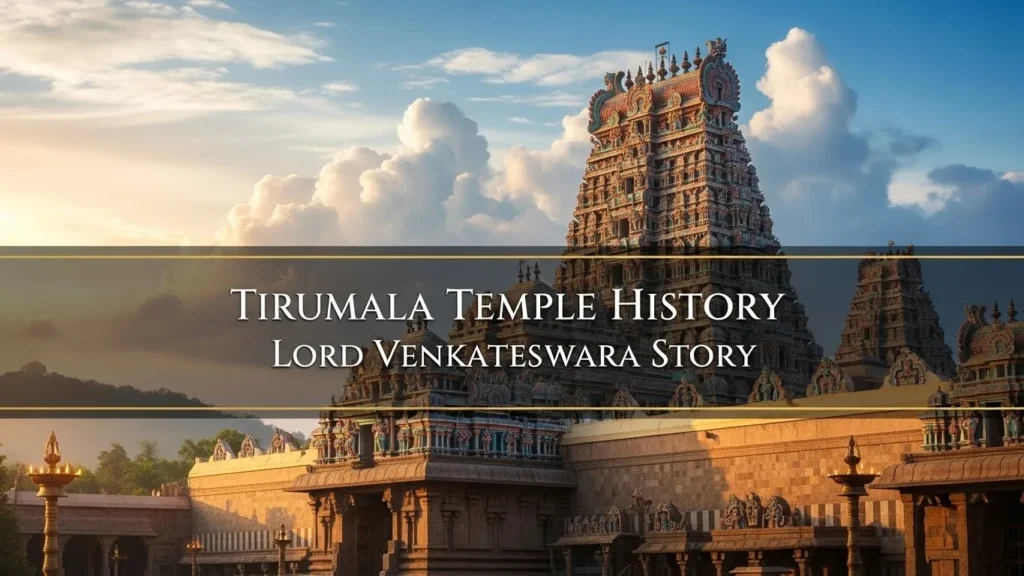
the original gopuram and prakhara with regular worship arrangements, then vastly improved and endowed by successive dynasties including Pallava queens (966 CE first recorded endowment by Queen Samavai donating jewels and land), Chola kings (10th century rich endowments with inscriptions still visible on prakara walls), and achieving its current magnificent grandeur under Vijayanagara Empire (14th-16th century golden age) when Emperor Krishnadevaraya in 1517 donated gold and jewels enabling
the Ananda Nilayam inner shrine dome to be gilded, with the temple constructed in South Indian Dravidian Tamil architectural style featuring unique elements like thousand-pillared mandapam, ornate Tirumalaraya swing pavilion, four tall pavilions in outer prakara corners, and garbhagriha below ground level housing the self-manifested deity discovered centuries ago when a shepherd noticed his cow giving milk to an anthill-covered spot.
According to the profound mythological foundation documented in Sri Venkatachala Mahatyam, Varaha Purana, Bhavishyottara Purana, and Skanda Purana, the sacred Tirumala Hills originated during Dwapara Yuga when celestial serpent Adisesha (Vishnu’s bed) and Vayu (wind god) engaged in a contest to determine who was stronger—Adisesha blocked Vayu from entering Vaikuntha as Lord Vishnu was in private company with consort Lakshmi, the incensed Vayu challenged Adisesha to prove superior might by attempting to blow him off the holy Meru mountain while Adisesha would protect the peak with his hood—after prolonged battle Vayu appeared to yield, but when Adisesha lifted his hoods assuming victory,
Vayu cunningly blew away one peak (Ananda Hill) which landed near Swarnamukhi river in present-day Andhra Pradesh, and when dejected Adisesha lamented his defeat, the compassionate gods transformed him into the seven sacred hills with his hood becoming Seshadri/Seshachalam/Venkatadri (highest peak where Lord Venkateswara resides), thus creating the sanctified landscape where Vishnu chose to dwell during Kali Yuga as the Adi Varaha (boar incarnation who rescued Earth from cosmic ocean) also appeared on the western bank of temple tank. The deeply moving Srinivasa-Padmavati love story central to temple worship reveals when Sage Bhrigu once tested the Trimurti (Brahma, Shiva, Vishnu) by kicking their chests to determine who was superior—arriving at Vaikuntha he found Vishnu resting with Lakshmi and kicked
the Lord’s chest in anger at being ignored, but Vishnu instead of retaliating gently apologized and massaged the sage’s feet asking if his foot was hurt—this supreme humility honored Bhrigu but deeply offended Goddess Lakshmi because Vishnu touched the sage’s foot that had kicked the divine chest (Lakshmi’s eternal abode), feeling disrespected she angrily left Vaikuntha and descended to Earth taking birth as Princess Padmavati (discovered as infant inside golden lotus by King Akasa Raja while ploughing field, Sage Narada revealed she was born through divine boon for royal couple’s penance)—heartbroken Vishnu incarnated as Srinivasa (handsome youth) and descended to Tirumala Hills in search of his beloved, was found and raised by Vakuladevi (cowherdess representing Yashoda)
who didn’t know his true identity, and one fateful day while hunting Srinivasa saw extraordinarily beautiful Padmavati in forest and they fell deeply in love at first sight—revealing his true identity as Lord Krishna to Vakuladevi, Srinivasa explained he had promised Vedavati (Sita’s previous birth who self-immolated unable to marry Rama) that he would marry her in next incarnation as Padmavati, desperate Vakuladevi arranged the marriage proposal to Akasa Raja and Queen Dharanidevi who consulted sage Brihaspati confirming the union was divinely ordained.
The legendary Kubera loan transaction that drives eternal devotee donations reveals Lord Srinivasa needing to impress wealthy King Akasa Raja before marriage and finance the grand wedding expenses (some versions say Akasa Raja looked down upon penniless Srinivasa demanding he prove himself by bearing dowry to marry his daughter), so Srinivasa approached Kubera (celestial treasurer and god of wealth) requesting a loan of 1 crore plus 1.14 crore gold coins (total 1.4 million Ramamudra coins in Dwapara Yuga calculation, astronomically monumental sum even by divine standards
Kubera agreed to lend the money for the divine wedding of Vishnu incarnate with Padmavati (earthly manifestation of Lakshmi reuniting), and Srinivasa commissioned Vishvakarma (divine architect) to create heavenly surroundings on Seshadri hills transforming the landscape into magnificent wedding venue—after the grand celestial marriage ceremony where all gods and goddesses attended as witnesses blessing
the divine couple, Srinivasa and Padmavati lived together for all eternity on Venkatadri hill while Goddess Lakshmi understanding Vishnu’s cosmic commitments chose to reside forever in his heart, but the debt to Kubera remains eternal and unpaid throughout Kali Yuga—creating the sacred tradition where devotees worldwide donate money to Venkateswara’s hundi (donation box) believing they help the Lord repay
this divine loan with conviction that Srinivasa blesses donors with ten times the contributed value plus Goddess Lakshmi’s prosperity, making offerings a sacred obligation rather than optional charity. The meticulous historical construction timeline documents Sangam literature Silapadikaram (500 BCE-300 CE) mentioning “Nediyon Kunram” (Thiruvengadam/Tirupati) as Tamil kingdoms’ northernmost frontier with detailed deity description in Book 11 lines 41-51, Pallava dynasty (6th-9th century CE) earliest temple patronage with first recorded endowment by Queen Samavai in 966 CE donating jewels and two land parcels (10 and 13 acres) with revenues for major festivals, Chola dynasty (10th century) vast improvements and rich endowments with inscriptions on prakara walls, Vijayanagara Empire (14th-16th century)
golden age transforming temple into magnificent complex—Madhavadasa in 1417 CE constructed Tirumamani Mandapam in front of Bangaru Vakili, Pedda Tirumalacharya in 1535 CE renovated temple tank and Adivaraha shrine, Saluva Narasimharaya in 1470 CE erected four tall four-pillared pavilions in outer prakara corners and instituted Dolamahothsavam Anna-Unjal Tirunal festival, Tirumalaraya in 1561 CE built ornate two-stage Mandapam south of Dhwajastambha with swing pavilion, and most famously Emperor Krishnadevaraya in 1517 CE donated gold and jewels gold-plating the Ananda Nilayam inner shrine vimana dome and installing statues of himself with consorts still visible today,
plus constructing thousand-pillared mandapam and Kodanda Rama Temple at Tirupati—followed by Ramanujacharya’s three transformative visits (learning Ramayana esoteric meaning from uncle Tirumalai Nambi, settling Shaivite-Vaishnavite dispute, installing Govindaraja image and founding present Tirupati town at advanced age 102) where he streamlined rituals according to Vaikhanasa Agama tradition, introduced Naalayira Divya Prabandham recitation, and established Tirupati Jeeyar Mutt in 1119 CE to institutionalize service and supervise temple rituals still observed today.
As millions undertake pilgrimage to the world’s richest temple understanding its profound three-millennia legacy—from 500 BCE Sangam literature references to current ₹5,258 crore annual budget managed by Tirumala Tirupati Devasthanams (TTD formed 1933 under Andhra Pradesh government after British East India Company 19th century management through Bruce’s Code 1821 and Mahants of Hathiramji Muth 1843-1933 administration), with the temple bearing over 640 inscriptions in Tamil, Telugu, Kannada, Sanskrit on walls documenting patronage history,
plus unique collection of 3,000 copper plates inscribed with Tallapaka Annamacharya’s Telugu Sankirtanas providing invaluable linguistic-musicological material, understanding complete Srinivasa-Padmavati divine love story reuniting Vishnu-Lakshmi after Sage Bhrigu’s test, Kubera’s eternal loan creating devotional donation tradition, Adisesha-Vayu contest origin of seven sacred hills, Vedavati’s previous birth promise fulfillment, Vakuladevi cowherdess adopted mother’s role, Akasa Raja’s golden lotus discovery, self-manifested deity under anthill, Tondaiman’s dream vision first construction, Vijayanagara golden age grandeur, and Ramanujacharya’s ritual systematization becomes essential for meaningful Hindu pilgrimage connecting ancient mythology with living tradition https://hindutva.online.
This comprehensive article presents Tirumala Temple’s complete 3,000-year history from Sangam literature to modern TTD management, Lord Venkateswara’s Srinivasa incarnation story with Sage Bhrigu’s test and Lakshmi’s departure, Srinivasa-Padmavati divine love story and Vedavati promise fulfillment, Kubera loan legend creating eternal donation tradition, Adisesha-Vayu contest creating seven sacred hills, complete construction timeline under Pallava-Chola-Vijayanagara dynasties, and temple’s evolution into world’s richest and most visited religious site.
The Mythological Foundation: Why Lord Venkateswara Came to Tirumala
Sage Bhrigu’s Test of the Trimurti
When Bhrigu visited Lord Vishnu who was in a private meeting with his consort Goddess Lakshmi and failed to immediately receive and honour the sage, the sage felt humiliated and angry by this act. Sage Bhrigu kicked Lord Vishnu in the chest, to which Vishnu did not react and instead apologized to the Sage by massaging his feet.
- Sage Bhrigu wanted to determine who among Trimurti was greatest
- Visited Brahma, Shiva, and Vishnu to test them
- Arrived at Vaikuntha found Vishnu resting with Lakshmi
- Ignored and angry, kicked Lord Vishnu’s chest
- Vishnu did not retaliate but instead apologized
- Massaged sage’s feet asking “Did my chest hurt your foot?”
- Supreme humility honored Bhrigu
Lakshmi Leaves Vaikuntha in Anger
- Vishnu’s chest = Lakshmi’s eternal abode
- Sage kicked Lakshmi’s dwelling place
- Instead of punishment, Vishnu touched sage’s foot
- Lakshmi felt deeply disrespected
- Angrily left Vaikuntha
- Descended to Earth
Vishnu Descends as Srinivasa Searching for Lakshmi
Lord Vishnu incarnated as Srinivasa and descended to Tirumala in search of her.
- Heartbroken Vishnu couldn’t live without Lakshmi
- Incarnated as Srinivasa (handsome youth)
- Descended to Tirumala Hills
- In search of beloved consort
- Chose to stay on Venkatadri hill
- Kaliyuga Vaikuntha = “Directly visible god of Kali Yuga”
Raised by Vakuladevi the Cowherdess
- Vakuladevi (cowherdess) found infant Srinivasa
- Raised him as her own son
- Represented Yashoda (Krishna’s foster mother)
- Didn’t know his true divine identity
- Brought him daily meals with love
- Later helped arrange his marriage
The Divine Love Story: Srinivasa and Padmavati
Padmavati’s Divine Birth
King Akasa Raja while ploughing field, discovered infant inside golden lotus, Sage Narada revealed she was born through divine boon.
- King Akasa Raja of Narayanavanam
- Queen Dharanidevi performed penance
- Sage Narada blessed with divine child
- Akasa Raja ploughing field
- Discovered infant inside golden lotus
- Named her Padmavati (lotus-born)
- She was Goddess Lakshmi incarnate
Vedavati’s Previous Birth Promise
- In Treta Yuga, Vedavati performed penance
- Wanted to marry Lord Rama
- But Rama was bound to Sita (eka-patni-vrata)
- Ravana attempted to molest Vedavati
- She self-immolated in fire
- Rama promised: “I will marry you in next birth“
- Vedavati reborn as Padmavati
- Rama reborn as Srinivasa (Krishna/Vishnu)
Love at First Sight in the Forest
One fateful day while hunting Srinivasa saw extraordinarily beautiful Padmavati in forest and they fell deeply in love at first sight.
- Srinivasa hunting in forests
- Saw Padmavati with her companions
- Struck by her divine beauty
- Fell in love immediately
- Padmavati also felt same attraction
- Both pining for each other
Vakuladevi Arranges the Marriage
After listening to Srinivasa’s story of how he had promised to marry Vedavati in her next birth as Padmavati, Vakuladevi realised that Srinivasa would not be happy unless he married Padmavati. She offered to go to Akasa Raja and his Queen and arrange for the marriage.
- Srinivasa returned home lovesick, refusing food
- Vakuladevi inquired about cause
- Srinivasa revealed his love for Padmavati
- Narrated story of Vedavati promise
- Revealed true identity as Lord Krishna/Vishnu
- Vakuladevi realized divine plan
- Offered to arrange marriage proposal
Tirumala Temple History Meeting Padmavati’s Parents
- Vakuladevi traveled to King’s palace
- Met maidservants returning from Shiva temple
- Learned Padmavati also pining for Srinivasa
- Vakuladevi met Queen Dharanidevi
- Fortune-teller had already predicted divine marriage
- Queen welcomed the proposal
Akasa Raja Consults Sage Brihaspati
Akasa Raja consulted Brihaspati about the propriety of the marriage and was informed that the marriage was in the best interest of both the parties.
- Akasa Raja consulted Sage Brihaspati
- Brihaspati confirmed marriage divinely ordained
- Best interest of both parties
- Fixed auspicious date for wedding
- Royal couple agreed with joy
The Kubera Loan: Eternal Debt of Devotion
Lord Srinivasa Needs Wedding Funds
Srinivasa sought a loan of one crore and 1.14 crore (1,14,00,000) coins of gold from Kubera and had Vishvakarma, the divine architect, create heavenly surroundings in the Seshadri hills.
- Grand wedding required massive expenses
- Srinivasa needed to impress wealthy king
- Some versions: Akasa Raja demanded dowry
- Looked down upon “penniless” Srinivasa
- Lord wanted to prove himself
Borrowing 1.4 Million Gold Coins from Kubera
The amount borrowed was an astonishing 1.4 million Ramamudra coins, a sum considered monumental even by divine standards.
- Approached Kubera (god of wealth, celestial treasurer)
- Loan amount: 1 crore + 1.14 crore = ₹2.14 crore gold coins
- In Dwapara Yuga currency: 1.4 million Ramamudra coins
- Monumental sum even by divine standards
- Purpose: Finance Padmavati marriage
Divine Architect Creates Heavenly Wedding Venue
- Commissioned Vishvakarma (divine architect)
- Create heavenly surroundings on Seshadri hills
- Transform landscape into magnificent venue
- Befitting divine wedding
The Grand Celestial Wedding
- All gods and goddesses attended
- Brahma performed ceremony (Brahmotsavam origin)
- Witnessed by entire divine pantheon
- Padmavati and Srinivasa united
- Lakshmi reunited with Vishnu
Living Together for Eternity on Venkatadri
- Srinivasa and Padmavati lived together
- For all eternity on Venkatadri hill
- Goddess Lakshmi understanding Vishnu’s commitments
- Chose to reside in his heart forever
The Eternal Unpaid Debt
- Debt to Kubera remains unpaid
- Throughout Kali Yuga
- Devotees worldwide donate to hundi
- Believe they help Lord repay loan
- Conviction: Srinivasa gives 10x blessing
- Plus Goddess Lakshmi’s prosperity
- Sacred obligation, not optional charity
Origin of Seven Sacred Hills: Adisesha-Vayu Contest
The Divine Contest at Meru Mountain
During Dwapara Yuga, Adisesha blocked Vayu from entering Vaikuntam as Lord Vishnu was in the company of His consort, Lakshmi. An incensed Vayu challenged Adisesha to a fight to decide the stronger between them.
- Adisesha (celestial serpent, Vishnu’s bed)
- Blocked Vayu from entering Vaikuntha
- Vishnu in private with Lakshmi
- Vayu incensed at being stopped
- Challenged Adisesha to prove superiority
Vayu’s Cunning Victory
Vayu was tasked with trying to blow off Adisesha from the holy Meru mountain while Adisesha was asked to protect the peak with his hood. After a long time, Vayu appeared to yield and Adisesha lifted his hoods assuming that he had won the contest. Vayu then blew away one of the peaks.
- Adisesha’s task: Protect Ananda peak with hood
- Vayu’s task: Try to blow him off Meru
- Prolonged contest raged
- Vayu appeared to yield
- Adisesha lifted hoods thinking victory
- Cunningly Vayu then blew away peak
Peak Lands Near Swarnamukhi River
- Ananda Hill peak blown off Meru
- Landed near Swarnamukhi river
- Present-day Andhra Pradesh
- Became Seshachalam Hills
Adisesha Transformed into Seven Peaks
When Adisesha was dejected with his defeat, the Gods converted Adisesha into the seven hills with the hood named as Seshadri hill or Seshachalam hill or Venkatadri hill.
- Seshadri (Adisesha’s hood) – Highest peak
- Neeladri (Blue mountain)
- Garudadri (Garuda’s hill)
- Anjanadri (Hanuman’s hill)
- Vrushabhadri (Bull hill)
- Narayanadri (Narayana’s hill)
- Venkatadri (Lord Venkateswara resides)
Alternative version:
- Adisesha fatigued by contest
- Lord Vishnu instructed him to rest on Earth
- Chose this location for Kali Yuga stay
- Adisesha became the seven hills
Varaha Purana Account
Tirumala is also called Venkatachala, an Adivaraha Kshetra where Lord Vishnu’s boar incarnation once appeared. According to the Varaha Purana, Adi Varaha (Vishnu’s Earth-rescuing form) appeared on the western bank of the temple tank.
- Adi Varaha appeared western bank
- Lord Venkateswara appeared southern bank
- Sacred center of divine manifestations
Discovery of Self-Manifested Deity
Lord Vishnu Meditates and Transforms into Stone
Centuries ago, Lord Vishnu meditated on the hill and transformed into stone. An anthill formed over him.
- Lord Vishnu meditated on Venkatadri
- Transformed into stone
- Anthill formed covering him
- Self-manifested deity (Swayambhu)
Shepherd’s Cow Gives Milk to Anthill
- Shepherd noticed cow giving milk
- To a specific spot daily
- Investigated the anthill
- Informed the king
King Tondaiman Uncovers the Stone Image
A shepherd noticed that his cow kept giving milk to that spot, which led the king to uncover the self-manifested stone image. King Tondaiman then built a temple at the site.
First temple construction:
- King excavated the site
- Discovered self-manifested Venkateswara
- Built first temple structure
Historical Construction Timeline
Ancient Origins: Sangam Literature (500 BCE – 300 CE)
The Sangam literature such as that of Silapadikaram and Satanar Manimekalai, dated between 500BC and 300AD, mentions Thiruvengadam (now named Tirupati) by the appellation “Nediyon Kunram” as the northernmost frontier of the Tamil kingdoms.
- Silapadikaram (Sangam epic)
- 500 BCE – 300 CE period
- Mentions “Nediyon Kunram” (Thiruvengadam/Tirupati)
- Tamil kingdoms’ northernmost frontier
- Detailed deity description in Book 11, lines 41-51
King Tondaiman: First Temple Builder (9th Century)
Thondaiman, ruler of Thondaimandalam (present day Kanchipuram and the surroundings), is believed to have first built the temple after visualizing Vishnu in his dream. He built the Gopuram and the Prakhara, and arranged for regular prayers to be conducted in the temple.
- Thondaiman king of Thondaimandalam (Kanchipuram)
- Visualized Vishnu in dream
- Built original gopuram and prakhara
- Arranged regular prayers
- Temple believed constructed starting 300 CE
Pallava Dynasty Patronage (6th-9th Century)
The earliest inscriptions at the Tirumala temple date back to the Pallava period, suggesting that they were the first to patronize and possibly initiate formal temple construction.
- 6th-9th century CE
- Earliest inscriptions on temple
- Formal temple construction patronage
- Early foundations and sanctum
Queen Samavai’s First Recorded Endowment (966 CE)
The first recorded endowment was made by Pallava queen Samavai in the year 966 CE. She donated many jewels and two parcels of land (one 10 acres and the other 13 acres) and ordered to use the revenues generated from that land to be used for the celebration of major festivals in the temple.
- 966 CE: First recorded endowment
- Pallava Queen Samavai
- Donated jewels
- Two land parcels (10 and 13 acres)
- Revenues for festivals
Chola Dynasty Improvements (10th Century)
Later on, the Chola dynasty vastly improved the temple and gave rich endowments. The various scripts are still seen inscribed upon the temple prakara walls.
- 10th century improvements
- Rich endowments
- Tamil inscriptions still visible
- Prakara walls inscribed
Vijayanagara Golden Age (14th-16th Century)
The temple gained most of its current wealth and size under the Vijayanagara Empire, with the donation of diamonds and gold.
| Year | Ruler | Contribution |
|---|---|---|
| 1417 CE | Madhavadasa | Tirumamani Mandapam in front of Bangaru Vakili |
| 1470 CE | Saluva Narasimharaya | Four tall four-pillared pavilions in outer prakara, Dolamahothsavam festival |
| 1517 CE | Krishnadevaraya | Gold-plated Ananda Nilayam dome, statues of himself with consorts |
| 1535 CE | Pedda Tirumalacharya | Renovated temple tank, Adivaraha shrine |
| 1561 CE | Tirumalaraya | Ornate two-stage Tirumalaraya Mandapam with swing pavilion |
Emperor Krishnadevaraya’s Magnificent Donations (1517)
In 1517, Vijayanagara Emperor Krishnadevaraya, on one of his many visits to the temple, donated gold and jewels, enabling the Ananda Nilayam (inner shrine) roofing to be gilded.
Greatest Vijayanagara contribution:
- 1517 CE: Historic visit
- Donated gold and jewels
- Gold-plated Ananda Nilayam inner shrine dome
- Statues of himself and consorts installed (still visible)
- Thousand-pillared mandapam
- Kodanda Rama Temple at Tirupati
- Golden age of temple glory
Ramanujacharya’s Ritual Systematization (1119 CE)
Ramanuja streamlined the rituals at Tirumala temple according to Vaikanasa Agama tradition and introduced the recitation of Naalayira Divya Prabandham. He also set up Tirupati Jeeyar Mutt in 1119AD in consultation with Tirumalai Ananthalwan to institutionalize service to the Lord and supervise the temple rituals.
Ramanujacharya’s three visits:
First visit:
- Spent one year with uncle Tirumalai Nambi
- Learned esoteric meaning of Ramayana
Second visit:
- Settled Shaivite-Vaishnavite dispute
- Regarding nature of image in temple
Third visit (age 102):
- Installed Govindaraja image
- Founded present Tirupati town
- Streamlined rituals per Vaikhanasa Agama
- Introduced Naalayira Divya Prabandham recitation
- Established Tirupati Jeeyar Mutt (1119 CE)
- Jeeyars still ensure ordained rituals observed
Modern History and TTD Formation
British East India Company (Early 19th Century)
With the advent of British during the early 19th century, the management of the temple passed to hands of East India Company, who accorded special status to temple and avoided interference in temple activities.
Colonial management:
- Early 19th century: British control
- Madras government Regulation 7 of 1817
- Temple to Board of Revenue
- Through Collector of North Arcot District
- 1821: Bruce’s Code management rules
Mahants of Hathiramji Muth (1843-1933)
In 1843 the East India Company transferred the Administration of Temple along with other Temples in Tirupati to Mahants of Hathiramji Muth, who acted as Vicaranakartas. The Temple was under the rule of Mahants for six generations until 1933.
Mahant administration:
- 1843-1933: 90 years
- Six generations of Mahants
- Acted as Vicaranakartas
Tirumala Tirupati Devasthanams Formation (1933)
Tirumala Tirupati Devasthanams was formed as a result of the TTD Act in 1933.
- 1933: TTD Act, TTD formed
- 1951: Madras Hindu Religious Endowment Act
- 1966: Under AP State Endowments Department
- 1979: New TTD Act
- Current: Committee with Executive Officer, Chairman, 2 government-nominated members
Temple Architecture and Inscriptions
Dravidian Tamil Architecture Style
The temple is constructed in South Indian Tamil Architectural Style.
Architectural features:
- Dravidian style construction
- Garbhagriha below ground level
- Called “Ananda Nilayam” (abode of bliss)
- Gold-plated vimana (dome)
- Thousand-pillared mandapam
- Ornate swing pavilions
- Four tall pavilions in outer prakara
Over 640 Temple Inscriptions
This Temple bears on its walls several Tamil inscriptions which are of historical, cultural and linguistic importance. The number of inscriptions on the Hill Temple and in the temples of Lower Tirupati and Tiruchanur exceed one thousand. As many as 640 inscriptions are found engraved on the walls of the temple.
- 640+ inscriptions on temple walls
- 1,000+ total including Lower Tirupati and Tiruchanur
- Primarily Tamil script
- Also Kannada, Sanskrit, Telugu
- Historical, cultural, linguistic importance
3,000 Copper Plates with Annamacharya Sankirtanas
Additionally, in the temple, there is a unique collection of about 3,000 copper plates on which the Telugu Sankirtanas of Tallapaka Annamacharya and his descendants are inscribed. This collection forms a valuable source of material for a historical linguist in Telugu apart from its importance to musicologists.
Musical heritage:
- 3,000 copper plates
- Tallapaka Annamacharya’s Telugu Sankirtanas
- Descendants’ compositions included
- Invaluable linguistic material
- Musicological treasure
Frequently Asked Questions
Who is Lord Venkateswara?
Lord Venkateswara is Srinivasa manifestation of Vishnu who descended to Tirumala during Kali Yuga after Sage Bhrigu kicked his chest testing Trimurti, Lakshmi left Vaikuntha feeling disrespected, Vishnu incarnated searching for her, reuniting with Lakshmi reborn as Padmavati whom he married after borrowing 1.4 million gold coins from Kubera.
What is the Srinivasa-Padmavati love story?
Srinivasa saw beautiful Padmavati (King Akasa Raja’s daughter born from golden lotus, actually Lakshmi incarnate) and fell in love; revealed to adoptive mother Vakuladevi he promised Vedavati (Sita’s previous birth) marriage in next life; Vakuladevi arranged proposal with royal couple who consulted Brihaspati confirming divine union.
Why did Lord Venkateswara borrow money from Kubera?
Srinivasa needed to finance grand wedding with Padmavati and impress wealthy King Akasa Raja (some versions say king demanded dowry looking down on “penniless” Srinivasa); borrowed 1 crore + 1.14 crore gold coins (1.4 million Ramamudra) from Kubera commissioning Vishvakarma to create heavenly wedding venue; debt remains eternal throughout Kali Yuga.
How did the seven hills of Tirumala originate?
During Dwapara Yuga celestial serpent Adisesha blocked Vayu from Vaikuntha; incensed Vayu challenged contest to blow Adisesha off Meru mountain; Vayu cunningly blew away Ananda peak which landed near Swarnamukhi river; dejected Adisesha transformed by gods into seven sacred hills with hood becoming Venkatadri where Lord resides.
Who built Tirumala Venkateswara Temple and when?
King Tondaiman of Thondaimandalam first built temple after visualizing Vishnu in dream (around 300 CE); temple vastly improved by Pallava dynasty (6th-9th century, Queen Samavai 966 CE first recorded endowment), Chola dynasty (10th century), achieving golden age under Vijayanagara Empire especially Emperor Krishnadevaraya who in 1517 gold-plated Ananda Nilayam dome.
What did Ramanujacharya contribute to the temple?
Ramanujacharya made three visits: learned Ramayana from uncle, settled Shaivite-Vaishnavite dispute, and at age 102 installed Govindaraja image founding present Tirupati town; streamlined rituals per Vaikhanasa Agama tradition, introduced Naalayira Divya Prabandham recitation, established Tirupati Jeeyar Mutt in 1119 CE ensuring ordained rituals still observed.
What is the significance of Sage Bhrigu’s test?
Sage Bhrigu kicked Lord Vishnu’s chest testing who among Trimurti was greatest; Vishnu instead of retaliating apologized and massaged sage’s feet asking if his foot was hurt; supreme humility honored Bhrigu but offended Lakshmi whose eternal abode (Vishnu’s chest) was kicked; angry Lakshmi left Vaikuntha descending to Earth.
When was TTD formed and what is its role?
Tirumala Tirupati Devasthanams (TTD) formed in 1933 under TTD Act after British East India Company management (19th century Bruce’s Code 1821) and Mahants of Hathiramji Muth administration (1843-1933); current 1979 TTD Act places temple under Andhra Pradesh government with Executive Officer, Chairman, and 2 government-nominated members managing world’s richest temple.
Conclusion
Tirumala Venkateswara Temple atop the sacred seven hills (Seshachalam Hills transformed from celestial serpent Adisesha after his contest with Vayu at Meru mountain) at 2,799 feet altitude in Andhra Pradesh—one of India’s oldest functioning temples with origins dating to 500 BCE-300 CE Sangam literature Silapadikaram mentions of “Nediyon Kunram” (Thiruvengadam/Tirupati) as Tamil kingdoms’ northernmost frontier and physical construction beginning around 300 CE—embodies a profound three-millennia convergence of divine mythology and historical patronage, with Wikipedia documenting
Chola dynasty (10th century rich endowments with Tamil inscriptions on prakara walls), achieving magnificent grandeur under Vijayanagara golden age especially Emperor Krishnadevaraya in 1517 donating gold-jewels gold-plating Ananda Nilayam inner shrine dome and installing his statues, plus Ramanujacharya’s three transformative visits streamlining rituals per Vaikhanasa Agama tradition and establishing Tirupati Jeeyar Mutt in 1119 CE https://hindutva.online.
What distinguishes Tirumala Temple’s extraordinary legacy is the convergence of divine mythology depth (Sage Bhrigu’s test establishing Vishnu’s supreme humility, Lakshmi’s departure and reunification as Padmavati, Srinivasa-Padmavati divine love story fulfilling Vedavati promise, Kubera’s eternal loan creating sacred donation tradition, Adisesha-Vayu contest transforming celestial serpent into seven sacred hills with Venkatadri as Lord’s chosen Kali Yuga abode, Varaha Purana’s Adi Varaha manifestation, self-manifested deity under anthill discovered through shepherd’s cow giving milk),
continuous historical patronage (500 BCE-300 CE Sangam literature mentions, Tondaiman’s first temple 300 CE, Pallava 6th-9th century earliest inscriptions, Chola 10th century improvements, Vijayanagara 14th-16th century golden age with Krishnadevaraya 1517 gold-plating transforming temple into magnificent complex with thousand-pillared mandapam, Ramanujacharya 1119 CE Vaikhanasa Agama ritual systematization institutionalizing service through Jeeyar Mutt still ensuring ordained practices),
architectural magnificence (Dravidian Tamil style with garbhagriha Ananda Nilayam below ground level, gold-plated vimana dome, ornate Tirumalaraya swing pavilion, four tall pavilions in outer prakara, 640+ Tamil-Telugu-Kannada-Sanskrit inscriptions documenting dynastic endowments, 3,000 copper plates with Annamacharya Telugu Sankirtanas forming invaluable linguistic-musicological treasure), and modern institutional excellence (TTD formation 1933 after British East India Company Bruce’s Code 1821 management and Mahants 1843-1933 administration, current 1979 TTD Act under Andhra Pradesh government managing ₹5,258 crore annual budget with ₹1,729 crore hundi collections from devotees helping repay eternal Kubera loan receiving 10x blessings, 24 million annual pilgrims making it world’s most visited religious site).
By understanding the complete Tirumala Temple history—combining profound Srinivasa-Padmavati love story reuniting Vishnu-Lakshmi after Bhrigu’s test, Kubera loan legend creating eternal devotional donation tradition, Adisesha-Vayu contest origin of seven sacred Seshachalam hills, Vedavati’s previous birth promise fulfillment, Vakuladevi cowherdess mother’s matchmaking role, self-manifested deity discovery under anthill, Tondaiman’s first construction, Vijayanagara golden age grandeur, Ramanujacharya’s ritual systematization, and TTD’s modern management excellence—devotees access the profoundly rich pilgrimage that ancient Hindu wisdom established across three millennia connecting timeless mythology with living tradition at the world’s richest and most visited temple where Lord Venkateswara manifests as Kaliyuga Vaikuntha directly visible to save mankind https://hindutva.online.
About the Author
Aditya Chauhan – Certified Yoga Therapist & Spiritual Wellness Expert
Aditya Chauhan is a certified yoga therapist with over 18 years of experience specializing in Hatha Yoga, pranayama, meditation, and traditional shatkarma purification practices. He holds advanced certifications in yoga therapy and has trained extensively in classical yogic texts including the Hatha Yoga Pradipika and Gheranda Samhita. Aditya Chauhan integrates ancient yogic wisdom with Ayurvedic principles to help students achieve optimal physical health and spiritual growth through authentic practices. His teaching focuses on making traditional techniques accessible to modern practitioners while maintaining the depth and transformative power of the original methods. He has guided thousands of students through systematic yoga sadhana at leading institutions and retreat centers across India and internationally.