

Tirupati Balaji Temple (Sri Venkateswara Temple) atop the seven Tirumala Hills at 2,799 feet altitude in Andhra Pradesh—officially recognized as the world’s richest religious institution with net worth estimated at ₹2.5-3 lakh crore and annual income exceeding ₹5,000 crore—represents an extraordinary convergence of ancient devotion and modern financial management, with Wikipedia’s authoritative documentation confirming that this 9th-century Dravidian architecture temple dedicated to Lord Venkateswara (Vishnu’s manifestation believed to have appeared on earth to save mankind from Kali Yuga troubles, hence called Kaliyuga Vaikuntha and Kaliyuga Prathyaksha Daivam meaning “directly visible god of Kali Yuga”)

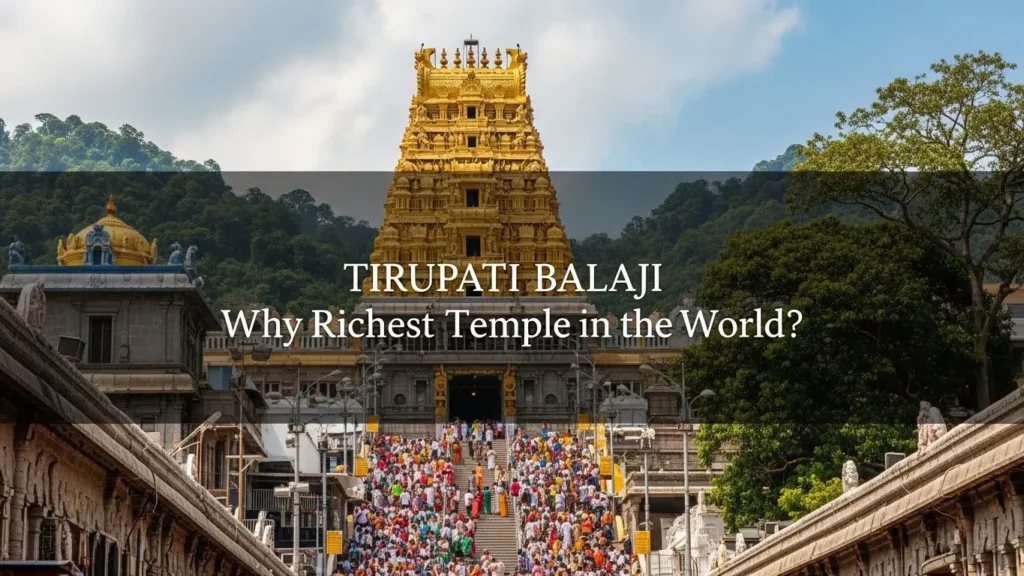
managed by Tirumala Tirupati Devasthanams (TTD) under Andhra Pradesh government attracts 24 million annual visitors making it the world’s most visited religious site—with average 60,000-87,000 daily pilgrims swelling to 150,000+ during Vaikunta Ekadasi and lakhs during nine-day Brahmotsavams festival—generating unprecedented wealth through multiple revenue streams including the famous Srivari Hundi donation box collecting ₹1,729 crore annually (₹3.6-4.10 crore daily average with December 31, 2024 recording single-day high of ₹4.10 crore), interest income of ₹1,310 crore from ₹18,000+ crore fixed deposits, darshan ticket sales ₹310 crore, Kalyanakatta hair tonsure revenue ₹176.5 crore, accommodation facilities ₹157 crore, and the unique international hair export business earning ₹200+ crore annually.
According to the sacred financial legend documented in Puranas and temple tradition, the temple’s immense wealth directly connects to the divine story where Lord Srinivasa (Venkateswara) borrowed one crore and 1.14 crore (₹1,14,00,000) gold coins from Kubera, the celestial treasurer, to finance his marriage with Princess Padmavati at Narayanavanam—commissioning divine architect Vishvakarma to create heavenly surroundings on Seshadri hills for the grand ceremony—devotees worldwide believe they must donate money to Venkateswara’s hundi (donation pot) to help the Lord repay this eternal debt to Kubera, with the conviction that Srinivasa blesses donors with ten times
the value they contribute and grants Goddess Lakshmi’s blessings, making hundi offerings a sacred obligation rather than optional charity. The extraordinary hair tonsure tradition documented by TTD’s international e-auction system reveals that when a cowherd hit Venkateswara on the head leaving a bald patch, Neela Devi (Gandharva princess) immediately cut her own hair using magic to implant it on his scalp—touched by her sacrifice, Venkateswara promised that all devotees visiting his abode would offer their hair to him with Neela Devi receiving all hair collected (one of the seven hills,
Neeladri, named after her)—resulting in 1 ton of hair collected daily from devotees who believe tonsuring removes sins, ego, and karmic burdens while fulfilling vows for answered prayers, health, success, childbirth, marriage—TTD conducts e-auctions categorizing hair as premium remy hair (long uniformly-trimmed women’s hair exported to Europe-US for luxury wigs-extensions), non-remy hair (short broken hair exported to China-Africa for cheaper wigs especially Nigeria market, Mumbai film industry), and l-cysteine extraction for food-pharmaceutical-personal care industries, generating ₹200+ crore annual revenue that funds free meals (annadanam), medical services, educational institutions, and temple maintenance.
The comprehensive financial structure managed by Tirumala Tirupati Devasthanams (TTD) operating under Andhra Pradesh government reveals FY 2025-26 approved annual budget of ₹5,258 crore (up from ₹5,179 crore in FY 2024-25) with revenue sources including: Hundi collections ₹1,729 crore projected (grew from ₹2.78 crore daily pre-Covid to ₹3.92 crore daily in 2025 showing devotees’ unwavering faith), interest income ₹1,310 crore from ₹18,000+ crore fixed deposits in banks, darshan ticket sales ₹310 crore (Special Entry Darshan ₹300 per person reducing 6-12 hour general queue to 1-2 hours, various VIP options),
Arjitha Seva tickets ₹130 crore, accommodation and Kalyana Mandapam receipts ₹157 crore, Kalyanakatta tonsure receipts ₹176.5 crore, trust receipts ₹90 crore, publications ₹31 crore, other receipts ₹170 crore—with 2024 statistics recording 2.55 crore devotees visiting temple, record hundi offerings of ₹1,365 crore collected (December 31 alone bringing ₹4.10 crore), and November 2024-October 2025 receiving unprecedented ₹918.6 crore donations including ₹579 crore digital payments (Anna Prasadam Scheme ₹338.8 crore, Srivani Donation Darshan ₹252.83 crore), making Tirupati significantly wealthier than India’s billionaire cricketers Sachin Tendulkar (₹1,300 crore annual) and Virat Kohli (₹1,000 crore annual).
As millions undertake the transformative Venkateswara darshan combining spiritual devotion with the world’s most sophisticated temple management system—with Tirupati city 138 km from Bangalore, 150 km from Chennai accessible via Renigunta Junction/Tirupati Railway Station, Sri Venkateswara Airport 15 km, then 21 km uphill to Tirumala Hills at 2,799 ft altitude via well-maintained ghat road or RTC buses every 2 minutes, comprehensive darshan options including Sarva Darshan free general queue (6-12 hours wait), Special Entry Darshan ₹300 (1-2 hours wait, online booking at ttdsevaonline.com), VIP Break Darshan, Divya Darshan for foot-pilgrims with biometric tokens,
separate queues for elderly-disabled-infants-NRIs, temple open 24×7 with Suprabhata Seva at 3 AM waking the deity and various daily-weekly-periodical rituals following Vaikhanasa Agama tradition, free prasadam Tirupati Laddu (GI-tagged, only TTD can make), free meals for all pilgrims, and two Vaikuntam Queue Complexes built in 1983 and 2000 managing crowds with CCTV monitoring—understanding why Tirupati Balaji is the world’s richest temple requires grasping the complete Kubera loan legend driving eternal donations, hair tonsure tradition generating ₹200+ crore annually, ₹5,258 crore annual budget with ₹18,000+ crore fixed deposits, 24 million annual pilgrims (highest globally), and TTD’s transparent financial management becomes essential for meaningful Hindu pilgrimage https://hindutva.online.
This comprehensive article presents Tirupati Balaji’s status as world’s richest temple, complete financial breakdown of ₹5,258 crore annual budget, Kubera loan legend driving eternal hundi donations, unique hair tonsure tradition and international auction business, 2.55 crore annual visitors making it most-visited shrine, complete darshan options and timings, how to reach Tirumala Hills, and TTD management excellence.
Why Tirupati Balaji Is the Richest Temple in the World
Net Worth: ₹2.5-3 Lakh Crore
According to some recent estimates, well, the temple is worth over ₹2.5 lakh crore. That’s precisely what ranks it really high in the list of the richest temples in India as well as in the entire world.
- Estimated net worth: ₹2.5-3 lakh crore
- Cash, gold, land, properties combined
- Managed by Tirumala Tirupati Devasthanams (TTD)
- World’s richest religious institution
- Wealthier than most corporations
Annual Income: ₹5,000+ Crore
Tirumala Tirupati Devasthanams trust board headed by chairman BR Naidu approved the annual budget estimates for the financial year 2025-26 for Rs 5258 crore. This is slightly higher by Rs.79 cr when compared to the revised approved budget estimates of Rs 5179 crore for the financial year 2024-2025.
FY 2025-26 Budget: ₹5,258 crore
Most Visited Religious Site: 24 Million Annual Pilgrims
The temple is one of the world’s most visited religious sites, attracts around 24 million devotees annually. The average daily pilgrim footfall is above 60,000 devotees, and the number crosses one lakh devotees during the annual Brahmotsavams, Vaikunta Ekadasi, and other festival and holiday seasons.
- 24 million annual devotees (world’s most visited)
- 60,000-87,000 daily average pilgrims
- 2.55 crore visitors in 2024 alone
- 150,000+ on Vaikunta Ekadasi (single day)
- Lakhs during Brahmotsavams (nine-day festival)
Complete Financial Breakdown: Where Does the Money Come From?
1. Hundi Donations: ₹1,729 Crore (Primary Revenue Source)
Like every year, the Tirupati trust expects the maximum revenues from the Hundi receipts which are estimates to grow to Rs 1,729 crore this financial year from Rs 1,671 crore last year.
| Year | Hundi Collection | Daily Average | Notable Records |
|---|---|---|---|
| FY 2025-26 (Projected) | ₹1,729 crore | ₹3.92 crore | Growth from pre-Covid ₹2.78 crore |
| 2024 | ₹1,365 crore | ₹3.6 crore weekday, ₹3.85 crore weekend | Dec 31: ₹4.10 crore single day |
| 2023 | ₹1,391.86 crore | — | — |
| 2022 | ₹1,291.69 crore | — | — |
| Nov 2024-Oct 2025 | ₹918.6 crore donations | — | Record surge in 11 months |
What devotees donate:
- Cash (notes and coins)
- Gold jewelry and ornaments
- Diamonds and precious stones
- Silver items
- Foreign currency
2. Interest Income: ₹1,310 Crore from Fixed Deposits
The Tirupati trust estimates an interest receipt of Rs 1310 cr from close to Rs 18000 cr plus fixed deposits lying with the banks.
- ₹18,000+ crore in fixed deposits
- Generates ₹1,310 crore annual interest
- Second-largest revenue source
- Smart financial management
3. Darshan Ticket Sales: ₹310 Crore
Other major receipts include sale of Darshan tickets: Rs.310 cr.
- Special Entry Darshan: ₹300 per person (most popular paid option)
- Seeghra Darshan: Fast-track darshan
- VIP Break Darshan: Premium access
- Various Arjitha Sevas: Special worship services
- Total annual revenue: ₹310 crore
4. Hair Tonsure (Kalyanakatta): ₹176.5 Crore
Kalyanakatta receipts: 176.5 cr.
- Direct tonsure services: ₹176.5 crore
- Hair auction sales: ₹200+ crore annually (2011-12 data)
- Total hair-related income: ₹350-400 crore estimated
5. Accommodation & Other Services: ₹500+ Crore
- Accommodation and Kalyana Mandapam: ₹157 crore
- Arjitha Seva tickets: ₹130 crore
- Trust receipts: ₹90 crore
- Rent, electrical, water charges: ₹66 crore
- Publications: ₹31 crore
- Other receipts: ₹170 crore
Total Annual Income: ₹5,258 Crore (FY 2025-26)
Revenue comparison:
- Tirupati Temple: ₹5,258 crore annually
- Sachin Tendulkar: ₹1,300 crore annually
- Virat Kohli: ₹1,000 crore annually
- Tirupati earns 4-5 times India’s richest cricketers
The Kubera Loan Legend: Why Devotees Donate
Lord Venkateswara’s Divine Marriage Debt
As per legend, it is believed that Srinivasa had to make arrangements for his wedding. Kubera credited money to Venkateswara (a form of the god Vishnu) for his marriage with Padmavathi. Srinivasa sought a loan of one crore and 1.14 crore (1,14,00,000) coins of gold from Kubera and had Vishvakarma, the divine architect, create heavenly surroundings in the Seshadri hills.
- Lord Srinivasa (Venkateswara) sought marriage with Princess Padmavati
- Borrowed from Kubera: 1 crore + 1.14 crore = ₹2.14 crore gold coins
- Commissioned Vishvakarma to create heavenly wedding venue
- Grand ceremony at Narayanavanam
- Debt remains eternal
Devotees Help Repay the Divine Loan
Together, Srinivasa and Padmavathi lived for all eternity while Goddess Lakshmi, understanding the commitments of Vishnu, chose to live in his heart forever. In remembrance of this, devotees go to Tirupati to donate money in Venkateswara’s hundi (donation pot) so that he can pay it back to Kubera.
- Sacred obligation to help Lord repay Kubera
- Belief that God gives 10 times the donated value
- Goddess Lakshmi blesses all hair donors
- Fulfillment of vows for answered prayers
- Karmic benefits and spiritual merit
Daily Hundi Collections: ₹3.6-4.10 Crore
The hundi collections go as high as ₹22.5 million a day.
- Weekdays: ₹3.6 crore average
- Weekends: ₹3.85 crore average
- December 31, 2024: ₹4.10 crore (single-day record)
- Festival days: Even higher collections
The Hair Tonsure Business: ₹200+ Crore Revenue
Legend: Neela Devi’s Sacrifice
As per legend, when Venkateswara was hit on his head by a cowherd, a small portion of his scalp became bald. This was noticed by Neela Devi, a Gandharva princess. Immediately, she cut a portion of her hair and, with her magic, implanted it on his scalp. Venkateswara noticed her sacrifice. As hair is a beautiful asset of the female form, he promised her that all his devotees who come to his abode would offer their hair to him, and she would be the recipient of all the hair received.
- Cowherd hit Venkateswara on head
- Small bald patch appeared on scalp
- Neela Devi (Gandharva princess) sacrificed her hair
- Venkateswara promised: All devotees will offer hair
- Neela Devi receives all collected hair
- Neeladri hill named after her
1 Ton of Hair Collected Daily
The daily amount of hair collected is over a ton.
- Over 1 ton daily (1,000+ kg)
- 365+ tons annually
- Thousands of devotees undergo tonsure daily
- Men, women, children all participate
- Free tonsure services in Kalyanakatta halls
Why Devotees Donate Hair
It is a popular belief that donating hair helps in getting rid of sins and ego. Every day, thousands of devotees at Tirupati Balaji temple donate their hair.
- Removes sins and ego
- Karmic burden reduction
- Doshas (astrological defects) removal
- Moksha (liberation) path
- Fulfillment of vows for answered prayers
- Health, marriage, childbirth, success gratitude
- Complete surrender (sharanagati) to divine
International Hair Auction: ₹200 Crore Annually
In 2011-12, the Tirumala temple earned nearly Rs 200 crore out of its total revenue of Rs 1949 crore, from auctioning hair.
- TTD conducts e-auctions periodically
- Categorizes hair by quality and type
- Sells to highest bidders internationally
- ₹200+ crore annual revenue (2011-12 data)
- Likely ₹300-400 crore currently
Global Hair Market Destinations
The long and uniformly trimmed hair is called remy hair, which has a big market in Europe and the US, where it is woven into wigs. The non-remy hair, broken and short, has a huge demand in China, which in turn makes wigs and sells it in the American or African market, especially Nigeria. In the domestic market, Tirumala hair is popular in Mumbai for making wigs for filmstars.
International buyers and uses:
| Hair Type | Destination | Usage |
|---|---|---|
| Remy Hair (long, uniformly trimmed women’s hair) | Europe, USA | Luxury wigs, high-end hair extensions |
| Non-Remy Hair (short, broken hair) | China → Africa (Nigeria), USA | Cheaper wigs, mass market |
| Premium Hair | Mumbai, India | Film industry wigs for celebrities |
| All Hair Types | Global pharmaceutical | L-cysteine extraction for food, medicine, personal care |
Hair to Humanitarian Services
Devotees take pride knowing their offering continues to serve humanity, transforming a personal act of devotion into collective welfare. This multiplies the spiritual merit of the offering.
- Free meals (Annadanam) for all pilgrims
- Medical services throughout complex
- Educational institutions
- Temple maintenance
- Charitable activities
- Devotees’ hair serves humanity
Record-Breaking 2024 Statistics
2.55 Crore Devotees Visited in 2024
In 2024, the Tirumala Tirupati Devasthanam saw 2.55 crore devotees.
2024 pilgrimage statistics:
- 2.55 crore total visitors (25.5 million)
- Slightly higher than usual 24 million annual average
- Record year for footfall
₹1,365 Crore Hundi Collections in 2024
In 2024, TTD received record offerings of ₹1,365 crore. In 2022, the hundi income of Srivari was ₹1,291.69 crore, while in 2023 it was ₹1,391.86 crore.
Hundi growth trajectory:
- 2022: ₹1,291.69 crore
- 2023: ₹1,391.86 crore
- 2024: ₹1,365 crore (record)
- Consistent growth despite minor fluctuation
November 2024-October 2025: ₹918.6 Crore in 11 Months
From November 2024 to October 16, 2025, the TTD has received a staggering Rs 918.6 crore donations from devotees. This remarkable surge in donations is attributed to the unwavering faith of devotees, and the TTD’s efforts to enhance pilgrim amenities and streamline darshan experience.
Record donations (Nov 2024-Oct 2025):
- Total: ₹918.6 crore in 11 months
- Digital payments: ₹579 crore
- Anna Prasadam Scheme: ₹338.8 crore
- Srivani Donation Darshan: ₹252.83 crore
- Offline (DD/cheques): ₹339 crore
- Record in TTD history
Temple Management: TTD Excellence
Tirumala Tirupati Devasthanams (TTD)
The temple is run by body Tirumala Tirupati Devasthanams (TTD) which is under control of Andhra Pradesh Government. The head of TTD is appointed by Andhra Pradesh Government.
Administration structure:
- TTD Board: 18 trustees (grew from 5 in 1951)
- Executive Officer: Appointed by AP Government
- Chairman: BR Naidu (current)
- Under: Andhra Pradesh Government control
Transparent Financial Management
TTD’s executive officer, Dharma Reddy, recently announced the details of the assets of Lord Balaji.
Financial transparency:
- Annual budget publicly announced
- Detailed revenue breakdowns shared
- Expenditure accounts published
- Audit systems in place
How Revenue Is Used
- Hindu Dharma Prachar Prasar (HDPP): ₹121 crore
- Loans and advances: ₹117.62 crore
- Facility management services: ₹80 crore
- Pension and gratuity: ₹100 crore
- State government contributions: ₹50 crore
- Free meals, medical, education: Substantial allocations
Darshan Options and Timings
1. Sarva Darshan (Free Darshan)
- Cost: Free
- Wait time: 6-12 hours (sometimes overnight)
- Most popular option
- Open to all devotees
2. Special Entry Darshan (₹300)
Darshan Slot Time: 10:00 am onward. Darshan waiting time: 1 hour – 2 hours 30 mins. Ticket Cost: Rs.300 per person. Children under 12 years don’t need tickets.
- Cost: ₹300 per person
- Wait time: 1-2.5 hours
- Timings: 10 AM – 6 PM (varies by rush)
- Children under 12: Free
- Advance booking: Online at ttdsevaonline.com
- Most recommended for time-constrained pilgrims
3. VIP Break Darshan
Premium access:
- Higher cost than Special Entry
- Minimal wait time
- Limited availability
4. Divya Darshan (For Foot-Pilgrims)
- Biometric tokens issued free
- First-come, first-served
- For pilgrims who walk up Tirumala Hills
- Two entry points: Alipiri Mettu (24×7), Srivari Mettu (6 AM-6 PM)
5. Special Darshan for Elderly, Disabled, Infants, NRIs
Special entry Darshan is orchestrated the physically debilitated and the senior subjects (over 65 years) through a different entryway from Dakshina Mada Street. The devotees falling under this class will be permitted in two unique spaces at 10 am and 3.00pm ordinary on demonstrating the age confirmation id-cards/medical certificate.
- Elderly (65+ years): With age proof
- Physically disabled: With medical certificate
- Infants: With birth certificate
- NRIs: With valid passport and visa
- Timings: 12 PM – 6 PM (not on special days)
Temple Opening Hours
- Temple never closes
- Suprabhata Seva: 3 AM (waking the deity)
- Various daily rituals: Throughout day
- Continuous darshan availability
How to Reach Tirupati and Tirumala
By Air
Nearest airport:
- Sri Venkateswara Airport (Renigunta): 15 km from Tirupati
- Flights from Bangalore, Chennai, Hyderabad, Delhi, Mumbai
- Taxis to Tirupati: ₹300-500
- Then 21 km uphill to Tirumala
By Train
Railway stations:
- Tirupati Railway Station: Main station, 138 km from Bangalore
- Renigunta Junction: Major junction nearby
- Well-connected to all major Indian cities
- Then 21 km road journey to Tirumala Hills
By Road
Road access:
- 21 km from Tirupati to Tirumala (uphill)
- Well-maintained ghat road
- APSRTC buses: Every 2 minutes from Tirupati
- Private taxis available
- Distances: Bangalore 250 km, Chennai 150 km, Hyderabad 600 km
Pilgrimage Tips
Essential Guidelines
- Book Special Entry Darshan (₹300) online to avoid 6-12 hour queue
- Start early morning (3-4 AM) for Sarva Darshan
- Carry valid ID for all bookings
- Dress modestly: Traditional attire preferred
- Follow dress code: No shorts, sleeveless, tight clothing
- Hair tonsure: Book in advance during peak seasons
- Free prasadam laddu included with darshan
- Free meals available at Annaprasadam complex
What to Experience
- Venkateswara darshan in garbhagriha (sanctum)
- Pancha Berams: Five deity forms in sanctum
- Hair tonsure at Kalyanakatta (spiritual rebirth)
- Hundi donation (help Lord repay Kubera)
- Thulabaram ritual (weighing against offerings)
- Bhuvaraha Swamy Temple (mandatory before main temple)
- Seven Hills (Saptagiri) representing Adisesha’s seven hoods
- Free prasadam laddu (GI-tagged, world-famous)
Frequently Asked Questions
Why is Tirupati Balaji the richest temple?
Net worth ₹2.5-3 lakh crore with annual income ₹5,258 crore from multiple sources: Hundi donations ₹1,729 crore (devotees helping Lord repay Kubera loan), interest ₹1,310 crore from ₹18,000+ crore fixed deposits, darshan tickets ₹310 crore, hair tonsure ₹176.5 crore plus ₹200 crore auction revenue, attracting 24 million annual pilgrims.
What is the Kubera loan legend?
Lord Srinivasa borrowed 1 crore + 1.14 crore gold coins from Kubera for wedding with Padmavati; devotees donate to Venkateswara’s hundi believing they help Lord repay eternal debt and receive 10 times blessing plus Goddess Lakshmi’s grace.
How much do devotees donate daily?
Average ₹3.6 crore on weekdays, ₹3.85 crore on weekends, with December 31, 2024 recording single-day high of ₹4.10 crore; annual hundi collections ₹1,729 crore projected for FY 2025-26.
Why do devotees donate hair?
When cowherd hit Venkateswara leaving bald patch, Neela Devi sacrificed her hair; Lord promised all devotees would offer hair to him; devotees believe tonsuring removes sins-ego-karmic burdens, fulfills vows, grants moksha; 1 ton collected daily.
How much does hair auction earn?
₹200+ crore annually (2011-12 data) from e-auction of categorized hair: remy hair (long women’s hair) to Europe-US for luxury wigs-extensions, non-remy to China-Africa for cheaper wigs, l-cysteine extraction for food-pharma industries; likely ₹300-400 crore currently.
How many people visit annually?
24 million annual devotees making it world’s most visited religious site; 60,000-87,000 daily average; 2.55 crore visited in 2024; 150,000+ on Vaikunta Ekadasi single day; lakhs during nine-day Brahmotsavams.
What is Special Entry Darshan cost?
₹300 per person reducing wait time from 6-12 hours general queue to 1-2.5 hours; timings 10 AM-6 PM; children under 12 free; book online at ttdsevaonline.com; most recommended fast-track option.
How does TTD use the revenue?
₹5,258 crore annual budget funds: Hindu Dharma Prachar ₹121 crore, facility management ₹80 crore, pension ₹100 crore, state contributions ₹50 crore, plus free meals (Annadanam), medical services, educational institutions, temple maintenance, charitable activities.
Conclusion
Tirupati Balaji Temple (Sri Venkateswara Temple) atop the seven Tirumala Hills at 2,799 feet altitude in Andhra Pradesh—officially the world’s richest religious institution with net worth ₹2.5-3 lakh crore and annual income ₹5,258 crore managed by Tirumala Tirupati Devasthanams under Andhra Pradesh government, attracting 24 million annual devotees (world’s most visited with 60,000-87,000 daily pilgrims swelling to 150,000+ during Vaikunta Ekadasi and lakhs during nine-day Brahmotsavams)—represents
Hinduism‘s extraordinary convergence of ancient devotion with modern financial excellence, with Wikipedia documenting the sacred Kubera loan legend where Lord Srinivasa borrowed 1 crore + 1.14 crore gold coins from celestial treasurer Kubera for marriage with Princess Padmavati commissioning divine architect Vishvakarma to create heavenly wedding venue on Seshadri hills—devotees worldwide donate to Venkateswara’s hundi believing they help the Lord repay eternal debt receiving 10 times blessing plus Goddess Lakshmi’s grace, generating unprecedented ₹1,729 crore annual
hundi collections (₹3.6-4.10 crore daily average with December 31, 2024 recording single-day high ₹4.10 crore), supplemented by ₹1,310 crore interest from ₹18,000+ crore fixed deposits, ₹310 crore darshan ticket sales, and the unique hair tonsure tradition earning ₹176.5 crore direct services plus ₹200+ crore international e-auction revenue from the divine promise where Venkateswara after Neela Devi sacrificed her hair to cover his bald patch declared all devotees would offer hair with 1 ton collected daily exported as remy hair to Europe-US for luxury wigs-extensions and non-remy to China-Africa for mass market generating funds for free meals, medical services, education, temple maintenance https://hindutva.online.
What distinguishes Tirupati’s extraordinary wealth is the convergence of sacred financial legend (Kubera loan driving eternal donation obligation with devotees believing they must help Lord repay debt receiving 10x blessings), unprecedented pilgrimage scale (24 million annual visitors = world’s highest, 2.55 crore in 2024, November 2024-October 2025 receiving record ₹918.6 crore donations including ₹579 crore digital payments), diversified revenue streams (Hundi ₹1,729 crore, fixed deposit interest ₹1,310 crore from ₹18,000+ crore corpus, darshan tickets ₹310 crore, hair business ₹350-400 crore total, accommodation-services ₹500+ crore making total ₹5,258 crore annual budget exceeding India’s richest cricketers Sachin-Virat combined),
unique hair economy (1 ton daily tonsuring based on Neela Devi sacrifice legend, international e-auction to Europe-US-China-Africa, l-cysteine pharmaceutical extraction, transforming devotion into ₹200+ crore humanitarian funding), transparent TTD management (18-member board, AP government oversight, public budget announcements, efficient crowd management with two Vaikuntam Queue Complexes, 24×7 temple operation, multiple darshan options including ₹300 Special Entry reducing 6-12 hour wait to 1-2.5 hours), and complete pilgrim infrastructure (free prasadam GI-tagged laddu, free Annaprasadam meals for all, medical services, accessible via Tirupati Railway/Airport then 21 km uphill, APSRTC buses every 2 minutes).
By understanding the world’s richest temple—combining sacred Kubera loan legend comprehension driving hundi donations, experiencing transformative hair tonsure following Neela Devi’s sacrifice tradition, booking ₹300 Special Entry Darshan online to avoid massive crowds, witnessing TTD’s transparent management of ₹5,258 crore annual budget with ₹18,000+ crore fixed deposits, and participating in the divine economy where personal devotion transforms into collective humanitarian welfare through free meals-medical-education funded by ₹1,729 crore hundi and ₹200+ crore hair auction—devotees access the profoundly unique pilgrimage that ancient Hindu wisdom established as Kaliyuga Vaikuntha where Lord Venkateswara remains directly visible blessing humanity while demonstrating that spiritual devotion and financial excellence can coexist transparently https://hindutva.online.
About the Author
Rajiv Anand – Certified Yoga Therapist & Spiritual Wellness Expert
Rajiv Anand is a certified yoga therapist with over 18 years of experience specializing in Hatha Yoga, pranayama, meditation, and traditional shatkarma purification practices. He holds advanced certifications in yoga therapy and has trained extensively in classical yogic texts including the Hatha Yoga Pradipika and Gheranda Samhita. Rajiv integrates ancient yogic wisdom with Ayurvedic principles to help students achieve optimal physical health and spiritual growth through authentic practices. His teaching focuses on making traditional techniques accessible to modern practitioners while maintaining the depth and transformative power of the original methods. He has guided thousands of students through systematic yoga sadhana at leading institutions and retreat centers across India and internationally.