

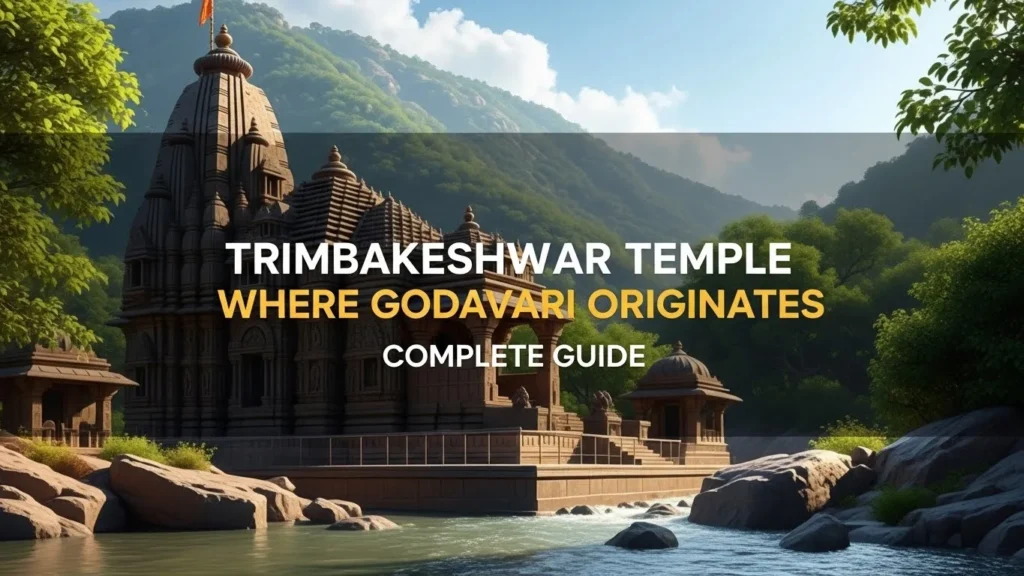
Trimbakeshwar Temple—the tenth of twelve sacred Jyotirlingas, nestled 28 km from Nashik between the three hills of Brahmagiri, Nilagiri, and Kalagiri in Maharashtra—represents Hinduism’s unique convergence of divine trinity and sacred river origin, with Wikipedia’s authoritative documentation confirming that this is the only Jyotirlinga where the divine presence of Brahma, Vishnu, and Shiva is worshipped together through three small lingas emerging from a pit embodying the supreme trinity of creation, preservation, and destruction, covered by a jeweled crown from the Pandava era studded with diamonds and emeralds
displayed Mondays 4-5 PM, and remarkably serving as the source of the sacred Godavari River—India’s second longest river and “Ganga of the South”—originating from the Kusavarta Kund sacred pond (21 ft deep, built 1750) within temple premises [web:847][web:851][web:855][web:861].

According to the legend documented in Hindu mythology and Shiva Purana, when Sage Gautama Rishi lived in his ashram with wife Ahalya on Brahmagiri Hill, a severe drought afflicted the region causing widespread hunger and thirst—but jealous neighboring sages conspired against prosperous Gautama by creating a celestial cow (Ganesha as cow or Parvati’s friend Jaya) that grazed in his field, and when Gautama threw Darbha grass to shoo it away,
the cow died instantly causing brahmins to accuse him of the gravest sin gau-hatya (cow killing) and ostracize the couple—prompting devastated Gautama to perform intense penance atop Brahmagiri for thousands of years until pleased Shiva directed Ganga to descend and flow as Godavari River to purify Gautama’s sin, thus establishing Trimbakeshwar Jyotirlinga beside this sacred water [web:854][web:857][web:858][web:860][web:863].
The extraordinary spiritual and geographical convergence validates profound significance: YouTube documentation of Brahmagiri trek reveals that Brahmagiri mountain at 1,298 m altitude features five peaks—Sadyo-Jata, Vamdev, Tat-Purusha, Aghora, and Ishana—considered the five mouths of Lord Shiva, with water flowing in three miraculous directions from the summit: eastward becoming Godavari River (flowing 1,465 km to Bay of Bengal),
southward forming Vaitarna River, and westward as west-flowing Ganga meeting Godavari at Chakra Tirtha, while Ahalya River meets Godavari directly in front of temple—requiring 2-hour trek up 500 stone steps (built 1908 by Seth Lalchand and Ganeshdas at ₹40,000 cost) to reach Godavari Temple at origin point where river emerges from Nandi’s mouth, surrounded by 108 Shivlings and Kolambika Devi temple [web:854].
The current temple’s architectural magnificence showcases black basalt Nagara style construction commissioned by Peshwa Balaji Baji Rao (Nanasaheb) after Mughal Aurangzeb’s destruction—built when Peshwa bet the stone surrounding Jyotirlinga was hollow and lost, thus constructing the marvelous present structure—featuring the stolen Nassak Diamond that adorned the linga until British looted it during Third Anglo-Maratha War (now with Edward J. Hand, Connecticut, USA), 28 m × 30 m Amritavarshini temple tank, three additional water bodies (Bilvatirtha, Viswanantirtha, Mukundatirtha), images of Ganga, Kedarnatha, Rama, Krishna, Parashurama, and Hindu genealogy registers (family records) maintained by pandits for pilgrims [web:847][web:861].
As hundreds of thousands undertake pilgrimage to experience the trinity Jyotirlinga and Godavari origin—with modern infrastructure including special rituals (Narayan Nagbali for ancestral curse/Pitru Shaap ₹2,100-5,100, Kalsarpa Shanti for astrological dosha ₹2,500, Tripindi Vidhi performed on specific dates over 3 days), temple timings 5:30 AM-9 PM with Rudrabhishek 7-8:30 AM, well-connected MSRTC buses from Nashik CBS covering 28 km in 40-50 minutes, and the scenic Brahmagiri trek for nature enthusiasts—understanding the complete Gautama legend, unique three-faced linga, Godavari origin story, Peshwa architecture, and practical visiting guide becomes essential for meaningful Hindu pilgrimage [web:847][web:856][web:862]https://hindutva.online.
This comprehensive article presents Trimbakeshwar’s sacred Sage Gautama cow-sin purification story, tenth Jyotirlinga’s unique trinity manifestation, Godavari River’s divine origin at Brahmagiri, Peshwa Balaji Baji Rao’s architectural legacy, complete darshan timings and ritual booking, Brahmagiri trek guide, how to reach from Nashik/Mumbai/Pune, and pilgrimage preparation tips.
The Legend: Sage Gautama and Godavari’s Birth
Gautama’s Ashram and Prosperity
The blessed period [web:854][web:858]:
- Sage Gautama and Ahalya lived on Brahmagiri Hill
- Their ashram was prosperous and abundant
- Many rishis moved nearby attracted by the peace
- Gautama’s fame and prosperity grew
The Severe Drought
Regional calamity:
- Severe drought struck Trimbakeshwar region
- People suffered from hunger and thirst
- Crops failed and famine spread
- Gautama prayed to Ganga for help
The Conspiracy and Cow’s Death
One day, they created a celestial cow named Jaya and sent it into Gautam’s field. While trying to drive the cow away, Gautam accidentally hit it, and it died [web:858][web:863].
The tragic incident [web:857][web:858][web:860][web:863]:
- Jealous neighboring sages conspired against Gautama
- Lord Ganesha appeared as a cow (or Parvati’s friend Jaya took cow form)
- The cow grazed in Gautama’s paddy field
- Gautama threw Darbha grass (sharp pointed grass) to shoo it away
- The slender cow fell to earth and died instantly
- It was unintentional killing
Accusation of Gau-Hatya (Cow Killing)
The humiliation [web:858][web:863]:
- Brahmins accused Gautama of gau-hatya—the gravest sin
- “With your sins, you can no longer pray to the gods”
- They rebuked and ostracized Gautama and Ahalya
- Asked them to leave the ashram
- Humiliated, sad, and hurt, the couple left
Intense Penance on Brahmagiri
The tapasya [web:847][web:857][web:860]:
- Gautama performed severe penance for thousands of years
- Prayed to Lord Shiva for purification
- Asked for Ganga to flow and wash away the sin
- Demonstrated unwavering devotion and determination
Shiva’s Blessing: Ganga as Godavari
The divine blessing [web:847][web:857][web:860]:
- Pleased with Gautama’s penance, Shiva appeared
- Directed Ganga to descend from heaven
- Ganga flowed through Trimbak hills as a stream
- This stream became Godavari River (also called Gautami Ganga)
- Ganga appeared at various tirthas: Gangadwar, Varaha-tirtha, Rama-Laxman tirtha, Ganga Sagar tirtha
Kushavarta: Where Ganga Stopped
The sacred pond [web:860][web:861]:
- Gautama surrounded river with enchanted Kusha grass
- The flow stopped at this spot
- Named Kushavarta (Kusha + avarta = surrounded by Kusha grass)
- From this Kushavarta, Godavari flows to the sea
- Gautama’s sin of cow killing was washed away
- Lord Shiva resided beside Ganga as Trimbakeshwar Jyotirlinga [web:857]
The Unique Three-Faced Jyotirlinga
Only Jyotirlinga with Brahma-Vishnu-Shiva
The trinity manifestation [web:847][web:851][web:855]:
- Unique feature: Three-faced Jyotirlinga
- Three small lingas emerging from a pit
- Embodies Brahma (creation), Vishnu (preservation), Shiva (destruction)
- All other Jyotirlingas have only Shiva as deity
- This is the only trinity representation among 12 Jyotirlingas
The Jeweled Crown and Pandava Legacy
The sacred crown [web:847][web:851][web:852]:
- Covers three-faced linga
- Placed over Gold Mask of Tridev
- From Pandava era (over 5,000 years old)
- Studded with diamonds, emeralds, precious stones
- Displayed every Monday 4-5 PM (Shiva’s day)
The Stolen Nassak Diamond
Historical loss [web:847]:
- Nassak Diamond adorned the linga
- British looted it during Third Anglo-Maratha War
- Currently with Edward J. Hand, trucking executive, Connecticut, USA
- Placed on a sword
Eroding Linga: Symbol of Human Society
Godavari River: The Ganga of South
Origin at Brahmagiri Mountain
The origin of the sacred Godavari river is near Trimbak [web:847][web:849].
Brahmagiri specifications [web:854]:
- Altitude: 1,298 meters (4,259 feet)
- Distance: 3 km from Trimbakeshwar
- Location: Western Ghats, Maharashtra
- Meaning: “Hill of Lord Brahma”
Five Peaks—Five Mouths of Shiva
Three-Direction Water Flow
The miraculous flow [web:847][web:854]:
- Eastward flow: Godavari River (1,465 km, India’s second longest, flows to Bay of Bengal)
- Southward flow: Vaitarna River
- Westward flow: West-flowing Ganga (meets Godavari at Chakra Tirtha)
Additional convergence:
- River Ahalya meets Godavari in front of Trimbakeshwar temple [web:854]
Kusavarta Kund—Sacred Pond Source
Kusavarta kunda (sacred pond) in the temple premises, built by Shrimant Sardar Raosaheb Parnerkar who was the Fadnavis of Indore State, is the source of the Godavari River [web:847][web:851].
Sacred pond details [web:847][web:861][web:864]:
- Built by: Sardar Raosaheb Parnerkar (Fadnavis of Indore State)
- Year: 1750
- Depth: 21 feet
- Significance: Where Ganga remerges after disappearing at Brahmagiri
- Bust: Sardar Fadnavis and his wife visible at edge of kunda
- Godavari’s actual source: Flows from here to the sea
Godavari—The Gautami Ganga
Sacred significance:
- Called “Gautami Ganga” after Sage Gautama
- “Ganga of the South” due to spiritual importance
- Second longest river in India (1,465 km)
- Most sacred river in South India
- Lord Rama performed Shraddha for father Dasharatha here [web:861]
Brahmagiri Trek: Journey to Origin
Trek Specifications
Trek details [web:854]:
- Starting point: Trimbakeshwar Temple
- Distance: 3 km / 2 km ascent
- Duration: 2 hours to summit
- Difficulty: Moderate, gradual ascent
- Steps: 500 stone steps built 1908
Historical Stone Steps
Earlier prohibition:
- Brahmagiri considered huge form of Lord Shiva
- Mountain climbing was considered a sin
- Stone steps made pilgrimage accessible
Summit Attractions
At the summit [web:854]:
- Lord Shiva temple
- Goddess Godavari temple (origin point)
- River emerging from Nandi’s mouth
- Kolambika Devi temple
- 108 Shivlings group
- Panoramic views of Western Ghats
Temple Architecture and Features
Location Between Three Hills
The temple is located between three hills namely: Brahmagiri, Nilagiri and Kalagiri [web:847].
Black Stone Nagara Architecture
Architectural features [web:847]:
- Material: Black basalt stone
- Style: Nagara architecture
- Location: Brahmagiri foothills
- Appealing sculpture and intricate carvings
Peshwa Balaji Baji Rao’s Construction
The current temple was built by Peshwa Balaji Baji Rao (Nanasaheb) [web:847][web:851][web:861].
The fascinating story [web:847]:
- Peshwa Nanasaheb bet whether stone surrounding Jyotirlinga was hollow
- Stone proved to be hollow
- On losing the bet, Peshwa built marvelous temple
- Commissioned after Aurangzeb destroyed previous structure
Water Bodies and Deities
Temple tanks [web:847]:
- Amritavarshini: Main temple tank (28 m × 30 m / 92 ft × 98 ft)
- Bilvatirtha
- Viswanantirtha
- Mukundatirtha
Deity images [web:847]:
- Ganga, Jaleswara, Rameswara
- Gautameswara, Kedarnatha
- Rama, Krishna, Parashurama
- Lakshmi Narayana
Hindu Genealogy Registers
Unique tradition:
- Family records maintained for centuries
- Pilgrims’ genealogies preserved
- Maintained by hereditary pandits
Special Rituals and Pujas
Narayan Nagbali
Narayan Nagbali puja is performed at Trimbakeshwar only. This puja is performed in three days [web:847][web:862][web:865].
Purpose and details [web:847][web:862][web:865]:
- Two different rituals: Narayan Bali + Nag Bali
- Narayan Bali: Removes ancestral curse (Pitru Shaap)
- Nag Bali: Removes sin of killing Cobra (Nag)
- Duration: 3 days
- Performed on: Special dates only
- Reasons: Illness, bad times, childlessness, financial crisis
- Cost: ₹2,100-5,100 for different packages
Vidhi includes: Ganpati Pujan, Punayahavachan, Matruka Pujan, Naandi Shradha, Navgraha Pujan, Rudhara Kalash Pujan, Balipradan, Purnahuti [web:862]
Kalsarpa Shanti / Kaal Sarp Dosha Puja
Dosha removal [web:847][web:862]:
- For astrological Kaal Sarp Dosha
- Duration: 6-hour continuous session
- Temple premises: ₹2,100-2,500
- Rahu Ketu Jaap: ₹5,100
- Removes obstacles and restores fortune
Tripindi Vidhi
Tripindi Vidhi are done here [web:847].
- Ritual for three generations of ancestors
- Performed on specific auspicious dates
Temple Timings and Darshan
Daily Temple Timings
Trimbakeshwar temple opens at 5:30 AM and closes at 9:00 PM [web:856].
Schedule:
- Opens: 5:30 AM
- Closes: 9:00 PM
- General Darshan: Allowed from 5 feet distance
Rudrabhishek Timings
Rudrabhishek timings are from 7:00 AM to 8:30 AM [web:856].
Crown Darshan
Special viewing:
- Jeweled Pandava crown displayed: Monday 4:00 PM – 5:00 PM [web:847]
How to Reach Trimbakeshwar
By Air
Nearest Airport: Nashik Airport [web:853]
- Distance: 45-50 km from Trimbakeshwar
- Travel time: 1-1.5 hours
Alternative: Mumbai Airport [web:853]
- Distance: 170-180 km
- Travel time: 4-5 hours by car
By Train
Nashik Road Railway Station is 39 kilometers by road [web:847][web:853].
Railway stations:
- Nashik Road: 40 km (major station)
- Nashik: 28 km (city station)
- Hire taxi or take bus from station
By Road from Nashik (Recommended)
From Nashik [web:853][web:856]:
- Distance: 28-30 km
- Travel time: 40-60 minutes
- MSRTC buses: Frequent from CBS (Central Bus Stop)
- Shared taxis: Available
- Private cabs: Convenient option
By Road from Other Cities
From Mumbai [web:853]:
- Distance: 170-180 km
- Time: 4-5 hours
- Popular day trip destination
From Pune [web:853]:
- Distance: 200+ km
- Route: Train to Nashik + road OR direct road
Nearby Attractions
Shri Nilambika/Dattatreya/Matamba Temple
This temple is on top of the Neel mountain. All goddesses (‘Matamba’, ‘Renuka’, ‘Mananmba’) came here to see ‘Parashuram’ when he was performing penance [web:847][web:851].
Legend: After Parashuram’s penance, he requested goddesses to stay; temple formed for them
Akhil Bhartiya Swami Samarth Gurupeeth
Temple of Shri Swami Samarth Maharaj. This temple is 1 km from Shiva Temple. This temple is a marvelous example of Vastu Shastra [web:847][web:851].
Best Time to Visit
Ideal Season
- October to March: Pleasant weather
- Post-monsoon (September-November): Lush greenery, waterfalls active
- Monsoon season: Spectacular scenic beauty [web:847]
Special Occasions
- Shravan month (July-August): Most auspicious for Shiva worship
- Maha Shivaratri: Huge crowds
- Monday: Weekly Shiva day (busier)
Pilgrimage Tips
Essential Tips
- Start early: Reach temple by 6-7 AM for peaceful darshan
- Book rituals in advance: Narayan Nagbali, Kalsarpa Shanti require specific dates
- Trek Brahmagiri: 2-hour climb to witness Godavari origin
- Carry water and snacks: For Brahmagiri trek
- Dress modestly: Traditional attire preferred
- Remove leather items: Before entering sanctum
What to Experience
- Three-faced linga darshan: Unique trinity representation
- Monday crown viewing: 4-5 PM jeweled Pandava crown
- Kusavarta Kund: Sacred pond where Godavari originates
- Brahmagiri trek: Witness three-direction water flow
- Godavari Temple at summit: See river emerging from Nandi’s mouth
- Hindu genealogy registers: Family history consultation
Frequently Asked Questions
Where is Trimbakeshwar Temple located?
Trimbakeshwar Temple is in Trimbak town, 28 km from Nashik city and 40 km from Nashik Road railway station in Maharashtra [web:847][web:856].
What is unique about Trimbakeshwar Jyotirlinga?
What is the legend of Godavari origin?
Sage Gautama accidentally killed a cow (gau-hatya sin), performed intense penance on Brahmagiri for thousands of years until Shiva directed Ganga to descend as Godavari River to purify his sin [web:847][web:857][web:858].
Where does Godavari River originate?
What are temple timings?
Temple opens 5:30 AM and closes 9:00 PM daily; Rudrabhishek 7:00-8:30 AM; Pandava crown displayed Mondays 4-5 PM [web:847][web:856].
What special rituals are performed here?
Narayan Nagbali (3 days, ₹2,100-5,100) for ancestral curse/nag killing, Kalsarpa Shanti (₹2,500) for Kaal Sarp Dosha, Tripindi Vidhi—performed only at Trimbakeshwar [web:847][web:862].
How to reach from Nashik?
What happened to the Nassak Diamond?
Conclusion
Trimbakeshwar Temple in Nashik—the sacred tenth Jyotirlinga uniquely embodying the divine trinity where three small lingas of Brahma (creation), Vishnu (preservation), and Shiva (destruction) emerge from a single pit covered by the jeweled Pandava-era crown studded with diamonds and emeralds (displayed Mondays 4-5 PM), making it the only Jyotirlinga among twelve worshipping all three deities together—represents Hinduism‘s extraordinary convergence of divine manifestation and sacred river origin, with Wikipedia’s documentation confirming that Sage Gautama’s thousands of years of intense penance after accidentally killing a cow (gau-hatya sin) prompted pleased Shiva to direct Ganga to descend from heaven as Godavari River flowing from Brahmagiri mountain’s miraculous three-direction water source (east becoming Godavari,
south Vaitarna, west meeting Godavari at Chakra Tirtha) to purify the sage, establishing Trimbakeshwar Jyotirlinga beside the sacred Kusavarta Kund (21 ft deep, built 1750) where Ganga remerges—while the current black basalt temple built by Peshwa Balaji Baji Rao (Nanasaheb) after Aurangzeb’s destruction features stolen Nassak Diamond by British, Hindu genealogy registers maintained for centuries, and special rituals (Narayan Nagbali ₹2,100-5,100, Kalsarpa Shanti ₹2,500) performed only here [web:847][web:854]https://hindutva.online.
What distinguishes Trimbakeshwar’s extraordinary significance is its convergence of unique trinity representation (only Jyotirlinga with three-faced Brahma-Vishnu-Shiva manifestation, Pandava crown with precious stones, eroding linga symbolizing human society), sacred river origin (Godavari—India’s second longest river and “Ganga of South”—originating from Brahmagiri’s five peaks representing Shiva’s five mouths, flowing 1,465 km to Bay of Bengal), geographical marvel (water flowing three miraculous directions from summit temple where river emerges from Nandi’s mouth,
Ahalya River meeting Godavari at temple front, Kusavarta Kund sacred 21-ft pond), architectural magnificence (Peshwa Nanasaheb’s black basalt Nagara construction after losing bet that stone was hollow, 28m × 30m Amritavarshini tank, images of Ganga-Kedarnatha-Rama-Krishna-Parashurama), and complete spiritual infrastructure (5:30 AM-9 PM temple timings, 28 km from Nashik CBS via frequent MSRTC buses taking 40-50 minutes, 2-hour Brahmagiri trek up 500 stone steps built 1908 to witness origin, special 3-day Narayan Nagbali and Kalsarpa Shanti rituals, Hindu genealogy consultation) [web:847][web:854][web:856][web:862].
By understanding this Maharashtra pilgrimage gem—combining three-faced linga darshan with Monday crown viewing, Kusavarta Kund sacred pond visit, challenging Brahmagiri summit trek to Godavari Temple where water flows three directions from 1,298 m altitude amid 108 Shivlings and Kolambika Devi shrine, and participation in unique ancestral rituals—devotees access the transformative journey that ancient Hindu wisdom established as Sage Gautama’s penance culmination where divine trinity and sacred river converge [web:847][web:854]https://hindutva.online.
About the Author
Sunita Reddy – Certified Yoga Therapist & Spiritual Wellness Expert
Sunita Reddy is a certified yoga therapist with over 18 years of experience specializing in Hatha Yoga, pranayama, meditation, and traditional shatkarma purification practices. He holds advanced certifications in yoga therapy and has trained extensively in classical yogic texts including the Hatha Yoga Pradipika and Gheranda Samhita. Sunita Reddy integrates ancient yogic wisdom with Ayurvedic principles to help students achieve optimal physical health and spiritual growth through authentic practices. His teaching focuses on making traditional techniques accessible to modern practitioners while maintaining the depth and transformative power of the original methods. He has guided thousands of students through systematic yoga sadhana at leading institutions and retreat centers across India and internationally.