

Vaidyanath Temple in Deoghar, Jharkhand—also known as Baba Baidyanath Dham, the ninth among twelve sacred Jyotirlingas—represents Hinduism’s testament to devotion’s triumph where even demon king Ravana’s intense sacrifice earned Shiva’s blessings, with Wikipedia’s authoritative documentation confirming that the temple houses the “Kamna Linga” (linga of desires) that Ravana obtained from Shiva after offering nine of his ten heads in penance at Kailash, but when transporting it to Lanka

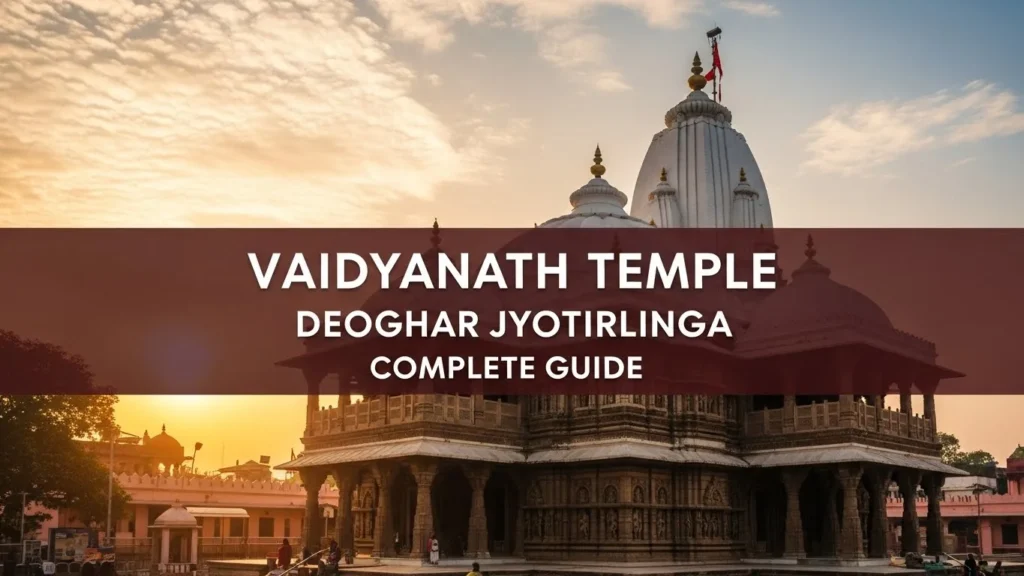
the gods conspired through Lord Varuna entering his stomach making him need to urinate near Deoghar—where Vishnu disguised as shepherd Baiju Gadariya held the linga and deliberately placed it on ground making it immovable, with frustrated Ravana pressing his thumb partially damaging the lingam before departing, after which Brahma, Vishnu, and celestial deities worshipped and constructed the Baidyanath Temple establishing Shiva’s permanent residence as “Vaidyanath” (Lord of Physicians) commemorating His healing of Ravana’s severed heads [web:866][web:867][web:870][web:873].
According to the temple’s spiritual significance documented in Hindu texts, the name “Vaidyanath” derives from “vaidya” meaning physician or healer—referring to Lord Shiva’s compassionate act of healing Ravana by reattaching his nine severed heads just as the demon king was about to sacrifice his tenth and final head, deeply impressed by such extreme devotion—while “Deoghar” meaning “abode of gods” reflects the sacred spot where celestial beings descended to worship the stuck linga, and devotees believe that sincere prayers at this Kamna Linga fulfill all desires and wishes, establishing Deoghar as Jharkhand’s holiest pilgrimage destination [web:867][web:873][web:880].
The extraordinary spiritual and cultural convergence validates profound significance: Inheritage Foundation’s 2025 architectural analysis reveals that the magnificent temple complex comprising 22 temples within fortified walls was commissioned around 1650 CE by Raja Puran Mal of the Gidhaur dynasty (founded 1266 CE by Raja Bir Vikram Singh) in classic Nagara architectural style characterized by curvilinear shikhara towers and intricate carvings, incorporating Late Gupta Period architectural influences and regional elements through sophisticated traditional building techniques—corbelling for distinctive shikhara construction, robust laterite structural core with finer sandstone for carved facades, precise joinery using dowels and tenons—surviving Maratha invasions of Bihar-Bengal and 1757 British East India Company interference until English collector Keating in 1788 wisely returned full control to high priests [web:866][web:876][web:878].
The transformative Shravan Mela/Kanwar Yatra documented by Doordarshan 2025 represents one of Asia’s largest annual pilgrimages where millions of Kanwariyas (devotees) walk barefoot 105-108 km from Sultanganj’s Ajgaibinath temple on Uttarvahini Ganga (north-flowing Ganges) carrying holy Ganga water in decorated kanwars (containers) on shoulders chanting “Bol Bam” continuously, beginning on Guru Purnima in Shravan month (July-August) when temple remains open 24×7 for continuous darshan, creating an electrifying atmosphere of devotion across Bihar-Jharkhand border—with pilgrims later visiting nearby Basukinath temple completing the sacred circuit [web:866][web:872][web:881][web:884].
As millions undertake pilgrimage to experience the Kamna Linga’s wish-fulfilling blessings—with modern infrastructure including Deoghar Airport with direct flights from Mumbai/Kolkata/Delhi via IndiGo Airlines (2 hours), three railway stations (Deoghar Junction 3 km, Baidyanath Dham Junction 2 km, Jasidih Junction 7 km) with trains from Kolkata/Patna/Ranchi, temple operating 4 AM morning aarti to 9 PM (24×7 during Shravan), free entry with organized darshan queues, and Kanwar Yatra packages (₹10,000 per person for 9 days covering Sultanganj-Deoghar-Basukinath-Gaya-Bodhgaya)—understanding
the complete Ravana devotion legend, Kamna Linga significance, 22-temple complex architecture, Asia’s largest Shravan Mela pilgrimage, and practical visiting guide becomes essential for meaningful Hindu pilgrimage [web:866][web:871][web:872][web:874][web:880][web:883]https://hindutva.online. This comprehensive article presents Vaidyanath’s sacred Ravana penance and Kamna Linga story, ninth Jyotirlinga’s healer deity significance, Raja Puran Mal’s 1650 CE architectural legacy, Shravan month Kanwar Yatra phenomenon, complete darshan timings and rituals, how to reach from major cities, and pilgrimage preparation tips.
The Legend: Ravana’s Devotion and Kamna Linga
Ravana’s Intense Penance in Himalayas
The extreme sacrifice [web:866][web:867][web:870][web:873]:
- Demon king Ravana sought to become omnipotent
- Performed severe penance in Himalayan region near Mount Kailash
- Offered his ten heads one by one as ultimate sacrifice to Shiva
- Cut off nine heads and offered them at Shiva’s feet
- As he was about to sacrifice his tenth and final head, Shiva appeared
Shiva Heals Ravana—Birth of “Vaidyanath”
The divine healing [web:867][web:868][web:870]:
- Lord Mahadev appeared before Ravana just before tenth head was cut
- Shiva was deeply impressed with such extreme devotion
- Revived Ravana and reattached all nine severed heads
- “Vaidyanath” = Lord of Physicians/Healer (vaidya = healer/physician)
- Healed Ravana completely, restoring his strength
The Boon: Kamna Linga to Lanka
Shiva’s conditional blessing [web:866][web:870][web:873]:
- Ravana requested the “Kamna Linga” (linga of desires/wishes)
- Wanted to take Shiva from Kailash to Lanka
- Shiva agreed but with one crucial condition
- If the lingam was placed en route, it would become permanent abode of deity
- Could never be moved again once placed on ground
Kamna Linga meaning:
- “Kamna” = desire/wish
- Believed that whoever worships this linga gets their dreams fulfilled [web:873]
Gods’ Conspiracy: Varuna Enters Ravana
The divine intervention [web:866][web:870][web:873]:
- Celestial gods feared consequences of Shiva’s linga at Ravana’s kingdom
- Sought Lord Vishnu’s help to prevent Ravana from reaching Lanka
- Vishnu asked Lord Varuna (water deity) to execute plan
- Varuna entered Ravana’s stomach through Achamanam (ritual water sipping)
- Achamanam involves reciting 21 names of Vishnu while sipping water
Ravana’s Call of Nature Near Deoghar
The critical moment [web:866][web:873]:
- Ravana took permission from Shiva for Achamanam purification process
- Arrived in Deoghar (meaning “abode of gods”) in the evening
- Due to Varuna’s presence in stomach, felt urgent need to urinate
- Needed to relieve himself but couldn’t place linga down
Vishnu as Shepherd Baiju Gadariya
The divine trick [web:866][web:870][web:873]:
- Lord Vishnu disguised himself as shepherd named Baiju Gadariya (Gadaria caste)
- Appeared as a mortal child (Ravana didn’t recognize him)
- Ravana found the child and requested him to hold Shiva Linga
- Ravana went to perform Sandhya Puja (evening worship)
- Due to Varun Dev’s presence, Ravana took very long time
The Linga Gets Fixed—Birth of Temple
The permanent establishment [web:866][web:873]:
- Baiju/Vishnu got angry waiting so long
- Deliberately placed lingam on the ground and disappeared
- When Ravana returned, attempted to pick up the lingam
- Was completely unsuccessful in lifting it
- Realized he had been pranked by Lord Vishnu
Ravana’s Thumb Impression
The permanent mark [web:866]:
- Frustrated Ravana pressed his thumb hard onto lingam
- This partially damaged the Shiva lingam
- Thumb impression still visible on the linga today
- Ravana then paid obeisance and departed to Lanka
Celestial Worship and Temple Construction
The sacred establishment [web:866][web:873]:
- Brahma, Vishnu, gods, goddesses, Gandharvas descended from abodes
- Worshipped the fixed Shiva linga
- Constructed the Baidyanath Temple at this spot
- Shiva permanently resides here as Kamna Linga
- Temple has sacred pond considered the water Ravana released [web:873]
Ninth Jyotirlinga: Vaidyanath Significance
Jyotirlinga Manifestation
The divine light:
- Infinite pillar of light establishing Shiva’s supremacy
- Vaidyanath listed as ninth among 12 Jyotirlingas
- Other 11: Somnath, Mallikarjuna, Mahakaleswar, Omkareshwar, Kedarnath, Bhimashankar, Viswanath, Trimbakeshwar, Nageshvara, Rameshwar, Grishneshwar
Deoghar: Abode of Gods
Meaning and significance:
- “Deoghar” = Abode of gods (Deva + ghar)
- Spot where celestial beings descended to worship
- Gods made permanent residence here with Shiva
- Considered one of holiest Shaivite shrines in India [web:881]
Kamna Mahadev: Fulfiller of Desires
Spiritual belief:
- Whoever worships Kamna Linga gets dreams fulfilled [web:873]
- Sincere devotion leads to wish fulfillment
- Attracts millions seeking blessings
Temple Architecture and Complex
22-Temple Sacred Complex
The temple complex comprises the central shrine of Baba Baidyanath along with 21 additional temples [web:866][web:876][web:879].
Complex structure [web:876][web:879]:
- Main Jyotirlinga temple at center
- 21 additional temples surrounding it
- Total: 22 beautiful temples in complex
- Encircled by formidable walls
- Each temple contributes to spiritual ambiance
Raja Puran Mal’s 1650 CE Construction
During the late medieval period, around 1650 CE, Raja Puran Mal commissioned the temple, adopting the Nagara style distinguished by curvilinear towers [web:876][web:878].
Historical construction [web:866][web:876][web:878]:
- Built 1650 CE (17th century)
- Commissioned by Raja Puran Mal of Gidhaur dynasty
- Gidhaur princely state founded 1266 CE by Raja Bir Vikram Singh
- Kings of Gidhaur much attached to temple
- Entire Deoghar area under their rule
Nagara Architectural Style
Architectural features [web:876][web:878]:
- Nagara style: Curvilinear shikhara (tower), North Indian tradition
- Intricate carvings throughout complex
- Late Gupta Period architectural influences
- Regional architectural elements incorporated
- Unique blend reflecting continuous patronage
Construction Techniques
Traditional building methods [web:876][web:878]:
- Corbelling: Successive stone courses projecting outward for shikhara
- Material combination: Robust laterite for structural core, finer sandstone for carved facades
- Precise joinery: Dowels and tenons for structural integrity
- Dry masonry techniques for walls and core
- Locally available materials connecting temple to geography
British Period
Colonial interference [web:866]:
- 1757: After Battle of Plassey, British interest began
- Mr. Keating (first English collector of Birbhum) took interest
- 1788: Mr. Keating’s assistant Mr. Hesilrigg (first Englishman to visit holy city)
- Initially attempted direct interference in temple administration
- Mr. Keating wisely abandoned policy after personal visit
- Handed full control back to high priest
Havan Kund Temple—Annual Opening
Shravan Mela: Asia’s Largest Kanwar Yatra
Millions of Kanwariyas
Scale of pilgrimage [web:872][web:881]:
- One of Asia’s largest pilgrimages
- Lakhs/millions of devotees participate annually
- Shravan month (July-August in Hindu calendar)
- Began 2025 on Guru Purnima adding spiritual significance
105-108 Km Barefoot Journey
This annual Kanwar yatra, one of the largest in Asia, covers 108-km route from Sultanganj to Deoghar [web:881][web:884].
The sacred route [web:872][web:881][web:884]:
- Starting point: Sultanganj, Bihar (Ajgaibinath temple)
- Destination: Deoghar, Jharkhand (Baidyanath temple)
- Distance: 105-108 kilometers
- Method: Barefoot pilgrimage carrying Ganga water
- Uttarvahini Ganga: North-flowing Ganges at Sultanganj
Carrying Ganga Water in Kanwars
The tradition [web:866][web:881][web:884]:
- Fetch holy Ganga water from Ajgaibinath temple
- Carry in decorated kanwars (containers) on shoulders
- “Kanwariya” = devotee carrying kanwar
- Water offered at Baidyanath Jyotirlinga
- Pilgrims later visit Basukinath temple to complete circuit
“Bol Bam” Chanting and Devotional Atmosphere
The roads were filled with thousands of Kanwariyas chanting “Bol Bam”, creating an electrifying and devotional atmosphere [web:881][web:884].
The experience [web:881][web:884]:
- Continuous chanting of “Bol Bam” (Say Shiva’s name)
- Path filled with Bhojpuri, Hindi, and local bhajans
- Electrifying devotional atmosphere
- Shraddha (faith), bhakti (devotion), and utsah (enthusiasm)
- Special camps, food, water arranged along route
Temple Open 24×7 During Shravan
Shravan Month: Temple remains open 24×7 for darshan [web:871].
Kanwar Yatra Packages
Package details [web:872]:
- Duration: 8 nights / 9 days
- Price: ₹10,000 per person
- Coverage: Patna → Sultanganj → Deoghar → Basukinath → Gaya → Bodhgaya
- Inclusions: Pickup/drop railway station/airport, hotel twin sharing, boat ride
- Booking: Online or through local tour operators in Patna, Ranchi, Kolkata
Temple Timings and Darshan
Daily Temple Timings
Baba Baidyanath Temple Timings [web:871][web:874]:
| Timing | Schedule |
|---|---|
| Temple Opens | 4:00 AM |
| Morning Aarti | 4:30 AM – 5:30 AM |
| Morning Darshan | 5:00 AM / 6:00 AM – 2:00 PM / 3:30 PM |
| Afternoon Break | 3:00 PM – 6:00 PM |
| Evening Darshan | 6:00 PM – 8:00 PM / 9:00 PM |
| Shringar Puja | 6:10 PM |
| Evening Aarti | 6:30 PM onwards |
| Temple Closes | 8:00 PM / 9:00 PM |
Special: Temple remains open 24×7 during Shravan month [web:871]
Entry Fee
Free entry to temple [web:874]
Best Time to Visit
Best Months to Visit: December to February [web:874]
Avoid summer heat: Pleasant winter weather ideal for pilgrimage
Popular Festivals
Shivratri, Shravani Mela, Maa Durga Puja, Kartikey Puja and Rath Yatra [web:874]
How to Reach Vaidyanath Temple
By Air (Recommended)
You can reach Deoghar via flight to Deoghar Airport [web:880][web:883].
Deoghar Airport [web:883]:
- Direct flights: Mumbai, Kolkata, Delhi
- Airlines: IndiGo Airlines
- Flight time: 2 hours from Mumbai, 1 hour from Kolkata
- Distance: Close to temple (local transport available)
By Train
Deoghar has three main station namely 1) Deoghar Junction (3 km) 2) Baidhnathdham Junction (2 km) 3) Jasidih Junction (7 km) [web:874][web:880][web:883].
Railway stations [web:874][web:880][web:883]:
- Deoghar Junction: 3 km from temple
- Baba Baidyanath Dham Junction: 2 km from temple
- Jasidih Junction: 7 km from temple
Major trains [web:883]:
- From Kolkata: Bagh Express 13019 (daily to Jasidih)
- From Mumbai: CSMT Asansol Express (Wednesday to Jasidih)
- From Agartala: Agartala Deoghar Express 15626 (Saturday)
- From Dibrugarh: Dibrugarh Deoghar Express 15926 (Tuesday)
By Road
Bayidhnath Temple is about 10km from Baghmara Inter State bus stand [web:880].
Road connectivity:
- Well-connected by state highways
- Buses from Patna, Ranchi, Kolkata, Gaya
- Private taxis and cabs available
- Local auto-rickshaws from stations to temple
Nearby Sacred Sites
Basukinath Temple
Pilgrims to the temple later visit the Basukinath temple [web:866].
Complete pilgrimage: Baidyanath → Basukinath circuit considered essential
Ajgaibinath Temple, Sultanganj
Source of Ganga water for Kanwar Yatra [web:866][web:881]
Pilgrimage Tips
Essential Tips
- Visit during Shravan: Experience Asia’s largest Kanwar Yatra
- Book accommodation advance: Especially during peak seasons
- Start darshan early: 4:30-5:30 AM morning aarti most peaceful
- Respect traditions: Remove leather items, dress modestly
- Carry cash: Limited ATMs in temple area
- Stay hydrated: Especially during Shravan summer pilgrimage
What to Experience
- Main Kamna Linga darshan: Wish-fulfilling deity
- 22-temple complex: Explore all shrines
- Shravan Mela: Witness millions chanting “Bol Bam”
- Ravana’s thumb impression: Visible on linga
- Sacred pond: Water Ravana released
- Basukinath temple visit: Complete pilgrimage circuit
Frequently Asked Questions
Where is Vaidyanath Temple located?
Vaidyanath Temple is in Deoghar, Santhal Parganas division, Jharkhand state; Deoghar Junction 3 km, Baidyanath Dham Junction 2 km, Jasidih Junction 7 km [web:866][web:880].
What is the legend of Vaidyanath Jyotirlinga?
Ravana offered nine heads to Shiva who healed him (hence “Vaidyanath” = physician); granted Kamna Linga with condition not to place down; gods made Ravana urinate near Deoghar; Vishnu as shepherd placed linga; Ravana couldn’t lift it [web:866][web:867][web:870].
Why is it called Kamna Linga?
What is Shravan Mela Kanwar Yatra?
One of Asia’s largest pilgrimages where millions walk 105-108 km barefoot from Sultanganj’s Ajgaibinath temple carrying Ganga water to offer at Baidyanath, chanting “Bol Bam,” during Shravan month July-August [web:866][web:881][web:884].
What are temple timings?
Temple opens 4 AM with morning aarti 4:30-5:30 AM, morning darshan 6 AM-3:30 PM, evening darshan 6-9 PM; during Shravan month temple open 24×7 [web:871][web:874].
How many temples in the complex?
22 temples total: main Baidyanath Jyotirlinga shrine plus 21 additional temples, all within fortified walls built 1650 CE by Raja Puran Mal [web:866][web:876][web:879].
How to reach from Mumbai or Kolkata?
Who built the present temple?
Conclusion
Vaidyanath Temple in Deoghar, Jharkhand—the sacred ninth Jyotirlinga known as Baba Baidyanath Dham where demon king Ravana’s extreme devotion of offering nine severed heads in Himalayan penance earned Lord Shiva’s compassionate healing and the boon of “Kamna Linga” (linga of desires) to transport to Lanka, but when gods conspired through Varuna entering his stomach forcing him to urinate near “Deoghar” (abode of gods) and Vishnu disguised as shepherd Baiju Gadariya deliberately placed the held linga on ground making it immovable—with frustrated Ravana’s pressed thumb permanently damaging
the lingam before celestial beings descended to worship and construct the temple—represents Hinduism‘s powerful testament to devotion’s supremacy, with Wikipedia’s documentation confirming the name “Vaidyanath” (Lord of Physicians) commemorates Shiva’s healing of Ravana’s reattached heads, the 1650 CE magnificent complex of 22 temples built by Raja Puran Mal of Gidhaur dynasty in Nagara style with Late Gupta architectural influences surviving Maratha invasions and British interference, and the transformative annual Shravan Mela where millions of Kanwariyas walk 105-108 km barefoot from Sultanganj’s Ajgaibinath temple carrying Ganga water on shoulders chanting “Bol Bam” continuously—one of Asia’s largest pilgrimages with temple open 24×7 during July-August [web:866][web:867][web:881]https://hindutva.online.
What distinguishes Vaidyanath’s extraordinary significance is its convergence of legendary devotion (even demon king Ravana’s nine-head sacrifice earned Shiva’s blessings, establishing that sincere worship transcends good-evil duality), wish-fulfillment power (Kamna Linga believed to fulfill all sincere desires, attracting millions seeking blessings), architectural magnificence (fortified complex with 22 temples including main Jyotirlinga shrine, sophisticated corbelling for curvilinear shikhara, laterite-sandstone combination with precise dowel-tenon joinery,
regional Late Gupta influences), cultural phenomenon (Asia’s largest Shravan Mela Kanwar Yatra with lakhs walking barefoot 105-108 km creating electrifying “Bol Bam” chanting atmosphere across Bihar-Jharkhand), and complete modern infrastructure (Deoghar Airport with IndiGo direct flights from Mumbai 2 hours/Kolkata 1 hour, three railway stations 2-7 km away, temple timings 4 AM-9 PM with free entry, ₹10,000 Kanwar Yatra packages covering Sultanganj-Deoghar-Basukinath-Gaya-Bodhgaya circuit, 24×7 darshan during Shravan) [web:866][web:872][web:876][web:881][web:883].
By understanding this Jharkhand pilgrimage gem—combining Kamna Linga darshan where Ravana’s thumb impression remains visible, exploration of 22-temple Raja Puran Mal complex, participation in transformative July-August Shravan Mela carrying Uttarvahini Ganga water 105-108 km barefoot, visit to Basukinath temple completing sacred circuit, and experiencing wish-fulfillment blessings—devotees access the profound journey that ancient Hindu wisdom established as Lord Shiva’s healing physician manifestation where even demon king’s extreme devotion earned eternal divine grace [web:866][web:867][web:881]https://hindutva.online.
About the Author
Rajiv Anand – Certified Yoga Therapist & Spiritual Wellness Expert
Aditya Chauhan is a certified yoga therapist with over 18 years of experience specializing in Hatha Yoga, pranayama, meditation, and traditional shatkarma purification practices. He holds advanced certifications in yoga therapy and has trained extensively in classical yogic texts including the Hatha Yoga Pradipika and Gheranda Samhita. Aditya Chauhan integrates ancient yogic wisdom with Ayurvedic principles to help students achieve optimal physical health and spiritual growth through authentic practices. His teaching focuses on making traditional techniques accessible to modern practitioners while maintaining the depth and transformative power of the original methods. He has guided thousands of students through systematic yoga sadhana at leading institutions and retreat centers across India and internationally.