


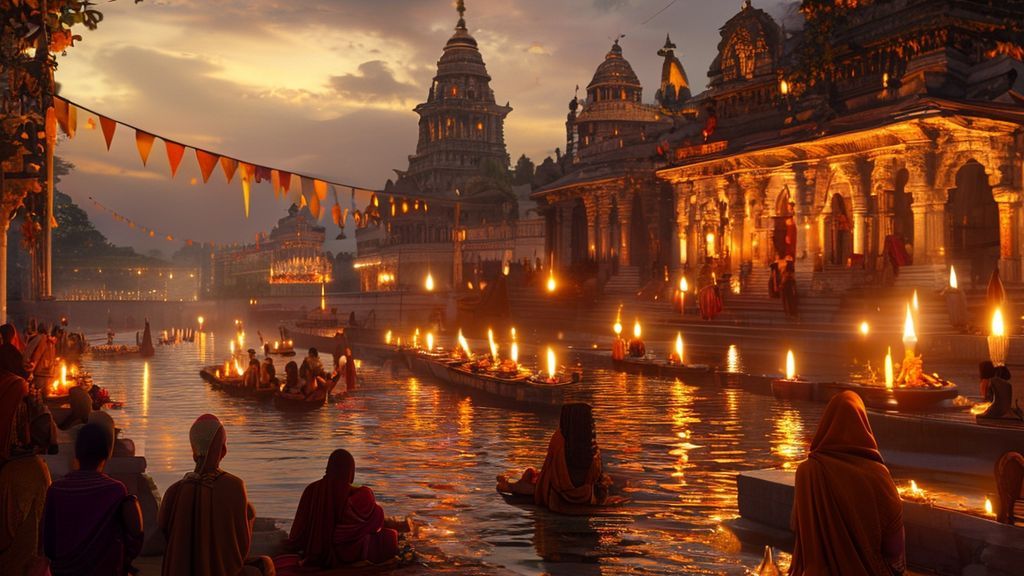
Varanasi Ganga Aarti is the profound daily ritual of offering radiant lamps, fragrant incense, and fervent chants to the sacred River Ganga, primarily performed with grandeur at Dashashwamedh Ghat. This ancient practice, revered across Bharat, symbolizes deep devotion and boundless gratitude towards the divine Mother Ganga, believed to purify sins and bestow immense spiritual blessings upon all sincere devotees.
| Attribute | Details |
|---|---|
| Primary Deity | Ganga Devi (Goddess Ganga) |
| Main Location | Dashashwamedh Ghat, Varanasi, Uttar Pradesh |
| Key Festivals | Ganga Dussehra (Ganga Avataran), Kartik Purnima (lamps significance), Maha Shivaratri |
| Scripture References | Skanda Purana (Kashi Khanda), Valmiki Ramayana, Mahabharata, Rig Veda |
| Ritual Timing | Daily at dusk (approximately 6:00 PM – 7:30 PM, varies seasonally) |
The Eternal Embrace: Varanasi Ganga Aarti
Varanasi, known eternally as Kashi, the City of Light and the spiritual heartland of Sanatan Dharma, is where the sacred River Ganga assumes her most profound role. For countless millennia, seekers and sages have journeyed to her banks, drawn by her promise of liberation. The daily Ganga Aarti is not merely a spectacle; it is a profound act of devotion, a living embodiment of Vedic reverence for the elemental forces of nature, particularly the life-giving waters of Mother Ganga. This meticulously choreographed ritual, performed with unparalleled grandeur, transcends mere performance, offering a direct pathway to connect with the divine energy permeating Kashi Kshetra. It is a vibrant assertion of faith, a collective prayer echoing through time, binding the devotee to the ancient spiritual lineage of Bharat.
Puranic History and Legend: The Descent of Ganga and Kashi’s Sanctity
The very existence of Ganga in Kashi is a tale woven into the fabric of our most sacred scriptures. The Skanda Purana, particularly its Kashi Khanda, describes Varanasi as the exclusive abode of Bhagwan Shiva, an Avimukta Kshetra – a place Shiva never forsakes. The Ganga, therefore, flowing through Kashi, is not just a river but a manifestation of divine energy, inextricably linked to Shiva himself.
The story of Ganga’s descent, or Ganga Avataran, is recounted majestically in the Valmiki Ramayana (Bala Kanda, Sarga 35-44) and the Bhagavata Purana (Canto 9). It narrates how the mighty King Bhagiratha undertook severe austerities for thousands of years to bring Ganga from the heavens to earth to purify the ashes of his ancestors, the 60,000 sons of King Sagara. The force of Ganga’s descent was so tremendous that only Bhagwan Shiva, upon Bhagiratha’s plea, could contain her in his matted locks (Jata), thereby softening her impact on Earth. Hence, Ganga is also known as Jahnavi, because she was once swallowed and then released by Sage Jahnu when she flooded his ashram.
The Dashashwamedh Ghat, the primary venue for the Aarti, bears its own significant history. Its name literally means “the Ghat of ten horse sacrifices.” According to legend, Brahma, the creator deity, performed ten Ashwamedha Yajnas (horse sacrifices) here to welcome Bhagwan Shiva to the earthly realm. This act elevated the spiritual potency of the ghat, making it a particularly auspicious site for sacred rituals. The tradition of offering light (Aarti) to a deity or sacred river is ancient, rooted in Vedic practices, symbolizing the dispelling of darkness with divine illumination and expressing deep reverence for the elemental five (Panch Mahabhuta).
The Spiritual Architecture & Divine Symphony of Aarti
While not “architectural” in the conventional sense of stone and mortar, the Ganga Aarti at Varanasi possesses a profound spiritual architecture and a meticulously designed ritualistic framework. The arrangement on the Dashashwamedh Ghat’s elevated platforms creates a natural amphitheater, allowing thousands of devotees to witness the sacred proceedings simultaneously. The brass lamps, or Deepams, are not just sources of light; they are multi-tiered structures, often seven-tiered, symbolizing the seven cosmic planes or the seven chakras, each flame representing a facet of divine energy. The priests, clad in saffron robes, stand on elevated wooden platforms, their synchronized movements creating a mesmerizing ballet of devotion.
The scientific marvel lies in the profound effect this collective ritual has on the human psyche and the environment. The rhythmic chanting, the resonating conch shells (Shankha), the clanging of large temple bells (Ghanta), and the fragrant smoke from incense (Dhupa) combine to create a deeply immersive sensory experience. This symphony of sound, light, and scent is not accidental; it is designed to induce a state of meditative calm, purification, and spiritual upliftment. The positive vibrations generated by thousands of devotees chanting and praying in unison have a tangible effect, creating a palpable field of spiritual energy around the ghat, aligning individual consciousness with the universal divine.
Rituals & Puja Vidhi: A Step-by-Step Guide for Devotees
Witnessing or participating in the Varanasi Ganga Aarti is an immersive spiritual journey. Here is the general flow of the ritual:
- Sankalp and Invocation: The priests begin by purifying themselves and the performance area. They offer preliminary prayers, invoking various deities and establishing the sacred intention (Sankalp) for the Aarti.
- Lighting the Lamps: The most iconic part begins with the lighting of large, multi-tiered brass lamps. These are filled with ghee or oil, and their numerous wicks are ignited, creating a spectacular display of light.
- Dhoop Arpan (Incense Offering): Fragrant incense sticks and conical dhuni are offered, their aromatic smoke purifying the atmosphere and carrying prayers to the heavens.
- Deep Pradhanam (Lamp Waving): The priests expertly wave the large lamps in circular motions, moving them towards and away from the river in a rhythmic, devotional dance. Each movement is a gesture of offering and reverence.
- Jal Arpan (Water Offering): Small pitchers of water from the Ganga itself are offered back to the river, symbolizing the cyclical nature of giving and receiving from the divine source.
- Vastra Arpan (Cloth Offering): Sometimes, a piece of cloth is offered symbolically to Mother Ganga.
- Chamara Seva (Whisk Waving): A ceremonial whisk (Chamara) made from yak hair is waved, symbolizing respect and service to the deity.
- Pankha Seva (Fan Waving): A ceremonial fan (Pankha) is also used in a similar manner to cool and honour the divine presence.
- Pushpa Varsha (Flower Shower): Flowers are offered, often showered onto the river or the deity’s image.
- Shankhnaad and Ghanta Dhwani: Throughout the Aarti, conch shells are blown, and large bells are rung in powerful, resonant tones, creating an auspicious and purifying soundscape.
- Final Arpan & Prasad: After the main Aarti, smaller lamps (diyas) are often lit by devotees and floated on the river, carrying their personal prayers. Prasad (consecrated food) may be distributed.
It is important to remember that the entire ritual is performed with immense devotion, known as Bhava, which is crucial for its spiritual efficacy. For deeper insights into such rituals, please explore more on Hindutva.online.
Mantras & Chants for Ganga Aarti
While the priests lead the specific Aarti mantras, devotees can silently or softly chant these powerful slokas:
-
Ganga Stuti (Common Invocation):
गंगे च यमुने चैव गोदावरि सरस्वती ।
नर्मदे सिंधु कावेरी जलेऽस्मिन् सन्निधिं कुरु ॥
“Gange cha Yamune chaiva Godavari Saraswati | Narmade Sindhu Kaveri jalesmin sannidhim kuru ||”
(O Ganga, Yamuna, Godavari, Saraswati, Narmada, Sindhu, Kaveri, may you all be present in this water.) -
Salutation to Ganga:
ॐ श्री गङ्गादेव्यै नमः
“Om Shri Gangadevai Namaha”
(Salutations to Goddess Ganga) -
Maha Mrityunjaya Mantra (for overall well-being and liberation, often chanted in sacred spaces):
ॐ त्र्यम्बकं यजामहे सुगन्धिं पुष्टिवर्धनम् ।
उर्वारुकमिव बन्धनान्मृत्योर्मुक्षीय माऽमृतात् ॥
“Om Tryambakam Yajamahe Sugandhim Pushtivardhanam | Urvarukamiva Bandhanan Mrityor Mukshiya Maamritat ||”
(We worship the three-eyed Lord Shiva, who is fragrant and nourishes all beings. May he liberate us from death for the sake of immortality, just as the cucumber is severed from its bondage to the creeper.) -
Hare Krishna Maha Mantra: (Widely chanted by devotees)
हरे कृष्ण हरे कृष्ण कृष्ण कृष्ण हरे हरे ।
हरे राम हरे राम राम राम हरे हरे ॥
“Hare Krishna Hare Krishna Krishna Krishna Hare Hare | Hare Rama Hare Rama Rama Rama Hare Hare ||”
Dos and Don’ts for Observing Ganga Aarti
To ensure a respectful and spiritually enriching experience, devotees should adhere to certain etiquettes:
- DO: Arrive early to secure a good viewing spot, especially during peak seasons.
- DO: Maintain silence and reverence during the Aarti. Let the spiritual atmosphere envelop you.
- DO: Participate in the chants and prayers if you feel inclined.
- DO: Offer small diyas (lamps) or flowers to the Ganga after the main Aarti, as a personal offering.
- DO: Dress modestly, covering shoulders and knees, out of respect for the sacredness of the place.
- DO: Seek blessings from the priests if you wish, but do so respectfully.
- DON’T: Talk loudly, use phones excessively, or disrupt the serene environment.
- DON’T: Take photographs with flash, as it can disturb both the priests and other devotees.
- DON’T: Litter or throw any non-biodegradable items into the Ganga.
- DON’T: Engage in any form of inappropriate behaviour or consumption of intoxicants near the ghats.
- DON’T: Touch the priests or their ritual items without permission.
Frequently Asked Questions About Varanasi Ganga Aarti
When is the best time to witness the Ganga Aarti?
The Ganga Aarti is performed daily at dusk. The exact timings vary slightly with the seasons (earlier in winter, later in summer). It is advisable to arrive at Dashashwamedh Ghat at least 45 minutes to an hour before sunset to secure a good viewing spot, as it draws immense crowds.
Can anyone participate in the Ganga Aarti? Is there an entry fee?
Yes, anyone can observe and participate in the collective spiritual experience of the Ganga Aarti. There is no entry fee as it is a public religious ceremony. Devotees are welcome to sit on the ghat steps or boats. Donations are voluntary and appreciated for the upkeep of the ghats and the ritual.
What is the significance of the lamps offered during the Aarti?
The lamps (deepams) symbolize divine light, knowledge, and the dispelling of darkness (ignorance). Offering them to Mother Ganga is an act of gratitude and prayer, acknowledging her as the source of life and purity. The flames represent the soul’s aspiration to merge with the divine, and their light is believed to cleanse impurities and bless the environment.
Are there other ghats where Ganga Aarti is performed in Varanasi?
While Dashashwamedh Ghat hosts the largest and most famous Ganga Aarti, smaller Aartis are also performed at other significant ghats, such as Assi Ghat and Rajendra Prasad Ghat. Each offers a unique, albeit less grand, devotional experience. The essence of the ritual, however, remains the same across all locations: an offering of reverence to Mother Ganga.
Dharmic Significance: Preserving Sanatan Dharma’s Heartbeat
The Varanasi Ganga Aarti is far more than a spiritual event; it is a vital pillar in the preservation and propagation of Sanatan Dharma. It serves as a living connection to our ancient past, echoing the Vedic hymns and Puranic legends that have shaped our civilization. In a rapidly changing world, this unwavering daily ritual reminds us of the eternal truths – the sanctity of nature, the power of devotion, and the collective strength of faith. It instills in every participant and observer a sense of belonging to a timeless tradition, fostering cultural identity and spiritual awakening. Through the rhythmic dance of light and sound on the banks of the holiest river, Varanasi continues to be the vibrant heart of Hindu spirituality, reminding us of the profound wisdom and enduring beauty of our Dharma. It is a testament to the unyielding devotion that continues to thrive, sustaining the spiritual essence of Bharat for generations to come. To truly understand the depth of Sanatan Dharma, one must experience such profound rituals, many of which are elaborated upon at Hindutva.online.