

The Vastu Puja – also called [translate:Vastu Shanti] or [translate:Vastu Dosh Nivaran Puja] – represents one of Hinduism’s most essential architectural ceremonies designed to purify new homes from negative energies accumulated through land’s past history, construction process vibrations, directional imbalances inherent in building layout, and planetary influences affecting specific spatial zones, transforming mere physical structure of bricks and cement into harmonious dwelling aligned with cosmic forces governing health, wealth, relationships, and spiritual growth through systematic worship of [translate:Vastu Purusha] (presiding deity of building) and 45 directional deities controlling different life dimensions from prosperity and intellectual development through disease prevention and emotional stability.

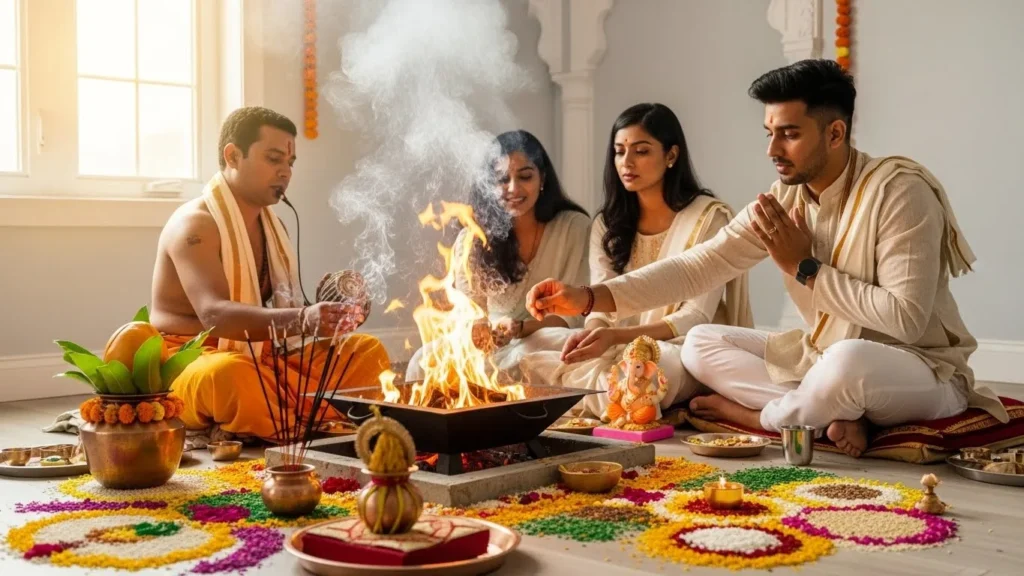
Unlike superficial secular approaches treating homes as neutral containers requiring only aesthetic decoration and functional furniture arrangement, Vastu Shastra recognizes buildings as living energy systems where spatial orientation, element balance (earth, water, fire, air, ether), and directional alignments create invisible force fields profoundly affecting occupants’ consciousness, success patterns, health conditions, and interpersonal dynamics – making proper sanctification through Vastu Puja essential transition from construction completion to actual residence establishing energetic foundation for decades of harmonious living within those walls.
The complete Vastu Puja ceremony involves understanding profound [translate:Vastu Purusha Mandala] – sacred geometric diagram mapping 45 deities across building’s floor plan with Brahma occupying central Brahmasthan creating energy core radiating through four cardinal directions (North-South-East-West) and four diagonal zones (Northeast-Southeast-Southwest-Northwest) each governed by specific deity controlling particular life aspects from Kubera in North bestowing wealth through Agni in Southeast managing digestive fire and financial expenditure to Yama in South representing death and discipline while Varuna in West oversees emotional bonding and children’s welfare – systematic worship of these directional forces through offerings, mantras, and havan (fire ceremony) correcting inherent architectural doshas (defects) even when structural modification proves impossible through modern construction constraints.
For families moving into 2025 homes, whether elaborate new constructions requiring comprehensive purification or previously occupied properties carrying past residents’ energetic imprints needing cleansing, understanding complete Vastu Puja framework proves essential – recognizing five warning signs indicating urgent need for ceremony (persistent unexplained illnesses, continuous financial losses despite hard work, family conflicts without apparent cause, career stagnation, disturbing dreams or eerie sensations), gathering complete samagri including kalash, specific directional offerings, Navagraha items, and Vastu yantra, performing step-by-step ritual sequence from preliminary space purification through kalash installation and directional.
deity worship to climactic havan and yantra placement, implementing powerful remedies addressing common defects like toilet in auspicious Northeast or kitchen in wrong direction without expensive demolition, and maintaining ongoing practices like salt-water cleansing, incense purification, and crystal placement sustaining positive energy long after initial ceremony – transforming house into sanctuary supporting residents’ complete flourishing across material prosperity, intellectual development, emotional harmony, physical health, and ultimate spiritual liberation.
Understanding Vastu Shastra and Negative Energy
Before examining specific purification procedures, grasping fundamental principles underlying Vastu science reveals profound wisdom distinguishing this tradition from mere superstition or arbitrary rules.
What is Vastu Shastra?
Vastu Shastra (Science of Architecture) represents ancient Indian architectural discipline harmonizing buildings with natural forces and cosmic energies.
Core Principles:
Five Elements ([translate:Pancha Mahabhuta]):
- Earth ([translate:Prithvi]) – Stability, grounding, nourishment
- Water ([translate:Jala]) – Flow, purification, emotions
- Fire ([translate:Agni]) – Transformation, energy, digestive power
- Air ([translate:Vayu]) – Movement, breath, life force
- Ether/Space ([translate:Akasha]) – Expansion, consciousness
Every building contains all five elements in varying proportions. Imbalance causes problems; Vastu Puja restores equilibrium.
Directional Energies:
Eight directions carry specific vibrations:
- East – New beginnings, children, health
- Southeast – Fire, expenses, digestion
- South – Fame, longevity, discipline
- Southwest – Stability, relationships, ancestors
- West – Gains, profits, children’s future
- Northwest – Movement, support, social connections
- North – Wealth, opportunities, career
- Northeast – Spirituality, clarity, water element
Scientific Basis:
While rooted in spiritual tradition, Vastu incorporates observable phenomena:
Geomagnetic Field: Earth’s magnetic axis (North-South) influences human biorhythms; sleeping aligned with poles reduces stress
Solar Path: Sun’s east-west movement affects temperature, light patterns; strategic window placement optimizes natural lighting and warmth
Gravitational Variations: Differential gravitational pull across space affects subtle energy distribution
Electromagnetic Radiation: Certain spatial configurations amplify or dampen electromagnetic frequencies affecting consciousness
What Constitutes Negative Energy?
Negative energy in Vastu context includes:
1. Land’s Historical Karma:
- Previous tragic events (deaths, violence, suffering)
- Cemetery land, cremation grounds nearby
- Sites of past conflicts or negative activities
- Abandoned properties with stagnation
2. Construction Process Vibrations:
- Workers’ consciousness levels (anger, dishonesty, suffering)
- Materials quality and sourcing ethics
- Construction during inauspicious periods
- Rushed or improper building procedures
3. Architectural Imbalances ([translate:Vastu Doshas]):
- Incorrect directional orientations
- Element imbalances (too much water, insufficient fire zones)
- Structural defects (protruding corners, missing sections)
- Blocked energy flows (heavy furniture in energy pathways)
4. Planetary Influences:
- Malefic planetary positions in horoscope affecting specific house zones
- Rahu-Ketu axis creating disturbances
- Saturn’s restrictive energy in wrong zones
- Afflicted directional planets
5. Accumulated Stagnation:
- Long vacancy allowing negative forces to settle
- Clutter blocking energy circulation
- Dirt, darkness, and deterioration
- Previous occupants’ unresolved emotional residues
5 Warning Signs Requiring Urgent Vastu Puja:
1. Persistent Unexplained Illnesses:
- Family members frequently sick despite medical treatment
- Chronic conditions without clear diagnosis
- Children falling ill repeatedly
- Sleep disturbances, nightmares, insomnia
2. Continuous Financial Losses:
- Money comes but immediately drains
- Unexpected expenses, accidents, losses
- Business stagnation despite effort
- Unable to save or accumulate wealth
3. Family Conflicts Without Cause:
- Constant arguments over trivial matters
- Lack of peace and harmony
- Domestic violence or severe discord
- Relationship breakdowns
4. Career and Educational Stagnation:
- No progress despite qualifications and effort
- Missed opportunities, obstacles at every turn
- Students unable to concentrate or perform
- Professional setbacks and failures
5. Eerie Sensations and Disturbances:
- Strange sounds without source
- Feeling of being watched or negative presence
- Pets behaving strangely (dogs barking at empty spaces)
- Objects moving or disappearing
- Oppressive, heavy atmosphere
If experiencing multiple signs, urgent Vastu Puja essential for cleansing and protection.
The Vastu Purusha Legend:
Understanding Vastu Purusha’s mythological origin explains why architectural worship proves essential:
The Story:
- Creation: Lord Brahma created cosmic being (Vastu Purusha) while experimenting with life
- Problem: Vastu Purusha grew insatiably hungry, devouring everything, threatening universal destruction
- Intervention: Shiva, Vishnu, Brahma, plus 42 other deities pinned him face-down onto earth
- Compensation: Brahma blessed Vastu Purusha as immortal presiding deity of all buildings on earth
- Condition: Mortals must worship him when constructing; those who don’t face his teasing/disturbances
Vastu Purusha’s Position:
- Lies face-down with head toward Northeast
- Feet toward Southwest
- 45 deities hold different body parts
- Each deity governs that spatial zone’s energy
Implication: Every building hosts Vastu Purusha and 45 directional deities who must be acknowledged and worshipped for harmonious dwelling.
The Vastu Purusha Mandala: Sacred Energy Map
The Vastu Purusha Mandala represents Vastu Shastra’s most important diagram – sacred geometric template mapping divine presences across building’s floor plan creating comprehensive energy management system.
Structure and Components:
The Square Mandala:
Typically depicted as square grid divided into sections (ranging from 64 to 81 squares in different systems, most common is 81-square Mandala).
Three Zones:
1. Central Brahmasthan (13 Inner Deities):
Brahma (Center):
- Absolute center of building
- Energy core from which all radiates
- Must remain empty, open – no heavy furniture, walls, or pillars
- Represents cosmic creator, source energy
- Ideal: Open courtyard, skylight, or simply unfurnished space
Four Cardinal Direction Deities (surrounding Brahma):
| Direction | Deity | Energy Function |
|---|---|---|
| North | Bhudhar | Initiating action, beginning tasks |
| East | Aryama | Social connections, relationships |
| South | Vivasvan | Fame, success, recognition |
| West | Mitra | Motivation, fruitful actions |
Eight Diagonal Deities (Ashtasiddhis):
Northeast Deities:
- Apa – Solutions, healing, right path
- Apavatsa – Nutritional reservoir, support for Apa
Southeast Deities:
- Savita – Motivation to begin action
- Sosa/Savitra – Financial management, support for Savita
Southwest Deities:
- Indra – Business expansion, property growth
- Jaya/Indrajaya – Tools and skills for expansion
Northwest Deities:
- Rudra – Uninterrupted task execution, emotional balance
- Rajyaksma – Supervision, mental ideation support
2. Middle Ring (16 Deities in Four Cardinal Directions):
North (Wealth Zone – Kubera’s Domain):
- Mikhya, Bhallata, Soma, Bhujanga
- Governs: Wealth accumulation, business success, health, medicine
East (Wisdom Zone – Indra’s Domain):
- Jayanta, Indra/Mahendra, Ravi/Surya, Satya
- Governs: Determination, focus, foresight, righteousness
South (Fame Zone – Yama’s Domain):
- Vitatha, Grahksta, Yama, Gandharva
- Governs: Stability, law, creativity, arts
West (Emotional Zone – Varuna’s Domain):
- Sugriva, Pushpadanta, Varuna, Asura
- Governs: Relationships, task completion, bonding, clarity
3. Outer Ring (16 Deities in Four Diagonal Directions):
Northeast (Most Auspicious – Ishaan/Shiva’s Zone):
- Aditi, Diti, Shikhi, Parjanya
- Governs: Safety, clarity, potential, fertility
- Critical: Never place toilet or heavy storage here
Southeast (Fire Zone – Agni’s Domain):
- Bhrisa, Akasha, Anila, Pusa
- Governs: Initiative, opportunities, energy, nourishment
- Ideal: Kitchen placement here
Southwest (Stability Zone – Nirriti/Rahu’s Domain):
- Bhringraja, Mriga, Pitra, Dauvrika
- Governs: Protection, ancestors, focus, guardianship
- Ideal: Master bedroom here for stability
Northwest (Movement Zone – Vayu’s Domain):
- Sosa, Papayaksma, Roga, Naga
- Governs: Removal of negativity, disease management
- Challenging zone: Can bring illness, addictions if imbalanced
Practical Application:
Room Placement Based on Mandala:
Northeast: Puja room, study (Shiva’s wisdom energy)
East: Children’s rooms, living area (new beginnings)
Southeast: Kitchen (Agni’s fire element)
South: Adult bedrooms (fame, longevity)
Southwest: Master bedroom (stability, relationships)
West: Children’s future planning, dining
Northwest: Guest rooms, storage (movement, temporary)
North: Office, business area (Kubera’s wealth)
Brahmasthan (Center): Open courtyard, living room without heavy furniture, or simply kept clear
Why Vastu Puja Works:
By worshipping all 45 deities according to Vastu Purusha Mandala:
- Activates dormant positive energies in corresponding zones
- Balances conflicting forces (devas and asuras both present)
- Corrects architectural defects through spiritual compensation
- Establishes conscious relationship with spatial energies
- Creates protective shield against negative influences
Understanding this sacred geometry transforms Vastu from mysterious superstition into sophisticated energy management science encoded in divine mythology.
Complete Vastu Puja Procedure
The systematic Vastu Shanti ceremony follows specific sequence purifying space and invoking divine blessings for harmonious dwelling.
Optimal Timing:
Best Days:
- Thursday (Brihaspativar – Jupiter’s day, wisdom and prosperity)
- Sunday (Ravivar – Sun’s day, vitality and authority)
- Friday, Wednesday acceptable
Avoid: Tuesday (Mars’ aggressive energy), Saturday (Saturn’s restrictive energy)
Best Muhurat (Time Window):
- Abhijit Kaal (11:30 AM – 12:30 PM) – Most auspicious midday period
- Brahma Muhurta (4:00 AM – 6:00 AM) – Early morning spiritual time
- Sunrise to 12 PM generally favorable
Avoid: Evening/night, Rahu Kaal (inauspicious 90-minute period daily)
Complete Samagri (Materials) List:
Essential Items:
| Category | Items |
|---|---|
| Kalash Setup | Copper/brass pot, Mango leaves (25-30), Coconut with husk, Sacred thread (moli), Betel nuts, Coins |
| Puja Basics | Ganga jal (holy water), Turmeric powder, Kumkum (vermillion), Sandalwood paste, Vibhuti (sacred ash), Akshat (unbroken rice), Rock salt |
| Deities & Images | Ganesha idol, Vastu Purusha image/yantra, Family kula devata |
| Flowers | Fresh flowers (white, yellow, red varieties), Garlands, Tulsi leaves, Bel patra (for Shiva) |
| Incense & Light | Incense sticks, Dhoop (frankincense/camphor blocks), Camphor, Ghee, Cotton wicks, Oil lamps (5-9) |
| Havan Items | Havan kund, Havan samagri, Navagraha samidha (9 sacred woods), Black sesame seeds, Dried coconut pieces, Ghee for offerings |
| Directional Offerings | Wheat (East), Turmeric (NE), Red lentils (South), Rice varieties, Jaggery, Specific colored flowers |
| Prasad | Fruits, Sweets, Coconut, Dry fruits |
| Special | Vastu Yantra (copper/silver), Yellow cloth, White cloth, Kalawa (sacred thread for tying) |
Step-by-Step Procedure:
PHASE 1: Preliminary Purification (15-20 minutes)
1. Space Cleansing:
Physical Cleaning:
- Thoroughly clean entire house before ceremony
- Remove clutter, sweep, mop
- Open windows for ventilation
Energetic Cleansing:
- Mix Ganga jal with rock salt in bucket
- Sprinkle in all corners, doorways, windows
- Pay special attention to bathrooms, dark corners
Mantra while sprinkling:
[translate:ॐ अपवित्रः पवित्रो वा सर्वावस्थां गतोऽपि वा।
यः स्मरेत् पुण्डरीकाक्षं स बाह्याभ्यन्तरः शुचिः॥]
“Om, whether pure or impure, in whatever state, whoever remembers the lotus-eyed Lord becomes pure internally and externally.”
2. Dhoop Purification:
- Light frankincense or camphor
- Carry throughout house allowing smoke to purify atmosphere
- Smoke drives away negative entities and stagnant energy
PHASE 2: Kalash Sthapana (20-30 minutes)
Purpose: Establishing divine presence anchor
1. Preparing Sacred Pot:
- Fill copper/brass kalash with water
- Add turmeric, kumkum, betel nuts, coins, durva grass
- Place mango leaves around rim
- Top with coconut (eyes facing up)
- Tie sacred thread around neck
2. Placement:
- Position at Brahmasthan (center of house) or Northeast corner
- On rice mound or clean plate
- Decorate with flowers
3. Invocation:
[translate:कलशस्य मुखे विष्णुः कण्ठे रुद्रः समाश्रितः।
मूले तत्र स्थितो ब्रह्मा मध्ये मातृगणाः स्मृताः॥]
“Vishnu dwells in kalash’s mouth, Rudra in neck, Brahma at base, Divine Mothers in middle.”
4. Worship:
- Offer flowers, sandalwood paste, kumkum
- Light lamp before kalash
PHASE 3: Ganapati Puja (15-20 minutes)
Purpose: Removing obstacles
Procedure:
- Ganesha idol placed prominently
- Offer durva grass, red flowers, modak
- Chant:
[translate:ॐ गं गणपतये नमः। वक्रतुण्ड महाकाय सूर्यकोटि समप्रभ।
निर्विघ्नं कुरु मे देव सर्वकार्येषु सर्वदा॥]
“Om Gam Ganapataye Namah. O Ganesha, make all undertakings obstacle-free.”
- Brief aarti with camphor
PHASE 4: Directional Deity Worship (Dasha Dikpala Puja) (45-60 minutes)
Purpose: Honoring 10 directional guardians
Procedure:
Face each direction sequentially, make offerings:
East (Indra – King of Gods):
- Offering: Wheat, white flowers
- Mantra: [translate:ॐ इन्द्राय नमः]
- Benefit: Leadership, respect, children’s welfare
Southeast (Agni – Fire God):
- Offering: Red lentils, ghee, red flowers
- Mantra: [translate:ॐ अग्नये नमः]
- Benefit: Digestive health, controlled expenses
South (Yama – Lord of Death/Dharma):
- Offering: Black sesame, iron items, dark flowers
- Mantra: [translate:ॐ यमाय नमः]
- Benefit: Longevity, discipline, ancestral peace
Southwest (Nirriti/Rahu – Demon):
- Offering: Black items, protective mantras
- Mantra: [translate:ॐ निर्ऋत्यै नमः]
- Benefit: Protection from enemies, stability
West (Varuna – Water God):
- Offering: Water, white items, silver
- Mantra: [translate:ॐ वरुणाय नमः]
- Benefit: Emotional bonding, children, relationships
Northwest (Vayu – Wind God):
- Offering: Light items, incense
- Mantra: [translate:ॐ वायवे नमः]
- Benefit: Movement, travel, social connections
North (Kubera – Wealth God):
- Offering: Gold items, yellow flowers, coins, jaggery
- Mantra: [translate:ॐ कुबेराय नमः]
- Benefit: Wealth, prosperity, career success
Northeast (Ishaan/Shiva):
- Offering: White flowers, bilva leaves, pure water
- Mantra: [translate:ॐ ईशानाय नमः]
- Benefit: Spiritual growth, clarity, wisdom
Zenith/Sky (Brahma – Creator):
- Offering: Flowers offered upward
- Mantra: [translate:ॐ ब्रह्मणे नमः]
- Benefit: Creative power, knowledge
Nadir/Earth (Ananta – Cosmic Serpent):
- Offering: Flowers placed on ground
- Mantra: [translate:ॐ अनन्ताय नमः]
- Benefit: Stability, support, grounding
PHASE 5: Navagraha Puja (30-40 minutes)
Purpose: Balancing nine planetary influences
Procedure:
Offer specific items to each planet:
Surya (Sun): Wheat, red flowers, jaggery
Chandra (Moon): Rice, white flowers, milk
Mangal (Mars): Red lentils, red flowers
Budh (Mercury): Green gram, green items
Guru (Jupiter): Yellow chana dal, turmeric, yellow flowers
Shukra (Venus): White rice, white flowers, sugar
Shani (Saturn): Black sesame, black items, iron
Rahu: Black gram, dark items
Ketu: Brown items, kusha grass
Navagraha Mantra:
[translate:ॐ सूर्याय नमः। ॐ चन्द्राय नमः। ॐ मंगलाय नमः।
ॐ बुधाय नमः। ॐ बृहस्पतये नमः। ॐ शुक्राय नमः।
ॐ शनैश्चराय नमः। ॐ राहवे नमः। ॐ केतवे नमः॥]
PHASE 6: Main Vastu Shanti Havan (45-60 minutes)
Purpose: Fire purification and offering
Procedure:
- Fire Setup:
- Havan kund placed at safe location
- Build fire with sacred woods
- Ignite with mantras
- Primary Vastu Mantra:
[translate:ॐ वास्तोष्पते प्रति जानीह्यस्मान् स्वावेशो अनमीवो भवा नः।
यत् त्वेमहे प्रति तन्नो जुषस्व शं नो भव द्विपदे शं चतुष्पदे॥]
“Om Vastu Purusha, recognize us as your own. Be gracious. Accept our worship. Be auspicious for our two-legged and four-legged beings.”
- Offerings:
- Each mantra chant ends with “Svaha!” while offering ghee
- Havan samagri, sesame seeds, grains offered systematically
- 108 offerings typical
- Completion:
- Final camphor aarti to fire
- Circumambulate fire once clockwise
PHASE 7: Vastu Yantra Installation (10-15 minutes)
Purpose: Continuous energy correction
Procedure:
- Vastu Yantra (sacred geometric diagram on copper/silver) energized with mantras
- Placed in Northeast corner or under doorway
- Ensures ongoing positive energy maintenance
PHASE 8: Final Aarti and Prasad (15-20 minutes)
1. Grand Aarti:
- Camphor aarti to all deities
- Family participates with clapping, singing
2. Blessings:
- Priest (or family elder) blesses household
- Sprinkles blessed water throughout house
3. Prasad Distribution:
- All offerings distributed to participants
- Everyone partakes sanctified food
Simplified DIY Version (Without Priest):
Minimum Essentials (1-2 hours):
- Basic space cleansing with salt water
- Simple kalash installation
- Brief Ganesha puja
- Directional prayers (simplified)
- Lighting lamps in all corners
- Vastu yantra placement
- Prasad sharing
Resources: Online videos, printed mantras, recorded priest audio provide guidance.
Simple Remedies for Common Vastu Defects
Not all Vastu problems require expensive structural changes. Powerful remedies exist addressing defects without demolition.
1. Main Door Blocked or Facing Wrong Direction:
Problem: Entrance blocked by wall, tree, pole; or facing South/Southwest
Remedies:
- Hang Swastik + Om symbol on door
- Place Ganesha idol near entrance (inside)
- Use bright lighting near door
- Keep entrance clutter-free, well-maintained
- Yellow doormat attracts positive energy
2. Kitchen in Wrong Direction (Not Southeast):
Problem: Kitchen in Northeast (worst), North, or Southwest
Remedies:
- Place pyramid near stove
- Keep silver coin under cooking vessel
- Paint kitchen in shades of red/orange (fire element)
- Ensure cook faces East while cooking if possible
- Avoid cooking during inauspicious hours (Rahu Kaal)
3. Toilet in Northeast (Most Inauspicious):
Problem: Toilet/bathroom in spiritual Northeast zone
Remedies:
- White candle burned daily in toilet
- Salt bowl (rock salt or sea salt) in corner absorbs negativity (replace weekly)
- Keep toilet door always closed
- Vastu Pyramid on outer wall
- Paint in white or light blue (never dark colors)
- Excellent ventilation and lighting
4. Bed Under Beam or Directly Under Toilet (Upper Floor):
Problem: Creates pressure, disturbs sleep, causes health issues
Remedies:
- Tie yellow cloth with turmeric on beam
- Place bamboo flute across beam
- Move bed if possible (easiest solution)
- Canopy over bed diffuses pressure
- Crystal cluster on nightstand balances energy
5. Mirror Facing Bed:
Problem: Disturbs sleep, creates energetic disturbance, doubles problems
Remedies:
- Cover mirror at night with cloth
- Remove mirror (best solution)
- Place Lakshmi Yantra near mirror
- Reposition bed so mirror doesn’t reflect it
- Use wardrobe mirrors that close
6. Clutter and Storage in Northeast:
Problem: Blocks spiritual energy, opportunities
Remedies:
- Immediate decluttering – this is non-negotiable
- Keep Northeast lightest, cleanest, emptiest area
- Water feature (small fountain) in Northeast ideal
- Place crystal in Northeast corner
- Never store garbage or heavy items here
7. Heavy Furniture in Brahmasthan (Center):
Problem: Blocks energy core, creates stagnation
Remedies:
- Move furniture to walls/corners
- If central pillar unavoidable (structural), paint yellow
- Keep center as open as possible
- Hanging crystal from ceiling diffuses blockage
- Central courtyard ideal (traditional solution)
8. Staircase in Northeast:
Problem: Drains positive energy downward
Remedies:
- Paint stairs in light colors (white, cream, light yellow)
- Bright lighting on stairs
- Vastu Pyramid at staircase base
- Ensure stairs ascend clockwise when climbing
- Place green plants near stairs
9. Extended or Cut Corners:
Problem: Missing sections create element imbalance
Remedies:
- Mirrors create illusion of completion (place on wall of cut section)
- Bright outdoor lighting in extended/cut zone
- Plantation or boundary wall completing shape symbolically
- Specific yantras for affected directions
10. Master Bedroom in Northeast:
Problem: Inappropriate use of spiritual zone for heavy furniture
Remedies:
- If cannot shift bedroom:
- Sleep with head toward South or East
- Keep room extremely clean and organized
- Daily meditation/prayer in morning
- Light colored, minimalist décor
- Good ventilation and natural light
Ongoing Practices: Maintaining Positive Energy
Vastu Puja isn’t one-time event but beginning of continuous energy maintenance through simple daily/weekly practices.
Daily Practices:
1. Morning Lamp Lighting:
- Light ghee lamp or oil lamp in Northeast corner
- Symbolizes dispelling darkness, inviting divine light
- Even 2-minute simple ritual maintains sanctity
2. Incense/Dhoop:
- Burn frankincense, sandalwood, or camphor daily
- Smoke purifies atmosphere
- Especially important after conflicts, illness, or negative visitors
3. Threshold Maintenance:
- Draw small rangoli or apply turmeric-kumkum at entrance daily
- Symbolizes sacred boundary between outside and home
- Prevents negative energies entering
4. Clutter Management:
- Daily tidying prevents energy stagnation
- Clutter = blocked energy = blocked opportunities
- Particularly maintain Northeast, North, East
5. Salt Water Cleansing:
- Bowl of salt water in corners (especially problematic zones)
- Change weekly
- Salt absorbs negative vibrations
Weekly Practices:
1. Deep Cleaning:
- Thorough mopping with salt water weekly
- Special attention to bathrooms, dark corners
- Fresh air circulation
2. Crystal Charging:
- If using crystals for Vastu correction
- Sunlight exposure weekly recharges them
- Full moon nights particularly powerful
3. Fresh Flowers:
- Replace flowers in puja area
- Fresh natural fragrance uplifts energy
- Never keep wilted/dead flowers (negative energy)
Monthly Practices:
1. Full Moon Cleansing:
- Purnima (full moon) night
- Open windows allowing moonlight to enter
- Particularly beneficial for Northeast zone
- Place water in silver vessel absorbing moon energy, use for next day’s puja
2. New Moon Protection:
- Amavasya (new moon) is vulnerable period
- Extra lighting in all corners
- Protective mantras
- Avoid major activities
3. Vastu Yantra Re-energizing:
- Monthly brief puja to installed Vastu Yantra
- Ensures continued efficacy
Annual Practices:
1. Major Vastu Puja Renewal:
- Annual repetition of complete Vastu Shanti
- Particularly recommended on:
- Ugadi/Gudi Padwa (Hindu New Year – March-April)
- Dussehra (October)
- Akshaya Tritiya (April-May)
2. Structural Maintenance:
- Annual building inspection
- Repair cracks (represent energy leaks)
- Fresh paint (rejuvenates energy)
- Roof waterproofing (protects from overhead negative influence)
Special Occasion Practices:
After Negative Events:
- Major illness, death, accident, severe conflict
- Complete space cleansing with camphor, salt, holy water
- Brief havan if possible
- Re-establish positive vibrations
Before Auspicious Events:
- Weddings, naming ceremonies, major celebrations
- Enhanced cleansing and decoration
- Fresh Vastu Puja ensuring maximum auspiciousness
When Selling/Renting:
- Departing residents should perform gratitude ritual
- Thank house, deities
- Leave space energetically clean for next occupants
- Creates good karma
Simple Modern Tools:
Essential Oils: Lavender, sandalwood, rose diffused regularly
Himalayan Salt Lamps: Natural ionizers, purify air
Indoor Plants: Tulsi, money plant, bamboo (avoid cactus, thorny plants)
Wind Chimes: Positive sound vibrations (place in Northwest)
Aquarium: Moving water in Northeast (extremely auspicious if feasible)
Frequently Asked Questions
Can Vastu Puja really remove negative energy or is it superstition?
Both spiritual and scientific basis exists. Spiritually, Vastu Puja invokes divine forces purifying space through sacred rituals, mantras, and offerings. Scientifically: 1) Salt and copper (kalash) neutralize electromagnetic stress, 2) Smoke from havan creates negative ions purifying air, 3) Systematic cleaning removes allergens and pathogens, 4) Directional awareness optimizes natural lighting and ventilation, 5) Ritual creates psychological placebo effect reducing stress. Whether you attribute benefits to divine intervention or natural principles, thousands of families report genuine improvements in health, finances, relationships after Vastu correction. Try with open mind, observe results yourself.
How much does complete Vastu Puja ceremony cost?
Highly variable based on location, priest, and elaboration: Priest Dakshina (Fees): ₹2,000-15,000 (metros expensive, small towns cheaper); Samagri (Materials): ₹1,500-8,000; Optional extras: Vastu consultant fees (₹5,000-50,000 for analysis), Remedial items (yantras, crystals – ₹500-10,000). Total range: ₹5,000-75,000. Budget option: ₹2,000-5,000 (simplified DIY ceremony with basic materials). Remember: Sincere simple ceremony proves more effective than expensive elaborate ritual performed mechanically. Devotion matters more than expenditure.
What if we already moved in without Vastu Puja?
Never too late! Perform Vastu Puja even after occupancy – classified as Dwandwah Griha Pravesh (re-entry type). Ceremony still purifies space, invokes blessings, corrects defects. Many families perform years after moving in when problems arise. Better late than never. While ideal timing before first occupancy maximizes benefits, retrospective ceremony remains highly beneficial. Choose auspicious muhurat, perform complete or simplified procedure depending on circumstances, and maintain ongoing practices afterward.
Can we do Vastu Puja ourselves without priest?
Yes, DIY Vastu Puja acceptable when budget or priest unavailability constrain. Approach: 1) Research procedure thoroughly (online videos, articles, books), 2) Print mantras in English transliteration, 3) Purchase basic samagri, 4) Perform with sincere devotion even if pronunciation imperfect, 5) Focus on cleansing, directional prayers, lamp lighting, minimal havan (or skip if unsafe without expertise). Remember: Sincerity compensates ritual imperfection. The divine responds to pure heart more than technical accuracy. Many families successfully perform DIY ceremonies creating genuine positive shifts.
Do simple remedies really work or only full structural changes?
Simple remedies surprisingly effective according to Vastu experts and practitioners’ experiences. While structural alignment ideal, spiritual remedies compensate architectural defects through: 1) Creating energy balance even when physical layout imbalanced, 2) Invoking divine forces offsetting negative influences, 3) Psychological shifts changing inhabitants’ relationship with space. Many report dramatic improvements through simple salt bowls, pyramids, yantras, proper cleaning without expensive renovation. Try prescribed remedies sincerely for 3-6 months before considering major construction changes. Often sufficient for most Vastu doshas.
Which is more important – Vastu or personal horoscope?
Both interact but serve different purposes. Horoscope: Individual karmic blueprint affecting entire life regardless of location. Vastu: Spatial energy field affecting whoever occupies space. Relationship: Good Vastu enhances positive planetary periods, mitigates difficult ones. Bad Vastu intensifies problems during challenging transits. Ideal approach: 1) Understand horoscope identifying strengths/weaknesses, 2) Use Vastu optimization supporting weak areas, enhancing strong areas, 3) Personal spiritual practices (prayer, meditation, charity) ultimately most powerful. Neither absolutely deterministic – free will and righteous living transcend both.
Should we consult Vastu expert or just do basic Puja?
Depends on situation severity. Consult expert if: 1) Experiencing multiple serious problems (health, finance, relationships), 2) Building new home from scratch (design stage), 3) Major renovation providing structural modification opportunity, 4) Buying expensive property where Vastu analysis worthwhile investment, 5) Persistent issues despite basic remedies. Basic Puja sufficient if: 1) Minor concerns or preventive purification, 2) Budget constraints, 3) Rental property where structural changes impossible, 4) General blessing for harmonious living. Middle path: Basic Vastu Puja initially, consult expert if problems persist after 6 months.
How to know if Vastu Puja worked?
Observable improvements typically appear within 3-6 months: Health: Chronic conditions improve, better sleep, increased energy, family members falling sick less frequently. Finances: Unexpected money inflow, expense reduction, business uptick, new opportunities, ability to save. Relationships: Reduced conflicts, improved communication, harmony increases, family bonding strengthens. Career: Progress after stagnation, promotions, recognition, obstacles clearing. Atmosphere: Home feels lighter, more peaceful, welcoming; eerie sensations cease. Subjective: Personal sense of wellbeing, optimism increases. Track changes – many families maintain diary noting improvements validating ceremony’s efficacy.
Conclusion
The Vastu Puja represents Hinduism’s profound recognition that physical spaces aren’t energetically neutral but living force fields profoundly affecting inhabitants’ consciousness, success patterns, health conditions, and interpersonal dynamics through invisible architectural energies requiring systematic purification and divine invocation transforming mere construction into harmonious dwelling aligned with cosmic forces.
Understanding complete framework – the mythological Vastu Purusha legend explaining why buildings demand worship, the sophisticated 45-deity Vastu Purusha Mandala mapping divine presences across spatial zones from wealth-governing Kubera in North through wisdom-bestowing Ishaan in Northeast to stability-creating Indra in Southwest, the systematic purification ceremony progressing from basic cleansing through kalash installation and directional deity worship to climactic havan and yantra placement, powerful simple remedies addressing common defects without expensive structural modifications, and ongoing maintenance practices sustaining positive energy through daily lamp lighting and periodic cleansing – enables approaching new home occupancy with proper spiritual foundation rather than merely signing legal documents and moving furniture.
As you prepare Vastu Puja for your 2025 home, remember that ceremony’s ultimate purpose transcends correcting architectural defects or attracting material prosperity toward establishing conscious relationship with sacred space recognizing that home serves as sanctuary supporting family’s complete flourishing across health, wealth, emotional bonding, intellectual development, and spiritual realization – making initial purification through comprehensive Vastu Puja combined with ongoing mindful maintenance practices worthy investment in energetic foundation that will support decades of happiness, create memories connecting generations, and establish dwelling where divine presence actively blesses residents.
through proper acknowledgment in systematic directional worship, element balancing, and grateful recognition that walls shelter far more than physical bodies but protect and nurture eternal souls on their journey toward ultimate liberation while simultaneously honoring cosmic forces governing earthly existence through ancient architectural wisdom encoded in Vastu Shastra’s timeless principles transcending cultural variations and historical periods to address universal human needs for harmony, protection, prosperity, and sacred dwelling aligned with natural rhythms and divine order.
[translate:॥ ॐ वास्तुदेवाय नमः। गृहं शान्तिमयं भवतु॥]
(Om, salutations to Vastu Deva. May this home become peaceful.)
About the Author
Rajiv Anand – Temple Architecture, Sacred Geometry, and Vastu Shastra Expert
Rajiv Anand is a distinguished scholar and practitioner specializing in Hindu temple architecture, sacred geometry, Vastu Shastra, and the intersection of traditional architectural wisdom with contemporary building practices. Holding advanced degrees in architecture and religious studies with specialization in Vastu principles, his research examines how ancient Indian architectural science encoded sophisticated understanding of spatial energies, directional influences, and geometric patterns affecting consciousness and wellbeing in ways modern architecture often neglects.
Rajiv has extensively studied the Vastu Purusha Mandala’s evolution from Vedic fire altar geometry through classical temple construction to modern residential applications, demonstrating how core principles about element balance, directional deities, and energy flow remain remarkably consistent across millennia despite dramatic changes in building materials, construction techniques, and lifestyle patterns. He regularly consults on Vastu optimization for homes, offices, and temples, guiding families through purification ceremonies, architectural corrections, and simple remedies balancing authentic traditional principles with practical modern constraints including apartment living, budget limitations, and contemporary aesthetic preferences.
His teaching emphasizes that Vastu Shastra represents genuine architectural science addressing observable phenomena like solar orientation and magnetic fields alongside subtle energy dynamics, that tradition deserves respectful examination revealing profound wisdom rather than dismissal as mere superstition or uncritical blind adherence to arbitrary rules, and that conscious architectural alignment creates tangible benefits for inhabitants’ thriving across material prosperity, emotional harmony, physical health, and spiritual development – making Vastu Puja and ongoing spatial consciousness essential practices for anyone seeking to establish truly harmonious dwelling supporting life’s highest purposes.