


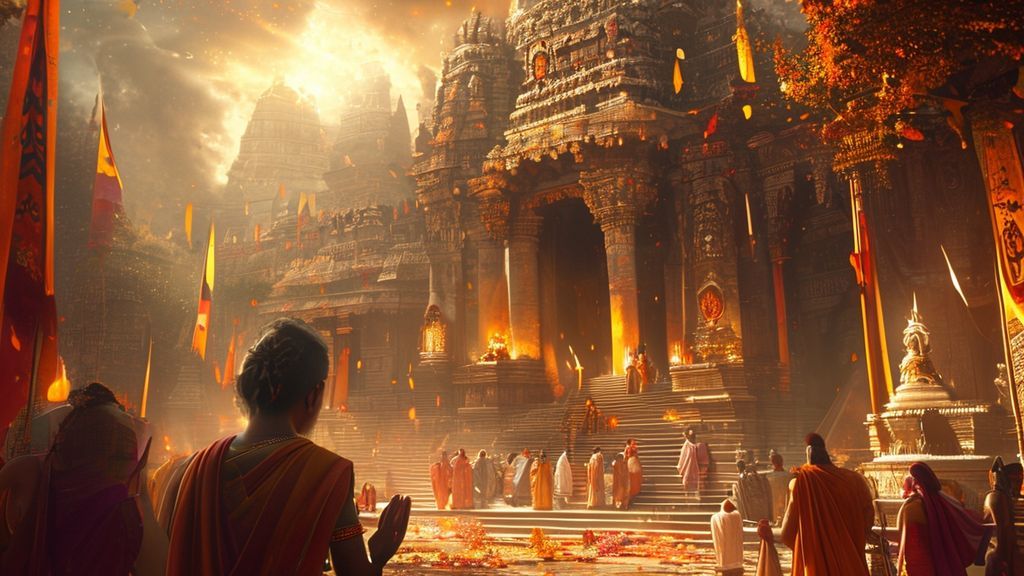
The **Vishnu Purana** is a foundational Sanskrit text of Hinduism, one of the eighteen Mahapuranas, primarily focusing on Bhagavan Vishnu as the supreme deity. It narrates cosmic creation, dissolution, the stories of Vishnu’s avataras, the lineages of kings, and philosophical treatises on Dharma, Karma, and Moksha, guiding devotees towards spiritual liberation.
| Attribute | Details |
|---|---|
| Deity Focus | Bhagavan Vishnu and His various Avataras. |
| Attributed Author | Sage Parashara, father of Vyasa. |
| Estimated Period | Often dated to the 1st millennium CE, with roots in ancient traditions. |
| Key Philosophy | Bhakti Yoga, the path of devotion to Vishnu, intertwined with Karma, Dharma, and Moksha. |
| Number of Cantos | Six Amsas (parts), starting with Pṛathamāṃśa and concluding with Ṣaṣṭhāṃśa. |
| Sanskrit Name | विष्णुपुराणम् (Viṣṇupurāṇam) |
Introduction: The Unfolding Glory of Bhagavan Vishnu
In the vast ocean of Sanatan Dharma, the Puranas serve as illuminating lamps, guiding humanity through intricate narratives, profound philosophies, and timeless wisdom. Among the most revered of these eighteen Mahapuranas is the **Vishnu Purana**, a text of unparalleled significance, especially for devotees of Bhagavan Vishnu. It is not merely a collection of stories but a comprehensive scripture that elucidates the nature of reality, the cosmic play of creation and dissolution, and the ultimate path to liberation through devotion.
Authored by the venerable Sage Parashara, who received this knowledge from his Guru Pulastya, the **Vishnu Purana** stands as a foundational text for Vaishnavism. It is often cited as a cornerstone of Bhakti Marga, emphasizing that unwavering devotion (Bhakti) to Vishnu, the preserver of the universe, is the supreme means to attain Moksha. Its teachings permeate the cultural and spiritual fabric of India, influencing rituals, festivals, and the very worldview of millions. Through its elegant verses, the Purana systematically unfolds the grandeur of the Supreme Lord, providing solace, direction, and profound spiritual insight to all sincere seekers.
Puranic History & Legend: Cosmic Tapestries from the Vishnu Purana
The **Vishnu Purana** is structured into six Amsas or parts, each delving into various facets of universal existence and divine play. It opens, in the Pṛathamāṃśa, with the genesis of the universe, proclaiming Vishnu as the supreme, all-pervading Brahman, from whom all creation emanates and into whom it ultimately dissolves. It elaborates on the concept of Prakriti and Purusha, the material and spiritual substratum, and how Mahat (intellect), Ahamkara (ego), and the Tanmatras (subtle elements) evolve to form the cosmos. This detailed cosmology lays the philosophical groundwork for understanding the divine order.
One of the most captivating narratives, central to the Purana, is the exposition of **Vishnu’s Avataras**. While it does not enumerate the ten principal avataras in the same sequence as some other Puranas, it provides detailed accounts of several key incarnations. For instance, the story of **Varaha Avatara** rescuing the Earth (Prithvi) from the primordial waters, after it was submerged by the demon Hiranyaksha, is vividly recounted. The Earth, personified as a goddess, offers prayers to Vishnu, who then takes the form of a mighty boar to lift her with his tusks, re-establishing cosmic order.
The Prahlada-Hiranyakashipu narrative is another cornerstone of the **Vishnu Purana**, illustrating the power of unshakeable devotion. Hiranyakashipu, a demon king, gains a boon of near immortality, leading him to persecute his own son, Prahlada, for his unwavering devotion to Vishnu. Despite myriad attempts to kill him, Prahlada is protected by Vishnu’s divine grace, culminating in the awe-inspiring manifestation of **Narasimha Avatara**, who appears from a pillar to vanquish the demon king, thus protecting his devotee and upholding Dharma. This story, in the Caturthāṃśa, profoundly teaches the essence of Bhakti and divine protection.
Furthermore, the **Vishnu Purana** meticulously details the lineages of kings, particularly the Surya Vamsha (Solar Dynasty) and Chandra Vamsha (Lunar Dynasty), tracing their origins to Ikshvaku and Pururavas respectively. These genealogies are not mere historical records but serve to connect the earthly rulers to their divine progenitors, reinforcing the concept of divine kingship and the preservation of Dharma through just governance. The story of Rama and Krishna, while not as extensively elaborated as in their respective epics, are acknowledged within these lineages, firmly placing them within the Vaishnava tradition.
The Purana also dedicates significant portions to the concept of time, Yugas, and the inevitable decline of Dharma in Kali Yuga, as described in the Pañcamāṃśa and Ṣaṣṭhāṃśa. It offers guidance on how devotees can maintain spiritual integrity amidst moral degradation, reiterating the supremacy of chanting Bhagavan’s names and engaging in selfless devotion as the means to liberation. These detailed narratives and philosophical expositions make the **Vishnu Purana** an inexhaustible fount of spiritual knowledge for seekers.
Rituals & Puja Vidhi: Embracing the Vishnu Purana in Practice
The **Vishnu Purana** not only narrates stories but implicitly guides devotees on how to integrate its teachings into their spiritual lives. The path it advocates is primarily that of Bhakti Yoga. Performing daily worship, or Nitya Puja, to Bhagavan Vishnu, His Avataras, or Salagrama Shilas, is a central practice.
Here’s a basic framework for incorporating the essence of Vishnu Purana:
- Sankalpa (Intention): Begin with a clear intention to worship Vishnu for spiritual growth and the welfare of all beings.
- Achamana & Pranayama: Purify oneself through sipping water (Achamana) and regulating breath (Pranayama).
- Dhyanam (Meditation): Meditate upon the beautiful form of Vishnu, holding Him in your heart, recalling His various attributes as described in the Purana.
- Avahanam (Invocation): Invoke the presence of Bhagavan Vishnu.
- Upacharas (Offerings): Offer various services like Padya (water for feet), Arghya (water for hands), Snana (bathing with water/milk), Vastram (garments), Chandan (sandalwood paste), Pushpam (flowers), Dhupam (incense), Deepam (lamp), Naivedyam (food), Tambulam (betel nut). These symbolise surrendering our senses and actions to the Divine.
- Mantra Japa: Chant the sacred mantras of Vishnu, such as the Ashtakshari Mantra or the Dwadasakshari Mantra.
- Parikrama (Circumambulation): Circumambulate the deity, expressing reverence.
- Pranama (Prostration): Offer humble prostrations, surrendering fully to the Lord.
- Reading & Contemplation: Dedicate time to read and contemplate sections of the **Vishnu Purana**, understanding the deeper meanings of the stories and philosophical discourses. This fosters a direct connection with the wisdom enshrined within.
Engaging with the Vishnu Purana is a sacred act that cultivates spiritual discipline and a profound connection to the Divine. Many more resources are available on Hindutva.online for detailed Puja Vidhis.
Mantras & Chants: Echoes of Divine Glory
The **Vishnu Purana** itself emphasizes the power of chanting the names and glories of the Lord. Reciting Vishnu Mantras is a potent way to invoke His blessings and purify the mind. Here are some fundamental chants recommended for devotees:
-
Om Namo Narayanaya (ॐ नमो नारायणाय):
This is the Ashtakshari Mantra, the eight-syllable mantra, highly revered in Vaishnavism. It signifies bowing to Narayana, another name for Vishnu, indicating His eternal abode and pervasive nature.
-
Om Namo Bhagavate Vasudevaya (ॐ नमो भगवते वासुदेवाय):
Known as the Dwadasakshari Mantra, the twelve-syllable mantra, it is a profound salutation to Vasudeva, the son of Vasudeva (Krishna), who is none other than Vishnu Himself. This mantra is especially potent in Kali Yuga for spiritual progress.
-
Vishnu Sahasranama (विष्णु सहस्रनाम):
While primarily found in the Mahabharata, the **Vishnu Purana** implicitly supports the glorification of Vishnu through His myriad names. Chanting the Sahasranama, which lists a thousand names of Vishnu, is considered extremely meritorious, encompassing all His attributes and glories mentioned across various scriptures.
-
Dhyana Shloka from Vishnu Purana (Chapter 1, Verse 86):
श्रीमद्विष्णुमयं सर्वं ततोऽन्यत्तदभावतः।
तत्पूज्यं तत्स्तुत्यं च तद्धेयमखिलं ततः॥Śrīmadvishṇumayaṃ sarvaṃ tato’nyattadabhāvataḥ.
Tatpūjyaṃ tatstutyaṃ ca taddheyamakhiṃlaṃ tataḥ.Meaning: “All this indeed is the glorious Vishnu; from Him is all else, and apart from Him, there is nothing. Therefore, He alone is to be worshipped, He alone is to be praised, and all else is to be rejected.” This verse encapsulates the monotheistic essence of the Purana.
Dos and Don’ts for Engaging with the Vishnu Purana
- Do: Approach the text with reverence, humility, and a sincere desire for spiritual knowledge.
- Do: Contemplate the profound philosophical messages alongside the enchanting narratives.
- Do: Strive to embody the virtues of Dharma, Bhakti, and compassion as taught within the Purana.
- Do: Share the wisdom of the **Vishnu Purana** with others, fostering devotion and understanding.
- Do: Cleanse yourself physically and mentally before reading or studying the sacred text.
- Don’t: Treat the Puranas as mere mythology or historical accounts; recognize their spiritual depth.
- Don’t: Read the text with a critical, dismissive, or disrespectful attitude.
- Don’t: Use the teachings for worldly gain or to disparage other traditions.
- Don’t: Neglect the practical application of its wisdom in daily life.
What is the main message of the Vishnu Purana?
The main message of the **Vishnu Purana** is the supremacy of Bhagavan Vishnu as the ultimate reality (Brahman) and the path of unwavering devotion (Bhakti) to Him as the most effective means to attain spiritual liberation (Moksha). It emphasizes that all creation emanates from and returns to Vishnu, and living a life of Dharma while remembering Him is paramount.
Who compiled the Vishnu Purana?
The **Vishnu Purana** is traditionally attributed to the revered Sage Parashara. He received the knowledge from his Guru, Pulastya, and then imparted it to his disciple, Maitreya, who serves as the primary interlocutor in the text. This lineage underscores its ancient and authoritative nature.
How does Vishnu Purana differ from other Puranas?
While all Mahapuranas share common themes, the **Vishnu Purana** stands out for its focused, systematic, and eloquent glorification of Vishnu without extensively diversifying into other deities as primary. It adheres more strictly to the five characteristics of a Purana (Pancha Lakshana) – Sarga (creation), Pratisarga (recreation), Vamsha (genealogies), Manvantara (epochs), and Vamshanucharita (dynastic histories) – often more cohesively than other Puranas. Its philosophical depth and emphasis on Bhakti are particularly prominent.
Is the Vishnu Purana part of the Vedas?
No, the **Vishnu Purana** is not part of the Vedas. The Vedas are Shruti (that which is heard), considered direct divine revelation. The Puranas, including the Vishnu Purana, are Smriti (that which is remembered), derived from and elaborating upon Vedic wisdom in narrative forms accessible to the common person. They serve as supplements to the Vedas, making profound spiritual truths digestible through stories and teachings.
Dharmic Significance: The Eternal Resonance of Vishnu Purana
The **Vishnu Purana** serves as an indispensable pillar of Sanatan Dharma, preserving and propagating the profound truths of our spiritual heritage. Its meticulous accounts of creation, divine avataras, and the cosmic order reinforce the principles of righteous living, the inevitability of Karma, and the ultimate purpose of human existence: to realize our intrinsic connection with the Divine. It firmly establishes Bhakti as a universal path, accessible to all, irrespective of societal standing, promising solace and salvation in an age of confusion.
By offering a comprehensive theological framework centered on Bhagavan Vishnu, the Purana guides humanity towards compassion, selflessness, and spiritual discipline. It is a timeless beacon, illuminating the path of Dharma for countless generations, ensuring that the eternal wisdom of Hinduism remains vibrant and relevant. The teachings within the **Vishnu Purana** are not mere historical curiosities but living truths, guiding every devotee towards a life imbued with divine purpose and ultimately, liberation, thereby safeguarding the very essence of our Sanatan Dharma. For further exploration of such profound texts, visit Hindutva.online.