


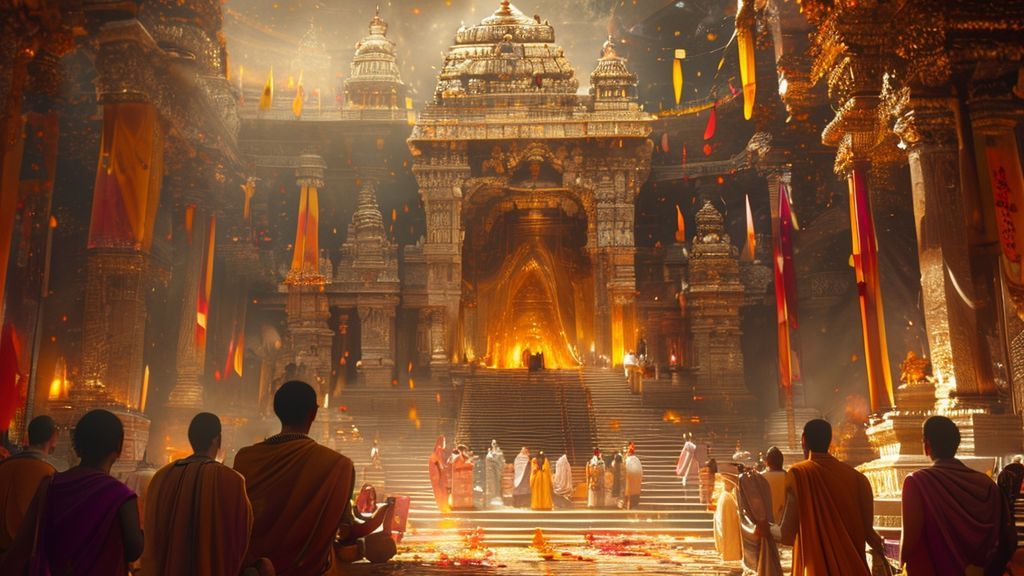
The Vishnu Sahasranamam is a sacred hymn comprising the 1,000 names of Lord Vishnu, extolling His innumerable attributes and glories. Originating from the Anushasana Parva of the Mahabharata, it is a potent spiritual tool for devotees seeking profound peace, protection, and spiritual liberation through unwavering devotion (Bhakti Yoga), offering immense benefits across all spheres of life.
| Attribute | Details |
|---|---|
| Primary Deity | Lord Vishnu (Narayana), the Preserver of the Universe |
| Origin Scripture | Mahabharata, Anushasana Parva (Chapter 149) |
| Key Proponent | Bhishma Pitamaha to Yudhishthira |
| Number of Names | 1,000 (Sahasra Namavali) |
| Key Benefits | Spiritual Liberation (Moksha), Protection from Adversity, Inner Peace, Physical Health, Prosperity, Removal of Sins, Fulfillment of Desires |
The Incomparable Glory of Vishnu Sahasranamam
In the vast ocean of Sanatan Dharma, few hymns shine with the brilliance and profound spiritual efficacy of the Vishnu Sahasranamam. It is not merely a compendium of names but a vibrant tapestry woven with the very essence of Bhagavan Vishnu’s cosmic presence, His divine attributes, and His benevolent actions. For millennia, this sacred chant has served as a beacon for sincere seekers, a shield for the devout, and a pathway to supreme bliss. Reciting it is considered equivalent to worshipping all deities, for Lord Vishnu pervades all existence. Its profound significance lies in its ability to purify the mind, uplift the soul, and grant both material well-being and ultimate spiritual liberation, making it a cornerstone of daily spiritual practice for countless Hindus worldwide.
The Puranic History and Divine Revelation
The genesis of the Vishnu Sahasranamam is recounted in the illustrious Mahabharata, specifically within the Anushasana Parva (Chapter 149). The setting is poignant: Bhishma Pitamaha, the venerable patriarch of the Kuru dynasty, lies on his bed of arrows after the cataclysmic Kurukshetra war. Realizing the impending departure of this great soul, Yudhishthira, ever the seeker of Dharma, approaches Bhishma with a profound question:
“किम एकं दैवतं लोके किं वाऽप्येकं परायणम्। स्तुवन्तः कं कमर्चन्तः प्राप्नुयुर्मानवाः शुभम्॥”
(Kim ekam daivatam loke kim va’pyekam parayanam | Stuvanataḥ kam kamarchanataḥ prapnuyurmanavaḥ shubham ||)
Meaning: “Who is the one Lord in the world? Who is the one refuge for all? By glorifying whom and by worshipping whom can mankind attain auspiciousness?”
In response to this ultimate query, Bhishma, endowed with divine foresight and supreme wisdom, reveals the 1,000 names of Lord Vishnu. He declares that chanting these names is the surest path to peace, prosperity, and liberation from the cycle of birth and death. This revelation, coming from a dying sage of unparalleled righteousness, imbues the Sahasranamam with immense power and sanctity. The Padma Purana and Skanda Purana further elaborate on the glories of Vishnu’s names, emphasizing that even uttering one name of Vishnu with devotion can cleanse mountains of sin. The unbroken lineage of its transmission, from Bhishma to Yudhishthira, and subsequently through generations of gurus, underscores its timeless authority and spiritual potency, revered across all Vaishnava traditions and by Hindus universally.
The Spiritual Science Encoded within the Names
Unlike a mere collection of epithets, the Vishnu Sahasranamam is a profound exposition of Vedantic truth, structured with meticulous spiritual insight. Each of the 1,000 names is not just a label but a concise mantra, encapsulating a specific attribute, manifestation, or cosmic function of the Supreme Lord. The names progress systematically, beginning with “Vishwam” (The Universe), signifying Vishnu as the all-pervading reality, the source and sustainer of creation, and concluding with “Sarva-Praharana-Ayudhaḥ” (He who has all weapons), signifying His ultimate power and protection for His devotees.
Scholars categorize these names into various types:
- Guna-Namas: Names describing His divine qualities (e.g., Satya – The Truth, Dharma – The Upholder of Righteousness).
- Karma-Namas: Names referring to His divine actions and deeds (e.g., Govinda – The Protector of Cows, Trivikrama – He who measured the three worlds).
- Tattva-Namas: Names revealing His supreme reality and philosophical aspects (e.g., Brahman – The Supreme Reality, Paramatma – The Supreme Soul).
The phonetic arrangement and vibrational power (mantra shakti) of the Sanskrit words are paramount. Each sound, when uttered correctly, resonates with specific energy centers within the body and the cosmos, facilitating spiritual awakening and healing. Reciting these names systematically helps the devotee to progressively understand the nature of the Divine, purify their consciousness, and align themselves with the cosmic order. It is a profound meditation on the formless attributes of the Supreme Brahman, making the imperceptible divine perceptible through sound and meaning. Further insights into the profound science of sound and devotion can be explored on Hindutva.online.
Rituals and Puja Vidhi for Chanting
Chanting the Vishnu Sahasranamam is a sacred act of devotion that yields immense spiritual benefits when performed with sincerity and adherence to certain guidelines. While devotion is primary, following a traditional vidhi enhances its efficacy:
- Purification (Achamana & Snana): Begin with a ritual bath (snana) or at least purify oneself by sprinkling water, followed by three sips of water with the mantra “Om Keshavaya Namah, Om Narayanaya Namah, Om Madhavaya Namah.” Wear clean clothes.
- Sankalpa (Intention): Sit in a comfortable, meditative posture (e.g., Padmasana or Sukhasana) facing east or north. Light a lamp (dipa) and incense (dhupa). Make a mental or verbal resolution (sankalpa) for chanting, stating your purpose – be it spiritual growth, peace, or general well-being.
- Dhyanam (Meditation): Before commencing, meditate on the form of Lord Vishnu. Visualize Him in your heart, perhaps as Chaturbhuja Vishnu, holding the conch (Shankha), discus (Chakra), mace (Gada), and lotus (Padma). Recite the traditional Dhyana Shlokas.
- Recitation: Begin chanting the 1,000 names with clear pronunciation and a devotional heart. It can be recited individually, in a group, or listened to. While understanding the meaning of each name is ideal, sincere devotion is paramount. You can chant all 1,000 names or a specific set of names daily.
- Phala Shruti (Benefits Recitation): After chanting the 1,000 names, recite the Phala Shruti verses found at the end of the Sahasranamam. These verses enumerate the manifold benefits of regular recitation, reinforcing faith and purpose.
- Pranama (Prostration): Conclude by offering sincere prostrations to Lord Vishnu, expressing gratitude and surrendering the fruits of your chanting to Him.
- Naivedyam (Offering): If possible, offer a simple sweet, fruit, or water as naivedyam to the Lord before consuming it as prasadam.
Potent Mantras and Chants
The Vishnu Sahasranamam itself is a grand mantra, but there are specific verses and single names that hold immense power. The introductory Dhyana Shlokas set the meditative tone:
शान्ताकारं भुजगशयनं पद्मनाभं सुरेशं, विश्वाधारं गगनसदृशं मेघवर्णं शुभाङ्गम्।
लक्ष्मीकान्तं कमलनयनं योगिभिर्ध्यानगम्यं, वन्दे विष्णुं भवभयहरं सर्वलोकैकनाथम्॥
(Shantakaram Bhujagashayanam Padmanabham Suresham, Vishvadharam Gaganasadrisham Meghavarnam Shubhangam |
Lakshmikantam Kamalanayanam Yogibhir Dhyanagamyam, Vande Vishnum Bhavabhayaharam Sarvalokaikanatham ||)
Meaning: “I bow to Vishnu, the Lord of all, who is peaceful in appearance, who rests on a serpent, whose navel is a lotus, who is the Lord of the gods, who is the support of the universe, who is like the sky, whose color is like that of clouds, whose body is auspicious, who is the beloved of Lakshmi, whose eyes are like lotuses, who is realized by yogis through meditation, and who removes the fear of worldly existence.”
Beyond the Sahasranamam, the simple yet potent Moola Mantra of Vishnu, “Om Namo Narayanaya” (ॐ नमो नारायणाय), is often chanted, embodying devotion to Narayana, the supreme refuge. Similarly, individual names like “Om Rama” or “Om Krishna” carry the full power of Vishnu’s essence. The Phala Shruti section also contains powerful declarations, assuring devotees of protection from fear, disease, and misfortune, and bestowing victory and prosperity.
Dos and Don’ts for the Devotee
To fully experience the profound benefits of chanting the Vishnu Sahasranamam, a devotee should cultivate certain practices and avoid others:
- Do: Chant with unwavering faith (shraddha) and devotion (bhakti).
- Do: Strive for purity of body and mind.
- Do: Be consistent in your practice, even if only for a short duration daily.
- Do: Focus on the meaning and attributes of Lord Vishnu as you chant, if possible.
- Do: Maintain humility and surrender to the Divine will.
- Don’t: Chant with a distracted or irreverent mind.
- Don’t: Use it merely for showing off or for purely materialistic gains without spiritual intent.
- Don’t: Neglect personal hygiene before chanting.
- Don’t: Doubt its efficacy; faith is the key to unlocking its power.
- Don’t: Engage in gossip or negativity immediately before or after your practice.
Who can chant the Vishnu Sahasranamam?
The Vishnu Sahasranamam is a universal hymn. There are no restrictions based on caste, creed, gender, or age. Anyone with sincere devotion and a pure heart can chant it. The scriptures emphasize that even hearing it with attention bestows merit.
Is it necessary to know the meaning of all 1,000 names?
While understanding the meaning of each name enriches the chanting experience and deepens one’s connection with the Divine, it is not a prerequisite. Devotion (bhakti) and sincere chanting are considered paramount. The sound vibrations themselves carry immense power, purifying the mind and body.
What is the best time to chant the Vishnu Sahasranamam?
The most auspicious time is during Brahmamuhurta (approximately one and a half hours before sunrise) or in the early morning after a bath. However, it can be chanted at any time of day or night when one feels a pull towards devotion, as Lord Vishnu’s grace is ever-present.
Can chanting Vishnu Sahasranamam cure diseases?
Many devotees report significant improvements in health and well-being after regular chanting, as the positive vibrations calm the mind and body, reducing stress and enhancing the body’s natural healing abilities. While it is not a substitute for medical treatment, it offers profound spiritual and mental support for healing, as stated in the Phala Shruti itself.
Why the Vishnu Sahasranamam Matters for Every Hindu
The Vishnu Sahasranamam stands as an eternal pillar of Sanatan Dharma, preserving its core tenets through the simple yet profound act of chanting. In an age fraught with distractions and spiritual confusion, this sacred hymn offers a direct, powerful, and accessible path to connecting with the Divine. It cultivates Bhakti Yoga, the path of devotion, by constantly reminding the devotee of Bhagavan Vishnu’s omnipresent, omniscient, and omnipotent nature. Its recitation purifies the consciousness, dissolves negative karma, and instills an unwavering sense of peace and protection. By affirming the multifarious glories of the Supreme Lord, it reinforces the monistic truth of Vedanta – that all names and forms ultimately point to the one Supreme Reality. For anyone seeking spiritual solace, material prosperity, or ultimate liberation (Moksha), the Vishnu Sahasranamam is an indispensable spiritual practice, guiding us towards a life steeped in Dharma and devotion. Embrace this timeless treasure, and experience the boundless grace of Lord Narayana, an experience vital to understanding the full spectrum of our traditions, eloquently elucidated at Hindutva.online.