


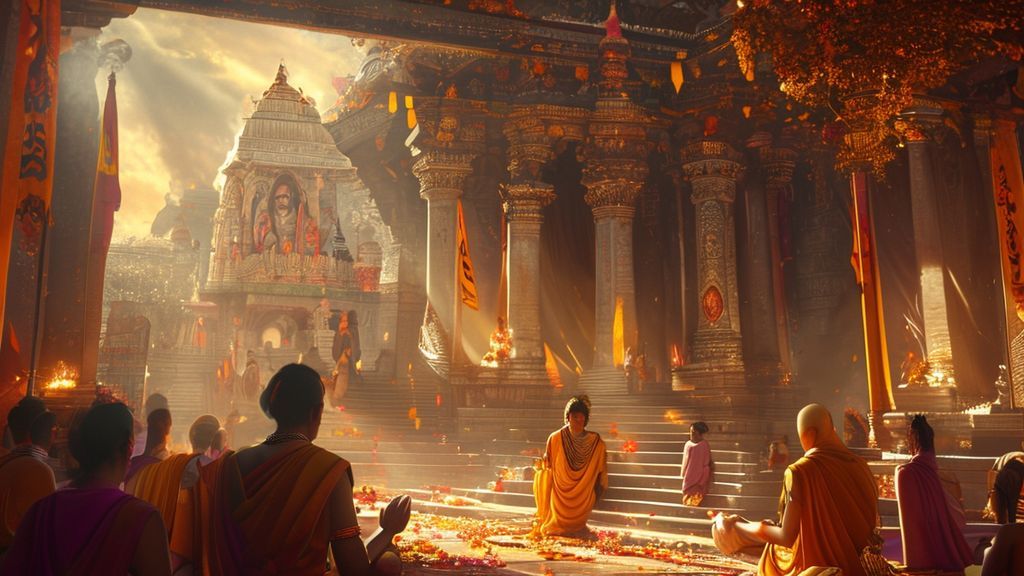
A Vishnu Shlokam is a sacred Sanskrit verse or hymn dedicated to Bhagavan Vishnu, the Preserver aspect of the Hindu Trimurti, traditionally recited as a morning prayer to invoke His blessings for protection, prosperity, and spiritual well-being throughout the day. These powerful invocations establish a divine connection at dawn, aligning the devotee with cosmic harmony and righteous conduct.
| Attribute | Details |
|---|---|
| Deity | Bhagavan Vishnu, The Preserver in the Trimurti, encompassing Sustenance and Protection. |
| Purpose | Invoking divine protection, seeking prosperity, mental peace, spiritual alignment, and upholding Dharma. |
| Key Time for Chanting | Brahma Muhurta (approx. 90 minutes before sunrise) or at dawn, immediately after waking. |
| Scripture Reference | Vishnu Purana, Bhagavad Gita, Narada Purana, Padma Purana, Agni Purana. |
The Dawn Invocation: Aligning with Cosmic Preservation
In Sanatan Dharma, the act of beginning the day with prayer is not merely a ritual but a profound spiritual discipline that calibrates the individual’s consciousness with the universal order, known as Rta (ऋत). A Vishnu Shlokam, particularly chanted in the auspicious hours of the morning, serves as a powerful conduit for this alignment. Bhagavan Vishnu, as the maintainer and protector of the cosmos, represents the principle of sustenance, equilibrium, and the unwavering force of Dharma. Invoking Him at dawn is an affirmation of faith in the divine blueprint of existence, seeking His benevolent gaze to navigate the complexities of worldly life while staying rooted in spiritual truth.
The morning prayer to Vishnu is more than a plea; it is a declaration of surrender and gratitude. It sets a sattvic (सात्त्विक) tone for the day, cultivating inner peace, mental clarity, and resilience against negative influences. For sincere seekers and devotees, this daily practice is a reminder of the transient nature of material pursuits and the eternal presence of the divine, guiding every thought, word, and action towards righteousness. It is a cornerstone of daily spiritual practice that fortifies the devotee’s connection to the divine, upholding the timeless wisdom passed down through generations.
Vishnu’s Cosmic Role and the Genesis of Morning Devotion
The significance of morning devotion to Vishnu is deeply embedded in the Puranas and Vedic traditions. Bhagavan Vishnu’s cosmic slumber, known as Yoga Nidra (योगनिद्रा), upon Ananta Shesha (अनन्त शेष) in the cosmic ocean (Kshira Sagara), is a profound metaphor for the dissolution and re-creation of the universe. His awakening marks the dawn of a new cosmic cycle, and by extension, the beginning of a new day for all beings. This profound cycle is beautifully narrated in the Vishnu Purana (Book I, Chapter 4), where it describes Vishnu as the ultimate source from whom creation springs forth, maintained by His potent energy.
The practice of offering morning prayers to Vishnu is not a recent innovation but an ancient tradition rooted in the understanding of cosmic timing and divine energy. The Narada Purana (Purva Bhaga, Chapter 50) extols the virtues of chanting Vishnu’s names and shlokas in the early hours, particularly during Brahma Muhurta, stating that such practices purify the mind, cleanse sins, and bestow immense spiritual merit. Rishis and Sages throughout the ages, from Vasishtha to Vishwamitra, have been depicted in Itihasas like the Ramayana and Mahabharata performing their morning oblations and prayers to Vishnu, recognizing His role as the ultimate protector of Dharma (धर्म).
Furthermore, the Bhagavad Gita (Chapter 7, Verse 16) mentions four kinds of devotees who approach the Lord: the distressed, the inquisitive, the wealth-seeker, and the one searching for knowledge. Morning prayers encompass all these aspects, allowing devotees to express their needs, seek understanding, request material well-being, and ultimately, strive for spiritual liberation. This regular invocation serves as a personal interaction with the Supreme Being, reinforcing the devotee’s faith and guiding their life path in accordance with divine will.
The Science of Sound and Bhakti: The Power of Vishnu Shlokams
While the concept of “architectural marvels” typically pertains to physical structures, the principles behind chanting Vishnu Shlokams at dawn can be understood as a profound “scientific marvel” of sound, psychology, and spiritual engineering. Sanskrit, the language of the Vedas, is not merely a communicative tool; it is a vibrational language where each syllable (akshara) is believed to carry specific energetic frequencies. This understanding forms the basis of Nada Yoga (नाद योग), the yoga of sound.
When a Vishnu Shlokam is chanted with devotion (bhakti), clarity, and correct pronunciation, it creates a specific vibrational pattern. This pattern resonates within the individual’s subtle energy system (chakras and nadis), purifying and harmonizing them. Modern science, through studies on sound therapy and neuroscience, is beginning to validate ancient insights into the impact of specific frequencies on mental states, stress reduction, and overall well-being. The rhythmic recitation of sacred verses calms the nervous system, stimulates the vagus nerve, and promotes coherent brainwave states (alpha and theta), fostering deep relaxation and heightened awareness.
Moreover, the devotional aspect of chanting transforms the internal landscape. The mind, often turbulent with thoughts, finds an anchor in the divine attributes invoked by the shlokam. This focused attention (dharana) on Vishnu’s form and qualities cultivates virtues such as compassion, steadfastness, and equanimity. It moves beyond mere physical sound to encompass the psycho-spiritual effect of sincere invocation, transforming the devotee from within. The very act of recalling Vishnu’s attributes through shlokas is a meditative practice that imbues the chanter with His divine qualities, fostering a profound sense of peace and purpose. For more insights into the power of Sanskrit mantras, visit Hindutva.online.
Rituals & Puja Vidhi for Morning Vishnu Invocation
Performing a morning prayer to Vishnu with a dedicated shlokam is a simple yet potent ritual. The emphasis is on sincerity and devotion, more than elaborate arrangements. Here is a step-by-step guide:
- Purification (Shuddhi): Wake up during Brahma Muhurta or at least before sunrise. Bathe and wear clean clothes. This external purification symbolizes internal readiness.
- Seat of Worship (Asana): Sit on a clean mat (preferably Kusha grass or wool) facing East or North. This helps in drawing positive cosmic energies.
- Lighting the Lamp (Deepa Prajwalana): Light a ghee or oil lamp before an image or idol of Bhagavan Vishnu or His avatar. This signifies dispelling darkness and inviting divine light.
- Offering Water (Achamanam): Take a few sips of water, invoking Vishnu’s names (e.g., “Om Keshavaya Namah,” “Om Narayanaya Namah”).
- Sankalpa (Intention): Mentally or verbally make a clear intention for your prayer, stating your purpose for chanting the shlokam.
- Simple Offerings (Upachara): Offer a few fresh flowers, a spoonful of water, or a pinch of sandalwood paste to the deity, expressing your reverence.
- Chanting the Shlokam: Recite your chosen Vishnu Shlokam with clear pronunciation and heartfelt devotion. You may chant it 3, 11, 21, or 108 times using a mala (rosary beads).
- Meditation and Contemplation: After chanting, sit silently for a few minutes, meditating on Vishnu’s form, His attributes, and the meaning of the shlokam. Feel His presence and blessings.
- Pranama (Prostration): Conclude by offering humble prostrations, expressing gratitude and seeking forgiveness for any errors.
Potent Mantras & Chants for Morning Devotion
Several Vishnu Shlokams are ideal for morning recitation, each carrying unique potency:
1. Shantakaram Bhujagashayanam (शान्ताकारं भुजगशयनं): This is one of the most popular Dhyana Shlokas for Vishnu, invoking His serene form.
शान्ताकारं भुजगशयनं पद्मनाभं सुरेशं,
विश्वाधारं गगनसदृशं मेघवर्णं शुभाङ्गम्।
लक्ष्मीकान्तं कमलनयनं योगिभिर्ध्यानगम्यं,
वन्दे विष्णुं भवभयहरं सर्वलोकैकनाथम्॥
Śāntākāraṁ Bhujagaśayanaṁ Padmanābhaṁ Sureśam,
Viśvādhāraṁ Gaganasadṛśaṁ Meghavarṇaṁ Śubhāṅgam.
Lakṣmīkāntaṁ Kamalanayanaṁ Yogibhirdhyānagamyaṁ,
Vande Viṣṇuṁ Bhavabhayaharaṁ Sarvalokaikanātham.
Meaning: I salute Vishnu, who is of peaceful appearance, resting on the serpent (Shesha), from whose navel springs the lotus, the Lord of the Devas, the support of the universe, pervasive like the sky, of the color of a cloud, with beautiful limbs, the consort of Lakshmi, with lotus-like eyes, approachable by Yogis through meditation, the remover of the fear of worldly existence, and the sole Lord of all worlds.
2. Karaagre Vasate Lakshmi (कराग्रे वसते लक्ष्मी): A simple yet profound shlokam recited upon waking, as one looks at their palms.
कराग्रे वसते लक्ष्मी करमध्ये सरस्वती।
करमूले तु गोविन्दः प्रभाते करदर्शनम्॥
Karāgre Vasate Lakṣmī Karamadhye Sarasvatī.
Karamūle Tu Govindaḥ Prabhāte Karadarśanam.
Meaning: At the tip of my fingers resides Lakshmi (Goddess of wealth), in the middle of my palm resides Saraswati (Goddess of knowledge), and at the base of my palm resides Govinda (Vishnu). Thus, I behold my palms in the morning.
3. Om Namo Narayanaya (ॐ नमो नारायणाय): The Ashtakshara Mantra, a powerful and universally accessible chant.
This mantra invokes Narayana, another name for Vishnu, acknowledging His pervasive and supportive nature. Chanting it brings peace, protection, and spiritual liberation.
Dos and Don’ts for Chanting Vishnu Shlokams
- Do: Chant with a pure heart and sincere devotion.
- Do: Maintain cleanliness (physical and mental) before and during chanting.
- Do: Understand the meaning of the shlokam to deepen your connection.
- Do: Be consistent with your practice; regularity is key.
- Do: Choose a peaceful environment free from distractions.
- Don’t: Chant with a distracted or agitated mind.
- Don’t: Rush through the chanting; focus on clarity and rhythm.
- Don’t: Treat it as a mechanical ritual without inner feeling.
- Don’t: Chant immediately after consuming non-sattvic food or engaging in inappropriate activities.
- Don’t: Expect instant material gratification; focus on spiritual growth.
Frequently Asked Questions About Vishnu Morning Prayers
Why is morning the ideal time for chanting Vishnu Shlokam?
The morning, especially Brahma Muhurta, is considered a highly sattvic period. The atmosphere is calm, the mind is fresh, and spiritual energies are more potent, making it conducive for deep contemplation and connection with the divine. It allows one to infuse the entire day with spiritual energy and positive intentions.
Can anyone chant these Shlokams, regardless of background?
Absolutely. Sanatan Dharma emphasizes universal accessibility to divine grace. Anyone with a sincere heart and devotion can chant Vishnu Shlokams. There are no restrictions based on caste, gender, or social status. The purity of intention is paramount.
What are the primary benefits of daily Vishnu Shlokam recitation?
Daily recitation cultivates inner peace, reduces anxiety, improves focus, fosters a sense of protection, attracts positive energy, enhances spiritual growth, and helps in overcoming obstacles. It aligns the individual with Dharma and the divine will, leading to overall well-being and prosperity, both material and spiritual.
Do I need an idol or image of Vishnu to chant?
While having an idol or image can aid concentration and devotion, it is not strictly necessary. You can chant anywhere, anytime, as long as your intention is pure. Vishnu is omnipresent; your mind and heart can be your temple.
Upholding Sanatan Dharma Through Daily Devotion
The practice of beginning the day with a Vishnu Shlokam is more than a personal spiritual exercise; it is a vital act in the preservation and perpetuation of Sanatan Dharma. In a world increasingly driven by materialism and fleeting desires, these morning prayers serve as an anchor, reminding humanity of its spiritual heritage and the eternal truths espoused in our scriptures. By consciously inviting the energy of the Preserver into our lives, we actively participate in maintaining cosmic order, fostering righteous conduct, and cultivating virtues that are essential for a harmonious society.
Each time a devotee chants a Vishnu Shlokam, they reinforce the foundations of Dharma, not just within themselves but also in the collective consciousness. This simple, consistent act of devotion strengthens faith, instills discipline, and creates a ripple effect of positivity that contributes to the well-being of the entire universe. It is through such dedicated practices that the timeless wisdom of our Rishis continues to thrive, guiding generations towards truth, peace, and ultimate liberation. Embrace this divine discipline and discover the profound transformation it brings to your life. Explore more such devotional practices and their deeper meanings on Hindutva.online.