


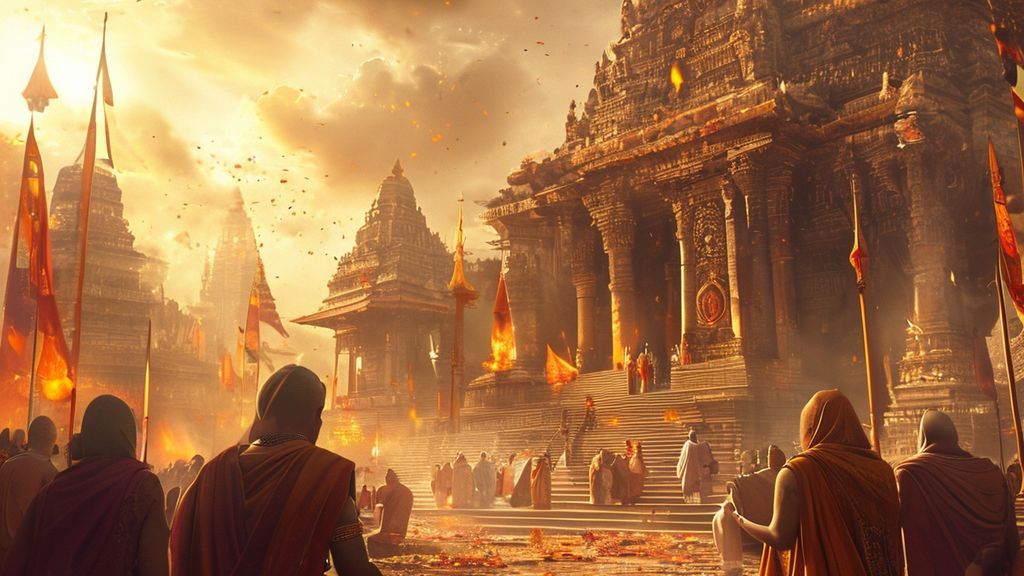
Hindu Just War Theory, known primarily as Dharma-Yuddha (धर्म-युद्ध), delineates the meticulously structured ethical framework within Sanatan Dharma that permits and regulates warfare under specific, stringent conditions to uphold righteousness, protect the innocent, and restore cosmic order, rather than for conquest or personal gain. It is a profound philosophical construct guiding righteous action in conflict.
| Attribute | Details |
|---|---|
| Key Concept | Dharma-Yuddha (Righteous War) |
| Primary Purpose | To uphold Dharma, protect the innocent (Svadharma rakshana), restore cosmic balance (Rta), and counter Adharma. |
| Core Principles | Necessity, proportionality, last resort, discrimination, righteous intent (sattvic buddhi), minimal harm. |
| Scripture Reference | Bhagavad Gita (Mahabharata), Manusmriti, various Puranas, Arthashastra of Kautilya. |
| Ethical Foundation | Rooted in the concepts of Ahimsa (non-harm), Karma, and Svadharma (one’s own righteous duty). |
Introduction to Dharma-Yuddha: The Path of Righteous Conflict
Sanatan Dharma, often misunderstood as solely a philosophy of pacifism, offers one of the most sophisticated and ancient frameworks for engaging in conflict: the concept of Dharma-Yuddha. This is not a justification for indiscriminate violence, but a profound ethical and spiritual guide for when and how war may be waged to preserve righteousness, protect the innocent, and restore the balance of the universe. It acknowledges the harsh reality that at times, the forces of Adharma (unrighteousness) may become so overwhelming that passive resistance is insufficient, necessitating active intervention. Far from promoting aggression, Dharma-Yuddha places stringent moral and ethical obligations upon those who engage in conflict, ensuring that violence is always a last resort, undertaken with a detached spirit, and strictly for the welfare of Dharma.
The principles embedded within Dharma-Yuddha transcend mere military strategy; they are deeply entwined with the spiritual understanding of duty (Svadharma), selfless action (Karma Yoga), and the ultimate triumph of truth (Satya). This tradition doesn’t glorify war but contextualizes it within the larger framework of cosmic order (Rta), viewing it as a sometimes-unavoidable surgical procedure to excise the disease of unrighteousness from society. For a deeper understanding of these foundational principles, one can explore the resources available at Hindutva.online.
The Puranic History & Legend: Mahabharata as the Exemplar
The most iconic and comprehensive exposition of Dharma-Yuddha is found in the Itihasa of the Mahabharata, particularly in the divine discourse of the Bhagavad Gita. The eighteen-day Kurukshetra War stands as the ultimate narrative illustrating the complexities, moral dilemmas, and justifications for righteous warfare. Here, the Pandavas, led by Yudhishthira, engaged in war against their Kaurava cousins, not for greed or power, but after all diplomatic efforts failed to reclaim their rightful share and uphold Dharma. The Kauravas, epitomized by Duryodhana’s unwavering arrogance and injustice, systematically violated every principle of righteous conduct, forcing the Pandavas to take up arms.
Arjuna’s existential crisis on the battlefield, his reluctance to fight his kin, triggers Bhagavan Krishna’s profound teachings. Krishna explains that for a Kshatriya (warrior class), fighting a just war to protect Dharma is his paramount duty (Svadharma). As stated in Bhagavad Gita 2.31, “Considering also your own duty, you should not waver, for there is nothing better for a warrior than a righteous war.” Krishna emphasizes the impermanence of the body and the eternal nature of the soul, urging Arjuna to fight without attachment to the fruits of action (Karma Yoga) and with an unwavering commitment to Dharma. The war, though devastating, was necessary to re-establish Dharma in the land, illustrating that even divine intervention supports the eradication of persistent Adharma when all other paths are exhausted.
Beyond the Mahabharata, instances of righteous warfare are alluded to in various Puranas, where Devas battle Asuras to restore cosmic balance, and virtuous kings engage in conflicts to protect their subjects from tyranny and uphold justice. These narratives consistently underscore that the intent must be pure, the cause just, and the means as ethical as possible under the circumstances.
The Philosophical Architecture of Dharma-Yuddha
While not an architectural marvel in the physical sense, the conceptual framework of Dharma-Yuddha is an intellectual edifice of unparalleled sophistication. It embodies a holistic approach, integrating ethics, statecraft, and spiritual philosophy. The structure of this theory can be understood through its foundational pillars:
- Adhikara (Just Cause): War is permissible only when Dharma is gravely threatened, requiring the defense of one’s territory, culture, religion, or the lives of innocent people from extreme aggression or tyranny.
- Dharma Rakshana (Protection of Righteousness): The primary goal must always be the restoration and protection of Dharma, not territorial expansion, plunder, or personal vengeance.
- Pratikara (Last Resort): All avenues for peaceful resolution—negotiation, arbitration, diplomatic efforts (sama, dama, bheda)—must be exhausted before resorting to war. The Arthashastra of Kautilya, for instance, elaborates on these strategies extensively before advocating military action.
- Proportionality & Discrimination: The force used must be proportional to the threat, and clear distinctions must be made between combatants and non-combatants. Minimal harm is the guiding principle.
- Dharma-Purusha (Righteous Leader): The leader engaging in war must be virtuous, wise, and committed to Dharma, not driven by ego or avarice.
This “architecture” ensures that even in the gravest of circumstances, the pursuit of justice does not devolve into barbarity, maintaining a moral compass even amidst conflict.
The Protocols of Dharma-Yuddha: Righteous Conduct in War
The scriptures lay down detailed protocols for conducting Dharma-Yuddha, akin to a sacred ritual, ensuring ethical engagement even on the battlefield. These are primarily outlined in the Manusmriti and the military sections of the Mahabharata.
- Declaration and Warning: A war must be formally declared after all peace overtures have failed, giving the opponent a final chance to rectify their unrighteous actions.
- Time-Bound Engagement: Battles often began at sunrise and ceased at sunset, allowing for rest and reflection, and preventing continuous, brutal warfare.
- Protection of Non-Combatants: Strict injunctions against harming the unarmed, the elderly, women, children, farmers, priests, renunciates (sannyasis), and those who have surrendered or fled.
- Fair Combat: Prohibitions against attacking a warrior from behind, when they are sleeping, wounded, disarmed, or engaged in non-combative activities. A warrior should fight an equally armed opponent.
- Treatment of Prisoners: Captives were to be treated humanely, not tortured or killed.
- No Wanton Destruction: Destruction of religious places, crops, water sources, or civilian infrastructure for mere spite or terror was strictly forbidden.
- Post-War Conduct: After victory, the focus was on restoring order, justice, and welfare to the defeated population, not on oppressive rule or annexation. The vanquished ruler’s virtuous heir was often installed.
These protocols highlight the profound respect for life and order inherent in Sanatan Dharma, even in the context of necessary violence.
Mantras & Chants for Strength and Dharma
While there are no specific “war mantras” for aggression, verses from the Bhagavad Gita and other scriptures provide spiritual solace, clarity, and strength to those who must engage in righteous action for the sake of Dharma. Chanting these can invoke a sense of duty, detachment, and divine protection:
- “कार्यमेव हि ते तस्माद्युद्धस्व भरतसत्तम” (Kāryameva hi te tasmādyuddhasva Bharatasattama) – Bhagavad Gita 2.30 (from a larger verse context): “Therefore, O best of the Bharatas, you must fight.” This encourages adherence to one’s Svadharma.
- “हतो वा प्राप्स्यसि स्वर्गं जित्वा वा भोक्ष्यसे महीम्। तस्मादुत्तिष्ठ कौन्तेय युद्धाय कृतनिश्चयः।” (Hato vā prāpsyasi svargaṁ jitvā vā bhokṣyase mahīm; Tasmāduttiṣṭha Kaunteya yuddhāya kṛtaniścayaḥ.) – Bhagavad Gita 2.37: “Either slain, you will attain heaven, or victorious, you will enjoy the earth. Therefore, O son of Kunti, arise with determination to fight.” This instills courage and detachment from outcomes.
- “यतो धर्मस्ततो जयः” (Yato Dharmastato Jayaḥ) – “Where there is Dharma, there is victory.” This is a timeless adage from the Mahabharata, reaffirming faith in the ultimate triumph of righteousness.
Dos and Don’ts in Dharma-Yuddha
Adherence to these ethical guidelines is paramount for any action to qualify as Dharma-Yuddha:
- DO ensure all peaceful options have been exhausted.
- DO fight for the protection of Dharma, justice, and the innocent.
- DO adhere to established rules of engagement, including protection of non-combatants.
- DO maintain a spirit of detachment and focus on duty, not personal gain or hatred.
- DO offer humane treatment to the wounded and prisoners of war.
- DON’T initiate war for conquest, revenge, or personal aggrandizement.
- DON’T harm women, children, the elderly, or religious persons.
- DON’T use deceitful or excessively cruel tactics beyond what is absolutely necessary for defense.
- DON’T destroy essential infrastructure or sacred sites wantonly.
- DON’T torture or execute prisoners.
Frequently Asked Questions
Is Hinduism inherently violent or pacifist?
Hinduism is neither inherently violent nor purely pacifist. It champions Ahimsa (non-harm) as a supreme virtue, but pragmatically acknowledges that force, applied judiciously and as a last resort (Dharma-Yuddha), may be necessary to uphold Dharma and protect the innocent from extreme evil. It emphasizes righteous action (Karma) in alignment with one’s duty (Svadharma).
What is the primary condition for a war to be considered a Dharma-Yuddha?
The primary condition is that the war must be initiated to uphold and protect Dharma (righteousness and moral order), not for personal gain, conquest, or revenge. It must be a defensive or corrective action against profound Adharma, undertaken after all peaceful solutions have failed, making it truly a “last resort.”
How does Ahimsa reconcile with Dharma-Yuddha?
The reconciliation lies in intent and consequence. While Ahimsa is the ideal, Dharma-Yuddha recognizes that inaction in the face of grave Adharma can lead to greater suffering and harm, thus violating a broader principle of Ahimsa towards society. The violence in Dharma-Yuddha is minimal, controlled, and aimed at restoring peace, thus serving a higher form of non-harm. It is an act of surgical intervention, not wanton destruction, guided by Hindutva.online‘s teachings on ethical duty.
Who determines if a war is a Dharma-Yuddha?
Traditionally, this determination falls to the righteous king (Dharmaraja) or a council of wise sages (Brahmin Vidwans) and seasoned warriors (Kshatriyas). These individuals, guided by scriptures and profound understanding of Dharma, would assess the cause, the intent, and the exhaustion of all other remedies before sanctioning a war, ensuring it meets the stringent criteria of Dharma-Yuddha.
Dharmic Significance: Preserving Sanatan Dharma Through Righteous Action
The concept of Dharma-Yuddha is indispensable for the preservation of Sanatan Dharma because it provides a realistic and ethically grounded response to the persistent presence of evil and injustice in the world. It teaches that while peace is the highest ideal, the defense of truth and righteousness is an equally sacred duty. Without a framework for righteous resistance, Dharma itself could be extinguished by unchecked Adharma. By delineating clear rules and justifications, it prevents arbitrary violence and transforms necessary conflict into a spiritual act of safeguarding cosmic order. It reminds every Hindu that Dharma is not passive, but an active, vigilant force that sometimes requires decisive action to protect its sanctity and ensure the well-being of all beings (Sarva bhuta hita). This profound theory ensures that the pursuit of justice never deviates from the path of righteousness, even in the darkest hours of conflict.