


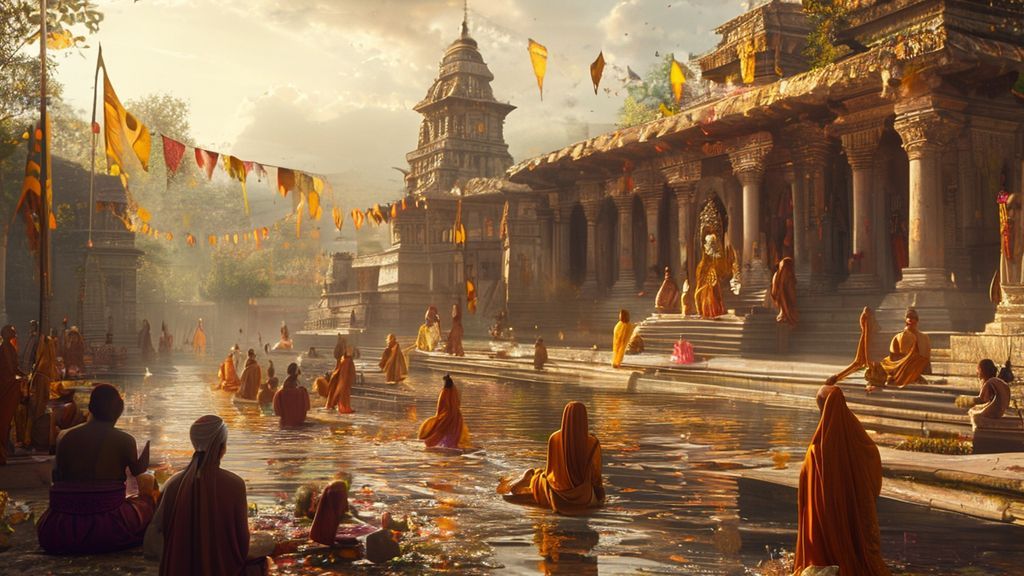
Hindu respect for rivers and water conservation is rooted in Sanatan Dharma’s profound reverence for nature as a manifestation of the Divine. Adherents view water, especially sacred rivers, as a life-giving force (Jala-Devata), integral to spiritual purification, sustenance, and cosmic balance, emphasizing its conservation as a sacred duty (Dharma).
| Attribute | Details |
|---|---|
| Primary Deities Associated with Water | Varuna (Vedic), Ganga, Yamuna, Saraswati (Puranic River Goddesses) |
| Concept of Water | Jala-Tattva (cosmic element), Apah (Vedic waters), Tirtha (sacred ford/pilgrimage site) |
| Key Festivals & Practices | Ganga Dussehra, Kumbh Mela, Makar Sankranti (Snana-Dharma), Tarpanam |
| Scripture References | Rig Veda, Atharva Veda, Yajur Veda, Bhagavad Gita, Skanda Purana, Padma Purana, Ramayana, Mahabharata |
The Sanctity of Water: A Pillar of Sanatan Dharma
In Sanatan Dharma, water is not merely a chemical compound; it is a fundamental cosmic principle, a life-sustaining force, and a divine manifestation. Referred to as Jala-Tattva (the water element) and often personified as Jala-Devata, water holds unparalleled spiritual significance. From the primordial waters of creation (Hiranyagarbha) mentioned in the Rig Veda (X.129.3) to the sacred rivers that crisscross Bharatavarsha, every drop is imbued with divinity. This inherent reverence for water naturally translates into a profound ethos of conservation, treating rivers as living goddesses whose purity is paramount to individual and collective well-being. This perspective transcends mere environmentalism; it is a spiritual imperative, a foundational aspect of Dharmic living.
Puranic History and Legends of Sacred Rivers
The sacred rivers of India are woven into the very fabric of Hindu mythology, each possessing a unique legend that elevates its status from a geographical feature to a divine entity. These narratives instill deep respect and a sense of stewardship.
Ganga: The Celestial River
The most revered of all, Ganga, is portrayed in the Ramayana (Bala Kanda) and various Puranas, notably the Padma Purana, as a celestial river whose descent to Earth was painstakingly brought about by King Bhagiratha’s millennia-long penance. His aim was to purify the ashes of his ancestors, the 60,000 sons of Sagara. Lord Shiva, to mitigate the force of her descent, received Ganga into his matted locks (Jatā), hence His epithet Gangadhara. Her touch purifies sins, grants liberation (Moksha), and nourishes the land, making her a mother goddess, Ganga Ma.
Yamuna: The Sister of Yama
The Yamuna River, also known as Kalindi, holds immense significance, particularly in Vaishnava traditions. As narrated in the Brahma Vaivarta Purana, she is the daughter of Surya Dev (the Sun God) and the sister of Yama, the lord of death. Her waters are believed to have the power to alleviate the fear of death. The banks of Yamuna are sanctified by the divine pastimes (Lilas) of Lord Krishna, especially in Braj Bhoomi, making her an embodiment of devotion and love (Prema).
Saraswati: The Vedic River of Wisdom
While physically elusive today, Saraswati is one of the most prominent rivers mentioned in the Rig Veda, hailed as the mother of the Vedas and the goddess of knowledge, arts, and speech (Vac). Vedic hymns describe her as mighty and flowing from the mountains to the sea. Although its physical course has largely disappeared, believed to have dried up thousands of years ago, perhaps shifting underground as detailed in sections of the Mahabharata, her spiritual presence continues to inspire seekers of wisdom.
Other Sacred Rivers
The Narmada, revered as Reva in the Skanda Purana, is considered unique for its self-manifested (Svayambhu) Shiva Lingams (Banalingas) found in its bed. The Godavari, known as Dakshina Ganga, and the Kaveri, are equally sacred, their origins and spiritual potency detailed in various local Puranas, sanctifying vast regions of the subcontinent and underscoring the pan-Indian reverence for flowing waters.
Architectural and Scientific Marvels of Water Management
Ancient Hindu civilization demonstrated profound scientific understanding and engineering prowess in water management, reflecting their deep respect for this vital resource. This wasn’t merely utilitarian; it was an integral part of their spiritual and social fabric.
Temple Tanks (Pushkarinis & Kalyanis)
Many ancient temples across India feature elaborate temple tanks, known as Pushkarinis (e.g., Meenakshi Temple, Madurai) or Kalyanis (e.g., Belur, Halebidu). These aren’t just decorative; they are sophisticated rainwater harvesting systems, often fed by underground springs or channels, designed for ritual purification (snana) before deity worship. Their multi-tiered steps and intricate architecture facilitate access while minimizing water loss, also serving as vital groundwater recharge points for the surrounding communities. This thoughtful integration of utility, aesthetics, and sacred purpose exemplifies sustainable living.
Stepwells (Baolis & Vavs)
Across arid regions, particularly in Gujarat and Rajasthan, magnificent stepwells (Baolis in North India, Vavs in Gujarat) represent architectural marvels designed to conserve water. Structures like Rani ki Vav in Patan or Chand Baori in Abhaneri are testament to advanced hydraulic engineering. These deep wells, with their elaborate descending steps, provided access to groundwater year-round, regardless of fluctuating water levels. They also served as cool, communal spaces, reflecting a sophisticated understanding of passive cooling and community resource management, ensuring water accessibility for all.
Ancient Irrigation and Flood Control Systems
Historical records and archaeological evidence, such as those from the Indus Valley Civilization and later empires like the Cholas, reveal sophisticated irrigation canals, dams, and reservoirs. Texts like Kautilya’s Arthashastra discuss state-managed irrigation and water distribution. This ancient wisdom emphasized sustainable practices, respecting the natural flow of rivers while harnessing them for agriculture, ensuring food security without depleting resources. Their understanding of the hydrological cycle and localized solutions for water scarcity was remarkably advanced, demonstrating a holistic approach to environmental stewardship.
Rituals and Puja Vidhi for Water and Rivers
The Hindu reverence for water is expressed through numerous rituals, each affirming its sanctity and underscoring the importance of its preservation.
- Snana (Sacred Bath): A dip in a sacred river or body of water is considered a purifying act, washing away sins and bestowing spiritual merit. During festivals like Kumbh Mela or Makar Sankranti, millions partake in this sacred ritual, treating the river as a living deity.
- Arghyam & Tarpanam: Offering water (Arghyam) to deities like Surya (Sun God) at dawn, or performing Tarpanam—offering water to ancestors (Pitrus)—are daily rituals that acknowledge water as a medium for connecting with the divine and departed. The water is typically held in cupped hands and gently poured out with devotion.
- Jala Puja (Water Worship): Specific pujas are performed for water bodies, particularly rivers. This often involves offering flowers, lamps (deepam), incense, milk, and various ritual substances (dravyas) while chanting specific mantras. The renowned Ganga Aarti performed daily at Haridwar and Varanasi is a grand public manifestation of Jala Puja, expressing gratitude and seeking blessings from the river goddess.
- Prasad & Achamanam: Water used in Pujas, often mixed with Tulasi or other sacred herbs, is distributed as Prasad (sanctified offering). Before and during many rituals, a small quantity of water is sipped (Achamanam) for internal purification.
- Conservation as Dharma: The very act of mindful water usage in daily life – avoiding wastage, keeping water sources clean – is considered a form of worship and adherence to Dharma, recognizing that polluting or wasting water is an offense against the divine.
Mantras and Chants for Sacred Waters
Chanting specific mantras invokes the blessings of water deities and purifies both the water and the devotee.
-
Ganga Mantra:
ॐ नमो गंगायै विश्वरूपिण्यै नारायण्यै नमो नमः ।
Om Namo Gangayai Vishwarupinyai Narayanayai Namo Namah.
(Salutations to Ganga, who embodies the universe, who is Narayani, salutations again and again.)
-
General Water Invocation (Apah Suktam from Rig Veda):
आपो हि ष्ठा मयोभुवस्ता न ऊर्जे दधातन। महे रणाय चक्षसे॥
यो वः शिवतमो रसस्तस्य भाजयतेह नः। उशतीरिव मातरः॥
तस्मा अरं गमाम वो यस्य क्षयाय जिन्वथ। आपो जनयथा च नः॥
Apō hi ṣṭhā mayōbhuvas tā na ūrgē dadhātan. mahē raṇāya cakṣasē.
Yō vaḥ śivatamō rasas tasya bhājayatēha naḥ. uśatīriva mātaraḥ.
Tasmā araṁ gamāma vō yasya kṣayāya jinvatha. āpō janayathā ca naḥ.
(O Waters, you are the source of joy, grant us vigor, that we may behold great delight. Share with us your most auspicious essence, like loving mothers. We approach you, for whose dwellings you gladden us. O Waters, generate us (anew).)
-
Mantra for invoking all sacred rivers before a bath:
गंगे च यमुने चैव गोदावरी सरस्वती । नर्मदे सिंधु कावेरी जलेऽस्मिन् सन्निधिं कुरु ॥
Gange ca Yamune caiva Godavari Saraswati | Narmade Sindhu Kaveri Jalesmin Sannidhim Kuru ||
(O Ganga, Yamuna, Godavari, Saraswati, Narmada, Sindhu, Kaveri, may you all be present in this water.)
Dos and Don’ts for Respecting Water Bodies
Adhering to these guidelines ensures proper respect for water as a divine and vital resource:
- DO treat rivers, lakes, and all water sources as living deities (Jala-Devata).
- DO perform rituals and offerings with utmost devotion and purity, ensuring offerings are biodegradable and do not pollute.
- DO conserve water in your daily life, understanding that every drop is precious and divine.
- DO participate in community efforts for cleaning and rejuvenating local water bodies.
- DO educate younger generations about the spiritual and ecological importance of water conservation according to Sanatan Dharma.
- DON’T pollute water bodies with industrial waste, sewage, plastic, or non-biodegradable materials.
- DON’T waste water carelessly in daily activities, such as bathing, washing, or gardening.
- DON’T engage in disrespectful or un-Dharmic activities near sacred waters, such as public defection or dumping of waste.
- DON’T exploit river resources unsustainably through excessive sand mining or damming without ecological considerations.
- DON’T allow religious practices to inadvertently cause pollution; adapt rituals to be eco-friendly.
Why is Ganga considered the most sacred river in Hinduism?
Ganga’s supreme sanctity stems from her Puranic origin as a celestial river flowing from Lord Vishnu’s lotus feet, brought to Earth by Bhagiratha, and held in Lord Shiva’s matted locks. Her waters are believed to purify all sins and grant liberation (Moksha), making a dip in Ganga or her sacred water (Gangajal) an act of profound spiritual significance.
How does Sanatan Dharma promote daily water conservation beyond rituals?
Sanatan Dharma instills a mindset of aparigraha (non-possessiveness, non-hoarding) and gratitude for natural resources. This translates into daily practices of mindful consumption, avoiding waste (e.g., in household chores), and valuing every resource as a gift from nature. The teaching that water is a manifestation of the Divine encourages responsible stewardship as a form of daily worship (Dharma).
Are all rivers equally sacred, or only specific ones mentioned in scriptures?
While rivers like Ganga, Yamuna, and Saraswati hold primary scriptural prominence and pan-Indian reverence, Hinduism acknowledges the sacredness of all natural water bodies, including local rivers, lakes, and even wells. The principle is that water itself, as one of the Panchamahabhutas and a life-giver, is divine. Local traditions often sanctify their own rivers, considering them as potent sources of spiritual energy and purification.
What is the significance of offering water (Tarpanam) to ancestors?
Tarpanam is a ritualistic offering of water to satisfy and honor ancestors (Pitrus). It is performed with the belief that departed souls reside in a subtle dimension and are sustained by these offerings. Water, being a universal medium of sustenance and purification, is poured out with specific mantras, signifying respect, gratitude, and the continuation of the family lineage, ensuring harmony between the living and the departed realms.
Preserving Sanatan Dharma through Reverence for Jala-Devata
The Hindu ethos of water conservation is far more than an environmental policy; it is a spiritual legacy, a timeless wisdom passed down through millennia. It teaches us that every river, every lake, every drop of water is an embodiment of the Divine, a sacred trust from the cosmos. By upholding the purity and sanctity of our water sources, we are not merely preserving a natural resource; we are preserving the very essence of Sanatan Dharma itself. Our ancestors, with their profound understanding of cosmic interconnectedness, knew that disrespecting nature is disrespecting the Divine. Therefore, to protect our rivers and conserve water is to live a Dharmic life, ensuring not just ecological balance but also the spiritual well-being and prosperity (Mangala) of all beings, echoing the prayer “Lokah Samastah Sukhino Bhavantu” – May all beings everywhere be happy and free. This reverence for Jala-Devata is a profound call to action, urging every Hindu to be a diligent guardian of this most precious element.