

What Are Vishnu’s Weapons In Hindu iconography’s vast symbolic vocabulary, Lord Vishnu—the Supreme Preserver deity of the Trimurti—is invariably depicted holding divine weapons (ayudhas) in his four hands, each representing distinct cosmic functions, protective powers, and philosophical principles necessary for maintaining dharma (cosmic law) and destroying adharma (unrighteousness) across the four yugas and three worlds.

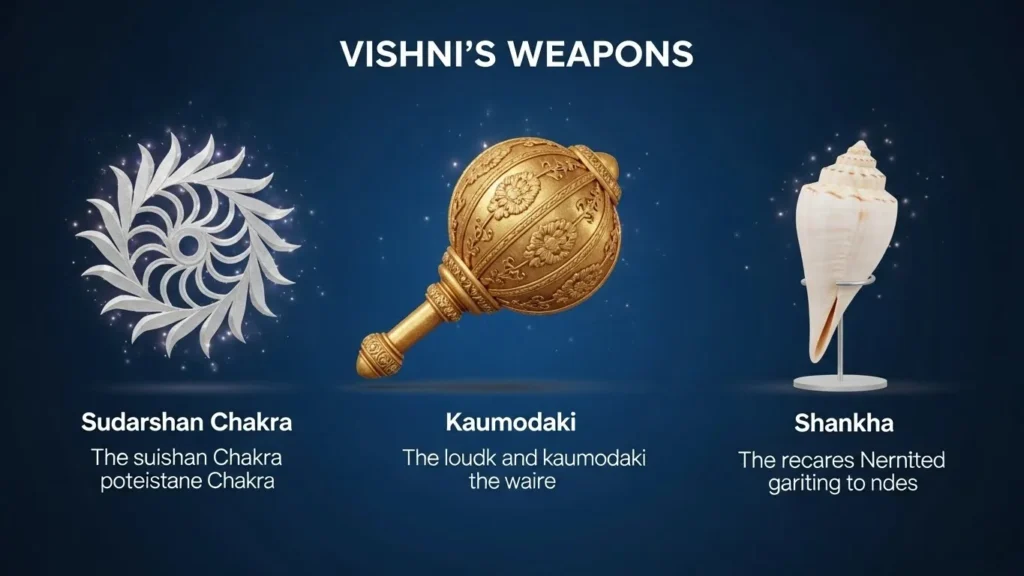
The most iconic representation shows Vishnu as Chaturbhuja (four-armed), carrying the Sudarshan Chakra (discus), Kaumodaki Gada (mace), Panchajanya Shankha (conch), and Padma (lotus)—though in certain forms, he may hold up to sixteen weapons including Nandaka (sword) and Sharanga (bow), demonstrating his omnipotent capacity to combat evil through multiple manifestations simultaneously. These weapons are not merely decorative attributes or physical tools but sentient divine entities with their own consciousness, mythology, and agency—capable of manifesting in human form (Ayudhapurusha), fighting independently when summoned, and returning to their master across any distance, making Vishnu’s arsenal fundamentally different from ordinary weapons that depend entirely on their wielder’s skill.
Each weapon’s origin involves dramatic mythology—the Sudarshan Chakra gifted by Shiva after Vishnu’s thousand-lotus worship test, Kaumodaki emerging from the cosmic ocean churning (Samudra Manthan), Panchajanya created from the demon Panchajana’s conch-shaped body after Krishna rescued his guru’s son, Sharanga bow crafted by divine architect Vishwakarma to settle Vishnu-Shiva superiority debates, and Nandaka sword seized from the hundred-armed asura Loha during Mount Meru’s protection.
Beyond their mythological narratives, these weapons embody profound philosophical symbolism—the Sudarshan Chakra represents time’s inexorable wheel and mental clarity piercing ignorance, Kaumodaki symbolizes dharmic authority and strength to uphold righteousness, Panchajanya represents Shabdabrahma (primordial sound) and the five elements, the lotus signifies spiritual purity rising above worldly illusions, and collectively they demonstrate that divine preservation requires both gentle compassion (lotus) and fierce protective power (chakra, gada, sword).
Understanding Vishnu’s weapons reveals fundamental Vaishnavite theology: that God personally engages in cosmic maintenance rather than remaining transcendently detached, that righteousness ultimately triumphs through divine intervention equipped with invincible tools, that devotion attracts active divine protection manifesting as tangible assistance in times of crisis, and that cosmic order depends on the balanced application of knowledge (sword), power (mace), time (chakra), sound (conch), and purity (lotus) across all dimensions of existence.
This comprehensive exploration examines each primary weapon’s detailed mythology, symbolic significance, famous deployments in Hindu epics, the concept of Ayudhapurusha (weapons as persons), and spiritual teachings embedded in this divine arsenal.
The Four Primary Attributes: Chaturbhuja Iconography
The standard Vishnu iconography depicts him with four arms (Chaturbhuja), representing dominion over the four cardinal directions, the four Vedas, the four yugas, the four varnas (social classes), and the four ashramas (life stages).
Symbolic Arrangement
In typical depictions, Vishnu’s four hands hold:
- Upper Right Hand: Sudarshan Chakra (discus)
- Upper Left Hand: Panchajanya Shankha (conch)
- Lower Right Hand: Kaumodaki Gada (mace)
- Lower Left Hand: Padma (lotus)
This arrangement is not arbitrary but reflects cosmic principles—the right side represents spiritual ascension and dharmic action, while the left side represents material manifestation and sustaining force. The upper hands hold instruments of destruction (chakra) and creation (conch/sound), while lower hands hold symbols of preservation (mace) and liberation (lotus).
What Are Vishnu’s Weapons Expanded Forms
In some temple sculptures and paintings, Vishnu appears with eight, sixteen, or even thirty-two arms, each holding different weapons and implements including:
- Nandaka (sword)
- Sharanga (bow)
- Various arrows
- Plough (especially in Balarama form)
- Disc variants
- Additional maces
These expanded forms emphasize his infinite capacity to maintain cosmic order through simultaneous multifaceted interventions.
1. Sudarshan Chakra: The Divine Discus
The Sudarshan Chakra is Vishnu’s most famous and powerful weapon—a spinning disc with serrated edges possessing two rows of ten million rotating spikes, capable of destroying any enemy, traveling faster than thought, and obeying only Vishnu or his avatars.
The Thousand Lotus Origin
According to the Shiva Purana, Vishnu performed intense penance and worship toward Lord Shiva, offering one thousand lotus flowers daily. On the final day of worship, Shiva decided to test Vishnu’s devotion by hiding one lotus flower.
When Vishnu discovered he was short by one flower, he remembered being called “Kamalanayani” (lotus-eyed one) and immediately plucked out his own eye to complete the offering of one thousand lotuses, demonstrating supreme dedication and willingness to sacrifice even his divine body parts for devotion.
Deeply pleased by this extraordinary gesture, Lord Shiva granted Vishnu the Sudarshan Chakra—naming it “Sudarshan” meaning “good vision” or “auspicious vision” as a cosmic play on words referencing Vishnu’s sacrificed eye-as-lotus.
Alternative Origin: Vishwakarma’s Craftsmanship
Another tradition credits Vishwakarma, the divine architect and craftsman, with forging the Sudarshan Chakra from solar matter shaved off from Surya Dev (the Sun God) when his wife Sanjana could no longer bear his excessive heat and requested help from her father Vishwakarma.
This solar origin explains the chakra’s blazing appearance, unstoppable momentum, and association with time—just as the sun marks time’s passage, the Sudarshan Chakra represents Kala Chakra (the wheel of time) destroying all things eventually.
Famous Deployments
Killing Shishupala: During the Rajasuya Yagna of King Yudhishthira, Krishna used the Sudarshan Chakra to behead Shishupala after the demon-king completed his destined one hundred offenses against Vishnu, demonstrating that divine patience has limits and karmic consequences eventually materialize.
Protecting King Ambarisha: When the irascible Sage Durvasa cursed the devoted King Ambarisha and created a fiery demon (Kritya) to kill him, Vishnu immediately dispatched his Sudarshan Chakra to protect his devotee. The chakra instantly incinerated the Kritya, then pursued Durvasa himself across all three worlds—heaven, earth, and the netherworld—until the sage finally sought forgiveness from King Ambarisha, teaching that God rushes to defend sincere devotees regardless of the offender’s spiritual status.
Creating Eclipses: According to one legend, the demon Rahu disguised himself as a deva during the Samudra Manthan to drink Amrita (nectar of immortality). Surya and Chandra informed Vishnu, who immediately threw the Sudarshan Chakra, severing Rahu’s head. Having already consumed some Amrita, Rahu’s head became immortal—periodically swallowing the sun and moon in revenge, creating solar and lunar eclipses.
Symbolism and Significance
The Sudarshan Chakra symbolizes multiple profound concepts:
Time: The spinning wheel represents Kala Chakra—time’s relentless forward motion that eventually destroys all material forms, making the weapon literally invincible because nothing can survive time indefinitely.
Mental Clarity: “Sudarshan” means auspicious vision or good seeing—the weapon represents spiritual wisdom and discriminative knowledge (viveka) that cuts through ignorance, delusion, and false identification with body-mind complex.
Divine Justice: The chakra’s ability to travel any distance and destroy any enemy demonstrates that divine justice operates beyond spatial limitations and eventually reaches all wrongdoers.
Protection: Unlike aggressive weapons requiring wielding, the Sudarshan Chakra can be deputed to independently protect devotees, remaining stationed as a guardian force activated by sincere devotion.
2. Kaumodaki Gada: The Invincible Mace
Kaumodaki is Vishnu’s divine mace or club—typically held in his lower right hand, representing physical and moral strength, dharmic authority, and the power to crush adharmic forces through righteous might.
Origin: The Cosmic Churning
According to most traditions, Kaumodaki emerged during the Samudra Manthan (churning of the cosmic ocean) along with other divine treasures like Goddess Lakshmi, Kaustubha jewel, Airavata elephant, Kamadhenu cow, and the Amrita nectar of immortality.
As one of the precious ratnas (jewels) extracted from the ocean’s depths, Kaumodaki naturally belonged to Vishnu as the supreme orchestrator of the churning process and rightful recipient of implements required for cosmic preservation.
Characteristics and Power
The Harivamsa (appendix to Mahabharata) describes Kaumodaki as invincible and without parallel—capable of crushing any opponent, breaking through any defense, and representing concentrated dharmic force that cannot be opposed by adharma regardless of apparent strength.
The mace symbolizes the fundamental law that righteousness possesses inherently greater power than unrighteousness, though the latter may appear temporarily dominant. Just as a heavy mace crushes obstacles through sheer mass and momentum, dharma ultimately prevails through its alignment with cosmic law.
Famous Deployments
Krishna’s Use: Lord Krishna slew the demon Dantavakra with Kaumodaki during his earthly avatar, demonstrating the mace’s continued use across incarnations. The weapon appears in Krishna’s hands during the Mahabharata war, though he primarily served as Arjuna’s charioteer rather than active combatant.
Protection During Kurukshetra: During the climactic battle between the Pandavas and Kauravas, Krishna’s weapons including Kaumodaki appeared in personified human form from the heavens to witness the conflict, demonstrating their independent consciousness and emotional investment in dharma’s restoration.
Avatar Appearances: The Kaumodaki appears in iconography of Vishnu’s avatars including Matsya, Kurma, Varaha, and Narasimha, indicating its fundamental association with preservation duty across all forms.
Symbolism and Significance
Kaumodaki represents multiple interconnected meanings:
Dharmic Authority: The mace symbolizes righteous governance and the king’s duty to punish wrongdoers, protect citizens, and enforce cosmic law through disciplined force when necessary.
Physical Strength: Unlike the chakra’s swift precision or sword’s sharp intellect, the mace represents raw power and endurance—the strength to bear responsibility, withstand opposition, and persist despite obstacles.
Crushing Ego: Psychologically, Kaumodaki symbolizes the spiritual force necessary to crush ego (ahamkara) and false pride that prevent recognition of divine truth.
Ancient Wisdom: The gada is one of humanity’s oldest weapons, representing timeless dharmic principles that predate sophisticated intellectual philosophies—fundamental moral laws written into existence’s structure.
3. Panchajanya Shankha: The Primordial Conch
Panchajanya is Vishnu’s divine conch shell—held in his upper left hand, representing the primordial sound (Shabdabrahma), the five elements (pancha-bhutas), and the creative power of sacred vibration underlying manifest existence.
Origin: Multiple Traditions
Samudra Manthan: One tradition states that Panchajanya emerged during the cosmic ocean churning along with other divine treasures, naturally belonging to Vishnu as the supreme deity coordinating the churning operation.
Demon Panchajana: The most detailed origin story comes from the Mahabharata and Bhagavata Purana. After completing his education with Guru Sandipani, Krishna asked what guru dakshina (teacher’s fee) he desired. The sage requested that Krishna find his lost son who had been kidnapped years earlier.
Through divine vision, Krishna discovered that a demon named Panchajana living in the ocean in the form of a conch shell had abducted and killed the guru’s son. Krishna dove into the ocean, battled the demon, killed him, and retrieved his body which had taken the form of a beautiful conch shell. Though unable to revive the guru’s already-deceased son, Krishna brought back his remains and claimed the conch for himself, naming it “Panchajanya” after the demon.
Demon Shankhachuda: According to Devi Bhagavata, conches originated from the bones of demon Shankhachuda killed by Lord Shiva. Vishnu blessed the demon that conch shells would become integral to his worship, transforming even demonic remains into sacred implements.
The Sound of Creation
The sound of Panchajanya represents the primordial Om vibration from which the universe emerged. When blown, the conch produces a deep, resonant sound that:
- Announces divine presence
- Purifies the atmosphere
- Dispels negativity and evil forces
- Awakens spiritual consciousness
- Represents the breath of life (prana)
Famous Deployment: Mahabharata War
At the beginning of the Kurukshetra war, Krishna blew Panchajanya alongside the conches of Arjuna (Devadatta), Bhima (Paundra), and other Pandava warriors. The Bhagavad Gita records: “Then Krishna, Arjuna, and all the great warriors blew their respective conches, and the sound was tumultuous.”
The tremendous sound of Panchajanya reverberating through heaven and earth pierced the hearts of Dhritarashtra’s sons, filling them with fear and foreboding, while encouraging the Pandavas—demonstrating how divine sound affects consciousness differently based on dharmic alignment.
Symbolism and Significance
Panchajanya embodies multiple layers of meaning:
Five Elements: The name “Pancha-janya” literally means “born of five”—representing the five great elements (pancha-maha-bhutas): earth, water, fire, air, and space that constitute all material existence.
Shabdabrahma: The conch represents primordial sound or vibration (Shabdabrahma/Nada Brahman)—the creative power through which the unmanifest becomes manifest, consciousness becomes creation, and formless reality takes form through sacred vibration.
Victory and Auspiciousness: Blowing the conch announces victory of dharma over adharma, knowledge over ignorance, and order over chaos. Its sound is considered supremely auspicious in Hindu tradition.
Liberation Through Sound: According to Vishnu Purana, the sound of Panchajanya liberated countless souls from hell—beings who had committed sins heard the divine conch’s vibration, remembered Narayana, and were immediately transported to heaven in aerial chariots, demonstrating that sacred sound possesses transformative power transcending karma.
4. Padma: The Sacred Lotus
The Padma (lotus) held in Vishnu’s lower left hand represents spiritual purity, detachment, creation, consciousness, and the highest yogic realization rising above material illusion while remaining engaged with the world.
Mythological Significance
The Vishnu Purana describes that at creation’s beginning, a lotus bloomed from Vishnu’s navel, and within that lotus sat Brahma the creator. This cosmogonic lotus (Padmanabha—lotus-naveled Vishnu) represents:
- The universe emerging from Vishnu’s being
- Consciousness (Vishnu) giving birth to creation (Brahma)
- The divine womb from which all forms manifest
Symbolism and Significance
The lotus carries profound multi-layered symbolism:
Purity Amid Impurity: The lotus grows in muddy waters but remains unstained—symbolizing how Vishnu maintains perfect purity while engaged in preserving the material universe, untouched by illusion despite being immanent throughout creation.
Spiritual Awakening: The unopened lotus bud represents potential consciousness; the blooming lotus represents spiritual awakening and realization—the highest yogic experience achievable through practice.
Detachment: Though rooted in mud (material existence) and floating on water (emotional realm), the lotus blooms toward sunlight (spiritual consciousness) without attachment to lower realms—teaching engaged detachment.
Creation and Fertility: The lotus represents the creative principle, fertility, and the generative power underlying existence, complementing Vishnu’s preservation function with sustained renewal.
5. Sharanga: The Divine Bow
Sharanga is Vishnu’s celestial bow—primarily associated with his Rama avatar but originally belonging to Vishnu himself, representing focused determination, dharmic warfare, and the power to strike precisely at evil from any distance.
Origin: Settling Divine Superiority
According to the Ramayana, divine architect Vishwakarma created two celestial bows—Pinaka for Shiva and Sharanga for Vishnu—to settle questions about these supreme deities’ relative power and superiority.
In the contest that followed, Vishnu proved victorious, demonstrating his preservation duty’s supremacy over destruction. Graciously, Shiva presented his Pinaka bow to the King of Mithila (Janaka), which later featured in Sita’s swayamvara where Rama broke it, earning her hand in marriage.
Avatar Appearances
Sharanga is notably employed by three Dashavatara incarnations:
Parashurama: The warrior-sage avatar used Sharanga during his campaign annihilating corrupt Kshatriya rulers twenty-one times, demonstrating that even Brahmin priests must take up arms when dharma demands intervention.
Rama: The most famous wielder, Rama is called Kodandapani (holder of the bow) and used Sharanga throughout the Ramayana to defeat demons including Ravana. Parashurama later challenged Rama to string the bow, which Rama accomplished effortlessly, proving himself as Vishnu’s higher incarnation.
Krishna: Though primarily using the Sudarshan Chakra, Krishna employed Sharanga during various battles, maintaining all of Vishnu’s traditional weapons across avatars.
Symbolism and Significance
Sharanga represents:
Focused Determination: The bow requires drawing back before releasing forward—symbolizing the spiritual principle of temporary restraint enabling greater future achievement, like tapas (austerity) creating spiritual power.
Precision: Unlike the mace’s crushing force or chakra’s pursuing destruction, the bow requires precise aim and calculation—representing dharmic warfare conducted with discrimination rather than blind rage.
Distance: The bow can strike enemies from afar—symbolizing divine intervention that doesn’t require physical proximity and consciousness’s ability to affect reality across spatial separation.
6. Nandaka: The Sword of Knowledge
Nandaka is Vishnu’s divine sword—representing discriminative knowledge (viveka), the power to cut through ignorance, and the sharp intellect necessary for spiritual liberation.
Origin: Battle with Loha
According to the Agni Purana, the hundred-armed asura Loha obstructed Brahma’s sacrifice on Mount Meru. Vishnu manifested from the sacrificial fire, seized the sword called Nandaka from the asura, and unsheathed it to battle.
Wielding his mace, the demon drove various celestial beings from the mountain. Finally, Vishnu slew Loha with Nandaka; the severed parts of the asura’s body fell to earth and transformed into iron ore upon contact with the divine sword.
Vishnu blessed the fallen demon that his body-parts would be employed for manufacturing weapons on earth—transforming even demonic remains into useful implements serving dharmic purposes.
Description and Characteristics
The sword is described as blue-hued with a gem-studded handle—matching Vishnu’s dark blue or black complexion and representing the depth of divine wisdom cutting through surface appearances.
Symbolism and Significance
Nandaka represents:
Knowledge as Weapon: In Hindu scriptures, the sword is consistently compared to spiritual knowledge (jnana) that cuts through the bonds of ignorance (avidya), destroying false identification and revealing ultimate reality.
Discrimination: The sharp blade symbolizes viveka (discriminative wisdom)—the ability to distinguish between eternal and temporary, real and unreal, Self and not-Self.
Swift Liberation: Unlike gradual spiritual practice, the sword represents the immediate cutting of karmic bonds through realization, the sudden awakening that liberates consciousness from cyclic existence.
Ayudhapurusha: Weapons as Conscious Beings
A unique aspect of Vishnu’s weapons is their personification as Ayudhapurusha—conscious entities capable of manifesting in human or divine form to serve dharmic purposes independently.
Mahabharata Evidence
The Mahabharata explicitly records that during the chakra-mushala conflict, Krishna’s weapons appeared in human form from the heavens to witness the battle, including his Sudarshan Chakra and Kaumodaki, alongside Balarama’s Samvartaka (plough) and Saumanda (pestle).
This demonstrates that divine weapons possess consciousness, emotions, loyalty, and the ability to manifest independently while remaining fundamentally connected to their divine wielder.
Incarnations as Saints
In Sri Vaishnavism tradition, certain saints are considered avatars of Vishnu’s weapons:
- Annamacharya: Avatar of Nandaka sword
- Peyalvar: Also considered Nandaka’s incarnation
This theological concept suggests that divine weapons can incarnate as devotees to glorify God through different means—replacing physical warfare with devotional poetry and philosophical wisdom.
Spiritual Teachings: The Arsenal of Consciousness
Beyond mythology and iconography, Vishnu’s weapons teach profound spiritual principles:
Integration of Opposites
The weapons combine seemingly contradictory qualities:
- Destruction and Preservation: The chakra destroys while protecting
- Force and Gentleness: The mace crushes evil while the lotus represents tender compassion
- Sound and Silence: The conch produces vibration emerging from primordial stillness
This integration teaches that spiritual maturity requires embracing paradox rather than choosing binary extremes.
Tools for Inner Transformation
Each weapon has psychological correlates:
- Sudarshan Chakra: Discriminative wisdom cutting through mental delusion
- Kaumodaki: Willpower and determination to persevere on spiritual path
- Panchajanya: Mantra practice and sacred sound as transformative force
- Padma: Meditative consciousness rising above sensory entanglement
- Nandaka: Intellectual clarity distinguishing permanent from impermanent
The Necessity of Divine Grace
The fact that these weapons came as gifts from other deities or emerged from cosmic events teaches that ultimate spiritual power comes through grace rather than individual effort alone—Vishnu received Sudarshan from Shiva, Kaumodaki from the ocean churning, weapons requiring divine bestowal beyond personal striving.
Frequently Asked Questions
What are the four main weapons of Lord Vishnu?
The four main weapons of Lord Vishnu held in his Chaturbhuja (four-armed) form are: 1) Sudarshan Chakra (divine discus) in the upper right hand—representing time, mental clarity, and unstoppable power; 2) Panchajanya Shankha (conch) in the upper left hand—representing primordial sound, the five elements, and creative vibration; 3) Kaumodaki Gada (mace) in the lower right hand—representing physical strength, dharmic authority, and moral power; 4) Padma (lotus) in the lower left hand—representing spiritual purity, creation, detachment, and yogic realization. Together these weapons symbolize Vishnu’s complete capacity to preserve cosmic order through destruction of evil, sound/vibration, righteous force, and liberating wisdom.
How did Vishnu get the Sudarshan Chakra?
Vishnu received the Sudarshan Chakra from Lord Shiva as a reward for extreme devotion. According to Shiva Purana, Vishnu worshipped Shiva by offering one thousand lotus flowers daily. On the final day, Shiva tested Vishnu by hiding one flower. Discovering he was short by one, Vishnu remembered being called “Kamalanayani” (lotus-eyed) and immediately plucked out his own eye to complete the thousand lotus offerings. Deeply moved by this sacrifice, Shiva granted Vishnu the Sudarshan Chakra, naming it “Sudarshan” (good vision/auspicious vision) as divine wordplay referencing the sacrificed eye. An alternative tradition credits Vishwakarma with forging it from solar matter shaved from the Sun God. The chakra possesses ten million rotating spikes and obeys only Vishnu or his avatars.
What is the story behind Panchajanya conch?
Panchajanya has multiple origin stories. The most detailed comes from the Bhagavata Purana: After completing his education, Krishna asked Guru Sandipani what guru dakshina (teacher’s fee) he desired. The sage requested that Krishna find his lost kidnapped son. Krishna discovered that a demon named Panchajana living in the ocean in the form of a conch shell had abducted and killed the guru’s son. Krishna dove into the ocean, battled and killed the demon, and retrieved his conch-shaped body as the divine instrument. The conch is named “Panchajanya” after this demon.
Another tradition states it emerged during Samudra Manthan (ocean churning). A third version credits demon Shankhachuda’s bones. Regardless of origin, it represents primordial sound (Om) and the five elements.
What does each of Vishnu’s weapons symbolize?
Each weapon carries profound symbolic meaning: Sudarshan Chakra symbolizes time’s inexorable wheel destroying all things, mental clarity piercing ignorance, and discriminative wisdom; Kaumodaki Gada represents dharmic authority, physical and moral strength, righteous governance, and the power to crush ego; Panchajanya Shankha represents primordial sound (Shabdabrahma),
the five elements, creative vibration, victory announcements, and liberation through sacred sound; Padma (lotus) represents spiritual purity amid worldly engagement, detachment, consciousness awakening, and creation emerging from the divine navel; Sharanga bow represents focused determination, precise dharmic warfare, and restrained power released strategically; Nandaka sword represents discriminative knowledge (viveka) cutting through ignorance. Together they demonstrate that divine preservation requires knowledge, power, sound, purity, and time working harmoniously.
What is Ayudhapurusha in Hindu mythology?
Ayudhapurusha refers to the anthropomorphic manifestation of divine weapons—sacred implements possessing consciousness, emotions, and the ability to take human or divine form independently. The term combines “Ayudha” (weapon) and “Purusha” (person). The Mahabharata explicitly records that during the chakra-mushala conflict, Krishna’s weapons including Sudarshan Chakra and Kaumodaki appeared in human form from the heavens to witness the battle.
This demonstrates that divine weapons are sentient entities with agency beyond mere tools. In Sri Vaishnavism, saints like Annamacharya and Peyalvar are considered avatars of Nandaka sword, suggesting weapons can incarnate as devotees. This concept reflects Hindu theology’s view that divine implements participate consciously in cosmic maintenance rather than serving as passive objects.
Why does Vishnu have four arms?
Vishnu’s four arms (Chaturbhuja) symbolize dominion over the four cardinal directions, the four Vedas (Rig, Sama, Yajur, Atharva), the four yugas (Satya, Treta, Dvapara, Kali), the four varnas (Brahmana, Kshatriya, Vaishya, Shudra), and the four ashramas (Brahmacharya, Grihastha, Vanaprastha, Sannyasa). The four hands also represent omnipotence and multifaceted divine nature—creation (conch/sound), preservation (mace/strength), destruction of evil (chakra/time), and liberation (lotus/purity) operating simultaneously.
The right side represents spiritual ascension and dharmic action, while the left side represents material manifestation and sustaining force. Some forms show eight or sixteen arms, emphasizing infinite capacity for cosmic maintenance. Four arms distinguish Vishnu from other deities and demonstrate his comprehensive power to preserve existence through multiple simultaneous interventions.
How is Kaumodaki different from other weapons?
Kaumodaki is unique as the oldest and most fundamental weapon—a mace or club representing raw physical power rather than refined strategy. Unlike the Sudarshan Chakra’s swift precision or Nandaka sword’s sharp intellect, Kaumodaki represents brute force, endurance, and the crushing weight of dharma that cannot be opposed regardless of clever defenses. It emerged during Samudra Manthan (ocean churning) and is described as invincible and without parallel.
The mace appears in early Vishnu avatar iconography (Matsya, Kurma, Varaha, Narasimha) more consistently than other weapons, suggesting its fundamental connection to preservation duty. Psychologically, it symbolizes willpower, determination, and the strength to crush ego. Unlike weapons requiring skill, the mace succeeds through sustained force—teaching that dharma ultimately prevails through alignment with cosmic law’s inherent weight.
Did Krishna use all of Vishnu’s weapons?
Yes, Krishna as Vishnu’s eighth avatar inherited and used all divine weapons, though selectively based on circumstances. He is most famous for deploying the Sudarshan Chakra—killing Shishupala at Yudhishthira’s Rajasuya Yagna and protecting devotee King Ambarisha from Sage Durvasa. He used Kaumodaki to slay demon Dantavakra. Krishna blew Panchajanya conch at the Kurukshetra war’s beginning, producing sounds that pierced the Kauravas’ hearts while encouraging the Pandavas. The Harivamsa describes Krishna and Balarama receiving four weapons from heaven during battle with Jarasandha—Krishna battled with Kaumodaki and Sharanga bow.
The Mahabharata records Krishna’s weapons appearing in personified human form from heaven to witness the chakra-mushala war, demonstrating their continued sentience across avatars. This continuity proves Vishnu’s weapons transcend individual incarnations.
About the Author
Neha Kulkarni – PhD in Vedic Studies and Ancient Indian History
Neha Kulkarni is a distinguished scholar specializing in ancient Indian history, Vedic traditions, and Hindu cultural practices. With over 15 years of research experience focused on decolonizing historical narratives, he has published extensively on Vaishnavite theology, Hindu iconography, weapon mythology, Puranic literature, symbolic interpretation, Ayudhapurusha traditions, and the intersection of material culture with spiritual philosophy. His work bridges academic rigor with devotional accessibility, making complex mythological and symbolic concepts understandable to contemporary audiences seeking authentic knowledge about Hindu wisdom traditions and their transformative potential for understanding divine attributes, cosmic preservation, and the integration of spiritual principles with practical power.