

The Hindu pheras ceremony – also What Happens During Hindu Pheras called [translate:Saptapadi] (seven steps) or [translate:Saat Phere] (seven circles) – represents the most visually striking and spiritually profound moment in Hindu weddings when bride and groom circle sacred fire ([translate:Agni]) seven times while reciting ancient Vedic vows, creating legally binding marriage recognized by both divine witnesses and Indian law from the moment seventh circle completes, transforming two individuals into one married unit through systematic progression addressing comprehensive marital dimensions from material security through emotional fulfillment toward spiritual realization.

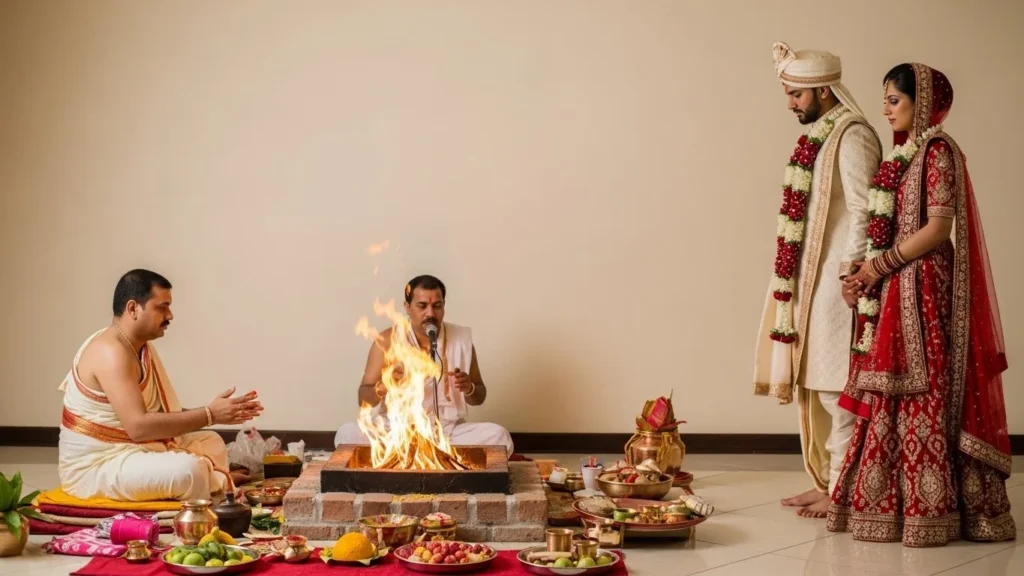
Unlike brief Western “I do” exchange lasting mere seconds, the pheras ritual extends 20-45 minutes depending on regional variations and priest’s elaboration, each circumambulation carrying distinct vow covering specific life dimension – first circle establishing household provision and nourishment, second promising mutual health support, third committing to righteous wealth accumulation, fourth pledging emotional happiness and respect, fifth seeking progeny blessings, sixth praying for longevity together, seventh declaring eternal friendship and fidelity – creating beautifully balanced framework addressing both practical necessities like food security and transcendent aspirations like seven-lifetime companionship while fire deity Agni serves as ultimate witness whose purifying presence sanctifies vows making them eternally binding and whose eternal nature symbolizes marriage’s permanence transcending physical death.
For couples planning 2025 weddings, whether traditional elaborate Vedic ceremonies with complete Sanskrit mantras and ritual procedures, simplified modern versions incorporating English translations making vows comprehensible to international guests and diaspora families, or creative fusion ceremonies blending Hindu elements with other traditions for interfaith marriages, understanding what actually happens during pheras – the precise setup of havan kund (fire altar) at mandap center, who leads which circles (traditionally groom leads first four representing his active role, bride leads final three symbolizing her superior spiritual power in some interpretations), what priest chants in seemingly incomprehensible Sanskrit (ancient prayers invoking divine blessings.
for each vow’s specific dimension), why couple maintains right-side orientation toward fire (auspicious Vedic direction), regional variations like Bengali stepping on betel leaves versus South Indian walking actual seven steps versus North Indian circular pattern, and critical practical considerations like maintaining safe distance from flames while wearing elaborate flammable wedding attire, managing heavy jewelry and long dupattas during movement, coordinating with photographers capturing this pivotal moment without obstructing ritual’s sacred flow – enables approaching ceremony with proper understanding transforming potentially stressful logistics into deeply meaningful experience establishing spiritual foundation for lifelong partnership built on conscious commitment witnessed by divine forces, blessed by assembled community, and validated by millennia-old tradition recognizing marriage as sacred bond transcending mere legal contract or romantic attraction.
The Sacred Significance of Agni in Hindu Weddings
Before examining the step-by-step procedure, understanding why fire plays such central role in Hindu marriage reveals profound theological philosophy distinguishing this tradition from other religious wedding ceremonies.
Agni: The Divine Witness
In Vedic cosmology, Agni holds unique position as:
The Mediator Between Worlds:
- Agni resides simultaneously in three realms: earth (fire), atmosphere (lightning), and heaven (sun)
- Carries offerings from humans to gods during all Vedic rituals
- Only deity who can witness AND convey vows to divine realm
- Makes Agni the perfect marriage witness – present on earth yet connected to eternal divine
The Purifier:
- Fire burns away impurities, transforming base matter into refined form
- Symbolizes burning away individual karmas and past-life impressions
- Creates purified union free from previous entanglements
- Transforms two separate beings into one married entity
The Sustainer:
- Digestive fire ([translate:jatharagni]) within body sustains life
- Without internal fire, no food digestion, no life possible
- Wedding fire symbolizes couple will now sustain new household together
- From individual survival to joint family sustenance
The Eternal Witness:
- Unlike human witnesses who may forget or die, fire represents eternal consciousness
- Vows spoken before Agni can never be denied or erased
- Creates permanent cosmic record of sacred commitment
- Divine accountability transcending human legal systems
The Scriptural Foundation:
Rigveda extensively praises Agni as supreme deity worthy of invocation in all sacred rites.
Grihya Sutras (household ritual manuals) establish fire as essential element without which marriage invalid:
[translate:अग्निः साक्षी विवाहस्य]
“Agni is the witness of marriage” – establishing that without fire presence, marriage incomplete regardless of other ceremonies performed.
Why Fire Specifically?
Among all elements, fire chosen because:
Transformative Power:
- Fire changes matter’s state (wood → ash, ghee → smoke)
- Marriage similarly transforms two individuals into one unit
- Alchemical symbolism: purifying base metal into gold
Upward Movement:
- Fire’s flames rise upward toward heaven
- Symbolizes couple’s spiritual aspirations ascending toward divine
- Contrast with earth-bound elements (water flows down, earth stays still)
Light and Clarity:
- Fire illuminates darkness, brings clarity
- Marriage should bring enlightenment, not confusion
- Dispels ignorance ([translate:avidya]) through wisdom of partnership
Sacred Direction:
- Clockwise circumambulation (keeping fire on right) follows sun’s apparent path
- Right side ([translate:dakshina]) considered auspicious in Vedic tradition
- Creates positive energy vortex through movement pattern
The Philosophical Depth:
Union of Purusha and Prakriti:
- Fire represents both masculine consciousness (Purusha) and feminine energy (Prakriti)
- Contains both heat (masculine) and light (feminine)
- Perfect symbol for marriage uniting complementary principles
Witness That Cannot Be Corrupted:
- Humans can lie, forget, be bribed
- Fire is incorruptible – cannot bear false witness
- Creates absolute accountability for vows taken
Connection to Yajna Philosophy:
- All life is sacrifice ([translate:yajna]) according to Vedic thought
- Marriage is mutual sacrifice – giving up individual freedom for partnership
- Fire receives this sacrifice and blesses it
- Transforms ordinary transaction into sacred offering
The Number Seven’s Significance:
Why seven circles specifically?
Scriptural Authority:
- Ancient texts prescribe seven steps/circles
- Number considered complete and auspicious across traditions
Mathematical Symbolism:
- 360 degrees in circle ÷ 7 = non-integer (approximately 51.43°)
- Seven is only single digit (1-9) that doesn’t evenly divide 360
- Symbolizes: Nothing can divide relationship established through seven circles
- Creates “indivisible” bond mathematically encoded
Cosmic Parallels:
- Seven chakras (energy centers in yogic system)
- Seven sages ([translate:Saptarishi]) in Hindu cosmology
- Seven sacred rivers
- Seven colors in rainbow (completeness)
- Seven musical notes ([translate:saptaswara])
- Seven days completing week cycle
Comprehensive Coverage:
Each circle addresses distinct life dimension – together covering complete marital existence from material through spiritual.
Modern Scientific Perspective:
While traditional understanding emphasizes religious significance, modern observation notes:
Ritual’s Psychological Impact:
- Extended ceremony (unlike brief Western vows) creates deep memory imprint
- Physical movement embodies abstract commitment
- Public performance before witnesses increases accountability
- Fire’s mesmerizing quality creates altered consciousness conducive to sincere vows
Social Bonding:
- Family gathered around fire creates collective energy
- Shared ritual strengthens community bonds
- Public ceremony reduces divorce likelihood through social accountability
Symbolic Power:
- Even non-religious couples report profound emotional impact
- Something about fire’s primal nature evokes deep response
- Creates sacred space transforming mundane into meaningful
The fire isn’t mere prop or decoration – it embodies the ceremony’s sacred essence, without which vows remain secular promises rather than eternal commitments witnessed by divine consciousness itself.
Pre-Pheras Setup: The Havan Kund and Mandap
Before bride and groom take their first step, elaborate preparation establishes sacred space where heaven and earth intersect through fire’s mediation.
The Mandap (Wedding Canopy):
Purpose:
- Creates sacred enclosure separating wedding space from mundane world
- Represents universe in miniature
- Four pillars symbolize four parents supporting new family
- Canopy represents protective divine grace
Traditional Materials:
- Wooden pillars
- Cloth canopy decorated with flowers, lights
- Fresh mango or banana leaves (considered auspicious)
- Marigolds, roses, and other sacred flowers
Modern Variations:
- Elaborate floral mandaps with thousands of flowers
- Crystal and LED-illuminated modern designs
- Minimalist contemporary structures
- Outdoor natural settings (gardens, beaches) with portable mandaps
The Havan Kund (Fire Altar):
Placement:
- Center of mandap – most critical positioning
- Ensures bride and groom can easily circumambulate
- Close enough to feel fire’s heat, far enough for safety
- Elevated slightly on platform for visibility
Traditional Design:
Square Shape:
- Usually square or rectangular pit
- Made from copper, brass, or clay
- Size varies: 12-18 inches width typical
- Depth: 6-12 inches for containing fire safely
Modern Variations:
- Decorative copper vessels with ornate designs
- Portable stainless steel kunds for venue flexibility
- Gas-fueled systems for indoor venues with fire restrictions
- Electric “flame” simulators (though traditional purists object)
Building the Sacred Fire:
Materials Required:
| Component | Significance |
|---|---|
| Wood | Mango, peepal, or sacred woods; symbolizes purity |
| Ghee (Clarified Butter) | Pure substance; when poured, creates bright flames |
| Camphor | Burns completely leaving no residue; represents ego dissolution |
| Sacred Herbs | Sandalwood, dried tulsi, specific Ayurvedic herbs |
| Havan Samagri | Special mixture: rice, sesame, barley, dried fruits, herbs |
| Coconut | Broken and offered; represents ego-breaking |
The Ignition Ritual:
Traditional Method:
- Priest arranges wood in specific pattern (usually pyramid)
- Places camphor at base
- Lights using traditional fire-starting methods or matches
- Chants ignition mantra:
[translate:ॐ अग्नये स्वाहा। अग्निः प्रजापतिः देवो विवाहस्य साक्षी भूयात्॥]
“Om, offering to Agni. May Agni, the lord of creation, be the witness of this marriage.”
What Happens During Hindu Pheras
Maintaining the Fire:
Throughout ceremony:
- Priest periodically adds ghee with special ladle
- Adds havan samagri at specific ritual moments
- Ensures flames remain strong and visible
- Fire must not extinguish during vows (considered inauspicious)
Additional Mandap Elements:
Kalash (Sacred Pot):
- Copper/brass pot filled with water
- Mango leaves around rim, coconut on top
- Represents abundance, life-giving properties
- Placed near havan kund
Priest’s Setup:
- Low stool or cushion for priest to sit
- Plate with puja items (kumkum, turmeric, rice, flowers)
- Sacred texts (Vedas, specific wedding mantras)
- Bell for ritual sounds
For Bride and Groom:
- Low stools, cushions, or designated seating
- Sometimes elaborate throne-like seats
- Positioned to allow easy standing and circling
- Clear path for circumambulation
Safety Considerations:
Critical for Modern Weddings:
Fire Proximity:
- Bride’s lehenga/sari highly flammable (synthetic fabrics, embellishments)
- Groom’s sherwani sleeves, dupatta can catch fire
- Maintain minimum 2-3 feet distance during circles
- Priest should monitor closely
Ventilation:
- Indoor venues: Adequate ventilation essential
- Smoke inhalation concerns
- Some venues require fire department approval
- Ventilation fans may be needed (away from fire)
Emergency Preparedness:
- Fire extinguisher nearby (discreetly placed)
- Water container accessible
- Venue staff aware and trained
- First aid kit for minor burns
Alternative Solutions:
For venues prohibiting open flames:
- Electric LED flame simulators (creates ambiance without actual fire)
- Small contained bio-ethanol burners (cleaner burning)
- Symbolic fire representation with lights
- Outdoor ceremony if indoor restrictions apply
Pre-Ceremony Puja:
Before pheras begin:
Ganesh Puja:
- Worshipping Lord Ganesha for obstacle-free ceremony
- Brief prayer, offering, aarti
Invoking Deities:
- Calling upon various deities to bless wedding
- Specific mantras invoking Vishnu, Lakshmi, Shiva, Parvati
Purifying Space:
- Sprinkling holy water (Ganga jal) around mandap
- Purification mantras
Family Blessings:
- Parents and elders positioned near mandap
- Ready to shower flower petals during pheras
With sacred space properly established and fire blazing bright, the stage is set for marriage’s defining moment.
Step-by-Step Pheras Procedure: What Actually Happens
Now to the central question: what precisely occurs during those sacred seven circles that legally and spiritually bind couple for seven lifetimes?
Pre-Pheras Rituals:
Granthi Bandhan (The Sacred Knot):
Immediately before pheras begin:
- Bride’s dupatta/pallu (sari end) brought together with groom’s scarf/shawl
- Priest ties them together in knot
- Often includes flowers, sacred thread
- Symbolism: Inseparable bond being created
- Remains tied throughout all seven circles
- Sometimes kept as keepsake post-wedding
Kanyadaan (If Not Already Done):
Some traditions place Kanyadaan (bride’s father giving her away) immediately before pheras, others earlier. Either way, this emotional moment precedes circles.
The Seven Pheras: North Indian Style
Direction: Clockwise circumambulation (keeping fire on right side)
Who Leads:
Traditional Interpretation:
- Groom leads first four circles
- Bride leads final three circles
Symbolism:
- Groom’s leadership first four = masculine active principle, provider role
- Bride’s leadership final three = feminine spiritual authority, ultimate power
- Demonstrates partnership equality – neither dominates all seven
Modern Variations:
- Some have groom lead all seven (more patriarchal)
- Progressive couples walk side-by-side equally
- Personal choice based on family tradition and couple’s values
Circle-by-Circle Breakdown:
FIRST CIRCLE – Nourishment and Provision
Priest Chants:
[translate:ॐ एष एकः विष्णुः त्वाम् अन्ववातु। यथा विष्णुः सर्वभूतानाम् अन्नदाता भवति तथैव भव॥]
“Om, may Lord Vishnu follow you to provide nourishment. As Vishnu nourishes all beings, may we nourish each other.”
Action:
- Couple completes first full circle around fire
- Groom typically holding bride’s hand or pinky finger
- Families begin showering flowers and rice
Vow Summary:
“We will provide adequate food, shelter, and material necessities for our household together.”
SECOND CIRCLE – Health and Strength
Priest Chants:
[translate:ॐ ऊर्जे त्वाम् अनुव्रातां ऊर्जा स्वाहा। यथा ऊर्जस्वन्ति देवाः तथा भवाव॥]
“Om, may you be united with strength and vigor. As the devas possess strength, so shall we.”
Action:
- Second complete circumambulation
- Flower shower continues
Vow Summary:
“We will support each other’s physical, mental, and emotional health.”
THIRD CIRCLE – Wealth and Prosperity
Priest Chants:
[translate:ॐ रायस्पोषाय त्वाम् अनुव्रातां रायस्पोषः स्वाहा॥]
“Om, may you be together in the increase of wealth. As wealth increases for the devas, so shall it for us.”
Action:
- Third circle around fire
- Priest may add ghee creating bright flames
Vow Summary:
“We will acquire wealth and resources through righteous ethical means.”
FOURTH CIRCLE – Happiness and Harmony
Priest Chants:
[translate:ॐ मयो भवाय त्वाम् अनुव्रातां मयोभूः स्वाहा॥]
“Om, may you be united in happiness. As happiness pervades the devas, so shall it pervade us.”
Action:
- Fourth circumambulation completes
- Transition point (in traditions where bride takes lead now)
- Bride now in lead position if following this interpretation
Vow Summary:
“We will cultivate mutual love, respect, trust, understanding, and emotional fulfillment.”
FIFTH CIRCLE – Children and Family
Priest Chants:
[translate:ॐ प्रजाभ्यः त्वाम् अनुव्रातां प्रजाः स्वाहा॥]
“Om, may you be blessed with progeny. As the devas are blessed with offspring, so shall we be.”
Action:
- Fifth circle with bride leading (traditional interpretation)
- Special blessings from elders for progeny
Vow Summary:
“We pray for children and commit to raising them with love, values, and wisdom.”
SIXTH CIRCLE – Longevity
Priest Chants:
[translate:ॐ ऋतुभ्यः त्वाम् अनुव्रातां ऋतवः स्वाहा॥]
“Om, may we be blessed with long life through all seasons. As the devas experience eternal time, may we have longevity together.”
Action:
- Sixth circumambulation
- Families’ blessings intensify
Vow Summary:
“We pray for long life together through all seasons and stages.”
SEVENTH CIRCLE – Friendship and Fidelity
Priest Chants:
[translate:ॐ सखे त्वाम् अनुव्रातां सखा स्वाहा॥]
“Om, may we remain true friends and companions. As the devas share eternal friendship, so shall we.”
Action:
- Final, most important circle
- Families shower maximum flowers and blessings
- Loud cheers and celebrations
- Marriage officially complete upon seventh step
Vow Summary:
“We vow to remain lifelong friends, companions, partners. We commit to fidelity and loyalty.”
Post-Seventh Circle:
Legal Status: According to Hindu Marriage Act 1955, marriage is complete and binding the moment seventh step is taken.
Immediate Follow-Ups:
Dhruva Darshan (Pole Star Sighting):
- If evening/night wedding, couple shown Dhruva (Pole Star)
- Symbolizes constancy – as Pole Star remains fixed, so should marriage
- Bride prays to remain as constant in husband’s life
- (Note: Often skipped in daytime weddings when star invisible)
Ashirvad (Blessings):
- Elders formally bless newly married couple
- Touch heads, offer gifts, good wishes
- Couple touches elders’ feet showing respect
Additional Rituals:
Depending on tradition, may include:
- Saptapadi (seven actual steps if not done as circles)
- Sindoor application (groom applying vermillion in bride’s hair part)
- Mangalsutra tying (if not done earlier)
- Various regional customs
Practical Management During Pheras:
Coordination Challenges:
Priest Pacing:
- Mantras can be lengthy – couple may need to pause mid-circle
- Or walk very slowly to match chanting
- Discuss pacing with priest beforehand
Outfit Management:
- Bride’s heavy lehenga/sari makes walking difficult
- Long dupattas can drag or catch fire
- Assistants (sisters, friends) often help manage trailing fabric
- Groom’s sherwani sleeves need watching near flames
Photography:
- Photographers circling alongside for perfect shots
- Can obstruct ritual or distract couple
- Coordinate beforehand – perhaps photographers alternate circles
- Videographer typically stationary capturing full scene
Family Participation:
- Flower shower timing
- Not blocking photographer or mandap access
- Maintaining decorum (controlling overenthusiastic relatives!)
Time Management:
- Full seven circles with complete Sanskrit mantras: 30-45 minutes
- Abbreviated version: 15-20 minutes
- Discuss with priest based on schedule
Duration and Timing:
Total pheras time varies:
- Traditional elaborate: 45-60 minutes (including pre/post rituals)
- Standard: 25-35 minutes
- Abbreviated: 15-20 minutes (shorter mantras, faster pacing)
Regional Variations: How Pheras Differ Across India
India’s diversity creates fascinating regional variations in how sacred seven is honored while maintaining core spiritual essence.
Bengali Weddings:
Major Differences:
Saptapadi = Seven Steps (Literal):
- Not circles around fire
- Seven betel leaves laid in straight line on mandap floor
- Each leaf decorated with turmeric (haldi) and vermillion (kumkum)
- Bride steps on each leaf sequentially with right foot
- Groom moves grinding stone (nora) with toe alongside
Who Leads:
- Groom leads first four steps
- Bride leads final three
- Same leadership symbolism as circular version
Saath Pak (Different Ritual):
- Don’t confuse Saptapadi with Saath Pak
- Saath Pak: Bride seated on stool, brother lifts and carries her around groom seven times
- She covers face with betel leaves
- Separate ritual from actual Saptapadi
South Indian Weddings (Tamil, Telugu, Kannada, Malayalam):
Common Pattern:
Seven Steps Forward:
- Not circles – walking seven steps in straight line
- Often facing east (auspicious direction)
- Each step on separate small pile of rice or betelnut
- Fire remains to couple’s right side throughout
Additional Elements:
- Extensive yellow rice (turmeric rice) showering
- Silver toe rings (metti) worn by bride
- Tying sacred thread (thaali/mangalsutra) prominent
- More elaborate pre/post Saptapadi rituals
Punjabi, Gujarati, Marwari Weddings:
Standard Circular Pattern:
- Seven full circles around fire
- Groom leads first four, bride leads last three (typically)
- Most similar to general North Indian described above
Gujarati Variation:
- Some Gujarati communities do only four circles
- Each representing one Purushartha (life goal):
- Dharma (righteousness)
- Artha (prosperity)
- Kama (pleasure/love)
- Moksha (liberation)
Sikh Weddings (Anand Karaj):
Four Laavan:
- Four circles only (not seven)
- Around Guru Granth Sahib (holy book), not fire
- Each circle accompanied by reading one Lavan (wedding hymn)
- Couple walks together throughout (no leadership switch)
Not identical to Hindu pheras but conceptually similar – sacred circumambulation marking marriage completion.
Odia Weddings:
Seven Rice Heaps:
- Seven small piles of rice (blessed by priest)
- Represent seven hills (Saptakil Parvatas) symbolizing life’s hardships
- Bride breaks each heap with right foot
- Groom by her side
- Symbolizes facing life’s challenges together
Additional Element:
- Bride’s brother places puffed rice in bride’s palm
- She and groom together pour into fire
- Represents prosperity she brings to new home
Modern Urban Weddings:
Contemporary Adaptations:
English Translation Included:
- Priest pauses after each Sanskrit mantra
- Provides English translation
- Helps diaspora guests and non-Hindi speakers understand
Shortened Versions:
- Complete mantras very lengthy (45+ minutes)
- Modern priests often use abbreviated forms
- Some couples request “express” version (20 minutes)
Interfaith Modifications:
- When one partner non-Hindu
- Core seven circles retained
- May add elements from other tradition
- Explanations provided for non-Hindu family
Destination Weddings:
- Portable mandaps and havan kunds
- Beach, resort, international locations
- Maintaining traditional authenticity with modern logistics
The Core Remains:
Despite regional variations:
- Seven as sacred number maintained (except Sikh four)
- Sacred witness (fire, holy book, or divine presence)
- Progressive vow structure covering life dimensions
- Public ceremonial binding creating marriage
The variations enrich tradition showing adaptability while preserving essential spiritual framework.
Frequently Asked Questions
Do both bride and groom walk during pheras or just one?
Both walk together during all seven circles. They may hold hands, or groom holds bride’s hand/pinky finger. In some traditions, bride’s chunni/pallu tied to groom’s scarf creating physical connection. The leadership question (who’s in front) varies – traditionally groom leads first four circles, bride leads final three in many North Indian traditions, though some have groom lead all seven or couple walk side-by-side. Both are actively participating throughout all circles – this is joint ritual cementing partnership.
What if fire goes out during pheras?
Considered very inauspicious if fire extinguishes during vows. Priest’s responsibility to maintain flames throughout ceremony by adding ghee and havan samagri. If fire does go out: Priest must relight immediately, potentially requiring redoing that particular circle or mantra. Prevention: Experienced priests ensure adequate fuel, protected from wind, properly built. Modern venues sometimes use gas-fed systems or enclosed kunds preventing accidental extinguishing. Don’t worry excessively – qualified priests rarely let this happen. Their primary job is maintaining sacred fire.
Can pheras be done without priest?
Ideally no – priest ensures proper mantras, procedures, timing, and ritual sanctity. However: Legally, Indian courts have ruled marriage valid based on Saptapadi completion regardless of who officiates. Alternatives if priest unavailable: Family elder familiar with procedures, recorded mantras played while couple circles, simplified DIY version (though loses traditional authenticity). For diaspora weddings where Hindu priests scarce, families sometimes use recorded ceremonies or video call with priest in India guiding remotely. Practical reality: Priest adds tremendous value – proper pronunciation, procedures, commanding presence. Invest in qualified priest if possible.
What happens if bride or groom trips during pheras?
No spiritual significance to accidental tripping – this isn’t omen or bad luck. Practical considerations: Heavy outfits, long dupattas, emotional state, and unfamiliarity with ritual make some stumbling normal. Prevention: Take small careful steps, assistants help manage trailing fabric, bride may wear comfortable hidden shoes, rehearse briefly if very nervous. If serious fall: Pause, help person up, ensure no injury, continue when ready. Marriage validity unaffected. Modern photographers often photoshop out minor stumbles for perfect album shots. Focus on ceremony’s meaning, not mechanical perfection.
Can interfaith couples do Hindu pheras?
Yes, absolutely! Many interfaith couples incorporate Hindu pheras into wedding. Common approaches: 1) Complete Hindu ceremony including pheras, plus elements from partner’s tradition (Christian vows, Jewish chuppah, etc.), 2) Hindu pheras with explanations for non-Hindu family and modified language inclusive of both faiths, 3) Two separate ceremonies honoring both traditions fully. Priest cooperation: Find progressive priest comfortable with interfaith weddings (some traditional priests may refuse). Legal recognition: Hindu Marriage Act applies only if both parties Hindu, but pheras ceremony can still occur symbolically for interfaith couples registering under Special Marriage Act. Many couples find deep meaning in pheras regardless of legal structure.
How much does mandap and havan kund setup cost?
Highly variable based on location, elaborateness, and whether renting or buying:
Basic Setup: ₹5,000-15,000 (simple mandap rental, basic havan kund, minimal decoration)
Mid-Range: ₹25,000-75,000 (decorated floral mandap, quality havan kund, standard setup)
Elaborate: ₹1,00,000-5,00,000+ (premium floral designs, custom mandaps, extensive decoration, international flowers)
Destination/Luxury: ₹5,00,000-50,00,000+ (elaborate destination setups, imported materials, celebrity-style)
Typically bundled into overall wedding decorator/planner costs. Havan kund alone: ₹2,000-25,000 depending on material (basic copper vs. ornate designs). Many families own havan kund, just need mandap rental.
Do women lead any circles or only men?
Depends on tradition and interpretation. Traditional North Indian: Bride leads final three circles (5th, 6th, 7th) while groom led first four. Symbolism: Acknowledges woman’s spiritual authority and power ultimately guiding marriage. Alternative interpretation: Groom leads all seven (more patriarchal understanding). Modern egalitarian: Both walk side-by-side equally without hierarchy. Regional variation: Bengali, South Indian have slightly different patterns. Couple’s choice: Discuss with priest and choose interpretation aligning with your values. No single “correct” answer – different authentic traditions exist. Progressive couples often prefer equal or bride-leading-more versions.
What’s difference between Saptapadi and pheras?
Technically: [translate:Saptapadi] means “seven steps,” [translate:phere] means “rounds/circles.” Same ritual, different terms. Regional usage: North India commonly says “saat phere” (seven circles); South India typically says “Saptapadi”; Sanskrit texts use Saptapadi. Subtle distinction some make: Saptapadi = literal seven steps (like South Indian/Bengali walking forward); Phere = circular pattern around fire (North Indian). Practical reality: Most people use terms interchangeably. Both refer to seven circumambulations/steps around fire making vows. Don’t worry about terminology – focus on understanding ritual’s meaning. Different words, same sacred ceremony binding couple for seven lifetimes.
Conclusion
The Hindu pheras ceremony represents far more than picturesque cultural tradition or photogenic wedding moment – it embodies profound spiritual wisdom about marriage as sacred partnership requiring comprehensive commitment across all life dimensions simultaneously, from ensuring basic material security through providing adequate food and shelter, through building emotional intimacy via mutual health support and loving respect, to creating generational legacy through blessed progeny, toward ultimate spiritual realization achieved together through lifelong friendship and fidelity witnessed by divine fire whose purifying eternal presence sanctifies vows making them cosmically binding across seven lifetimes.
The systematic seven-circle progression demonstrates sophisticated understanding that successful marriages require balanced attention to practical necessities (household provision, wealth acquisition), psychological dimensions (emotional happiness, mental strength), social responsibilities (family creation, community participation), and transcendent aspirations (longevity, eternal companionship) – rejecting both purely romantic idealism ignoring economic realities and purely pragmatic arrangements lacking emotional depth or spiritual meaning while creating integrated framework addressing marriage’s multidimensional complexity through systematic progressive vow structure refined across millennia of lived experience.
As you approach or reflect upon your pheras in 2025, whether through traditional elaborate Vedic ceremonies with complete Sanskrit mantras chanted before blazing sacred fire, simplified modern adaptations incorporating English translations making vows comprehensible to international guests and diaspora families, or creative fusion ceremonies respectfully blending Hindu elements with other traditions for interfaith partnerships, remember that these seven circles represent far more than beautiful ritual or legal formality – they constitute conscious choice to walk life’s journey together.
around sacred center represented by purifying fire, accepting both joys and challenges that partnership entails, committing publicly before divine witness and assembled community to supporting each other’s complete flourishing across material prosperity, emotional fulfillment, family creation, and spiritual evolution while maintaining that commitment through inevitable difficulties and changes recognizing that bond created through seven circumambulations connects souls across seven lifetimes making present conflicts temporary obstacles on eternal journey together.
The pheras’ enduring power lies not in magical Sanskrit syllables or photogenic flames but in sincere intention transforming ordinary promises into sacred vows, in conscious participation understanding each circle’s specific meaning rather than mechanically following priest’s instructions, and in daily choice to honor commitments made before sacred fire through small acts of love, service, compromise, and mutual support transforming ordinary marriage into sacred union mirroring divine partnerships that create, sustain, and ultimately liberate all existence.
[translate:॥ ॐ तत् सवितुर्वरेण्यं भर्गो देवस्य धीमहि।
धियो यो नः प्रचोदयात्॥]
(Om. We meditate on that excellent glory of the divine vivifying Sun. May he illumine our minds. – Gayatri Mantra)
About the Author
Dr. Aryan Mishra – Hindu Philosophy and Comparative Religion Scholar
Dr. Aryan Mishra is a distinguished academic specializing in Hindu philosophy, comparative religion, theological interpretations, Vedic ritual systems, and the philosophical foundations underlying Hindu ceremonial practices. Holding a doctorate in Religious Studies with specialization in Hindu marriage theology and ritual symbolism, his research examines how ceremonies like pheras encode sophisticated philosophical principles about consciousness transformation, sacred witnessing, and the integration of material and spiritual dimensions in householder life.
Dr. Mishra has extensively studied the evolution of Hindu wedding rituals from Vedic fire ceremonies through regional variations to modern adaptations, demonstrating how core philosophical principles remain remarkably consistent despite dramatic changes in external forms, social contexts, and gender interpretations.
He regularly teaches courses on Hindu sacraments (samskaras), the theology of sacred fire in Vedic tradition, comparative wedding rituals across world religions, and the intersection of ancient wisdom with contemporary relationship challenges.
His scholarship emphasizes that authentic Hindu practice combines proper understanding of scriptural and philosophical foundations with sincere devotional consciousness, that rituals serve consciousness transformation rather than being mechanical ends in themselves, that traditions deserve respectful examination revealing their profound psychological and spiritual sophistication rather than dismissal as mere superstition or uncritical blind adherence, and that ancient ceremonial wisdom like the pheras ritual offers timeless insights about partnership, commitment, and sacred transformation remaining profoundly relevant for contemporary couples navigating modern challenges within framework connecting them to eternal truths transcending historical and cultural variations.