


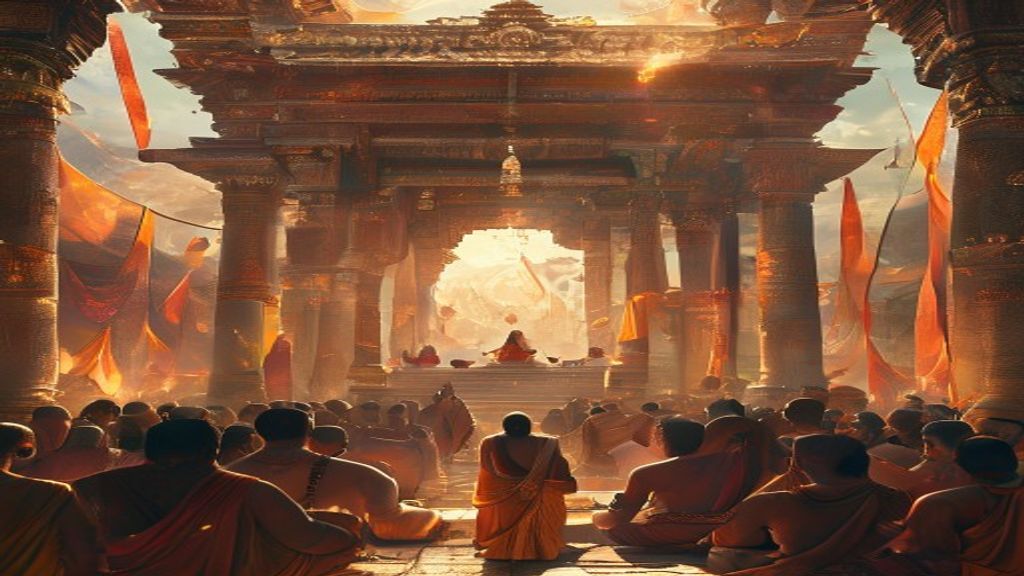
What Hindus think about other religions is rooted in the ancient principle of *Ekam Sat Vipra Bahudha Vadanti* (Truth is one, sages call it by many names), asserting that all paths ultimately lead to the Divine. Hinduism embraces a profound pluralism, recognizing the validity and spiritual efficacy of diverse spiritual traditions, fostering a spirit of universal acceptance and respect for all seekers.
| Attribute | Details |
|---|---|
| Core Principle | **Ekam Sat Vipra Bahudha Vadanti** (Rig Veda 1.164.46) – Truth is one, sages call it by many names. |
| Key Sanskrit Term | **Sarva Dharma Sambhava** (Equality of all religions/paths) |
| Philosophical Foundation | Non-exclusivity; **Ishta Devata** (personal chosen deity) concept extends to recognizing divine manifestations beyond Hindu pantheon. |
| Scripture Reference | **Bhagavad Gita** (4.11, 7.21-22, 9.23-25); **Upanishads** (e.g., Brihadaranyaka, Kena); **Puranas** (illustrating interaction with diverse traditions). |
| Historical Praxis | Long tradition of religious tolerance and absorption, evident in ancient kingdoms and modern India’s secular fabric. |
Introduction: The Spiritual Basis of Sanatana Pluralism
Sanatana Dharma, often known as Hinduism, is not merely a religion but a profound way of life, an eternal tradition rooted in timeless wisdom. At its core lies an unparalleled understanding of religious pluralism, a philosophy that embraces the multiplicity of spiritual paths as valid means to apprehend the ultimate Truth. Unlike many Abrahamic faiths, Sanatana Dharma does not claim exclusive ownership of the divine or proclaim a singular, mandated path to salvation. Instead, it offers a grand, overarching vision where every sincere seeker, regardless of their chosen deity or spiritual framework, is seen as moving towards the same supreme reality, **Brahman**.
This deep-seated inclusivity is a hallmark of Hindu thought, fostering an environment where diverse beliefs can coexist and even flourish. It stems from the realization that human beings, with their varied temperaments, intellectual capacities, and cultural backgrounds, require different approaches to the divine. Just as different rivers flow into the same ocean, so too do different faiths lead to the same universal Spirit. This guide delves into the scriptural foundations, philosophical nuances, and practical manifestations of this extraordinary pluralism, offering a definitive insight into what Hindus genuinely believe about other religions.
The Sanatana Dharma’s Historical Stance on Pluralism
The spirit of religious pluralism is not a modern construct within Hinduism but is deeply embedded in its most ancient scriptures and historical practices. The **Rig Veda**, foundational to Hindu thought, explicitly articulates this truth in Mandala 1, Sukta 164, Mantra 46: “एकं सद्विप्रा बहुधा वदन्ति” (Ekam Sat Vipra Bahudha Vadanti), meaning “Truth is one, sages call it by many names.” This single verse encapsulates the essence of Hindu universalism, affirming the singular nature of the ultimate reality while acknowledging the diverse expressions and understandings of it by enlightened beings.
Throughout the Itihasas and Puranas, we find countless narratives illustrating this principle. The **Bhagavad Gita**, a revered text within the Mahabharata, further elaborates on this in Chapter 4, Verse 11, where Lord Krishna declares: “ये यथा मां प्रपद्यन्ते तांस्तथैव भजाम्यहम् । मम वर्त्मानुवर्तन्ते मनुष्याः पार्थ सर्वशः ॥” (Ye yathā māṁ prapadyante tāṁs tathaiva bhajāmyaham | Mama vartmānuvartante manuṣyāḥ pārtha sarvaśaḥ ||) – “As individuals approach Me, so do I receive them. All paths that people take, Arjuna, lead to Me.” This statement is a direct affirmation that the divine responds to devotion in whatever form it manifests, validating all sincere spiritual pursuits.
Historically, Hindu kingdoms and societies have demonstrated a remarkable capacity for religious tolerance and integration. From the Mauryan Empire’s accommodation of Jainism and Buddhism, to the Vijayanagara Empire’s patronage of temples, mosques, and churches, the Indian subcontinent has served as a crucible for diverse faiths to coexist. The **Skanda Purana**, particularly the Kashi Khanda, describes Kashi (Varanasi) as a sacred space where Shiva himself welcomes all beings, irrespective of their creed, to attain liberation. This historical evidence underscores that pluralism is not a theoretical concept but a lived reality and a foundational value for followers of Sanatana Dharma, a principle further explored at Hindutva.online.
Philosophical Depth: The Many Facets of Sanatana Pluralism
The pluralistic outlook of Sanatana Dharma is sustained by several profound philosophical concepts:
- **The Nature of Brahman:** The ultimate reality, Brahman, is understood as infinite, formless, and beyond all attributes (Nirguna Brahman), yet simultaneously capable of manifesting in countless forms and names (Saguna Brahman). This understanding naturally accommodates the diverse conceptions of God found in various religions. Each deity or divine concept is seen as a legitimate, albeit partial, manifestation of the one supreme reality.
- **Ishta Devata:** The concept of **Ishta Devata** (chosen deity) allows an individual devotee to focus their worship on a particular form of God that resonates most with them, without negating the validity of other forms. This personal freedom of worship extends beyond the Hindu pantheon, implying an acceptance of other traditions’ divine figures as valid points of access to the Absolute.
- **Karma and Rebirth:** The doctrines of **Karma** and **Rebirth** emphasize individual spiritual evolution over countless lifetimes. This framework implies that each soul is on its unique journey, learning and progressing at its own pace. Therefore, judging or invalidating another’s spiritual path becomes irrelevant, as everyone is understood to be on their own path towards ultimate liberation (**Moksha**).
- **Vasudhaiva Kutumbakam:** This ancient Sanskrit phrase, found in the **Maha Upanishad** (Chapter 6, Verse 72), means “The world is one family.” It embodies a universal vision of interconnectedness and brotherhood, transcending boundaries of religion, race, or nationality. This principle forms the ethical cornerstone for peaceful coexistence and mutual respect among all people, regardless of their spiritual affiliations.
This intricate philosophical tapestry provides a robust framework for understanding and embracing religious diversity, moving beyond mere tolerance to genuine acceptance and respect. It’s a testament to the profound wisdom embedded in Sanatana Dharma, a wisdom that fosters harmony in a multi-religious world.
Cultivating Interfaith Harmony: A Dharmic Approach
For a Hindu, practicing inclusivity is not a passive acceptance but an active engagement guided by Dharmic principles. It involves cultivating a mindset of genuine respect and understanding.
- **Self-Reflection and Inner Purity:** Begin by purifying one’s own mind (चित्त शुद्धि – *Chitta Shuddhi*) through practices like meditation (ध्यान – *Dhyana*) and selfless service (सेवा – *Seva*). A calm and compassionate mind is naturally more open to understanding others.
- **Study and Understanding:** Engage in the study of one’s own scriptures to deepen the understanding of universal principles like **Ahimsa** (non-violence) and **Satya** (truth). This foundation allows for a more informed and respectful appreciation of other faiths.
- **Respectful Dialogue:** Participate in interfaith dialogues with an open heart and a sincere desire to learn, rather than to debate or convert. Share your own tradition’s wisdom while respectfully listening to and understanding others’.
- **Universal Prayers:** Incorporate prayers for universal well-being into daily practices, such as “लोकाः समस्ताः सुखिनो भवन्तु” (Lokāḥ Samastāḥ Sukhino Bhavantu) – “May all beings everywhere be happy and free.” This fosters a global perspective of compassion.
- **Acts of Service:** Engage in humanitarian activities that benefit all, irrespective of religious background. This practical expression of **Dharma** builds bridges and reinforces the idea of shared humanity.
Mantras & Chants for Universal Well-being
Chanting these mantras fosters a sense of universal interconnectedness and invokes blessings for all creation:
- **Om Sarvesham Svastir Bhavatu**
सर्वेशां स्वस्तिर् भवतु ।
सर्वेशां शान्तिर् भवतु ।
सर्वेशां पूर्णं भवतु ।
सर्वेशां मङ्गलं भवतु ।
लोकाः समस्ताः सुखिनो भवन्तु ॥
(Om Sarvesham Svastir Bhavatu, Sarvesham Shāntir Bhavatu, Sarvesham Pūrṇam Bhavatu, Sarvesham Maṅgalam Bhavatu. Lokāḥ Samastāḥ Sukhino Bhavantu.)
Meaning: May auspiciousness be unto all. May peace be unto all. May fullness be unto all. May prosperity be unto all. May all beings in all worlds be happy. - **Asato Ma Sadgamaya** (Brihadaranyaka Upanishad 1.3.28)
असतो मा सद्गमय ।
तमसो मा ज्योतिर्गमय ।
मृत्योर् मा अमृतं गमय ॥
(Asato Mā Sadgamaya, Tamaso Mā Jyotirgamaya, Mṛtyor Mā Amṛtaṁ Gamaya.)
Meaning: From the unreal lead me to the real. From darkness lead me to light. From death lead me to immortality. (A universal prayer for spiritual enlightenment.)
Dos and Don’ts in a Multi-Religious Context
- Do: Respect the sacred texts, symbols, and places of worship of other religions.
- Do: Engage in sincere dialogue to understand different perspectives and common values.
- Do: Focus on shared ethical principles such as compassion, truthfulness, and non-violence.
- Do: Uphold your own Dharma while acknowledging the validity of other paths.
- Don’t: Criticize or denigrate other religious beliefs or practices.
- Don’t: Attempt to proselytize or convert others, as Hinduism generally does not advocate for conversion.
- Don’t: Force your beliefs upon others; respect individual spiritual journeys.
- Don’t: Judge others based on their religious affiliation; look for the inherent divinity within all.
Frequently Asked Questions About Hindu Pluralism
Do Hindus believe all religions are exactly the same?
No, Hindus generally do not believe all religions are identical in their doctrines, rituals, or practices. The understanding is that while the paths (religions) are distinct and diverse, the ultimate goal or underlying Truth (Brahman) is one. Differences are acknowledged, but their validity as paths to the Divine is affirmed. As the great sage Sri Ramakrishna Paramahamsa demonstrated, different paths lead to the same ultimate experience of God.
Does Hinduism encourage conversion to its faith?
Historically and traditionally, Hinduism has not been a proselytizing religion. Its emphasis is on orthopraxy (right action) and individual spiritual realization, rather than on converting others to a particular creed. While individuals can certainly adopt Hindu practices, the concept of aggressive conversion is largely absent from its ethos. The focus is on finding one’s own path to **Dharma** and **Moksha**.
How does the concept of Karma influence Hindu views on other religions?
The doctrine of Karma reinforces the idea of individual spiritual responsibility and the unique journey of each soul. It implies that every being, irrespective of their current religious affiliation, is undergoing an evolutionary process dictated by their actions. This perspective discourages judgment of others’ paths, as it understands that each soul is precisely where it needs to be on its journey towards liberation, making external conversion efforts largely irrelevant to the ultimate spiritual progress of the individual.
Is it possible for a Hindu to worship in a temple and also respect a mosque or church?
Absolutely. For a sincere Hindu, the reverence for the Divine extends beyond the confines of their own tradition. While a Hindu may primarily worship their chosen deity (**Ishta Devata**) in a temple, the understanding that the same universal divine principle manifests in different forms allows for deep respect towards places of worship of other faiths. This is a natural outflow of the principle of **Sarva Dharma Sambhava** and can be observed in the harmonious coexistence of diverse religious structures across India, a testament to the enduring spirit of Hindutva found on platforms like Hindutva.online.
Why This Matters for Every Hindu
Embracing and embodying the principles of Sanatana pluralism is not just an intellectual exercise; it is fundamental to preserving the essence of Sanatana Dharma. In an increasingly interconnected yet often fractured world, the ancient wisdom of “Truth is One” offers a beacon of hope and a framework for peace. For every Hindu, understanding this profound inclusivity strengthens their own faith by recognizing the universal nature of the Divine, fostering compassion, and promoting harmony. It empowers Hindus to engage with the world not with fear or exclusivity, but with an open heart, acknowledging the divinity inherent in all beings and all sincere spiritual quests. This profound legacy of pluralism is a gift to humanity, reminding us that while paths may differ, the destination of ultimate truth and love remains universally accessible.