


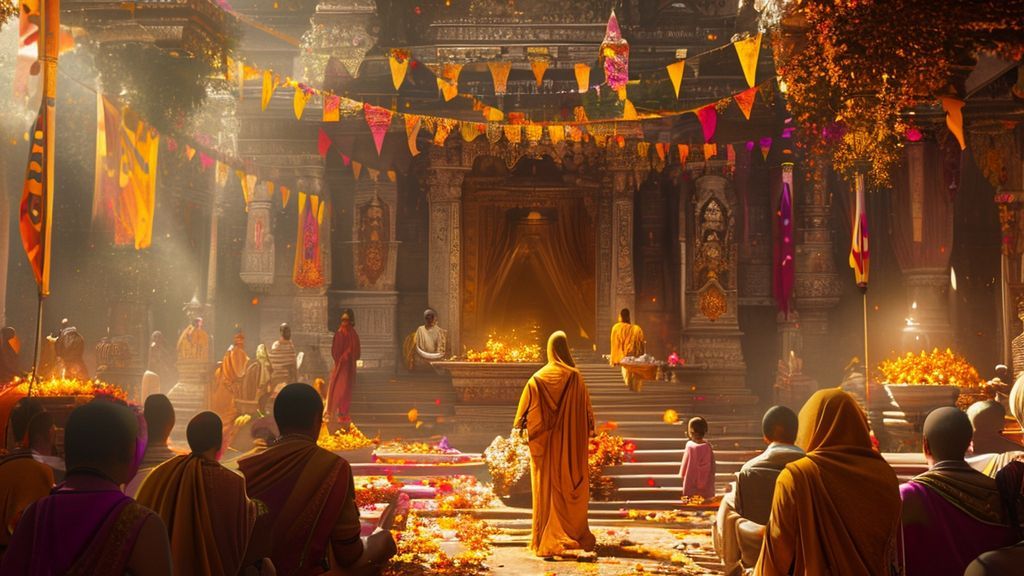
The Haldi Ceremony, also known as Pithi or Ubtan, is a sacred pre-wedding ritual in Sanatan Dharma where a paste of turmeric (Haridra) is applied to the bride and groom. This ancient practice purifies the body and soul, bestows blessings for a blissful marital life, wards off negativity, and enhances natural radiance, symbolizing auspicious beginnings and prosperity.
| Attribute | Details |
|---|---|
| Ritual Component | Application of Haldi (turmeric) paste |
| Primary Deity Associated | Devi Lakshmi (for prosperity), Surya Deva (for radiance), Ganesha (for obstacle removal) |
| Key Ingredient | Turmeric (Haridra), often mixed with besan (gram flour), oil, and rosewater. |
| Scriptural Basis | Mentioned in Atharvaveda for medicinal properties; principles of purification in Grihya Sutras. |
| Symbolic Significance | Purification, blessings, beauty, auspiciousness, protection from evil eye, prosperity. |
The Sanctity of Haldi: A Pre-Wedding Anointing for Purity and Prosperity
In the vibrant tapestry of Hindu wedding traditions, the Haldi Ceremony shines as a luminous beacon of spiritual preparation and cultural heritage. More than just a festive event, it is a profound ritual deeply embedded in Sanatan Dharma’s principles of purification (Shuddhi), auspiciousness (Mangalya), and divine blessings. This cherished pre-wedding rite involves the anointing of the bride and groom with a sacred paste primarily composed of turmeric, known as Haridra in Sanskrit. It symbolizes the cleansing of the body and spirit, preparing the individuals for the sacred union of matrimony, ensuring they embark upon their new journey with radiant skin, a pure heart, and the abundant grace of the Divine. Its significance transcends mere aesthetics, reaching into the spiritual realm to invoke protection and prosperity for the impending sacred bond.
The Puranic Roots and Ancient Lore of Haridra
The reverence for Haridra (turmeric) is not a modern innovation but a wisdom inherited from the profound depths of Vedic and Puranic scriptures. While the “Haldi Ceremony” as a specific named pre-wedding ritual evolved culturally, its foundational elements—the use of turmeric for purification, healing, and auspiciousness—are ancient and well-documented. The Atharvaveda, particularly in sections like AV 5.28.5 and 6.68.1-3, extols the medicinal and protective virtues of Haridra, referring to it as a powerful herb capable of dispelling disease and evil influences (Rakshoghna). It is revered as a potent antiseptic and a substance that confers vitality and radiant energy, connecting to the solar principle (Surya Deva).
In the Puranas, turmeric often finds mention in contexts of prosperity and divine blessings. The yellow hue of turmeric is intrinsically linked to Devi Lakshmi, the Goddess of Wealth and Prosperity, symbolizing gold and abundant fortune. Anointing oneself with turmeric is thus an invocation of her blessings for a prosperous conjugal life. Furthermore, Haridra Ganesha, an idol of Lord Ganesha crafted from turmeric paste, is worshipped in many rituals to remove obstacles (Vighnaharta) and ensure smooth, successful undertakings. This practice underscores turmeric’s role in sanctifying beginnings. The Grihya Sutras, which detail household rituals, prescribe the use of purifying substances, including various herbs and pastes, before significant life events (Sanskara) to ensure purity and auspiciousness, a principle upon which the Haldi ceremony firmly rests. Therefore, the ceremony isn’t just about a turmeric paste; it’s a living embodiment of Vedic ideals of purity and prosperity, passed down through generations.
The Vedic Science and Spiritual Efficacy of Haldi
The Haldi ceremony, though appearing simple, is a profound application of Ayurvedic principles and spiritual science. Haridra, or Curcuma longa, is a powerhouse of beneficial compounds, most notably curcumin. From an Ayurvedic perspective, turmeric is renowned for its ushna virya (heating potency) and its ability to balance Kapha and Pitta doshas, making it ideal for detoxifying and purifying the body. Its application to the skin before the wedding is not merely for cosmetic glow; it is a ritualistic detoxification. Turmeric is a potent natural antiseptic, anti-inflammatory, and antioxidant. Applied topically, it cleanses the skin, promotes healthy circulation, and imparts a natural radiance, preparing the bride and groom for their wedding day with a vibrant, healthy glow. This physical purification is paralleled by a spiritual one, as the act of anointing is believed to cleanse the aura, removing any lingering negativity or obstacles (drishti) that might impede the sacred union.
Beyond the physical, the spiritual science dictates that the collective good wishes and positive intentions of family and friends during the application infuse the turmeric paste with auspicious energy. The yellow color, as stated earlier, is associated with the planet Jupiter (Guru), symbolizing knowledge, wisdom, and good fortune, and is also linked to the Manipura Chakra, representing vitality and self-esteem. Thus, the ritual aligns the couple’s physical and subtle bodies with cosmic energies, ensuring their readiness for the spiritual and social responsibilities of married life. This integration of natural science and spiritual intention is a hallmark of Sanatan Dharma’s holistic approach to life events, truly enriching our understanding, as detailed further on Hindutva.online.
Rituals and Puja Vidhi for the Haldi Ceremony
The Haldi ceremony is typically performed separately at the homes of the bride and groom, usually a day or two before the wedding. While regional variations exist, the core ritual remains consistent, imbued with devotion and collective blessings.
- Preparation of the Haldi Paste: The primary ingredient is fresh turmeric powder or ground turmeric root. It is traditionally mixed with other auspicious ingredients like gram flour (besan), sandalwood powder (chandana), oil (mustard or coconut), and rosewater or milk. The mixing is often done by married women (Suhagan) to invoke blessings of a harmonious married life.
- Sacred Space: A designated clean area is chosen, often decorated with flowers and auspicious symbols (rangoli). The bride/groom sits on a low stool (Chowki) or cushion, facing East or North.
- Ganesha Invocation: Before the application begins, a small prayer to Lord Ganesha is offered to remove obstacles and ensure the ceremony proceeds smoothly. A small lamp (Diya) is lit.
- Application by Family: Family members, starting with elders, apply the Haldi paste to various parts of the bride’s/groom’s body. Traditionally, it is applied to the face, neck, arms, and legs. Each application is accompanied by silent prayers and blessings for the individual’s future happiness and prosperity.
- Significance of Direction: The paste is usually applied upwards on the body, symbolizing growth, ascent, and an upward trajectory in life.
- Auspicious Bath: After the application, the bride/groom takes a ritualistic bath to wash off the paste. The water used for this bath is often considered imbued with the blessings of the Haldi and is sometimes collected and offered to plants, symbolizing growth and fertility.
- Sharing the Auspiciousness: Often, a portion of the Haldi paste from one’s ceremony is sent to the other partner’s home, signifying the merging of their auspicious energies even before the wedding.
Mantras and Chants for Divine Anointing
While specific lengthy mantras are not always chanted during the application, the ceremony is steeped in devotional intent. Family members often chant simple prayers or sing traditional folk songs (Geet) related to weddings and blessings. Devotees may internally recite Mantras invoking purification, prosperity, and blessings:
- General Invocation of Auspiciousness:
ॐ स्वस्ति न इन्द्रो वृद्धश्रवाः स्वस्ति नः पूषा विश्ववेदाः।
स्वस्ति नस्तार्क्ष्यो अरिष्टनेमिः स्वस्ति नो बृहस्पतिर्दधातु॥
Om Svasti Na Indro Vṛddhaśravāḥ | Svasti Naḥ Pūṣā Viśvavedāḥ |
Svasti Nas Tārkṣyo Ariṣṭanemiḥ | Svasti No Bṛhaspatir Dadhātu ||
(May Indra, of great fame, grant us well-being; May Pūṣan, the all-knower, grant us well-being; May Tārkṣya, of unhindered speed, grant us well-being; May Brihaspati grant us well-being.) This Vedic Shanti Mantra invokes general welfare and blessings. - For Purification and Radiance (connecting to Surya Deva):
ॐ घृणिः सूर्य आदित्यः॥
Om Ghṛṇiḥ Sūrya Ādityaḥ ||
(Salutations to the brilliant Sun, the giver of light and life.) - For Prosperity and Purity (associating with Lakshmi and turmeric):
ॐ ह्रीं श्रीं लक्ष्मीभ्यो नमः॥
Om Hrīm Śrīm Lakṣmībhyo Namaḥ ||
(Salutations to Devi Lakshmi, the source of wealth and auspiciousness.)
The very act of applying turmeric is itself a non-verbal mantra, a devotional act of offering the self to divine blessings.
Dos and Don’ts for the Haldi Ceremony
To uphold the sanctity and ensure the smooth conduct of this sacred ritual, certain etiquette and traditions are followed:
- Do Offer Prayers: Always begin with a small prayer to Lord Ganesha for obstacle removal and to the chosen family deity for blessings.
- Do Use Fresh Ingredients: Ensure the turmeric and other components of the paste are fresh and pure, reflecting the purity of the intention.
- Do Include Married Women: Traditionally, married women (Suhagans) prepare and apply the paste, as their blessings are considered potent for a happy married life.
- Do Wear Auspicious Colors: Guests and family members often wear yellow or other bright, auspicious colors to reflect the joy and positivity of the occasion.
- Do Not Waste: Respect the sanctity of the Haldi paste; avoid wasteful or disrespectful handling.
- Do Not Apply to Unmarried Individuals (Strictly for Ceremony Participants): While applying Haldi for general skincare is fine, the ritualistic Haldi from the wedding ceremony is specifically for the bride and groom. Some traditions extend it to unmarried siblings for fun, but the primary focus remains the couple.
- Do Not Allow Negativity: Maintain a positive and joyous atmosphere, refraining from arguments or ill-wishes, as the ceremony is about inviting blessings.
- Do Not Interrupt the Ritual: Once the application has begun, try to avoid unnecessary interruptions, allowing the spiritual flow to remain unbroken.
What is the spiritual significance of turmeric in Hindu rituals?
Turmeric, or Haridra, holds immense spiritual significance in Hinduism, symbolizing purification, prosperity, and protection. It is believed to cleanse the body and mind, ward off evil spirits (Drishti Nivaran), and invite the blessings of deities like Lakshmi (for wealth) and Ganesha (for obstacle removal). Its vibrant yellow color is intrinsically linked to the sun, representing life, energy, and auspiciousness, making it indispensable in all Mangala Karya (auspicious functions).
Can the Haldi ceremony be performed on both the bride and groom simultaneously?
While typically performed separately at their respective homes, some modern interpretations or regional customs might see a combined Haldi ceremony if logistics allow, especially for destination weddings. However, the traditional practice emphasizes separate ceremonies to prepare each individual within their familial context before their union, fostering intimacy within their immediate circles. The concept of ‘sharing’ the same Haldi paste is, however, a symbolic gesture of unity.
Are there regional variations in the Haldi ceremony?
Yes, the Haldi ceremony exhibits beautiful regional variations across India. For instance, in some parts of North India, it’s called Ubtan and might include mustard oil for added glow. In Maharashtra, it’s known as Halad Chadavane, where the paste is thicker. Bengali weddings feature ‘Gae Holud’, often followed by traditional Bengali songs. Each region adds its unique cultural flavor through specific ingredients, songs, and additional minor rituals, all while retaining the core essence of turmeric application for blessings.
Preserving Sanatan Dharma: Why This Matters for Every Hindu
The Haldi Ceremony is far more than a colorful precursor to a wedding; it is a profound embodiment of Sanatan Dharma’s timeless wisdom. It reminds us that every significant life transition, particularly marriage, demands spiritual and physical preparation. By adhering to such rituals, we actively participate in a living tradition that connects us to our ancestors, scriptures, and the eternal principles of cosmic order. It teaches us the sacredness of even the simplest ingredients like turmeric, revealing the deep science and spiritual meaning woven into our daily lives and major life events. Participating in and understanding such ceremonies strengthens our faith, reinforces cultural identity, and ensures the vibrant transmission of our Dharmic heritage to future generations. Embrace this sacred tradition, and explore its deeper meanings on Hindutva.online, for in these practices lies the very heart of our eternal Dharma.