

What Is Satsang Sanskrit term satsang stands as one of Hinduism’s most profound yet often misunderstood concepts, representing far more than mere social gathering or religious meeting. Derived from sat (truth, reality, or goodness) and sanga (association or company), satsang literally translates as “association with truth” or “the company of the wise,” pointing toward a sacred practice that has sustained spiritual seekers across millennia. In an era of unprecedented technological connection yet profound human isolation, the ancient wisdom embedded in satsang tradition offers contemporary society a powerful antidote to the loneliness epidemic and spiritual fragmentation characterizing modern life.

Historical evidence demonstrates that spiritual progress accelerates exponentially within supportive community contexts, validating the traditional teaching that sincere seekers require not only personal discipline but collective energy and mutual support to overcome the powerful gravitational pull of worldly consciousness. As 2025’s spiritual landscape evolves through digital connectivity and globalized access to diverse traditions, understanding satsang’s authentic meaning, traditional forms, and transformative power becomes increasingly essential for anyone serious about spiritual development. Whether you’re exploring Hindu spirituality as a beginner or deepening established practice, recognizing satsang’s role provides crucial insight into how genuine transformation unfolds through the synergistic combination of individual effort and collective spiritual resonance.
The Essence and Meaning of Satsang
Understanding what satsang truly represents requires moving beyond superficial definitions to grasp its multilayered significance within Hindu spiritual philosophy. At the most literal level, satsang denotes physical gathering with spiritually evolved beings – saints, sages, realized masters, and sincere seekers – whose presence embodies and radiates truth consciousness. The traditional understanding emphasizes that proximity to enlightened beings creates a field of elevated consciousness that naturally uplifts those within its influence, much as approaching a fire inevitably warms anyone nearby regardless of their intention or awareness.
However, satsang’s meaning extends beyond physical association to encompass relationship with truth itself in all its manifestations. Sacred texts constitute satsang through their preservation of realized wisdom. Solitary meditation on ultimate reality represents internal satsang where consciousness associates with its own true nature. Even contemplation of virtuous qualities or righteous actions qualifies as satsang by directing attention toward sattvic (pure, luminous) aspects of existence rather than rajasic (passionate, agitated) or tamasic (dull, ignorant) dimensions. This broader interpretation reveals satsang as fundamentally about alignment with truth rather than merely social gathering.
The philosophical depth underlying satsang connects with classical Hindu metaphysics that recognizes three fundamental qualities (gunas) pervading all manifest existence: sattva (purity, knowledge, harmony), rajas (activity, passion, restlessness), and tamas (inertia, ignorance, darkness). Satsang specifically cultivates sattva while diminishing rajas and tamas, gradually transforming consciousness from its ordinary state dominated by sensory distraction and egoic identification toward its natural condition of peaceful awareness and self-knowledge. This transformative process occurs not through intellectual understanding alone but through sustained immersion in environments, relationships, and activities that embody sattvic qualities.
Traditional teachings emphasize satsang as among the most powerful spiritual practices available to seekers, a principle deeply connected to the guru-shishya parampara tradition. The Bhagavad Gita repeatedly references good company as essential for maintaining spiritual focus amidst worldly pressures. The Ramayana describes Vibhishana’s spiritual elevation through association with Rama despite being born into a demon family, illustrating how satsang’s influence transcends even karmic predispositions. Numerous Upanishadic passages prescribe approaching realized teachers (sad-guru) as the indispensable means for transcendental knowledge acquisition. This consistent scriptural emphasis across diverse texts and traditions validates satsang’s central importance within the Hindu spiritual framework.
The concept acknowledges a profound psychological and spiritual principle: human consciousness profoundly reflects its habitual associations and environments. Just as physical health depends substantially on food consumed, spiritual health depends primarily on consciousness content regularly absorbed through associations, entertainment, conversation, and attention focus. Satsang provides systematic methodology for curating these inputs toward spiritual rather than materialistic ends, creating the conditions within which higher consciousness naturally emerges.
Traditional Forms and Components of Satsang
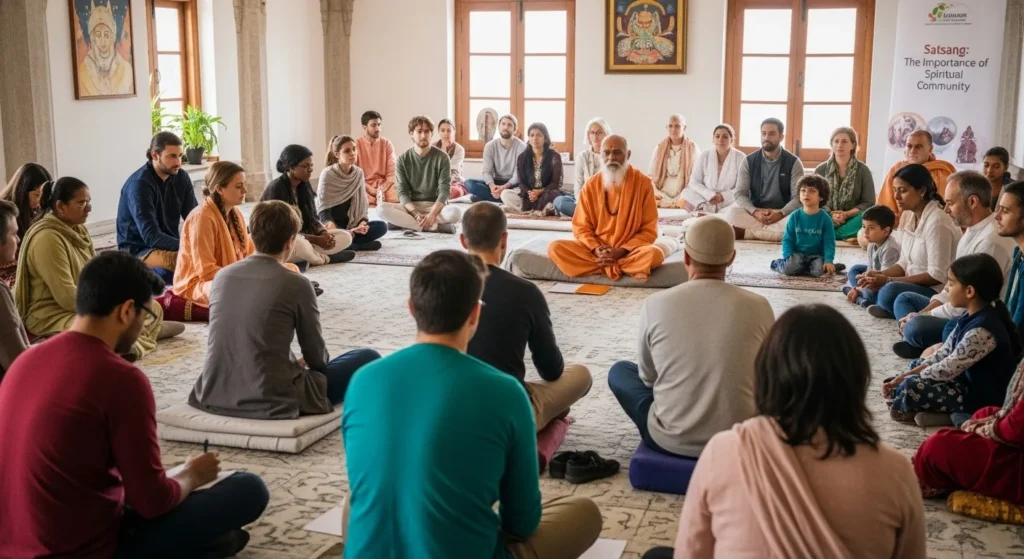
Satsang manifests through diverse traditional forms, each emphasizing different aspects while sharing the common purpose of facilitating truth association. Understanding these various expressions helps practitioners identify authentic satsang opportunities and create meaningful spiritual gatherings within their own communities. The most classical form involves physical presence with a realized spiritual master (sat-guru) who transmits not merely intellectual teachings but subtle spiritual energy through their enlightened consciousness. These gatherings traditionally occurred in ashrams, forest hermitages, or temple complexes where seekers resided in extended proximity to accomplished teachers.
The typical structure of formal satsang includes several complementary components designed to engage participants’ complete being – intellectual, emotional, devotional, and meditative dimensions. Most gatherings begin with devotional singing (kirtan or bhajan), using music and collective vocalization to create harmonious group energy while shifting consciousness from mundane concerns toward spiritual focus. The melodious repetition of divine names and sacred mantras naturally induces meditative states while fostering emotional devotion and communal bonding. Many practitioners report that group singing produces spiritual experiences difficult to access through solitary practice, validating the traditional emphasis on collective devotional expression.
| Satsang Component | Purpose | Typical Duration |
|---|---|---|
| Opening Prayers | Invocation, creating sacred space | 5-10 minutes |
| Kirtan/Bhajan | Devotional singing, emotional opening | 15-30 minutes |
| Meditation | Collective silence, inner deepening | 10-30 minutes |
| Discourse/Teaching | Wisdom transmission, intellectual understanding | 30-60 minutes |
| Q&A Session | Clarifying doubts, personalized guidance | 15-30 minutes |
| Arati/Closing Ritual | Honoring the divine, concluding ceremony | 5-10 minutes |
Following devotional singing, many satsangs incorporate guided or silent meditation, allowing participants to internalize the elevated state cultivated through music while experiencing the power of collective meditative energy. Practitioners consistently report that meditation within groups proves easier and deeper than solitary practice, as the focused attention of multiple consciousnesses creates a stabilizing field that supports individual efforts. This phenomenon validates the yogic understanding that consciousness operates not merely within isolated individuals but as a field phenomenon capable of collective resonance and mutual reinforcement.
The core of most satsangs involves spiritual discourse (pravachan) by a teacher, guru, or realized practitioner who shares wisdom from scriptures, personal realization, or practical spiritual guidance. Unlike academic lectures, authentic spiritual discourse aims not at intellectual information transfer but consciousness transformation – the teacher’s words serving as vehicles for subtle energy transmission that awakens dormant spiritual capacities within receptive listeners. Traditional teachings emphasize that receiving knowledge in the teacher’s physical presence produces effects impossible through merely reading their written words or recorded talks, though these secondary forms retain value when direct access proves impossible.
Question-and-answer sessions provide opportunities for participants to seek clarification on teachings, request guidance for personal spiritual challenges, or explore philosophical concepts in dialogue with the teacher. This interactive dimension distinguishes satsang from passive lecture attendance, creating dynamic exchange where the teacher responds to specific needs and questions arising within the gathered community. The dialogic format reflects the traditional guru-disciple relationship while extending its benefits to broader groups rather than limiting guidance to formally initiated disciples.
Satsangs typically conclude with ceremonial offerings (arati) where participants collectively honor the divine through waving lights, offering flowers, and singing concluding prayers. Many gatherings conclude with distribution of blessed food (prasada) and informal social interaction, recognizing that community bonding and mutual support among practitioners constitute important dimensions of comprehensive spiritual life. These social elements should not be dismissed as mere additions to “real” spiritual practice but understood as integral to satsang’s community-building function that sustains long-term spiritual commitment.
The Transformative Power of Spiritual Community
The profound benefits produced through regular satsang participation extend far beyond the immediate peace or inspiration felt during gatherings, creating cumulative transformative effects that fundamentally reshape consciousness, character, and life direction. Contemporary research in psychology and neuroscience increasingly validates traditional claims about community’s essential role in human flourishing, with studies demonstrating that social connection and supportive relationships constitute primary determinants of mental health, emotional resilience, and even physical wellbeing. Satsang specifically focuses these universal community benefits toward spiritual development, harnessing collective energy for consciousness evolution rather than merely social enjoyment.
The primary benefit involves maintaining spiritual motivation and discipline amidst worldly pressures that constantly pull attention toward material concerns and sensory gratifications. The power of regular association with fellow seekers and realized teachers provides consistent reminders of higher purposes and ultimate values that otherwise become obscured by daily demands and cultural conditioning emphasizing material success over spiritual realization. Just as establishing a consistent spiritual practice requires ongoing commitment rather than occasional intense efforts, spiritual development demands sustained practice that satsang supports by creating external accountability and collective encouragement.
What Is Satsang Importance
Satsang functions as what Maharaj Charan Singh termed “a fence around the crop” – protection for the fragile spiritual progress cultivated through personal practice. The meditation, study, and ethical discipline performed in solitude face constant threats from doubt, distraction, and the mind’s habitual return to familiar patterns. Regular satsang participation reinforces these individual efforts by surrounding them with supportive energy, validated teachings, and living examples of others successfully walking the path. This protective function proves especially crucial during inevitable periods when personal practice feels dry, progress imperceptible, or commitment wavering under life’s challenges.
The elevation of consciousness occurring within authentic satsang environments creates temporary but powerful experiences of peace, clarity, love, and devotional feeling that provide direct experiential validation of spiritual teachings. While intellectual understanding proves necessary, genuine transformation requires experience that moves beyond mental concepts to direct perception. Many practitioners report breakthrough experiences during satsang – moments of profound peace, spontaneous tears of devotion, sudden insight into previously confusing teachings, or tangible sense of divine presence – that would never occur through solitary practice alone. These grace-filled moments sustain commitment across months and years when practice yields no dramatic experiences.
Satsang naturally cultivates virtuous qualities and diminishes negative tendencies through association with elevated consciousness and ethical individuals. The psychological principle that humans unconsciously adopt characteristics of their frequent associates applies powerfully in spiritual contexts – regular satsang participation gradually shapes practitioners toward greater compassion, patience, humility, generosity, and truthfulness simply through osmotic absorption of these qualities from the environment and fellow practitioners. Conversely, negative tendencies like anger, greed, jealousy, and pride find less reinforcement and gradually weaken when starved of the worldly validation they receive in ordinary social contexts.
The question-and-answer format and informal interactions within satsang provide opportunities for personalized guidance addressing specific obstacles, doubts, or confusions that arise on the spiritual path. While scriptures offer general principles, individual circumstances require specific applications that teachers and experienced practitioners can provide through direct dialogue. This guidance function distinguishes authentic satsang from entertainment or mere social gathering, ensuring participants receive not only inspiration but practical direction for navigating their unique spiritual journeys.
Finding and Participating in Authentic Satsang
For contemporary seekers in 2025, identifying and accessing authentic satsang requires discernment amidst proliferating options ranging from traditional ashram programs to informal study groups to virtual online gatherings. The democratization of spiritual teachings through digital technology creates unprecedented opportunities while simultaneously presenting challenges of distinguishing genuine teachers from self-appointed gurus and substantive gatherings from superficial imitations. Applying traditional criteria for evaluating spiritual teachers and communities proves essential for ensuring satsang participation genuinely serves spiritual development rather than ego gratification or commercial exploitation.
Authentic satsang centers on realized or genuinely progressing practitioners rather than commercial entertainment or personality cults. The focus remains on truth, teachings, and transformation rather than the teacher’s charisma, followers’ numbers, or organizational prestige. Warning signs of inauthentic satsang include emphasis on miraculous claims over ethical living, financial exploitation demanding excessive donations, authoritarian control restricting members’ independence, or behavioral inconsistencies where teachers fail to embody the values they espouse. Genuine spiritual communities welcome sincere questions, encourage critical thinking within devotional frameworks, and maintain transparency in organizational operations – principles also essential when choosing a spiritual guru.
Traditional Hindu temples, established spiritual organizations, and recognized ashrams offer reliable access to authentic satsang grounded in legitimate lineages and time-tested teachings. Organizations like the Ramakrishna Mission, various Shankaracharya institutions, ISKCON centers, Chinmaya Mission, and numerous other established entities conduct regular satsangs rooted in authentic traditions while adapting to contemporary contexts. These institutional frameworks provide quality control ensuring teachers possess proper training and authorization while offering systematic spiritual education rather than merely charismatic performances.
For those unable to access physical satsangs due to geographical isolation or life circumstances, contemporary technology enables participation in virtual gatherings that preserve essential elements while adapting to digital mediums. Numerous teachers and organizations now livestream satsangs, host video conference gatherings, or maintain online communities where practitioners connect across geographical distances. While these virtual formats lack the subtle energy transmission possible through physical presence with realized teachers, they nonetheless provide valuable access to authentic teachings, collective practice, and supportive community when alternatives remain unavailable.
Creating or joining local study groups and practice circles offers another accessible option, particularly in areas lacking established spiritual centers. Small groups of sincere seekers who meet regularly for scriptural study, meditation, devotional singing, and spiritual discussion generate authentic satsang energy without requiring recognized teachers or formal structures. The key involves maintaining focus on spiritual development rather than mere socializing, establishing regular schedules ensuring consistent participation, and incorporating traditional elements like devotional singing, meditation, and scriptural study rather than limiting gatherings to intellectual discussion.
Several practical considerations enhance satsang participation’s benefits:
- Arrive early and settle into a receptive, quiet state before formal activities begin
- Minimize distractions by silencing devices and mentally releasing worldly concerns
- Participate actively in singing, meditation, and discussions rather than passive attendance
- Approach teachings with open receptivity balanced by intelligent discrimination
- Maintain regular attendance establishing continuity and deepening community bonds
- Volunteer for service opportunities supporting the satsang’s practical operations
- Apply teachings in daily life rather than limiting spirituality to gathering attendance
The frequency and regularity of satsang participation matters more than duration or intensity of individual sessions. Weekly attendance at modest-length gatherings proves far more beneficial than occasional attendance at intensive programs, as the consistent rhythm creates cumulative effects impossible through sporadic engagement. Traditional recommendations suggest treating satsang attendance as non-negotiable commitment rather than optional activity dependent on convenience or mood – this reliability itself constitutes spiritual discipline that strengthens commitment and generates momentum.
Satsang in Modern Context and Digital Age
The fundamental principles underlying satsang remain timeless, yet their application necessarily adapts to contemporary circumstances characterized by technological connectivity, globalized spiritual access, time pressures from demanding professional and family obligations, and cultural shifts affecting how community forms and functions. Understanding how satsang manifests authentically within 2025’s unique conditions enables practitioners to access its benefits while navigating modern challenges without compromising essential elements that make the practice transformative.
The most significant contemporary development involves digital technology’s expansion of satsang access beyond traditional geographical and institutional limitations. Online platforms enable seekers worldwide to receive teachings from realized masters, participate in live virtual gatherings, and connect with fellow practitioners regardless of physical location. Teachers who historically reached only those able to visit their ashrams now transmit wisdom globally through livestreamed satsangs, recorded discourses, and virtual question-answer sessions. This democratization benefits isolated seekers, those with mobility limitations, and anyone lacking access to quality spiritual communities in their local areas.
However, virtual satsang’s advantages carry corresponding limitations requiring honest acknowledgment. The subtle energy transmission occurring through physical proximity to realized beings cannot be fully replicated through screens and speakers. The collective energy generated when practitioners meditate together in shared physical space possesses qualities impossible to completely recreate through simultaneous but geographically dispersed practice. The informal interactions and relationship building that strengthen community bonds occur more naturally in physical gatherings than through digital interfaces. These limitations don’t invalidate virtual satsang but suggest viewing it as valuable supplement or temporary substitute rather than complete replacement for physical participation when both options remain available.
Contemporary life’s time pressures require creative adaptations in satsang format and duration while preserving core elements. Many urban spiritual centers now offer shorter weekday satsangs (30-60 minutes) accommodating professional schedules, supplemented by longer weekend programs for those able to dedicate more time. Early morning and evening options provide flexibility for varying work schedules and family obligations. Recorded satsangs enable time-shifted participation when live attendance proves impossible, though the energetic benefits diminish compared to live participation whether physical or virtual.
The proliferation of spiritual teachers, traditions, and gathering formats in contemporary pluralistic contexts raises questions about navigating diversity while maintaining focus and depth. The temptation exists to sample perpetually from various teachers and traditions without committing deeply to any single path – an approach that provides broad intellectual exposure but rarely produces genuine transformation requiring sustained practice within consistent frameworks. Traditional wisdom emphasizes selecting one primary teacher and tradition while remaining respectfully open to universal truths expressed across diverse lineages. This focused commitment doesn’t demand narrow fundamentalism but recognizes that spiritual depth emerges through sustained practice within proven methodologies rather than constant exploration of novelties.
Contemporary satsang increasingly incorporates modern therapeutic understanding, social justice awareness, and scientific validation alongside traditional spiritual teachings. Progressive spiritual communities address mental health, trauma healing, and psychological wellbeing explicitly rather than assuming purely spiritual practices suffice for all human challenges. Discussion of ethical issues like environmental responsibility, social inequality, and political engagement reflects recognition that spirituality divorced from worldly concerns risks escapism rather than genuine transformation. Integration of scientific research validating meditation benefits, consciousness studies, and contemplative neuroscience provides contemporary validation for traditional claims, making teachings more accessible to empirically-minded modern seekers.
The ongoing evolution of satsang formats and contexts continues the tradition’s historical adaptability while maintaining commitment to core purposes – facilitating truth association, supporting spiritual development, and building communities dedicated to consciousness evolution. Whether occurring in traditional ashrams, modern yoga studios, living rooms, or virtual spaces, authentic satsang remains recognizable through its sincere focus on spiritual truth over entertainment, genuine teacher wisdom over charismatic performance, participant transformation over numerical growth, and sustainable community building over temporary enthusiasm.
Frequently Asked Questions
What is the literal meaning of satsang?
Satsang literally translates from Sanskrit as “association with truth” or “company of the good.” The term combines sat (truth, reality, goodness, or existence) with sanga (association, company, or gathering). This etymological meaning points toward satsang’s dual aspects – both gathering with spiritually evolved beings who embody truth and cultivating internal relationship with one’s own true nature beyond ego-identification. The term encompasses physical gatherings, solitary meditation on reality, scriptural study, and any activity aligning consciousness with truth rather than illusion.
How is satsang different from regular religious services?
While both involve spiritual gatherings, satsang emphasizes direct experiential transmission and consciousness transformation rather than purely ritual performance or doctrinal instruction. Satsang focuses on the living presence of realized teachers or collective spiritual energy rather than institutional authority. The interactive format encouraging questions and dialogue distinguishes it from services following fixed liturgies. Satsang participants seek personal spiritual development and self-realization, whereas religious service attendees may focus on ritual fulfillment, community obligation, or devotional expression without necessarily pursuing intensive spiritual practice or transformation.
Can I benefit from satsang if I’m a beginner to Hindu spirituality?
Absolutely – satsang proves especially valuable for beginners who benefit greatly from experienced practitioners’ guidance, community support, and exposure to authentic teachings and practices. Many satsangs specifically welcome newcomers and offer introductory explanations alongside advanced teachings. The collective energy and devotional atmosphere naturally uplift beginners regardless of their understanding level. Starting satsang participation early establishes beneficial patterns and community connections supporting long-term spiritual development. Begin by simply attending with open receptivity, asking questions when confused, and participating in practices like singing and meditation without concern about expertise.
How often should I attend satsang?
Traditional recommendations emphasize regular weekly attendance as ideal for maintaining spiritual momentum and community connection. However, frequency depends on availability, life circumstances, and satsang accessibility in your area. Weekly attendance proves manageable for most people while providing sufficient regularity to generate cumulative benefits. More frequent participation accelerates progress if sustainable without creating stress or neglecting other legitimate responsibilities. Consistency matters more than frequency – reliable monthly attendance surpasses sporadic weekly attendance. Begin with whatever schedule you can maintain reliably, potentially increasing frequency as spiritual commitment deepens.
What should I expect during my first satsang?
Expect a welcoming environment with singing, meditation, spiritual discourse, and possibly question-answer sessions. Arrive slightly early to settle in and observe protocols. Most satsangs involve sitting on the floor (bring cushion if needed) or chairs if provided. Remove shoes before entering as customary in Hindu settings. Silence mobile devices and minimize distractions. Don’t worry about understanding everything or feeling pressure to participate beyond your comfort level. Simply remain present and receptive. Many satsangs conclude with prasada (blessed food) and social interaction providing opportunities to meet community members and ask practical questions about participation.
Can satsang be conducted without a guru or teacher?
Yes, though traditionally ideal satsang involves realized teachers, gatherings of sincere practitioners studying scriptures, meditating together, and discussing spiritual topics constitute valuable satsang. Peer-led study groups focusing on texts like the Bhagavad Gita, Upanishads, or teachings from recognized masters generate authentic satsang energy. The collective intention toward truth and mutual support among genuine seekers creates beneficial effects even without physically present enlightened teachers. However, maintain connection with authentic lineages through studying recorded teachings and potentially attending occasional satsangs with recognized teachers to ensure understanding remains aligned with tradition.
Are online/virtual satsangs as effective as in-person gatherings?
Virtual satsangs provide genuine benefits including access to quality teachings, collective practice, and community connection, though they cannot fully replicate subtle energy transmission occurring through physical proximity to realized beings and collective field generated by practitioners meditating in shared space. View virtual satsang as valuable when in-person attendance proves impossible due to geography, health, family obligations, or other limitations. Many practitioners successfully combine occasional in-person satsangs with regular virtual participation. The key involves engaging fully rather than treating virtual satsang as inferior alternative – bring same presence, devotion, and receptivity you would to physical gatherings.
How do I find authentic satsang in my area?
Research established Hindu temples, yoga centers, meditation groups, and spiritual organizations in your region. Organizations like Chinmaya Mission, Ramakrishna Mission, ISKCON, and various ashram affiliates typically conduct regular satsangs. Online directories and social media groups for local spiritual communities provide information about gatherings. Attend several different options evaluating whether teachings align with authentic tradition, whether atmosphere feels genuinely spiritual rather than commercial, and whether teacher demonstrates ethical conduct and spiritual maturity. Ask experienced practitioners for recommendations. Begin with established institutions offering quality assurance through recognized lineages and organizational accountability before exploring independent teachers or informal groups.
Conclusion
The ancient practice of satsang stands as one of Hindu spirituality’s most accessible yet profoundly transformative elements, offering contemporary seekers a time-tested methodology for accelerating spiritual development through collective energy, authentic guidance, and supportive community. In an era characterized by unprecedented technological connectivity yet widespread loneliness, superficial relationships, and fragmented spiritual seeking, satsang’s emphasis on genuine association with truth and truth-seekers provides powerful antidote to modern isolation while directing spiritual aspiration toward authentic rather than commercial or ego-serving ends. The consistent testimony across centuries from realized masters and sincere practitioners validates traditional claims that spiritual progress achieved through satsang participation far exceeds what individual effort alone typically produces.
Understanding satsang’s authentic meaning extends beyond mere definition to recognizing its multilayered significance – physical gathering with evolved beings, contemplation of sacred teachings, internal alignment with truth consciousness, and cultivation of sattvic qualities that naturally elevate awareness toward its ultimate potential. The diverse forms satsang manifests – traditional ashram programs, temple gatherings, study groups, devotional singing, virtual meetings – all serve the common purpose of facilitating consciousness transformation through immersion in environments, relationships, and activities embodying spiritual truth rather than material illusion. Contemporary adaptations utilizing digital technology and modern formats necessarily modify traditional structures while preserving essential principles ensuring satsang retains transformative power rather than degenerating into entertainment or social club.
The journey toward self-realization, while ultimately solitary in its deepest dimensions, paradoxically requires community support, collective energy, and guidance from those who have traveled further along the path. Satsang provides this essential support structure, creating sacred containers within which individual spiritual efforts receive protection, reinforcement, and inspiration sustaining commitment across inevitable challenges and dry periods. As you integrate satsang into your spiritual practice, approach it not as optional supplement but as foundational element equal in importance to meditation, study, and ethical living – recognizing that genuine transformation emerges through synergistic combination of individual discipline and collective spiritual resonance that only authentic community provides.
About the Author
Rajiv Anand – Spiritual Practices Expert and Yoga Philosophy Scholar
Rajiv Anand is a dedicated practitioner and teacher of Hindu spiritual practices with over 15 years of experience in yoga, meditation, and Vedantic philosophy. Trained in traditional guru-shishya parampara, he specializes in making ancient spiritual wisdom accessible to modern practitioners. His writings explore the practical application of Bhakti, Jnana, and Karma Yoga paths, alongside in-depth analysis of the transformative power of spiritual community and satsang participation. Rajiv holds certifications in classical yoga and Ayurveda, and regularly facilitates satsangs and study groups focused on authentic spiritual development. His work emphasizes the integration of traditional Hindu spiritual disciplines with contemporary life challenges, guiding seekers toward holistic spiritual growth through both individual practice and collective wisdom.