

What Is the Katha Upanishad The Katha Upanishad stands among the most beloved and philosophically profound Upanishads, weaving together captivating narrative with deep metaphysical teachings in a manner that has inspired spiritual seekers across millennia. Unlike more abstract Upanishadic texts that present philosophical principles through direct instruction, the Katha Upanishad employs a dramatic story framework featuring a young boy named Nachiketa who courageously journeys to the realm of death itself, engages the Lord of Death (Yama) in philosophical dialogue, and ultimately receives the most profound knowledge concerning life’s ultimate questions – the nature of the Self, the mystery of death, and the path to liberation.

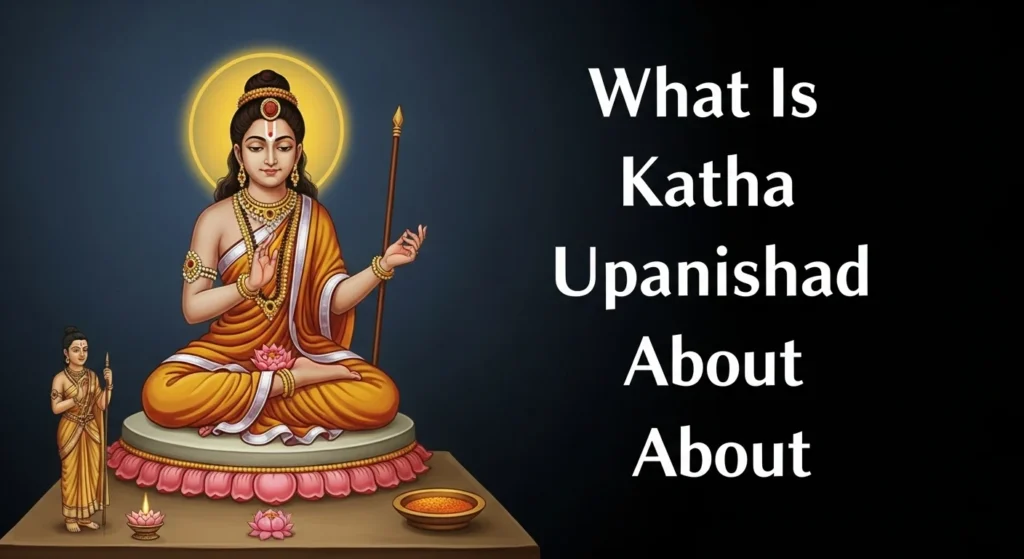
This masterful integration of storytelling and philosophy makes the Katha Upanishad accessible to beginners while containing depths that challenge advanced practitioners, explaining why it remains one of the most frequently studied and commented upon Upanishadic texts in both traditional and contemporary spiritual education.
The narrative’s universal themes – a young person’s fearless quest for truth despite discouragement from authority figures, willingness to renounce immediate gratification for ultimate knowledge, and the transformative dialogue between seeker and teacher – resonate powerfully with modern audiences in 2025 navigating similar tensions between material pursuits and spiritual yearning. Understanding what the Katha Upanishad teaches requires examining both its unforgettable story and the philosophical doctrines that story conveys, recognizing how narrative and teaching interweave to create one of Hindu scripture’s most compelling expressions of Vedantic wisdom.
The Story of Nachiketa and Yama
The Katha Upanishad opens with a compelling narrative that immediately engages readers through its dramatic tension and relatable characters. The story begins with a Brahmin named Vajashravas (also called Uddalaka in some versions) who decides to perform a religious sacrifice (yajna) called Vishwajit (all-conquering), where the performer gives away all his possessions to gain spiritual merit and heavenly rewards. However, Vajashravas demonstrates incomplete renunciation by giving away only old, infirm cattle past their productive years – technically fulfilling the sacrifice’s letter while violating its spirit of genuine selfless giving.
Nachiketa, Vajashravas’ young son, observes this ritual hypocrisy with a clear conscience untainted by the compromises adults often make. Recognizing that his father’s incomplete renunciation cannot produce the promised spiritual benefits, Nachiketa becomes troubled. Traditional interpretations suggest Nachiketa’s motivation combined genuine spiritual concern for his father with youthful idealism refusing to accept the gap between proclaimed values and actual practice. In some versions, Nachiketa innocently asks his father, “To whom will you give me?” – a question stemming from the logic that if everything must be given away, children too fall within that category.
After Nachiketa persists with this question three times (a pattern significant in Vedic tradition), the father, irritated by what he perceives as impertinent questioning of his religious performance, angrily responds, “I give you to Death!” (Mṛtyave tvā dadāmi). This hasty curse, once uttered, cannot be retracted according to traditional understanding – words spoken by a father during a sacred ritual carry irrevocable power. Rather than being frightened or begging forgiveness, Nachiketa calmly accepts this pronouncement and prepares to journey to Yama’s realm, demonstrating extraordinary courage and spiritual maturity.
Upon arriving at Yama’s abode, Nachiketa finds the Lord of Death absent. The guards refuse entry to any visitor without Yama’s explicit invitation, so Nachiketa waits patiently at the entrance for three days and three nights without food or water – a detail emphasizing his determination, discipline, and the serious intent behind his quest. This waiting period also serves literary function, building dramatic tension while demonstrating Nachiketa’s worthiness through the traditional test of patience and endurance.
When Yama finally returns and learns that a Brahmin boy has waited three days without hospitality (a serious breach of dharmic obligations even for Death’s household), he feels immediate concern and regret. To compensate for this negligence and honor the sacred duty of hospitality toward Brahmins, Yama offers Nachiketa three boons – one for each night spent waiting without proper reception. This sets the stage for the philosophical dialogue that constitutes the Upanishad’s teaching core.
For his first boon, Nachiketa demonstrates filial devotion by requesting that his father’s anger subside, that peace be restored between them, and that his father recognize and welcome him when he returns. Yama immediately grants this wish, praising Nachiketa’s priorities and assuring him that his father will be freed from anxiety and anger. This boon establishes Nachiketa’s character – despite his father’s hasty curse, the boy harbors no resentment but seeks reconciliation.
The second boon reveals Nachiketa’s spiritual aspirations. He asks Yama to teach him about the sacred fire (Agni) that leads to heaven, specifically requesting knowledge of how to build and maintain the sacrificial fire whose worship grants celestial rewards and freedom from fear and sorrow. Yama willingly explains this ritual knowledge in detail, describing the proper arrangement of bricks, the mantras to be chanted, and the metaphysical principles underlying this practice. So impressed is Yama with Nachiketa’s receptivity and understanding that he declares this sacred fire will henceforth bear Nachiketa’s name – Nāchiketāgni, the Nachiketa Fire.
Nachiketa’s Third Boon: The Ultimate Question
The narrative reaches its philosophical climax when Nachiketa requests his third and final boon – knowledge about what happens after death. He asks directly: “When a person dies, there arises this doubt – some say ‘he exists,’ others say ‘he does not exist.’ I wish to know the truth about this from you, O Yama. This is my third boon.” This question drives to the heart of human existential anxiety and spiritual inquiry across all cultures and eras. What is death? Does consciousness survive bodily demise? What is the ultimate nature of our being?
Yama’s initial response reveals the question’s profundity – he attempts to dissuade Nachiketa from pursuing this inquiry, admitting that even the gods (devas) remain uncertain about death’s mystery. Yama offers instead extraordinary temptations designed to divert Nachiketa from his chosen question:
- Long life spanning many generations for himself and his descendants
- Vast kingdoms with sovereign power
- Immense wealth including gold, gems, and cattle
- Beautiful maidens with golden chariots and musical instruments
- All sensory pleasures human beings desire
- Everything the material world offers except the one thing Nachiketa requested
Yama’s temptations serve dual literary functions. First, they demonstrate traditional pedagogical testing where the teacher challenges the student’s commitment to determine whether genuine spiritual hunger or mere curiosity motivates the inquiry. Second, they illustrate the fundamental spiritual choice all seekers face – the path of pleasure (preyas) versus the path of good (shreyas). The foolish choose immediate gratification, while the wise choose that which leads to ultimate benefit despite requiring present sacrifice.
Nachiketa’s response demonstrates the exceptional spiritual maturity and discrimination that qualifies him to receive the highest teaching. He recognizes that all worldly pleasures, however magnificent, remain temporary and cannot satisfy the soul’s deepest longing. He tells Yama: “These things last only until tomorrow, O Death. They wear away the vigor of all the sense organs. Even the longest life is short indeed.
Keep your horses, dance and song for yourself. Wealth cannot satisfy us if we have seen you. Who that is subject to decay and death would delight in a life however long, after he has pondered on the pleasures of beauty and love? This doubt about the great hereafter – tell me what it is! This is my choice, which penetrates the mystery. Nachiketa chooses no other boon but that.”
This declaration impresses Yama so profoundly that he recognizes Nachiketa as a rare qualified disciple capable of receiving and implementing the supreme knowledge. Having passed the test, Nachiketa demonstrates the essential qualifications for spiritual learning identified across Hindu philosophical traditions: discrimination between eternal and temporary (nitya-anitya viveka), dispassion toward worldly pleasures (vairāgya), sincere longing for liberation (mumukṣutva), and unwavering focus on the ultimate goal despite distractions.
The Philosophical Teachings: Nature of the Self
Having established Nachiketa’s qualification through the narrative framework, the Upanishad transitions into systematic philosophical instruction as Yama reveals the profound truths about the Ātman (the Self) and its relationship to ultimate reality. These teachings form the Katha Upanishad’s core contribution to Vedantic philosophy and provide practical guidance for spiritual realization.
Yama begins by addressing Nachiketa’s question about post-death existence through a radical reformulation. The question itself contains a false premise – the assumption that “I” as commonly understood might either continue or cease after bodily death. Yama reveals that the true Self (Atman) is neither born nor does it die. The very question “What happens to me after death?” presupposes identification with the body-mind complex, whereas spiritual knowledge requires recognizing one’s essential nature as the eternal, unchanging consciousness that was never born and therefore cannot die.
The Upanishad presents several famous verses describing the Atman’s nature:
न जायते म्रियते वा विपश्चित्
नायं कुतश्चिन्न बभूव कश्चित् ।
अजो नित्यः शाश्वतोऽयं पुराणो
न हन्यते हन्यमाने शरीरे ॥
“The Self is not born, nor does it die. It has not come from anything, nor has anything come from it. Unborn, eternal, everlasting, and ancient, it is not slain when the body is slain.” (1.2.18)
This verse establishes the Self’s four primary characteristics:
- Unborn (aja) – The Self has no origin or beginning. It doesn’t come into existence at conception or birth but eternally exists as the foundation of consciousness itself.
- Eternal (nitya) – Unlike everything in the phenomenal world subject to change and decay, the Self remains permanently, without modification or diminishment across time.
- Everlasting (śāśvata) – The Self continues without end. While the body undergoes birth, growth, decay, and death, the Self remains untouched by these temporal processes.
- Ancient (purāṇa) – The Self predates all temporal phenomena. It is not merely old but exists beyond time’s categories entirely, as the eternal present awareness within which past and future appear.
The teaching continues by emphasizing the Self’s indestructibility through vivid metaphors: “Weapons cannot cut it, fire cannot burn it, water cannot wet it, wind cannot dry it. It is eternal, all-pervading, stable, immovable, and ancient.” (1.2.19-20) These descriptions serve therapeutic purposes, addressing the fundamental human fear of annihilation. By recognizing one’s true nature as indestructible consciousness rather than the vulnerable physical body, existential anxiety dissolves at its root.
The Upanishad further describes the Self as subtler than the subtlest yet greater than the greatest – a paradoxical formulation pointing toward transcendence of ordinary categories. The Self cannot be grasped through sensory perception or conceptual thought but reveals itself to refined consciousness through meditation and self-inquiry. It dwells in the hearts of all beings as their essential reality, closer than anything else yet overlooked due to outward-directed attention.
A crucial teaching distinguishes between two birds sitting on the same tree (a metaphor appearing in multiple Upanishads). One bird actively eats the fruits, experiencing their various tastes – sweet, sour, bitter – representing the individual soul (jīvātman) engaged with experience, pleasure, and pain. The other bird merely witnesses without eating, representing the supreme Self (Paramātman) that observes all experience without involvement or modification. Spiritual realization involves recognizing that these apparently separate birds are actually one – the witness consciousness is one’s true identity, while the engaged experiencer represents a false identification with body-mind processes.
The Famous Chariot Analogy
Among the Katha Upanishad’s many contributions to Hindu philosophy and practice, the chariot analogy (appearing in verses 1.3.3-11) stands out for its practical value in understanding consciousness, spiritual practice, and the path to Self-realization. This metaphor has profoundly influenced subsequent Hindu, Buddhist, and Jain philosophical developments, appearing in various forms throughout Indic spiritual literature including the Bhagavad Gita, Mahabharata, and Buddhist texts.
Yama instructs Nachiketa: “Know the Self as the rider in the chariot, and the body as the chariot itself. Know the intellect as the charioteer, and the mind as the reins. The senses, they say, are the horses; the objects of sense are the paths they traverse. The wise call the Self – united with the body, senses, and mind – the enjoyer.” (1.3.3-4)
The analogy systematically maps spiritual psychology onto familiar objects:
| Component | Represents | Function |
|---|---|---|
| Passenger | Self (Atman) | True identity; witness consciousness; destination seeker |
| Chariot | Body (physical form) | Vehicle for experience; temporary structure |
| Charioteer | Intellect (Buddhi) | Discriminative wisdom; decision-maker; guide |
| Reins | Mind (Manas) | Control mechanism; thought processes |
| Horses | Five Senses | Driving forces toward objects; naturally restless |
| Roads | Sense Objects | External world; attractions pulling attention |
The metaphor’s genius lies in illustrating the proper hierarchical relationship among these components and explaining spiritual struggle’s psychological mechanics. When the charioteer (intellect) remains alert, skilled, and properly managing the reins (mind), the horses (senses) travel the roads efficiently toward the destination (Self-realization). However, when the charioteer lacks skill or falls asleep, and the reins go slack, the horses run wild wherever their natural impulses lead, pulling the chariot into dangerous territory far from the intended destination.
Yama explains the implications: “He who has understanding, whose mind is constantly held firm – his senses are under control, like good horses under the command of a charioteer. But he who lacks understanding, whose mind is unsteady and impure – his senses are uncontrollable, like vicious horses. He who has understanding and is mindful, ever pure, reaches that goal from which he is born no more. But he who lacks understanding and is unmindful, ever impure, does not reach that goal and goes on to transmigration.” (1.3.5-8)
What Is the Katha Upanishad
The analogy provides practical guidance for spiritual discipline:
- Developing Buddhi (Intellect): The charioteer’s skill determines the journey’s success. Spiritual practice involves cultivating discriminative wisdom that distinguishes real from unreal, beneficial from harmful, eternal from temporary. This develops through study of scriptures, reflection on teachings, and application of principles to lived experience.
- Training the Mind (Manas): The reins must be held firmly but not rigidly. Mental discipline develops through meditation practice, where one learns to maintain focus despite distractions. A well-trained mind responds quickly to intellect’s directions rather than being pulled helplessly by sensory impulses.
- Mastering the Senses (Indriyas): The horses require proper handling – neither given complete freedom nor cruelly suppressed. Sense control (indriya-nigraha) doesn’t mean denying all sensory experience but directing sense activity toward dharmic purposes rather than mere pleasure-seeking. The senses become servants rather than masters.
- Recognizing True Identity: The crucial insight involves identifying with the passenger (Self) rather than the chariot (body), charioteer (intellect), reins (mind), or horses (senses). While managing these components is necessary for successful spiritual journey, none of them constitutes one’s essential nature. The Self remains the unchanging witness of all these changing phenomena.
The chariot metaphor addresses a common spiritual misunderstanding – the belief that liberation requires physically abandoning activity and senses. The analogy clarifies that the chariot itself (body and senses) isn’t problematic; rather, the problem lies in who’s driving. When the Self (true identity) remains aware through a skilled intellect managing a trained mind controlling disciplined senses, full engagement with the world becomes the path to liberation rather than an obstacle. This teaching provides the foundation for the Bhagavad Gita’s later integration of spiritual practice with worldly duty.
Path to Realization: Shreya vs Preya
Beyond describing ultimate reality’s nature, the Katha Upanishad provides practical teaching about the spiritual path through its famous distinction between shreya (the good, beneficial path) and preya (the pleasant, immediately gratifying path). This teaching addresses the fundamental choice confronting every human being in every moment – pursuing what brings immediate pleasure or choosing what leads to ultimate welfare.
Yama instructs: “The good (shreya) is one thing, and the pleasant (preya) is another. Both, having different aims, bind a person. It is well for one who clings to the good, but one who chooses the pleasant misses the goal. Both the good and the pleasant present themselves to people. The wise person examines them both and distinguishes between them. The wise prefer the good to the pleasant, while fools choose the pleasant through greed and attachment.” (1.2.1-2)
This distinction operates at multiple levels:
Immediate Application: In daily life, preya represents choices driven by sensory attraction, emotional impulse, or short-term gratification – overeating despite health consequences, procrastination despite deadlines, reactive anger despite relationship damage, unnecessary purchases despite financial stress. Shreya represents choices aligned with long-term wellbeing, dharmic principles, and genuine values – healthy habits, disciplined work, patient communication, mindful consumption. The path of shreya often requires initial sacrifice or discomfort but produces lasting benefit, while preya offers immediate reward followed by negative consequences.
Spiritual Application: On the spiritual path, preya manifests as attachment to worldly pleasures, status, possessions, and relationships as ultimate sources of happiness. Shreya involves recognizing these as temporary and unreliable, orienting life toward Self-knowledge and liberation. Yama illustrated this through his temptations to Nachiketa – offering wealth, power, pleasure, and longevity (all preya) versus knowledge of the Self (shreya).
Ultimate Wisdom: At the deepest level, the distinction points toward fundamental reorientation of values. Most people unconsciously pursue pleasure and avoid pain as life’s organizing principles, creating endless suffering as circumstances inevitably frustrate these pursuits. The wise recognize that permanent peace arises not from obtaining desired objects (preya) but from realizing the Self that transcends all objects and experiences (shreya).
The teaching doesn’t advocate extreme asceticism or pleasure-denial for its own sake. Rather, it cultivates discrimination (viveka) – the capacity to recognize which choices lead toward liberation versus which create deeper bondage despite apparent attractiveness. This discrimination develops gradually through practice, reflection, and the consequences of choices both wise and foolish.
Contemporary application in 2025 proves especially relevant given modern consumer culture’s systematic cultivation of preya pursuit. Advertising, entertainment, social media, and economic structures all reinforce the message that happiness comes through acquisition, sensory pleasure, status achievement, and external validation. The Katha Upanishad’s teaching provides antidote to this conditioning, offering criteria for evaluating choices beyond immediate gratification – asking not “What feels good now?” but “What leads toward liberation and genuine flourishing?”
Contemporary Relevance and Modern Applications
The Katha Upanishad’s teachings, though expressed through ancient narrative and philosophical vocabulary, address timeless human concerns that remain acutely relevant in 2025’s context. Understanding how these ancient insights apply to contemporary challenges enables modern seekers to access the text’s transformative power rather than relegating it to historical curiosity.
Death Anxiety and Existential Fear: Modern society systematically avoids confronting mortality through medical technology, euphemistic language, and entertainment distractions. Yet death anxiety operates unconsciously, driving much addictive behavior, compulsive achievement, and relationship dysfunction. The Upanishad’s teaching about the Self’s immortality addresses this root fear directly, offering not reassuring belief but investigable truth – inviting practitioners to discover through meditation and self-inquiry the awareness that observes all experience yet isn’t touched by birth, aging, disease, or death.
Consumer Culture and Materialism: Yama’s temptations to Nachiketa mirror contemporary advertising’s promises – that accumulating possessions, achieving status, obtaining pleasure, and extending life produce happiness. The teaching’s response remains relevant: these pursuits, while not inherently wrong, cannot satisfy the soul’s deepest longing because they address symptoms rather than root causes. Modern application involves consciously choosing shreya over preya in consumer decisions, recognizing when marketing exploits spiritual hunger through material promises.
Mental Health and Psychological Wellbeing: The chariot analogy provides sophisticated psychological framework addressing anxiety, depression, addiction, and compulsive behavior. Much psychological suffering arises from identification with thoughts (mind), emotions (also mind), and sensory impulses (horses running wild) rather than recognition of awareness itself (the passenger). Modern therapeutic approaches increasingly incorporate meditation and mindfulness practices that operationalize the Upanishad’s core insight – disidentification from mental content while maintaining witness awareness.
Purpose and Meaning: Contemporary culture’s crisis of meaning – epidemic loneliness, purposelessness, and existential emptiness despite unprecedented material abundance – reflects collective preya pursuit without shreya anchor. The Upanishad teaches that lasting meaning emerges not from external achievement but from Self-realization, reorienting life toward this ultimate purpose while engaging fully with worldly responsibilities.
Environmental Ethics: The teaching that the same immortal Self pervades all beings provides spiritual foundation for environmental concern and animal welfare. If all life shares the same essential consciousness, exploitation and destruction of nature become violations of one’s own Self. This ecological interpretation, while not explicit in the original text, represents legitimate extension of its core principles.
Practical applications for modern practitioners include:
- Daily contemplation of the Self’s eternal nature as antidote to death anxiety
- Regular discrimination practice asking “Is this shreya or preya?” before significant decisions
- Meditation techniques developing witness consciousness separate from thought and emotion
- Scriptural study exploring traditional commentaries and modern interpretations
- Community engagement through satsang providing mutual support in spiritual practice
- Service activities (karma yoga) expressing Self-knowledge through compassionate action
The text’s narrative structure – a young person’s courageous quest for truth despite authority figures’ discouragement and attractive distractions – resonates powerfully with contemporary seekers. Nachiketa represents the authentic spiritual impulse within every person, while Yama’s initial resistance symbolizes both external obstacles (cultural conditioning, social pressure) and internal resistance (fear, attachment, doubt) that aspirants must overcome. The ultimate teaching that death itself delivers the highest wisdom paradoxically suggests that confronting what we most fear reveals what we most essentially are.
Frequently Asked Questions
What is the main message of the Katha Upanishad?
The Katha Upanishad’s central message teaches that the true Self (Atman) is immortal, unchanging, and identical with ultimate reality (Brahman). Through Nachiketa’s dialogue with Yama, the text demonstrates that liberation from suffering and the cycle of birth and death comes through Self-knowledge rather than ritual performance, worldly achievement, or sensory pleasure. The teaching emphasizes choosing the path of good (shreya) over immediate pleasure (preya), developing control over mind and senses through discrimination and practice, and recognizing one’s essential nature as eternal consciousness rather than the temporary body-mind complex.
Who was Nachiketa and why did he visit Yama?
Nachiketa was a young Brahmin boy, son of Vajashravas, who observed his father’s incomplete renunciation during a religious sacrifice. When Nachiketa questioned this hypocrisy, his irritated father rashly said, “I give you to Death!” Taking this curse seriously, Nachiketa courageously journeyed to Yama’s realm. His visit wasn’t motivated by morbid fascination but by profound spiritual seeking – he wanted ultimate knowledge about death and the Self. His determination, demonstrated by waiting three days without food at Yama’s gates and refusing worldly temptations, proved his qualification to receive the highest teaching.
What are the three boons Nachiketa received from Yama?
The three boons were: First, Nachiketa requested that his father’s anger subside and their relationship be restored peacefully. Second, he asked for knowledge of the sacred fire ritual (Agni) that leads to heaven and freedom from fear. Third, and most importantly, he requested knowledge about what happens after death – whether consciousness survives and what the ultimate nature of being is. While Yama granted the first two readily, he initially resisted the third, attempting to dissuade Nachiketa with worldly temptations before finally revealing the profound teaching about the immortal Self.
What does the chariot metaphor in the Katha Upanishad mean?
The chariot metaphor provides a psychological framework for understanding consciousness and spiritual practice. The Self is the passenger (true identity), the body is the chariot (vehicle for experience), the intellect is the charioteer (decision-maker), the mind is the reins (control mechanism), the senses are horses (driving forces), and sense objects are roads (external attractions). When the charioteer (intellect) skillfully manages the reins (mind), the horses (senses) proceed toward the destination (Self-realization). But when control lapses, the horses run wild and the chariot crashes. This teaches that spiritual success requires developing discriminative wisdom, mental discipline, and sense control while recognizing one’s identity as the eternal witness rather than these changing components.
How is the Katha Upanishad relevant to modern life?
The Katha Upanishad addresses universal human challenges that remain relevant in 2025: death anxiety (teaching the Self’s immortality), materialism and consumer culture (distinguishing lasting benefit from temporary pleasure), mental health struggles (providing psychological framework through the chariot metaphor), and meaning crisis (offering purpose through Self-realization). Its teaching about choosing shreya (good) over preya (pleasant) applies to daily decisions from consumer purchases to career choices to relationship dynamics. The text’s courage narrative resonates with modern seekers pursuing authentic spirituality despite cultural pressure toward materialism.
What is the difference between shreya and preya?
Shreya (the good) represents choices and paths leading to ultimate welfare, Self-knowledge, and liberation, often requiring present sacrifice or discipline. Preya (the pleasant) represents choices driven by immediate sensory gratification, emotional impulse, or short-term pleasure, typically offering quick rewards but creating long-term problems. The wise discriminate between these options and choose shreya despite its initial difficulty, while fools pursue preya through greed and attachment, missing life’s ultimate goal. This isn’t puritanical pleasure-denial but recognition that lasting happiness arises from alignment with truth rather than satisfaction of endless desires.
Can the Katha Upanishad help with fear of death?
Yes, the Katha Upanishad specifically addresses death anxiety by revealing the Self’s immortal nature. The text teaches that the true Self is never born and never dies – it existed before the body formed and continues after the body expires. Death affects only the physical form, not consciousness itself. By identifying with eternal awareness rather than the temporary body-mind, existential fear dissolves at its root. This isn’t mere belief or consoling philosophy but an investigable truth practitioners can verify through meditation and self-inquiry. Countless spiritual seekers across centuries report that deeply understanding and realizing these teachings eliminates death fear.
Should I read the complete Katha Upanishad or just summaries?
While summaries provide helpful orientation, reading the complete Katha Upanishad (available in numerous translations with commentaries) offers richer experience. The narrative’s dramatic tension, poetic language, and systematic teaching development create cumulative impact that summaries cannot replicate. Traditional commentaries by Adi Shankaracharya and modern interpreters provide invaluable context and philosophical elaboration. Many study groups and online courses offer guided exploration verse-by-verse. Begin with an accessible translation and gradually engage deeper interpretations as understanding develops. The text rewards repeated reading, revealing new dimensions with each encounter as spiritual maturity deepens.
Conclusion
The Katha Upanishad’s enduring power stems from its masterful integration of compelling narrative with profound philosophy, creating a teaching vehicle that engages heart and mind simultaneously. Through Nachiketa’s courageous quest and Yama’s revelatory teachings, the text addresses humanity’s most fundamental questions – What am I? What happens at death? How should I live? – with answers that challenge conventional assumptions while providing practical guidance for spiritual transformation. The story’s archetypal elements resonate across cultures and eras: the young seeker’s fearless pursuit of truth despite authority’s discouragement, temptation’s allure overcome through discrimination, and ultimately the revelation that what we most fear (death) conceals what we most essentially are (immortal consciousness).
The Upanishad’s central teachings remain remarkably relevant for contemporary seekers navigating 2025’s unique challenges. The distinction between shreya and preya provides criteria for choices in consumer culture systematically promoting immediate gratification over lasting benefit. The chariot metaphor offers psychological framework addressing mental health challenges through conscious development of discriminative wisdom, mental discipline, and sense control. The teaching about the Self’s immortal nature addresses existential anxiety at its root rather than merely managing symptoms. These ancient insights prove not outdated but timelessly applicable to universal human conditions that transcend particular historical contexts.
For those beginning serious spiritual study, the Katha Upanishad offers ideal introduction to Upanishadic wisdom. Its narrative accessibility provides entry point for beginners, while its philosophical depth rewards advanced practitioners with continued insights across years of study and practice. The text invites not merely intellectual understanding but embodied realization – transformation of identity from body-mind identification to recognition of one’s essential nature as eternal, unchanging consciousness. May Nachiketa’s example of unwavering commitment to ultimate truth despite attractive distractions inspire contemporary seekers toward the same courageous inquiry that reveals the immortal Self dwelling in the heart of all beings, beyond birth and death, forever free.
About the Author
Sunita Reddy – Hindu Mythology and Narrative Traditions Scholar
Sunita Reddy is a distinguished scholar specializing in Hindu mythology, epic narratives, and the symbolic dimensions of sacred storytelling. With a Ph.D. in Sanskrit Literature and Comparative Mythology from the University of Mumbai, her research explores how ancient narratives convey philosophical truths through archetypal characters, dramatic tension, and symbolic imagery.
Sunita has published extensively on Upanishadic literature, Puranic stories, and the pedagogical power of narrative in spiritual traditions. Her work emphasizes making these profound stories accessible to contemporary audiences while preserving their transformative potential and traditional interpretive depth. She regularly conducts workshops on sacred storytelling and teaches courses on Hindu narrative traditions at various institutions, helping students appreciate both the literary artistry and spiritual wisdom embedded in India’s timeless tales.