

The question of what to do with old god photos and idols represents one of the most emotionally sensitive yet practically unavoidable challenges facing Hindu households, arising when deity images fade from years of lamp smoke exposure, frames crack and deteriorate, beloved childhood Krishna murti develops chips compromising aesthetic beauty, or families accumulate multiple redundant deity photos through gifts, festival purchases, and generational inheritance until storage space proves insufficient yet conscience prevents casual discard of items that once served sacred purpose and carried household’s devotional energy across years or even decades of daily worship.

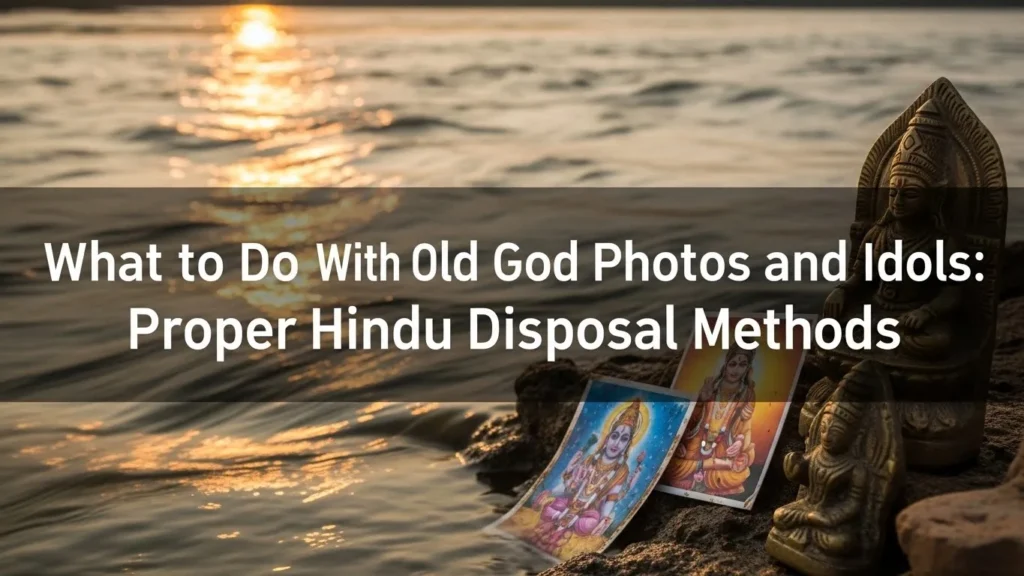
Unlike flowers and prasad having clear decomposition timelines naturally indicating disposal readiness, deity images and consecrated idols exist in ambiguous category – they’re neither consumable items meant for temporary use nor permanent fixtures guaranteed eternal preservation, creating profound uncertainty among devotees who intuitively know treating god photos like regular garbage constitutes terrible disrespect yet lack clear guidance on religiously appropriate alternatives that balance reverence for divine representations with practical necessity of eventually releasing physical objects whose useful service has concluded through damage, redundancy, or changed household circumstances.
Traditional Hindu theology offers sophisticated framework distinguishing material image from eternal divine essence – recognizing that while Supreme Reality (Brahman) transcends all forms, sanctified images serve as temporary dwelling places (alaya) where divine presence focuses for devotees’ worship benefit, and when that service period naturally concludes, proper farewell procedures (visarjan vidhi) enable respectful release of physical form while acknowledging divine essence’s eternal, unchanging nature independent of any particular representation.
For Hindu families in 2025, navigating this sensitive terrain requires understanding multiple disposal options ranging from traditional water immersion (jala visarjan) in sacred rivers following formal ritual withdrawal of divine presence, through temple donation programs where religious institutions accept old deity items for collective proper handling, to modern eco-conscious alternatives like respectful burial under sacred trees or specialized organizations collecting and processing deity images through appropriate ceremonies, each method valid when executed with proper consciousness recognizing you’re not discarding divinity itself but mindfully concluding one particular form’s sacred service while maintaining unbroken devotional relationship with the eternal divine principle that inhabits all forms yet remains forever beyond form’s limitations.
Understanding the Theological Framework
Before examining specific disposal procedures, grasping Hindu theology’s nuanced understanding of deity images, consecration, and the relationship between form and formless reality provides essential philosophical foundation preventing either irreverent casual disposal or opposite extreme of neurotic anxiety about handling sacred objects.
The Distinction: Murti vs. Divinity
Hindu philosophy teaches fundamental distinction between:
Paramatma (Supreme Self): The ultimate, eternal, unchanging divine reality that pervades all existence, transcends all forms, has no beginning or end, cannot be damaged or destroyed
Pratima/Murti (Image/Idol): The physical representation – stone, metal, clay, paper – that serves as temporary focal point enabling human consciousness to connect with formless divine through form’s accessible medium
This isn’t dualism suggesting divinity and image exist separately; rather, panentheistic understanding where:
- Divine essence pervades image (making it sacred)
- Divine essence simultaneously transcends image (remaining unaffected by image’s fate)
- Image serves as window/door/lens focusing devotional consciousness
- Image’s sanctity derives from its functional role, not inherent permanent divinity
The Bhagavad Gita (12.5) acknowledges this reality:
क्लेशोऽधिकतरस्तेषामव्यक्तासक्तचेतसाम्॥
“Greater is the difficulty for those whose minds are attached to the unmanifest (formless divine), for the path of the formless is hard for embodied beings to reach.”
Krishna validates using forms as skillful means helping embodied beings connect with formless reality – but the forms themselves remain means, not ultimate end.
Consecration: Pran Pratishtha
When new deity idol undergoes consecration ceremony:
What Actually Happens:
- Priest performs elaborate ritual following Agama Shastra procedures
- Mantras invoke divine presence to “dwell” in image
- Symbolically, divine awareness focuses through this particular form
- The murti becomes “alive” (chaitanya) – worthy of worship, capable of receiving offerings
What Doesn’t Happen:
- The Supreme Divine doesn’t “move” from elsewhere to the idol (divinity is omnipresent, not spatially located)
- The idol doesn’t become the only location where that deity exists
- Divinity doesn’t get “trapped” in physical form requiring perpetual maintenance
The Upanishadic Teaching:
ईशावास्यमिदं सर्वं यत्किञ्च जगत्यां जगत्॥
“The Lord dwells in all this – whatever exists in this changing universe.”
If divinity already pervades everything, then consecration simply acknowledges and focuses pre-existing divine presence rather than magically importing divinity into previously empty object.
What to Do With Old God Photos
Implications for Disposal:
This theological understanding means:
✅ Old/damaged deity images can be properly released – you’re concluding one focal point’s service, not destroying divinity
✅ Formal farewell (visarjan) is respectful and appropriate – acknowledging the service rendered, releasing divine focus from that particular form
✅ The divine you worshipped remains accessible – through new image, through formless meditation, through service, through nature, through all existence
❌ You’re NOT “throwing away god” – you’re respectfully retiring one representation that served its purpose
❌ You’re NOT committing sacrilege – when done properly with reverence and prescribed procedures
❌ You’re NOT severing divine connection – your devotional relationship continues independent of particular physical object
Categories of Sacred Items:
Different items require different considerations:
Fully Consecrated Temple Idols (Pran Pratishtha):
- Underwent formal installation ceremony with priest
- Receive daily worship (nitya puja)
- Highest sensitivity – require most formal visarjan
- Typically only in temples or very traditional homes
Home Shrine Idols (Partially Consecrated):
- May have simple home ceremony or no formal consecration
- Regular worship but less elaborate than temple standards
- Moderate sensitivity – simpler visarjan acceptable
Deity Photos/Prints:
- No formal consecration ceremony
- Visual focal points for devotion
- Lower ritual sensitivity but still deserve respect
- Can use simplified disposal methods
Mass-Produced Items:
- Calendars, small charms, key chains with deity images
- Minimal consecration, primarily commercial/decorative
- Basic respect sufficient – no elaborate ritual needed
Understanding these gradations prevents both extremes: treating everything as equally requiring elaborate temple-level procedures (impractical), or treating everything as disposable commercial items (disrespectful).
Traditional Disposal Methods: Visarjan Procedures
The formal visarjan (farewell ceremony) represents traditional Hindu approach to properly concluding a deity image’s service, applicable particularly for consecrated idols that have received regular worship over extended periods.
When Visarjan is Necessary:
Required for:
- Fully consecrated temple-quality idols
- Family deity images receiving daily worship for years
- Broken/damaged idols that were formally installed
- When replacing old idol with new one
Optional but respectful for:
- Unconsecrated but regularly worshipped photos
- Old prints that served in home shrine
- Even if no formal pran pratishtha occurred, visarjan shows respect
Not necessary for:
- Mass-produced calendar deity images
- Small decorative items with deity pictures
- Items never used for actual worship
The Complete Visarjan Vidhi (Procedure):
Step 1: Preparation
Timing:
- Choose auspicious day if possible (consult panchang)
- Morning hours preferred
- Avoid inauspicious times (rahu kaal, eclipses)
Materials:
- Fresh flowers, incense, camphor
- Gandha (sandalwood paste), kumkum
- Rice grains (akshat)
- Small amount of food offering (fruits, sweets)
- Vessel with water
- Cloth piece (to wrap idol if immersing)
Mental Preparation:
- Resolve any guilt or anxiety
- Recognize this as respectful conclusion, not rejection
- Maintain devotional consciousness throughout
Step 2: Final Puja
Before releasing the deity image, perform one last worship:
- Clean the idol/photo gently and respectfully
- Place on clean altar with fresh cloth
- Light lamp and incense
- Offer flowers while chanting deity’s name
- Offer food (naivedya) and water
- Chant deity’s mantra (108 times if possible)
- Perform brief aarti
This final worship honors the service the image provided and your gratitude for years of devotional support.
Step 3: Avagunthana (Withdrawal of Divine Presence)
This is the crucial ritual step – formally requesting divine essence to withdraw from physical form:
Procedure:
- Sit before deity in meditative posture
- Close eyes, hands in prayer position
- Mentally visualize divine light dwelling in idol
- Request deity to withdraw presence:
Avagunthana Mantra:
आवाहनं न जानामि न जानामि विसर्जनम्।
पूजां चैव न जानामि क्षमस्व परमेश्वर॥
“I do not know the proper method of invocation, nor do I know dismissal procedures. I do not know perfect worship methods. Please forgive me, O Supreme Lord.”
यान्ति देवव्रता देवान् पितॄन्यान्ति पितृव्रताः।
भूतानि यान्ति भूतेज्या यान्ति मद्याजिनोऽपि माम्॥
“Those devoted to devas go to devas; those devoted to ancestors go to ancestors; those devoted to spirits go to spirits; those devoted to Me come to Me.”
- Visualize divine light gradually withdrawing upward from idol, returning to infinite formless source
- Mental acknowledgment: “The eternal divine essence is released from this form. The physical representation has completed its sacred service.”
Step 4: Physical Disposal
After avagunthana, the physical object is no longer actively “inhabited” by focused divine presence (though all matter remains suffused with divinity’s omnipresence). Now proceed with respectful physical disposal:
Traditional Method: Jala Visarjan (Water Immersion)
Ideal Scenario:
- Access to clean, flowing sacred river (Ganga, Yamuna, Narmada, etc.)
- Purely biodegradable idol (clay, natural materials)
- Traditional procedure used for millennia
Procedure:
- Wrap idol in clean cloth
- Carry to river with reverence (or have priest do this)
- Wade into flowing water
- Recite prayer:
आपः पुनन्तु पृथिवीम् पृथिवी पूता पुनातु माम्।
“May the waters purify the earth; may the purified earth purify me.”
- Gently release idol into current
- Watch it float away or sink
- Offer handful of water and flowers
- Return without looking back
Modern Reality Check:
This traditional method faces serious problems in contemporary context:
❌ Most urban “rivers” are polluted sewage channels where immersion adds to degradation
❌ Many idols use non-biodegradable materials (plaster, synthetic paints, metal parts)
❌ Authorities increasingly ban religious item immersion in protected water bodies
❌ Volume of simultaneous festival visarjans overwhelms even large rivers
Better Modern Alternative: Temple Tank Visarjan
Some temples maintain clean tanks specifically for visarjan where items are later collected and properly disposed. Inquire if local temples offer this service.
Alternative Method: Earth Burial (Bhu Visarjan)
When to Use:
- No access to clean flowing water
- Want eco-friendly option
- Have garden or access to appropriate land
- Particularly suitable for photos (completely bio-degradable)
Procedure:
- Select location:
- Under sacred tree (Peepal, Banyan, Tulsi plant ideal)
- Designated sacred corner of garden
- Temple grounds (with permission)
- Remote natural area where won’t be disturbed
- Dig pit:
- Depth: 12-18 inches minimum
- Width: Sufficient for idol/photo plus wrapping
- Ensure location where won’t be accidentally dug up
- Placement:
- Wrap item in clean cotton cloth
- Place gently in pit
- Sprinkle flowers
- Chant while burying:
पृथ्वी त्वया धृता लोका देवी त्वं विष्णुना धृता।
त्वं च धारय मां देवी पवित्रं कुरु चासनम्॥
“O Earth Goddess, you support all worlds, yourself supported by Vishnu. Please hold this offering and purify this space.”
- Cover with soil
- Mark location (small stone marker) to prevent accidental disturbance
- Water the spot
Advantages:
✅ Completely eco-friendly – natural decomposition
✅ Creates sacred space in garden
✅ Avoids water pollution
✅ Can be done at home
For Photos Specifically:
Since most deity photos use paper/card:
- Tear/cut into small pieces before burial (speeds decomposition)
- Bury under Tulsi plant (particularly appropriate)
- The paper naturally decomposes in 6-12 months
Alternative Method: Agni Visarjan (Fire)
When to Use:
- Traditional havan practice in your home
- Items are burnable (photos, not stone idols obviously)
- Outdoor space for safe fire
- Permitted by local regulations
Procedure:
- Prepare sacred fire (havan kund)
- Perform brief havan with ghee and holy wood
- Place photo/burnable items while chanting:
ॐ अग्नये स्वाहा। ॐ अग्नये इदं न मम॥
“Om, offering to Agni. Om, this belongs to Agni, not to me.”
- Allow complete burning
- Collect ashes after cooling
- Immerse ashes in flowing water or scatter under sacred tree
Advantages:
✅ Complete transformation through sacred fire element
✅ Traditional Vedic method
✅ No physical remains to dispose
Limitations:
❌ Only for paper/wood items
❌ Requires fire ceremony setup
❌ Not feasible in most urban apartments
❌ Air quality concerns with frequent burning
Modern Solutions: Temple Donations and Collection Programs
Contemporary Hindu organizations increasingly offer practical disposal services addressing devotees’ needs while ensuring items receive proper religious handling – ideal for those lacking river access, personal garden, or ritual knowledge for home visarjan.
Temple Donation Programs:
How It Works:
Many temples, especially larger ones, now accept old deity items:
- Check with local temple: Call or visit, ask if they accept old deity photos/idols
- Prepare items: Remove frames, clean dust, separate by type
- Deliver respectfully: Wrap in clean cloth, carry with care
- Temple handles visarjan: Priests perform collective formal visarjan ceremony periodically
What Temples Do:
Consecrated Idols:
- Priests perform proper avagunthana (withdrawal ceremony)
- If metal (bronze, brass, silver): may be melted and recast into new temple items
- If stone/clay: respectful burial in temple land or immersion in temple tank then collection
- Formal collective visarjan on auspicious days
Photos/Prints:
- Accumulated and burned in sacred fire during temple havan
- Ashes immersed in temple’s designated water body
- Or buried in temple garden under sacred trees
Advantages:
✅ Ensures proper ritual procedures by trained priests
✅ Collective handling reduces individual anxiety
✅ Appropriate for those without ritual knowledge
✅ Eco-friendly (temples increasingly adopt sustainable practices)
Organizations Collecting Old Deity Items:
Several Indian organizations now run specialized collection programs:
- Collects old deity photos and idols across major Indian cities
- Performs collective shanti homa and proper visarjan
- Partners with temples for ritual handling
- Provides pickup services in some areas
BookMyPooja Initiative:
- Collection points in Bangalore and other cities
- Devotees register family details for blessing ceremony
- Collective shanti homa performed
- Respectful disposal following Vedic rituals
- Contact: 9869929292 / 8150878717
Local Temple Networks:
- Many city temples coordinate regional collection
- ISKCON temples often accept Radha-Krishna items specifically
- South Indian temples (especially Tamil Nadu) have organized programs
How to Participate:
- Research local options: Search “[Your City] old deity idol donation” or ask at temples
- Prepare items:
- Remove metal frames (can be recycled separately)
- Clean items gently
- Pack respectfully in cloth/box
- List items if organization requests inventory
- Deliver or schedule pickup:
- Some organizations offer pickup services
- Others have designated drop-off points
- Include your family details if requested for blessing ceremony
- Participate in ceremony if offered:
- Some organizations invite donors to collective visarjan ceremony
- Provides closure and peace of mind
- Opportunity to witness proper procedures
Advantages:
✅ Professional ritual handling by qualified priests
✅ Collective approach reduces individual burden
✅ Often include family blessings/ceremonies
✅ Eco-conscious organizations use sustainable disposal methods
✅ Good option for large quantity disposal (inherited collection, temple reorganization)
Home Disposal for Unconsecrated Photos
For simple deity photos that never underwent formal consecration and served primarily as visual devotional reminders rather than formal worship objects, simplified home disposal proves acceptable when temple donation or collection programs unavailable.
Assessing Your Item:
Simple Home Disposal Appropriate for:
- Calendar photos that served one year
- Small prints used for meditation/inspiration
- Gifted deity images never formally installed in shrine
- Photos that only received occasional flowers but no regular worship
- Mass-produced items (deity key chains, small charms, decorative tiles)
Temple Donation/Full Visarjan Better for:
- Photos that received daily worship for years
- Items in actual puja room receiving regular offerings
- Consecrated idols of any kind
- Large framed photos serving as primary deity image
- Items with strong personal/family devotional attachment
Simple Home Procedure:
If you determine simple home disposal appropriate:
Method 1: Paper Burial
- Brief acknowledgment:
- Hold photo, close eyes
- Mental prayer: “Thank you for serving as reminder of divine presence. May the eternal truth these images represent guide me always.”
- Simple mantra: ॐ नमः शिवाय or ॐ नमो भगवते वासुदेवाय (108 times)
- Prepare for burial:
- Remove from frame
- Can tear into smaller pieces (not necessary but speeds decomposition)
- Wrap in clean cloth or plain paper
- Burial:
- Bury in garden under plant (Tulsi ideal)
- Or potted plant on balcony
- Or coordinate with neighbor who has garden
- Depth: 6-8 inches minimum
- Simple prayer while burying:
ॐ शान्तिः शान्तिः शान्तिः
“Om Peace Peace Peace”
Method 2: Burning (If Allowed)
- Safe outdoor location
- Brief prayer as above
- Burn completely in controlled fire
- Collect ashes when cooled
- Scatter ashes:
- Under sacred tree
- In potted plant soil
- In flowing water (if clean)
- In garden
Method 3: Temple Drop-off (Simplest)
Even for unconsecrated photos:
- Wrap in clean cloth
- Take to temple
- Place in designated collection box (many temples have these)
- Or hand to temple staff explaining these are old deity photos
- Temple will handle appropriately
What NOT to Do:
❌ Never throw in regular garbage with kitchen waste, old newspapers – extremely disrespectful
❌ Never flush down toilet – terrible disrespect plus plumbing issues
❌ Don’t leave in public places (roadside, under trees thinking “returning to nature”) – this is littering, not piety
❌ Don’t give to friends/neighbors assuming they’ll dispose – your responsibility, not theirs
❌ Don’t store indefinitely avoiding decision – accumulated clutter also creates problems
Special Case: Damaged/Broken Idols:
Broken consecrated idols require special attention:
If Broken is Repairable:
- Consider professional restoration before deciding disposal
- Ancient temple idols regularly undergo restoration
- Your family deity worth repairing if damage isn’t severe
If Beyond Repair:
- Absolutely requires proper visarjan (can’t use casually)
- Temple donation ideal – they handle broken idols regularly
- Or full home visarjan with avagunthana
- Broken pieces should be kept together, buried/immersed together
If Metal Idol:
- Can be melted and recast into new deity (requires temple/metalworker)
- This is traditional and highly respectful
- The sacred metal continues divine service in new form
Frequently Asked Questions
Can I keep old god photos even if faded and damaged?
Yes, absolutely! There’s no obligation to dispose of old deity photos simply because they’ve aged or faded. Many families retain old images for sentimental/devotional reasons even when acquiring newer ones. However, if storage becomes problematic or you genuinely want to release them respectfully, that’s also fine. The choice is yours – neither retaining nor disposing (when done properly) is wrong. If keeping, store respectfully – wrapped in clean cloth, in designated area (not casually mixed with random storage), treated with continuing reverence even if no longer primary worship focus.
What if I don’t know if my idol was formally consecrated?
When in doubt, assume higher level of sanctity and use more formal disposal methods. If the idol received regular worship (daily or weekly) for extended period, treat as if consecrated even if you’re unsure about formal ceremony. Better to err on side of too much respect than too little. Perform simple visarjan procedure at home or donate to temple. The avagunthana mantra acknowledging “I don’t know proper procedures” specifically addresses this uncertainty – its very wording recognizes our imperfect knowledge while requesting divine understanding of sincere intention.
Can I give old god photos to others instead of disposing?
Generally not recommended unless recipient specifically wants them for worship. Issues: 1) You’re transferring disposal burden to another person, 2) They may not treat with proper respect, 3) Creates social awkwardness. Exception: Temple donations where temple specifically accepts such items. Or organized charities that supply deity images to new shrines being established. But don’t give to friends/neighbors assuming they’ll “deal with it” – that’s avoiding your responsibility. If items still usable and someone genuinely wants for their own worship, sharing can be appropriate – but ensure recipient’s sincere devotional intention, not casual acceptance to please you.
Is it bad karma to dispose of god photos/idols?
No, when done properly with prescribed procedures. Bad karma comes from disrespect (throwing in trash, burning casually without prayer, treating as worthless garbage). Good karma comes from conscious, reverent handling – performing visarjan, temple donation, respectful burial with prayer. Your intention and method matter, not the fact of disposal itself. Divine essence doesn’t need your particular physical representation to continue existing. Think of it like retiring worn national flag – there’s respectful protocol (cremation, not trash) but following protocol honors rather than dishonors what flag represents. Same principle applies.
What about deity images on calendars, notebooks, packaging?
Mass-produced commercial items with deity pictures require less formal disposal than actual worship idols/photos, but still deserve basic respect:
Calendars: After year ends, can be torn/cut and buried in garden or potted plant. Brief prayer appreciated but not elaborate ritual needed.
Notebooks/Paper: Tear out deity image pages before recycling rest. Bury/burn image pages separately with basic reverence.
Product Packaging: (Ghee containers, incense boxes with deity pictures) – Rinse clean if possible, cut out deity image portion, bury/burn respectfully. Rest can be regular recycled.
General principle: Even mass-produced images deserve more respect than trash, less formality than worshipped idols. Brief acknowledgment + appropriate disposal method (burial/burning) suffices.
Can I dispose of one deity’s photo while keeping another’s?
Yes, absolutely no problem. You’re not obligated to dispose all deity images simultaneously. Common scenarios:
- Replacing damaged with new: Old Ganesh photo faded, buying new one – dispose old, keep others
- Simplifying shrine: Too many deity images creating clutter – keep primary deities your family connects with, respectfully release others
- Changing devotional focus: Shifting from multiple deities to single ishta devata (chosen deity) – respectfully release others
The divine doesn’t take offense. Each deity image can be independently released when appropriate while maintaining others. No religious requirement for “all or nothing” approach.
What should I do with deity items inherited from deceased relatives?
Inherited deity idols/photos carry special emotional significance deserving thoughtful handling:
If you can continue worship: Wonderful! Continue family tradition, perhaps formally installing in your shrine with brief ceremony inviting divine presence. Maintains family’s devotional continuity.
If you cannot: Completely acceptable to respectfully release. Your deceased relative would understand changed circumstances. Options:
- Temple donation (many families prefer this for inherited items – temple continues worship)
- Offer to other family members who may want to continue tradition
- Proper visarjan with extra prayer acknowledging item’s family history and thanking relative’s devotion
Don’t feel guilty. Deceased relative’s spiritual connection was with divinity itself, not dependent on specific physical object’s perpetual preservation. Respectful handling of physical representation honors their devotion while releasing you from impractical burden.
How often should I replace deity photos in home shrine?
No fixed timeline. Replace when:
- Photo becomes damaged (torn, broken frame, severe fading)
- Desire for fresh image during house renovation/shrine reorganization
- Moving to new home (some families prefer fresh start)
- Personal devotional inspiration to update
Don’t replace simply due to arbitrary time passage if current images remain intact and serve well. Some families worship same deity photos for decades – perfectly fine. Quality over novelty. Better one well-maintained, devotionally-charged image than frequently rotating new ones without real devotional depth. If your current photos inspire devotion and remain presentable, no need to change.
Conclusion
The question of what to do with old god photos and idols ultimately tests your understanding of Hindu theology’s sophisticated relationship between eternal formless divine essence and temporary material representations – recognizing that while Supreme Reality transcends all forms and remains forever unchanged regardless of any particular image’s fate, the physical objects serving as worship focal points deserve reverent handling honoring their sacred service rather than casual discard treating them as worthless garbage.
Whether you choose traditional jala visarjan in flowing sacred waters following formal avagunthana ceremony withdrawing divine presence from physical form, modern eco-conscious burial under sacred trees returning organic materials to earth’s cycles, practical temple donation enabling trained priests to perform collective proper disposal, or participation in emerging collection programs offering professional ritual handling with family blessing ceremonies, the essential requirement remains conscious intention combining gratitude for service rendered, reverence for divine principle represented, and mindful awareness that you’re concluding one representation’s temporary role while maintaining unbroken devotional relationship with eternal truth that no damage, disposal, or deterioration of physical forms can ever diminish.
As you navigate these decisions in your home in 2025, remember that neither extreme serves well – neither neurotic anxiety preventing any disposal creating overwhelming clutter of damaged deteriorating items supposedly too sacred to release, nor opposite extreme of irreverent casual disposal treating deity images like ordinary commercial waste demonstrating failure to appreciate symbolic spiritual significance even when understanding intellectual distinction between symbol and symbolized.
The middle path recognizes these physical representations fulfilled important purposes – focusing your devotion, reminding you of divine presence, beautifying your sacred space, connecting you with tradition – and when that service naturally concludes through damage, redundancy, or changed circumstances, proper farewell honors both the service rendered and the eternal divine reality that remains forever accessible through infinite other forms, through formless meditation, through selfless service, through all creation, and most essentially through your own deepest self (atman) which never was separate from Supreme Reality (Brahman) regardless of whether particular physical representations come or go in the ever-changing flow of material existence.
॥ ॐ पूर्णमदः पूर्णमिदं पूर्णात् पूर्णमुदच्यते।
पूर्णस्य पूर्णमादाय पूर्णमेवावशिष्यते॥
(Om. That is complete, this is complete. From the complete comes the complete. Taking the complete from the complete, only the complete remains.)
About the Author
Rajiv Anand – Hindu Festivals, Pujas, and Religious Ceremonies Expert
Rajiv Anand is a respected authority on Hindu festivals, puja procedures, ceremonial practices, and the practical application of Vedic rituals in contemporary contexts. With extensive training in traditional puja vidhi from family lineage of temple priests combined with modern understanding of urban Hindu practice constraints, his work focuses on making ancient ritual procedures accessible and meaningful for contemporary practitioners while maintaining authentic scriptural basis and theological understanding. Rajiv has guided thousands of families through complex ceremonial questions including deity consecration, proper visarjan procedures, festival observances, and life-cycle samskaras, helping devotees navigate between mechanical rule-following lacking understanding and opposite extreme of casual disregard for traditional wisdom.
He regularly publishes on topics including puja step-by-step procedures, mantra meanings and proper pronunciation, festival preparations, handling sacred objects, and the intersection of traditional ritual requirements with modern practical constraints including urban living, environmental concerns, and time limitations. His teaching emphasizes that authentic Hindu practice combines proper knowledge of scriptural procedures with sincere devotional consciousness and intelligent adaptation to changed circumstances, recognizing that rituals serve consciousness transformation rather than being ends in themselves, and that divine grace responds primarily to devotional sincerity rather than mechanical perfection in external observances.