

Who Is Saraswati Goddess In Hinduism’s divine feminine pantheon where goddesses embody cosmic forces from fierce warrior Durga to wealth-bestowing Lakshmi, Goddess Saraswati (सरस्वती) stands uniquely as the embodiment of pure knowledge, wisdom, learning, music, arts, speech, and all intellectual pursuits—depicted serenely in flowing white robes, seated on a pristine white lotus, playing the veena (stringed instrument) while her vehicle the swan (hamsa) symbolizes discriminative wisdom separating truth from falsehood, representing not worldly power or material abundance but the transformative illumination of consciousness through education, creativity, and spiritual understanding.

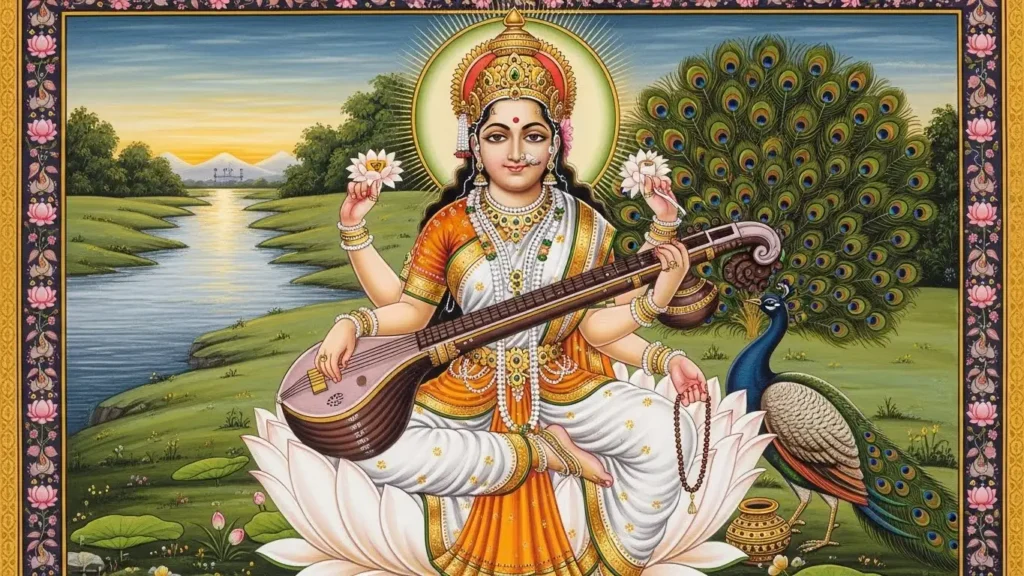
Unlike goddesses adorned in brilliant colors and gold jewelry displaying wealth and power, Saraswati’s consistent white attire symbolizes purity, detachment from materialism, clarity of thought, and the luminous quality of knowledge that illuminates minds like white light reflecting all colors yet remaining untainted by worldly corruption.
Her origin stories vary across Puranic texts—some describe her emerging from Brahma’s mouth during creation, symbolizing knowledge’s inseparable bond with the creative process, while others present her as Brahma’s consort helping manifest the universe through divine speech (Vak) that transforms thought into reality, or as the personification of the ancient Saraswati River mentioned prominently in the Rigveda where enlightened sages composed sacred hymns on its banks before the river mysteriously vanished around 1900 BCE according to geological and archaeological evidence.
In her four arms, Saraswati holds sacred objects with profound symbolism: a pustaka (book/manuscript) representing the eternal Vedas and all forms of learning, a mala (rosary) symbolizing meditation and focused spiritual practice, a kamandalu (water pot) representing purity and the purifying power of knowledge, and the veena (musical instrument) representing harmony between intellect and emotion, demonstrating that wisdom finds beautiful expression through creative arts.
Her worship reaches its annual peak during Vasant Panchami (also called Saraswati Puja), celebrated on the fifth day of the bright fortnight in the Hindu month of Magha (January-February), when students place books, musical instruments, and educational tools near her idol seeking blessings for academic success, creative inspiration, and intellectual growth—a practice especially prominent in educational institutions across India where children are formally initiated into learning through the Vidyarambham ceremony.
Beyond Hinduism’s boundaries, Saraswati’s influence spread throughout Asia via Buddhist transmission—becoming Benzaiten in Japanese Buddhism (one of the Seven Lucky Gods of Japan), retaining associations with music, eloquence, and wisdom while incorporating local Shinto elements including water dragons and serpents absent from her Hindu iconography.
Understanding Saraswati reveals fundamental Hindu values about the supremacy of knowledge over material wealth, the liberating rather than binding quality of true wisdom, the integration of intellectual and creative pursuits, and the principle that education represents humanity’s highest aspiration—she doesn’t promise riches like Lakshmi or physical protection like Durga but offers something more profound: the illumination of consciousness that transforms ignorance into understanding, enabling moksha (spiritual liberation) through jnana (knowledge) yoga.
This comprehensive exploration examines Saraswati’s origin stories, her rich symbolic iconography, the significance of Vasant Panchami worship, famous mantras, her connection to the lost Saraswati River, her transformation into Benzaiten in Japan, and contemporary relevance for students and seekers.
Origin Stories: Birth of the Knowledge Goddess
Multiple Puranic texts offer varying accounts of Saraswati’s manifestation, each revealing different aspects of her cosmic function.
Emerging from Brahma’s Mouth
According to several traditions including references in the Rigveda and later Puranic literature, Saraswati emerged from Lord Brahma’s mouth during the creation of the universe, symbolizing the fundamental principle that knowledge (represented by Saraswati) and creation (represented by Brahma) are inseparably linked—one cannot create coherently without knowledge, and knowledge seeks expression through creative manifestation.
This origin emphasizes Saraswati as Vak Devi—the goddess of speech and divine sound (Shabdabrahma) through which the unmanifest becomes manifest. As Brahma’s creative intelligence, she represents the wisdom necessary to design and maintain the universe’s intricate order, from cosmic laws governing celestial bodies to subtle principles structuring consciousness itself.
Brahma’s Consort and Co-Creator
In many Puranic accounts, Saraswati serves as Brahma’s consort or shakti (feminine creative power), not his biological daughter as sometimes mistakenly interpreted. The creator deity requires feminine creative energy to manifest the universe—Brahma represents the formless creative principle while Saraswati embodies the intelligent design, order, and knowledge structuring creation.
According to this framework, Saraswati assists Brahma in creating the universe by providing the wisdom, speech, and aesthetic principles transforming chaotic potential into ordered beauty—explaining why she governs not just dry intellectual knowledge but also music, poetry, arts, and all forms of refined cultural expression.
The Controversial Shatarupa Connection
Some texts conflate Saraswati with Shatarupa (the first woman Brahma created), leading to controversial narratives about Brahma’s inappropriate desire. However, scholarly interpretations emphasize these are allegorical rather than literal—representing the creator becoming enamored with his own creation, the mind infatuated with its own thoughts, or ego obsessed with its self-generated reality.
Modern interpretations treat Saraswati as Brahma’s associate or consort helping with creation, not his daughter, avoiding problematic familial relationships while maintaining her essential function as the knowledge principle enabling intelligent creation.
Manifestation from the Saraswati River
The goddess’s name and earliest references connect her intimately to the Saraswati River, a major waterway mentioned prominently in the Rigveda (composed approximately 1500-1200 BCE) where it’s praised as a mighty river flowing from the mountains to the sea, sustaining civilization and inspiring spiritual revelation.
The river’s name “Saraswati” means “having many pools” or “flowing waters”, and over time, the sacred waterway became deified—personified as a goddess embodying the life-giving, purifying, and illuminating qualities of flowing water transformed metaphorically into flowing knowledge.
When the physical river mysteriously dried up around 1900-1800 BCE due to tectonic shifts altering its tributaries, Saraswati’s transformation from river goddess to abstract knowledge deity likely accelerated, making her increasingly associated with invisible flowing wisdom rather than visible flowing water.
Iconic Symbolism: Decoding Saraswati’s Attributes
Every element of Saraswati’s iconography carries profound symbolic meaning revealing her multifaceted nature.
The White Attire: Purity and Clarity
Saraswati always appears dressed in flowing white robes or sari, dramatically different from other goddesses adorned in vibrant reds, greens, or yellows with abundant gold jewelry. This consistent white symbolizes multiple interconnected meanings:
Purity: White represents untainted, uncorrupted consciousness—just as white light contains all colors yet remains pure, true knowledge encompasses all subjects while remaining free from personal bias, cultural conditioning, or ideological distortion.
Detachment: Unlike material desires binding consciousness to worldly objects, knowledge liberates rather than enslaves. The white dress indicates Saraswati’s complete detachment from materialism, showing that pursuit of wisdom requires renouncing attachment to wealth, status, and sensory pleasures.
Clarity: White reflects and illuminates like the moon’s gentle light, symbolizing how wisdom illuminates the mind, dispelling the darkness of ignorance (avidya) and revealing reality clearly without distortion.
Simplicity: Saraswati’s lack of ornate jewelry or colorful decoration teaches that true knowledge values substance over appearance, essence over ornamentation, internal wisdom over external display.
The White Lotus: Purity Amid Chaos
Saraswati typically sits on a pristine white lotus flower, one of Hinduism’s most powerful symbols representing spiritual perfection and divine purity.
The lotus grows in muddy water yet remains completely unstained, its petals repelling moisture and dirt—perfectly symbolizing how a truly wise person lives in the world of ignorance, materialism, and chaos yet remains untouched by corruption, maintaining inner purity despite external circumstances.
The white color of the lotus emphasizes Saraswati’s association with sattvic (pure) qualities rather than rajasic (passionate) or tamasic (inert) energies, indicating that genuine knowledge cultivation requires cultivating mental purity, ethical conduct, and spiritual discipline.
The Four Arms: Aspects of Consciousness
Saraswati’s four arms represent four aspects of the human personality in learning:
Manas (Mind): The sensory mind receiving external impressions
Buddhi (Intellect): The discriminating intelligence analyzing and understanding
Chitta (Consciousness): The deeper awareness storing memories and impressions
Ahamkara (Ego): The sense of individual identity as knower
Together, these four represent the complete psychological apparatus required for learning—not just intellectual processing but the entire conscious system integrating sensory data, analytical thinking, stored knowledge, and self-awareness into coherent understanding.
The Veena: Harmony of Knowledge and Creativity
In one hand, Saraswati holds the veena, a stringed musical instrument requiring both technical skill and artistic sensitivity to play beautifully.
The veena symbolizes multiple profound meanings:
Integration of Arts and Sciences: The instrument represents all creative arts alongside intellectual sciences, teaching that true education develops both analytical thinking and aesthetic appreciation, technical mastery and creative expression.
Harmony and Balance: Playing the veena requires perfectly balancing tensions between strings, timing between notes, and coordination between hands—symbolizing the harmonious integration of intellect and emotion, discipline and creativity, structure and spontaneity necessary for genuine wisdom.
Inner Tuning: The veena’s strings must be precisely tuned to produce beautiful music, symbolizing the spiritual practice of tuning one’s inner consciousness—aligning thought, speech, and action—to resonate with cosmic truth and produce a harmonious life.
Expression of Knowledge: Saraswati holding the veena represents that knowledge seeks expression through creativity—information becomes wisdom when beautifully communicated, teaching becomes transformative when artfully shared, understanding matures when creatively manifested.
Who Is Saraswati Goddess The Pustaka: Sacred Knowledge
In another hand, Saraswati holds a pustaka (book or manuscript), typically identified with the Vedas—the oldest and most sacred Hindu scriptures containing timeless spiritual wisdom.
The book symbolizes:
Universal Knowledge: The Vedas represent not just religious texts but universal principles governing existence—scientific laws, moral truths, psychological insights, and spiritual realizations accessible through study and contemplation.
Preservation Through Writing: The book emphasizes literacy, scholarship, and systematic preservation of knowledge across generations—honoring the written word as humanity’s greatest tool for accumulating and transmitting wisdom beyond individual lifespans.
Learning and Study: The pustaka reminds devotees that knowledge requires dedicated study—not just spontaneous intuition but disciplined engagement with accumulated wisdom, respect for teachers and traditions, and humility before the vastness of what can be known.
The Mala: Concentration and Meditation
The third hand holds a mala (rosary/prayer beads), typically made of white crystals or pearls, used for mantra repetition and meditation practice.
The rosary symbolizes:
Focused Concentration: Learning requires sustained attention and mental discipline—the mala represents the ability to focus consciousness single-pointedly, essential for deep understanding beyond superficial familiarity.
Spiritual Practice: Knowledge without spiritual development remains incomplete—the mala indicates that education should include inner transformation, ethical development, and meditative practices cultivating wisdom beyond mere information accumulation.
Inner Reflection: The counting of beads represents systematic self-examination and contemplative inquiry—turning attention inward to question assumptions, examine beliefs, and discover self-knowledge complementing external learning.
The Kamandalu: Purity and Essence
In the fourth hand, Saraswati holds a kamandalu (water pot), traditionally carried by ascetics and filled with pure water for rituals and purification.
The water pot symbolizes:
Purifying Power: Knowledge purifies consciousness like water cleanses the body—washing away ignorance, dissolving false beliefs, and clarifying perception to reveal reality accurately.
Discrimination: Water’s ability to flow and separate contaminants represents viveka (discriminative wisdom)—the capacity to distinguish essential from inessential, truth from falsehood, permanent from temporary.
Nourishment: Just as water sustains physical life, knowledge nourishes the mind and soul, quenching spiritual thirst and enabling conscious evolution beyond animal survival into human flourishing.
The Swan (Hamsa): Wisdom’s Discrimination
Saraswati’s vahana (vehicle) is the hamsa—a swan or sometimes interpreted as a wild goose—possessing legendary discriminative abilities in Hindu symbolism.
The swan represents:
Separating Truth from Falsehood: Hindu tradition attributes to the swan the miraculous ability to separate milk from water when the two are mixed—perfectly symbolizing viveka (discrimination), the highest intellectual faculty distinguishing eternal spiritual truths from temporary material illusions.
Grace and Beauty: The swan moves gracefully across water with elegance and poise, representing how genuine wisdom manifests as refined behavior, cultured expression, and aesthetic sensitivity rather than crude intellectualism or arrogant scholarship.
Spiritual Perfection: In yogic symbolism, the hamsa represents the individual soul (jivatma) seeking union with cosmic consciousness (paramatma)—the ultimate knowledge transcending subject-object duality into non-dual realization.
Migratory Nature: Swans migrate seasonally across vast distances, symbolizing the spiritual journey from ignorance to enlightenment, from worldly consciousness to transcendent realization, following an innate compass guiding toward truth.
Vasant Panchami: The Festival of Knowledge
Saraswati worship reaches its annual peak during Vasant Panchami (also called Saraswati Puja or Basant Panchami), one of Hinduism’s most educationally significant festivals.
Timing and Seasonal Significance
Vasant Panchami falls on the fifth day (Panchami) of the bright fortnight (Shukla Paksha) in the Hindu month of Magha (January-February), marking the arrival of spring (Vasant) when nature awakens from winter dormancy with blooming flowers, singing birds, and vibrant greenery.
The spring timing symbolizes new beginnings, fresh growth, and creative renewal—perfectly aligned with Saraswati’s association with learning as intellectual and spiritual springtime awakening consciousness to higher possibilities.
Yellow Color Symbolism
Devotees traditionally wear yellow clothes and prepare yellow foods on Vasant Panchami, with yellow being the festival’s signature color representing:
- Blooming mustard flowers covering fields in spring
- Solar energy, warmth, and illumination
- Vibrancy, energy, and optimism
- Knowledge bringing brightness to ignorance’s darkness
Worship Rituals and Practices
Home and Temple Worship: Families establish Saraswati idols or images decorated with flowers, especially marigolds and yellow blooms. Devotees offer flowers, fruits, sweets (particularly yellow sweets), and perform traditional aarti (lamp offering) with devotional songs.
Placing Books and Instruments: Students place their textbooks, notebooks, musical instruments, and educational tools near Saraswati’s idol seeking her blessings for academic success, creative inspiration, and intellectual growth—recognizing education as sacred rather than merely practical.
Vidyarambham Ceremony: In many communities, especially in Bengal, Vasant Panchami marks the auspicious day for formally initiating young children into education through the Vidyarambham ceremony where children write their first letters on rice, sand, or slate with the guidance of elders, symbolizing education’s sacred beginning.
School Celebrations: Educational institutions across India conduct elaborate Saraswati Pujas with cultural programs including musical performances, poetry recitations, debates, and artistic competitions—transforming schools into temples of learning for the day.
Fasting and Meditation: Some devotees observe partial fasting and spend the day in study, contemplation, and meditation, honoring knowledge through disciplined practice rather than just ritual worship.
Association with Krishna and Radha
Beyond honoring Saraswati, Vasant Panchami also celebrates divine love between Lord Krishna and Radha, with traditions suggesting Krishna worshipped Saraswati on this day to attain knowledge and wisdom—integrating devotional love (bhakti) with intellectual pursuit (jnana) as complementary rather than contradictory paths.
Sacred Mantras: Invoking Saraswati’s Grace
Multiple powerful mantras invoke Goddess Saraswati’s blessings for knowledge, creativity, and wisdom.
Saraswati Gayatri Mantra
The most prominent is the Saraswati Gayatri Mantra composed in the classical 24-syllable Gayatri meter:
Sanskrit: ॐ ऐं वाग्देव्यै विद्महे कामराजाय धीमहि। तन्नो देवी प्रचोदयात्॥
Transliteration: Om Aim Vagdevyai Vidmahe Kamarajaya Dhimahi | Tanno Devi Prachodayat ||
Translation: “Om, let us meditate on the goddess of speech. O Mistress of all desires, we meditate on You and pray for attainment of good sense. O Goddess, illuminate our intellect with the light of knowledge.”
Chanting this mantra increases knowledge and wisdom, pleases Goddess Saraswati, and proves especially helpful for students preparing for examinations or pursuing academic excellence.
Simple Saraswati Prayer
Sanskrit: सरस्वति नमस्तुभ्यं वरदे कामरूपिणि।
विद्यारम्भं करिष्यामि सिद्धिर्भवतु मे सदा॥
Transliteration: Saraswati Namastubhyam Varade Kamarupini |
Vidyarambham Karishyami Siddhirbhavatu Me Sada ||
Translation: “O Goddess Saraswati, salutations to you, the granter of boons and fulfiller of wishes. I am beginning my studies; may there always be accomplishment for me.”
Students traditionally recite this before beginning study sessions, invoking divine blessings for successful learning.
The Saraswati River Mystery: From Physical to Metaphysical
Rigvedic References
The Rigveda (composed approximately 1500-1200 BCE) contains numerous hymns praising the Saraswati River as a mighty waterway flowing from the mountains to the sea, sustaining agriculture and civilization, inspiring spiritual revelation on its banks where sages composed sacred verses.
The river was described as abundant, powerful, and pure—worthy of worship as a goddess embodying life-giving feminine energy nourishing both body and spirit.
The Physical River’s Disappearance
Geological, archaeological, and satellite studies suggest a major river system once flowed through northwest India parallel to the Indus River, corresponding to Vedic descriptions of the Saraswati. However, around 1900-1800 BCE, tectonic shifts in the Himalayas altered tributary flows, gradually drying the river until it disappeared completely.
This physical disappearance coincided with the Saraswati’s increasing abstraction into a goddess of invisible knowledge rather than visible water—her transformation from river deity to wisdom goddess reflecting the shift from material to metaphysical understanding.
Mystical Interpretation: The Invisible River
In later Hindu tradition, Saraswati joins Ganga and Yamuna as an invisible third river at the sacred Triveni Sangam in Prayagraj (Allahabad)—representing the subtle spiritual channel (nadi) flowing underground in consciousness, accessible only to realized souls.
This mystical interpretation transforms the river’s physical disappearance into spiritual teaching: true knowledge flows invisibly beneath surface appearances, requiring inner vision and meditative realization to experience directly.
Saraswati Beyond India: Benzaiten in Japan
Goddess Saraswati’s influence extended far beyond India through Buddhism’s cultural spread, particularly transforming into Benzaiten in Japanese culture.
Buddhist Transmission
During the 5th-8th centuries CE, Buddhism spread from India through Central Asia, China, and Korea to Japan, carrying not just Buddha’s teachings but also numerous Hindu deities incorporated into Buddhist texts and practices.
Buddhist scriptures like the “Sutra of Golden Light” (translated from Sanskrit into Chinese and then Japanese) prominently featured “Sarasvatî Devî”, whose worship became integrated into Japanese religious culture.
Transformation into Benzaiten
In Japan, Saraswati evolved into Benzaiten (弁財天), one of the Seven Lucky Gods (Shichifukujin), blending Hindu, Buddhist, and Shinto elements:
Retained Attributes: Music, eloquence, wisdom, learning, and the arts
New Additions: Wealth, prosperity, water dragons, serpents, and ocean associations
Syncretic Iconography: Sometimes shown with eight arms holding various weapons alongside traditional musical instruments
This transformation demonstrates Hinduism’s cultural influence beyond religious boundaries, with deities adapting to local contexts while preserving core symbolic meanings.
Contemporary Relevance: Saraswati for Modern Seekers
Goddess Saraswati offers timeless lessons for contemporary education and spiritual development.
Knowledge as Liberation
In an era prioritizing practical skills and career preparation, Saraswati reminds us that education’s highest purpose is liberating consciousness—not just earning credentials but transforming understanding, expanding awareness, and realizing truth.
Integration of Arts and Sciences
Saraswati’s veena symbolizes that genuine education develops both analytical and creative capacities—resisting false dichotomies between STEM fields and humanities, technical mastery and artistic sensitivity, left-brain logic and right-brain intuition.
Purity of Intention
Her white attire teaches pursuing knowledge with pure motives—studying to understand rather than to impress, learning to serve rather than to dominate, cultivating wisdom for collective wellbeing rather than individual advantage.
Focus and Discipline
The mala in her hand emphasizes that genuine learning requires sustained concentration, meditative depth, and disciplined practice—countering contemporary attention fragmentation and superficial information consumption with contemplative engagement.
Frequently Asked Questions
Who is Goddess Saraswati?
Goddess Saraswati is the Hindu deity embodying pure knowledge, wisdom, learning, music, arts, speech, and all intellectual pursuits. She appears serenely dressed in white robes, seated on a white lotus, playing the veena (musical instrument) with her vehicle the swan (hamsa) symbolizing discriminative wisdom. Her four arms hold sacred objects: a pustaka (book representing the Vedas), mala (rosary for meditation), kamandalu (water pot for purification), and veena (representing harmony between intellect and creativity). Unlike goddesses promising material wealth or physical protection, Saraswati offers intellectual illumination and spiritual understanding.
She is worshipped especially by students, scholars, artists, musicians, and anyone pursuing educational excellence. Her name derives from the ancient Saraswati River mentioned in the Rigveda, connecting her to life-giving water transformed into flowing knowledge.
What is the origin story of Saraswati?
Multiple Puranic texts offer varying origin accounts. The most common describes Saraswati emerging from Lord Brahma’s mouth during creation, symbolizing knowledge’s inseparable bond with the creative process. As Vak Devi (goddess of speech), she represents divine sound (Shabdabrahma) through which thought manifests into reality.
In many accounts, she serves as Brahma’s consort or shakti (feminine creative power), providing the wisdom and aesthetic principles structuring creation—not his biological daughter as sometimes mistakenly interpreted, but his associate helping manifest the universe intelligently. Another origin connects her to the ancient Saraswati River mentioned prominently in Vedic literature—a mighty waterway flowing through northwest India that mysteriously dried up around 1900 BCE, transforming from physical river goddess into abstract knowledge deity representing invisible flowing wisdom.
What is the symbolism of Saraswati’s white attire?
Saraswati’s consistent white clothing carries profound meaning unlike other goddesses dressed in vibrant colors with gold jewelry. White symbolizes: 1) Purity—untainted consciousness like white light containing all colors yet remaining pure, representing knowledge free from bias or distortion; 2) Detachment—wisdom liberates rather than binds, indicating complete detachment from materialism; 3) Clarity—white reflects and illuminates like moonlight, symbolizing how knowledge dispels ignorance’s darkness; 4) Simplicity—lack of ornamentation teaches that true wisdom values substance over appearance, essence over decoration.
The white dress represents sattvic (pure) qualities rather than rajasic (passionate) or tamasic (inert) energies, indicating genuine knowledge cultivation requires mental purity, ethical conduct, and spiritual discipline. It teaches that pursuit of wisdom requires pure heart, clear intention, and detached mind.
What does Vasant Panchami celebrate?
Vasant Panchami (also called Saraswati Puja or Basant Panchami) is Hinduism’s premier knowledge festival celebrated on the fifth day of the bright fortnight in Magha month (January-February), marking spring’s arrival. The festival specifically honors Goddess Saraswati, with students placing textbooks, notebooks, and musical instruments near her idol seeking blessings for academic success and creative inspiration. Educational institutions conduct elaborate pujas with cultural programs including music, poetry, debates, and artistic competitions.
The Vidyarambham ceremony formally initiates young children into education through writing first letters on rice or slate. Devotees wear yellow clothes and prepare yellow foods representing blooming mustard flowers, solar energy, and knowledge’s illumination. Beyond Saraswati worship, the festival celebrates divine love between Krishna and Radha, integrating devotional love (bhakti) with intellectual pursuit (jnana) as complementary paths.
What is the significance of Saraswati’s swan vahana?
The swan (hamsa) as Saraswati’s vehicle symbolizes multiple profound meanings. Most importantly, Hindu tradition attributes to swans the miraculous ability to separate milk from water when mixed—perfectly representing viveka (discriminative wisdom), the highest intellectual faculty distinguishing eternal spiritual truths from temporary material illusions, essence from appearance, real from unreal.
The swan’s grace and beauty represent how genuine wisdom manifests as refined behavior, cultured expression, and aesthetic sensitivity rather than crude intellectualism or arrogant scholarship. In yogic symbolism, the hamsa represents the individual soul (jivatma) seeking union with cosmic consciousness (paramatma)—the ultimate knowledge transcending subject-object duality into non-dual realization. Swans’ migratory nature symbolizes the spiritual journey from ignorance to enlightenment, following an innate compass guiding toward truth across vast distances and obstacles.
How did Saraswati become Benzaiten in Japan?
During the 5th-8th centuries CE, Buddhism spread from India to Japan carrying Hindu deities incorporated into Buddhist texts. Buddhist scriptures like the “Sutra of Golden Light” prominently featured “Sarasvatî Devî,” whose worship integrated into Japanese culture. In Japan, Saraswati evolved into Benzaiten (弁財天), one of the Seven Lucky Gods (Shichifukujin), blending Hindu, Buddhist, and Shinto elements.
She retained associations with music, eloquence, wisdom, learning, and arts, but gained new attributes including wealth, prosperity, water dragons, and serpents absent from Hindu iconography. Sometimes depicted with eight arms holding weapons alongside musical instruments, Benzaiten demonstrates Hinduism’s cultural influence beyond religious boundaries, with deities adapting to local contexts while preserving core symbolic meanings. This transformation shows how spiritual principles transcend cultural boundaries through creative synthesis.
What are the objects in Saraswati’s four hands?
Saraswati’s four arms hold sacred objects with profound symbolism: 1) Pustaka (book/manuscript)—representing the eternal Vedas and all forms of learning, emphasizing literacy, scholarship, and systematic knowledge preservation across generations; 2) Mala (rosary/prayer beads)—symbolizing meditation, focused concentration, spiritual practice, and inner reflection necessary for deep understanding beyond superficial information; 3) Kamandalu (water pot)—representing purity, the purifying power of knowledge washing away ignorance, and discriminative wisdom (viveka) separating essential from inessential truth from falsehood; 4) Veena (stringed instrument)—representing harmony between intellect and emotion, integration of arts and sciences, and the beautiful expression of knowledge through creativity.
Together, these objects demonstrate that genuine education develops analytical thinking and aesthetic appreciation, external learning and internal transformation, intellectual mastery and spiritual development as an integrated whole.
Why do students worship Saraswati?
Students worship Saraswati because she embodies knowledge, wisdom, learning, and intellectual excellence—offering blessings for academic success, creative inspiration, memory retention, focused concentration, and clarity of understanding. Unlike deities granting material wealth or physical protection, Saraswati provides intellectual illumination transforming ignorance into understanding.
Her worship teaches that education is sacred rather than merely practical, encouraging pure motivations (studying to understand rather than impress), disciplined practice (sustained concentration), ethical conduct (using knowledge for service), and integration of analytical and creative capacities. Vasant Panchami allows students to place books and instruments near her idol, seeking divine grace for their educational journey. School pujas transform institutions into temples of learning, recognizing that intellectual development requires not just effort but spiritual blessings. This practice cultivates reverence for knowledge, humility before wisdom’s vastness, and gratitude for teachers and traditions.
About the Author
Rajiv Anand – PhD in Vedic Studies and Ancient Indian History
Rajiv Anand is a distinguished scholar specializing in ancient Indian history, Vedic traditions, and Hindu cultural practices. With over 15 years of research experience focused on decolonizing historical narratives, he has published extensively on Hindu goddess theology, Puranic literature, symbolic iconography, Vedic river systems, cultural transmission through Buddhism, festival traditions, educational philosophy, and the intersection of ancient wisdom with contemporary learning. His work bridges academic rigor with devotional accessibility, making complex mythological and symbolic concepts understandable to contemporary audiences seeking authentic knowledge about Hindu wisdom traditions and their transformative potential for intellectual development, creative expression, and spiritual awakening through the pursuit of knowledge.