

Hindu Temples Built are constructed using sacred geometry because ancient architects understood that precise mathematical patterns, proportional relationships, and geometric configurations could create structures that align with cosmic order, channel divine energies, promote spiritual transformation, and harmonize human consciousness with universal principles. This sophisticated architectural science, codified in Vastu Shastra (science of dwelling) and Shilpa Shastra (science of sculpture and construction), prescribes that temples function not merely as physical worship spaces but as three-dimensional yantras—cosmic diagrams that manifest abstract spiritual truths through geometry, proportion, orientation, and spatial relationships.

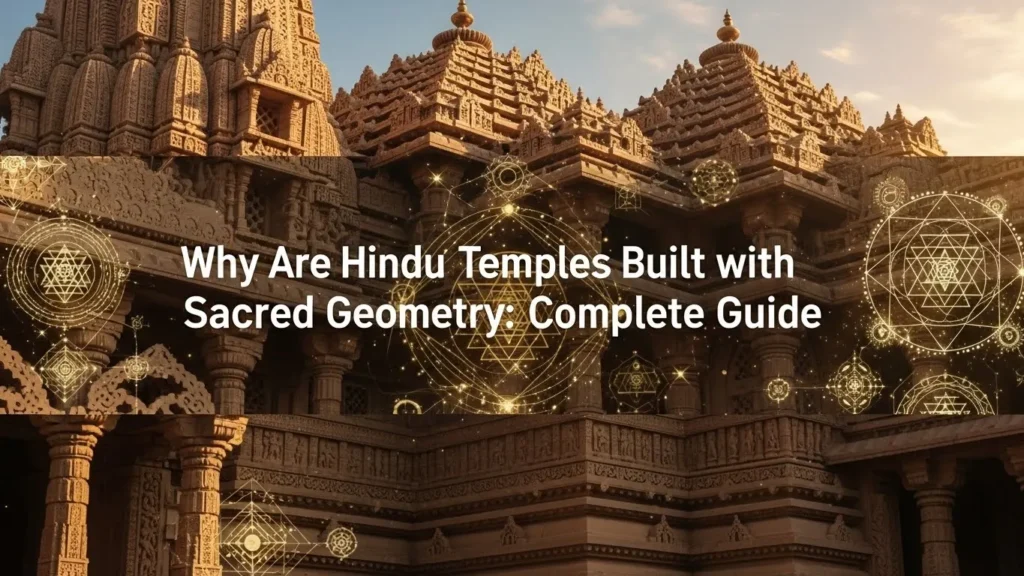
The foundational element of this sacred geometry is the Vastu Purusha Mandala, a divine geometric grid dividing temple sites into 64, 81, or 100 square subdivisions (padas), each governed by specific deities, cosmic principles, and elemental forces that determine spatial organization, energy flow, and the building’s relationship with natural and supernatural dimensions. By incorporating mathematical principles including the golden ratio (phi ≈ 1.618), fractal patterns, circular mandala forms, and precise proportional systems, temple architects created structures that resonate with fundamental patterns found throughout nature, the cosmos, and human perception—producing buildings that feel inherently harmonious, spiritually uplifting, and psychologically transformative.
This architectural approach reflects Hindu cosmological understanding that the universe operates according to mathematical laws (rita—cosmic order), with geometry serving as the visible manifestation of invisible divine principles. Temples built following sacred geometry embody this cosmic order, creating earthly dwelling places for deities that simultaneously function as instruments for spiritual practice, facilitating meditation, enhancing energy circulation, balancing the five elements (pancha bhuta), and elevating human consciousness from mundane reality to transcendent awareness.
This comprehensive guide explores the Vastu Purusha Mandala’s structure and purpose, the mathematical principles governing temple proportions including the golden ratio, how sacred geometry channels cosmic energies and balances elemental forces, the yantra concept in temple architecture, specific applications in famous temples, and the continuing relevance of these ancient principles in contemporary understanding of Hindu philosophy and sacred architecture.
The Vastu Purusha Mandala: Foundation of Sacred Geometry
Origins and Mythological Significance
The Vastu Purusha Mandala represents the fundamental geometric construction underlying all traditional Hindu temple architecture, organizing spatial partitions and determining energy flow throughout the structure. The mandala’s mythology describes how Vastu Purusha, a cosmic being born from primordial chaos, was subdued by Brahma and 44 other deities who pinned him face-down to the earth. This cosmic being’s body, oriented along the cardinal directions with head in the northeast and feet in the southwest, became the sacred template upon which all structures should be built.
The name combines three Sanskrit terms:
- Mandala: Circle or circular pattern representing wholeness, completion, and cosmic order
- Purusha: Universal essence, cosmic consciousness, or the primordial being underlying all existence
- Vastu: Dwelling structure or built environment
Together, Vastu Purusha Mandala signifies a sacred dwelling structure based on universal cosmic principles, transforming architectural design from pragmatic construction into spiritual practice aligned with divine order.
Hindu Temples Built Grid Structure and Pada Divisions
The Vastu Purusha Mandala divides space into equal square subdivisions called padas, with the total number varying based on structure type and complexity:
64-Pada Grid (8×8): The most common configuration for residential structures and smaller temples, creating 64 square subdivisions arranged in an 8×8 pattern
81-Pada Grid (9×9): Frequently used for medium-sized temples and important buildings, providing 81 subdivisions in a 9×9 arrangement
100-Pada Grid (10×10): Reserved for large temple complexes and major structures requiring elaborate spatial organization
Each pada receives assignments of specific deities, planetary influences, elemental correspondences, and directional energies that determine appropriate functions for spaces occupying those squares. For example, the southeast pada governed by Agni (fire god) becomes the ideal location for kitchens and fire rituals, while the northeast pada ruled by Ishana (auspicious Shiva aspect) serves as the most sacred direction for meditation spaces and deity placement.
Spatial Zones: From Center to Periphery
The mandala organizes space into concentric zones radiating from the sacred center outward to the profane periphery:
Brahma Padas (Central Zone)
The innermost 9 or 16 squares at the mandala’s center (depending on grid type) constitute the Brahma Padas or Brahmasthan—the most sacred zone where Lord Brahma, the creator deity, resides. This central zone represents:
- Cosmic Creation Point: The bindu (point) from which all existence emanates and to which it returns
- Universal Consciousness: The unchanging divine essence underlying manifest reality
- Structural Center: The point of maximum stability and energy concentration
In temple architecture, the garbhagriha (sanctum sanctorum) must be positioned precisely at the Brahma Padas, with the deity placed exactly at the cosmic center and the shikhara/vimana (tower) rising vertically above this point, creating the axis mundi (world axis) connecting earth to heaven.
Devika Padas (Inner Divine Zone)
Surrounding the Brahma Padas are the Devika Padas, inhabited by 13 major deities representing divine energies and celestial forces. This zone provides space for:
- Subsidiary shrines dedicated to associated deities
- Ritual preparation areas
- Inner circumambulatory passages (pradakshina patha)
- Sacred architectural elements requiring proximity to the divine center
Manusha Padas (Human Zone)
The outer zones occupied by humans provide functional spaces for devotee activities:
- Assembly halls (mandapas)
- Congregational areas
- Outer circumambulatory corridors
- Educational and administrative spaces
Paisachika Padas (Peripheral Zone)
The outermost squares inhabited by lower beings and demonic forces serve as:
- Temple boundaries and protective walls
- Service areas and utility spaces
- Storage facilities
- Peripheral structures
Directional Deities and Cosmic Alignment
The 32 subdivisions along the mandala’s border represent the nakshatras (lunar mansions), integrating astrological calculations with architectural design. The eight cardinal and intercardinal directions receive governance by specific deities:
This directional theology determines temple orientation, with most structures facing east to receive sunrise rays in the garbhagriha, though specific deities may require alternative orientations based on their cosmic associations.
Mathematical Principles: Golden Ratio and Sacred Proportions
The Golden Ratio (Phi) in Temple Architecture
The golden ratio (phi, φ ≈ 1.618) appears extensively in Hindu temple proportions, creating dimensional relationships that human perception finds inherently harmonious and aesthetically pleasing. This mathematical constant, where a line divided into two parts maintains the proportion a:b = b:(a+b), occurs naturally throughout biological systems, cosmic structures, and human anatomy, suggesting its fundamental role in universal design principles.
Vedic cosmology and sacred architecture employed the golden ratio as a foundational principle, creating structures that resonated with natural patterns found in spiral galaxies, nautilus shells, flower petals, and human facial proportions. Ancient architects recognized phi as evidence of divine mathematical ordering of creation—what medieval European scholars called the “divine proportion”.
Applications in Temple Design
Brihadeeswara Temple, Thanjavur: Modern mathematical analysis reveals that Raja Raja Chola I’s masterpiece incorporates golden ratio proportions throughout its plan and elevation:
- The ratio of slant height to base width approximates phi
- Relationships between vimana height, width, and courtyard dimensions follow golden section principles
- Subsidiary shrine placements maintain phi-based spatial relationships
- The entire courtyard exhibits golden ratio proportions
Researchers concluded that “one of the secrets of beauty of the Brihadeeswara temple is golden proportion influenced its plan of designs and constructions”, demonstrating how mathematical precision enhanced aesthetic excellence.
Column Proportions: Temple pillars frequently exhibit height-to-diameter ratios approximating 1.6:1, remarkably close to phi. This creates columns that appear neither too squat nor too elongated, achieving balance that feels inherently correct to human perception. The spacing between columns and the proportions of capitals to shafts also follow golden ratio principles, creating rhythmic patterns guiding worshippers through sacred spaces.
Vertical Alignment: The three-dimensional extension of mandala mathematics maintains proportional relationships vertically, not just horizontally. Each level of multi-story temples preserves the same golden ratio proportions as the base, creating structures that are mathematically consistent from foundation to pinnacle.
Fractal Geometry and Self-Repeating Patterns
Hindu temple architecture exhibits fractal characteristics—self-similar patterns repeating at multiple scales from the largest structural elements down to the smallest decorative details. This creates visual complexity and harmony simultaneously:
Macro to Micro Repetition: The overall temple form (pyramidal shikhara/vimana) repeats in miniature shrine structures (urushringa) adorning the main tower’s sides, which in turn repeat in tiny decorative elements carved on pillars and walls
Mandala Recursion: The fundamental square-within-circle pattern of the Vastu Purusha Mandala recurs at every architectural level—from the overall site plan to individual shrine layouts to decorative ceiling patterns
Natural Resonance: Fractal patterns mirror natural formations (tree branching, mountain profiles, cloud formations), creating structures that feel organically integrated with the natural environment despite being human-made
Circular Patterns and Mandala Mathematics
Temple floor plans integrate circular patterns with square grids, creating what scholars call “mandala mathematics”. The circle represents:
- Cosmic Wholeness: The unbroken unity of divine consciousness
- Cyclical Time: The eternal return of cosmic cycles (yugas)
- Circumambulation: The devotional practice of walking around sacred spaces
The geometric challenge of “squaring the circle”—creating equivalent square and circular areas—becomes central to temple design, symbolizing the transformation of infinite divine reality (circle) into finite manifest form (square).
Energy Flow and Cosmic Vibrations
Temples as Energy Vortices
Hindu temples function as designed energy centers or power vortices (teerthas), concentrating and amplifying subtle cosmic energies that influence consciousness, health, and spiritual development. The sacred geometry creates conditions where:
The Sanctum Sanctorum Acts as a Chakra: The garbhagriha functions like a human energy center (chakra), concentrating subtle energy (prana) at the temple’s geometric and spiritual core
Circumambulation Aligns Energy Fields: The pradakshina patha (circumambulatory corridor) designed according to sacred geometry principles aligns with natural energy flow patterns, harmonizing devotees’ biofields with the temple’s energetic structure
Material Properties Enhance Energy: Construction materials chosen for their natural energetic properties:
- Granite: Exhibits piezoelectric properties, converting mechanical stress into electrical charge and vice versa; extensively used in South Indian temples to harness and amplify cosmic vibrations
- Copper Plates: Positioned beneath the sanctum to augment energy fields, creating serene meditative atmospheres
- Gold and Brass: Conduct subtle pranic energy throughout decorative elements
- Marble and Sandstone: Possess natural vibrations enhancing energy flow
Acoustic Design and Vibrational Resonance
Temple geometry creates sophisticated acoustic environments that enhance meditation and spiritual practice:
Frequency Amplification: Circular pillars, domed ceilings, and stone surfaces amplify specific sound frequencies, particularly those produced by Sanskrit mantras, devotional chanting, and classical music
Brainwave Resonance: Temple architecture resonates with human alpha (8-12 Hz) and theta (4-8 Hz) brainwave frequencies associated with relaxation, meditation, and altered consciousness states
Standing Wave Patterns: Certain temple corridors create perfect echo patterns forming measurable standing sound waves that enhance concentration and induce meditative states
Mantric Amplification: The garbhagriha’s small, enclosed space with thick walls creates acoustic chambers that powerfully amplify priestly chanting, filling the entire chamber with reverberating sacred sound
Scientific Validation
Modern studies examining temple environments have documented:
- Increased Air Ionization: Sacred spaces show elevated negative ion concentrations associated with improved mood and reduced stress
- Reduced Stress Biomarkers: Devotees measured before and after temple visits show decreased cortisol levels and other stress indicators
- Improved Brain Coherence: EEG measurements reveal increased hemispheric synchronization and alpha wave production in temple environments
- Enhanced Meditation Depth: Practitioners report deeper meditative states achieved more rapidly in properly designed temple spaces
The Five Elements (Pancha Bhuta) and Spatial Balance
Elemental Theory in Vastu Shastra
Vastu Shastra emphasizes balancing the five fundamental elements (Pancha Bhuta) that constitute all cosmic creation according to Hindu philosophy:
- Prithvi (Earth): Stability, grounding, physical matter
- Apas (Water): Emotions, purification, fluidity
- Agni (Fire): Transformation, energy, purification
- Vayu (Air): Movement, breath, circulation
- Akasha (Space/Ether): Expansion, consciousness, the medium containing other elements
Each element governs specific directions and influences well-being in unique ways:
| Element | Direction | Characteristics | Temple Application |
|---|---|---|---|
| Akasha | East | Expansion, enhancement, new beginnings | Main entrance, sunrise orientation |
| Vayu | West | Movement, joy, happiness, circulation | Ventilation, air flow paths |
| Agni | South | Power, confidence, fame, transformation | Fire rituals (yagna), oil lamps |
| Apas | North | Spirituality, ideas, thoughts, healing | Sacred water tanks (pushkarini) |
| Prithvi | Center, Diagonal | Stability, peace, harmony | Foundation, garbhagriha placement |
Balancing Elements Through Sacred Geometry
Proper elemental balance ensures:
Physical Health: Correct alignment supports bodily well-being through optimized air quality, temperature regulation, and energy flow
Mental Clarity: Balanced environments encourage clear thinking, emotional stability, and psychological equilibrium
Spiritual Growth: Harmonized elements enhance focus, deepen meditation, and facilitate transcendent experiences
Cosmic Alignment: Structures resonate with natural laws (rita), creating spaces that feel inherently right and supportive
Directional Placement in Temples
Temple architects apply elemental theory through:
Water Elements (North): Sacred tanks (pushkarini), ritual bathing areas, and water features positioned in the northern sector to enhance spiritual purity and healing energies
Fire Elements (South/Southeast): Fire altars, lamps (diyas), and ritual fire pits (yagna kundas) placed in southern or southeastern areas to maximize transformative power
Air Flow (East-West): Architectural designs ensuring proper ventilation along east-west axes, allowing fresh air circulation while maintaining temperature stability
Earth Stability (Center): The heaviest structural elements including the garbhagriha foundation and primary load-bearing walls positioned at the center and along diagonal axes for maximum stability
Space/Ether (Throughout): Open courtyards, tall vimanas/shikharas, and interior volumes creating the expansive spatial quality necessary for consciousness elevation
Temples as Three-Dimensional Yantras
The Yantra Concept
A yantra is a geometric design representing the cosmos, used in Hindu liturgy (puja) and meditation (dhyana) to focus consciousness on divine principles. Yantras function as:
- Visual meditation objects concentrating spiritual energy
- Symbolic diagrams encoding theological concepts
- Ritual instruments channeling divine forces
- Cosmological maps depicting universal structure
Temple architecture constitutes architectural yantras—three-dimensional cosmic diagrams that devotees physically enter and circumambulate, creating embodied engagement with sacred geometry rather than merely visual contemplation.
Sri Yantra and Temple Design
The Sri Yantra represents the most complex and significant yantra, consisting of nine interlocking triangles forming 43 smaller triangles organized in five concentric levels around a central point (bindu). The yantra symbolizes:
Cosmic Union: Four upward-pointing triangles represent Shiva (masculine divine principle); five downward-pointing triangles represent Shakti (feminine divine principle); their intersection embodies the union of opposites creating manifest reality
Concentric Creation: The trinangular web symbolizes the entire cosmos or the womb of creation; the bindu represents the cosmic center from which all emanates
Astrological Correspondence: The 12 sides of the four upward triangles and 15 sides of the five downward triangles correspond to the 12 zodiacal signs (solar) and 15 lunar phases, integrating celestial rhythms
Golden Ratio Properties: The Sri Yantra exhibits golden ratio relationships in its triangular proportions and spacing, connecting it to broader sacred geometry principles
Temple Applications: Some temples incorporate Sri Yantra patterns in:
- Foundation diagrams embedded beneath the garbhagriha
- Ceiling decorations in mandapas
- Floor patterns in sanctum areas
- Yantra plates installed in deity images
The Temple as Cosmic Mountain
Temple towers (shikhara/vimana) represent Mount Meru—the mythical cosmic mountain at the universe’s center around which all celestial bodies revolve. The pyramidal, conical, or curved mountain-like shape:
- Embodies the vertical dimension of the Vastu Purusha Mandala
- Creates the axis mundi connecting underworld, earth, and heaven
- Symbolizes spiritual ascent from mundane existence toward divine realization
- Mirrors actual mountain profiles including the Himalayas and especially Mount Kailash, Shiva’s abode
The concentric circles and squares governing vertical proportions ensure the three-dimensional structure maintains mathematical consistency with the ground plan’s sacred geometry.
Temple Architecture and Human Consciousness
Psychological Impact of Sacred Geometry
Geometric patterns affect human perception and consciousness in measurable ways:
Pattern Recognition: The human brain evolved to detect patterns; exposure to harmonious geometric relationships produces neurological responses associated with pleasure, security, and aesthetic appreciation
Phi and Human Perception: The golden ratio appears so frequently in nature and the human body that brains recognize these proportions as fundamentally “correct,” generating positive emotional and cognitive responses
Symbolic Processing: Geometric forms carry universal symbolic meanings—circles suggest wholeness and infinity, squares represent stability and earthly manifestation, triangles embody dynamic energy and ascension
Meditative Focus: Regular geometric patterns provide ideal objects for meditation (dharana), allowing consciousness to settle while maintaining engaged attention
Temples and Altered States
Sacred geometry facilitates consciousness transformation:
Progressive Threshold Experiences: Moving through successive geometric spaces (gopuram → outer courtyard → mandapa → antarala → garbhagriha) creates psychological progression from mundane to sacred consciousness
Sensory Reduction: The garbhagriha’s darkness, enclosure, and geometric simplicity reduce sensory input, enabling introverted focus and meditative absorption
Acoustic Induction: Geometrically optimized sound amplification creates auditory environments supporting trance states and devotional ecstasy
Ritual Context: Sacred geometry provides the architectural framework supporting ritual actions (circumambulation, prostration, offering) that engage body, speech, and mind simultaneously
Temple as Microcosm of the Human Body
The Vastu Purusha Mandala mirrors human anatomical structure:
- Head (Northeast): The most refined, conscious area; analogous to the brain and crown chakra
- Heart (Center): The garbhagriha positioned where the heart resides; seat of divine presence within
- Feet (Southwest): The foundation and support; lowest chakras governing stability
- Limbs (Cardinal Directions): Extensions reaching toward the universe’s four quarters
This correspondence teaches that divine presence resides within the human body just as the deity dwells in the temple’s core—both are sacred structures built according to cosmic principles housing divine consciousness.
Contemporary Relevance and Applications
Modern Temple Construction
Contemporary temple architects continue applying sacred geometry while adapting to modern contexts:
Traditional Principles + Modern Engineering: New temples combine Vastu Shastra grid systems, golden ratio proportions, and elemental balancing with earthquake-resistant construction, climate control systems, and modern materials
Diaspora Hindu Temples: Communities outside India recreate sacred geometry in new cultural contexts, demonstrating these principles’ universality and adaptability
Eco-Conscious Design: Sacred geometry’s emphasis on natural element balance aligns with sustainable architecture, creating environmentally harmonious structures
Scientific Investigation
Modern researchers study sacred geometry’s effects:
Architectural Psychology: Examining how geometric patterns, proportions, and spatial configurations affect mood, behavior, and consciousness
Acoustic Engineering: Analyzing temple sound propagation to understand chanting amplification and meditative state induction
Energy Field Measurement: Documenting electromagnetic, biofield, and subtle energy patterns in sacred spaces
Neuroscientific Studies: Using brain imaging to examine consciousness changes during temple experiences
Broader Applications
Sacred geometry principles extend beyond religious architecture:
Holistic Design: Incorporating geometric harmony, proportional systems, and elemental balance in residential and commercial architecture
Healing Spaces: Applying geometric principles to hospitals, therapy centers, and wellness facilities
Educational Environments: Designing schools using proportions and spatial relationships supporting learning and concentration
Urban Planning: Scaling sacred geometry principles to neighborhood and city design
Major Temple Examples Demonstrating Sacred Geometry
Brihadeeswara Temple, Thanjavur
Raja Raja Chola I’s masterpiece exemplifies sacred geometry:
- Golden ratio proportions throughout plan and elevation
- Precise Vastu Purusha Mandala alignment
- Garbhagriha positioned at exact geometric center
- 216-foot vimana rising vertically above Brahma pada
- Courtyard dimensions following phi relationships
- Granite construction exploiting piezoelectric properties
Konark Sun Temple, Odisha
The architectural marvel designed as a colossal chariot demonstrates:
- Complex geometric calculations for the 24-wheeled chariot form
- Astronomical alignment tracking solar movements
- Nata-mandapa platform following precise proportional systems
- Sculptural programs integrated with architectural geometry
Meenakshi Temple, Madurai
The sprawling complex showcases:
- Multiple concentric prakaras (enclosure walls) expanding from central garbhagriha
- 14 gopurams positioned at geometrically calculated locations
- Thousand Pillar Mandapa exhibiting modular geometric planning
- Sacred tank (pushkarini) placed according to elemental water placement
Virupaksha Temple, Hampi
Vijayanagara architecture featuring:
- Musical pillars demonstrating geometric acoustic engineering
- Ranga-mandapa proportions following classical ratios
- Stone chariot mandapa combining geometry with symbolic chariot form
Frequently Asked Questions
Why do Hindu temples use sacred geometry?
Hindu temples employ sacred geometry to align structures with cosmic order (rita), channel divine energies, facilitate spiritual transformation, and create three-dimensional yantras that embody theological principles. The Vastu Purusha Mandala provides geometric foundations ensuring temples function as instruments for consciousness elevation, not merely physical worship spaces. Sacred geometry creates harmonious proportions resonating with natural patterns, producing buildings that feel inherently balanced and spiritually uplifting.
What is the Vastu Purusha Mandala?
The Vastu Purusha Mandala is a divine geometric grid dividing temple sites into 64, 81, or 100 square subdivisions (padas), each governed by specific deities, cosmic principles, and elemental forces. Based on the myth of Vastu Purusha (cosmic being) pinned face-down by deities, the mandala determines spatial organization, energy flow, directional orientations, and the garbhagriha’s placement at the sacred center (Brahma pada) with the shikhara/vimana rising vertically above.
How is the golden ratio used in Hindu temples?
The golden ratio (phi ≈ 1.618) appears in temple proportions including height-to-width relationships, column dimensions, courtyard layouts, and vertical alignments. Brihadeeswara Temple incorporates golden section principles throughout its design, creating aesthetically pleasing dimensional relationships that human perception finds inherently harmonious. Ancient architects recognized phi as divine proportion reflecting mathematical ordering of creation, applying it to create structures resonating with natural patterns.
What are the five elements in Vastu Shastra?
The Pancha Bhuta (five elements) are Prithvi (earth), Apas (water), Agni (fire), Vayu (air), and Akasha (space/ether), each governing specific directions and influencing well-being. Temples balance elements through proper placement: akasha (east) for expansion, vayu (west) for movement, agni (south) for transformation, apas (north) for spirituality, and prithvi (center) for stability. Elemental balance promotes physical health, mental clarity, spiritual growth, and cosmic alignment.
How do temples function as energy centers?
Temples concentrate and amplify cosmic energies through sacred geometry, material properties, and acoustic design. The garbhagriha acts as an energy vortex concentrating prana at the geometric center. Granite’s piezoelectric properties convert mechanical stress to electrical charge, amplifying vibrations. Copper plates beneath sanctums augment energy fields. Circular architecture and stone acoustics create resonance with alpha/theta brainwaves, inducing meditative states.
What is a yantra in temple architecture?
A yantra is a geometric design representing the cosmos used in meditation and ritual. Temples function as three-dimensional architectural yantras—cosmic diagrams devotees physically enter and circumambulate. The Vastu Purusha Mandala itself is a yantra, while specific yantras like Sri Yantra (nine interlocking triangles) are embedded in foundations or carved in decorative elements. This transforms temples into instruments channeling divine forces and encoding theological concepts geometrically.
How does temple geometry affect consciousness?
Sacred geometry facilitates psychological transformation through pattern recognition, proportional harmony, progressive threshold experiences, sensory modulation, and acoustic optimization. The brain recognizes golden ratio proportions as fundamentally “correct,” producing positive responses. Moving through successive geometric spaces induces consciousness shifts from mundane to sacred. Geometrically optimized acoustics create environments resonating with meditative brainwave frequencies, supporting altered states and spiritual experiences.
Why is the garbhagriha at the temple’s center?
The garbhagriha must occupy the Brahma pada—the Vastu Purusha Mandala’s sacred center representing cosmic creation’s source point. This placement ensures the deity resides at the universe’s symbolic center with the shikhara/vimana rising as the axis mundi connecting earth to heaven. The Brahmasthan concentrates maximum cosmic energy, making it ideal for divine presence. Central positioning also provides optimal structural stability for supporting the temple tower’s weight.
Conclusion
Hindu temples embody one of civilization’s most sophisticated applications of sacred geometry—an architectural science integrating mathematical precision, cosmological principles, elemental balance, and spiritual insight into built forms that function simultaneously as worship spaces, cosmic diagrams, energy centers, and consciousness-transforming instruments. The Vastu Purusha Mandala’s systematic geometric grid, with its zones, directional deities, and elemental correspondences, provides foundations ensuring temples align with universal laws (rita) while creating harmonious environments promoting well-being and spiritual development.
The application of mathematical principles including the golden ratio, fractal patterns, and circular mandala forms produces structures exhibiting aesthetic excellence that transcends cultural preferences—these proportions resonate with fundamental patterns pervading nature, the cosmos, and human perception itself, explaining why properly designed temples feel inherently balanced, uplifting, and transformative. Ancient architects’ recognition of phi as “divine proportion” demonstrates profound understanding that mathematical relationships embody spiritual truths, with geometry serving as visible manifestation of invisible divine principles.
The sophisticated integration of energy flow concepts, acoustic engineering, material properties, and elemental balancing reveals temple architecture’s comprehensive approach treating buildings as living organisms that influence consciousness, health, and spiritual development through multiple simultaneous mechanisms. Modern scientific investigations validating claims about ionization effects, brainwave resonance, and consciousness alteration in sacred spaces suggest ancient architects possessed empirical knowledge about architecture’s psychological and physiological impacts that contemporary science only now begins rediscovering.
Understanding why Hindu temples employ sacred geometry enriches appreciation of these monuments beyond superficial architectural tourism, revealing how every geometric relationship, proportional system, directional orientation, and spatial configuration carries precise symbolic meanings supporting Hindu philosophy‘s comprehensive vision. These structures embody the teaching that divine presence permeates mathematical order underlying manifest reality—temples built according to cosmic principles become earthly dwelling places for deities precisely because they replicate the geometric patterns through which divinity expresses itself throughout creation.
The continuing relevance of sacred geometry in contemporary temple construction and broader architectural applications demonstrates these principles’ timeless validity and universal applicability. Whether creating modern Hindu temples, designing healing environments, or pursuing sustainable architecture, sacred geometry offers proven methodologies for creating spaces that support human flourishing, honor natural laws, and facilitate the ultimate human aspiration—transformation of ordinary consciousness into direct realization of divine reality dwelling within geometric order itself.
About the Author
Sunita Reddy – Cultural Heritage & Temple Architecture Specialist
Sunita Reddy is an accomplished writer and researcher specializing in Hindu festivals, temple architecture, and India’s rich cultural traditions. With a Master’s degree in Indian Art History from Maharaja Sayajirao University, she has extensively documented pilgrimage sites, temple iconography, and folk traditions across India. Her work focuses on making India’s spiritual heritage accessible to contemporary audiences while preserving authentic cultural narratives.