

The practice of wearing toe rings Hindu Married Women Wear Toe Rings- called [translate:बिछिया] (bichiya) in Hindi, [translate:मெட்டி] (metti) in Tamil, and [translate:మెట్టెలు] (mettelu) in Telugu – represents one of Hinduism’s most unique, scientifically intriguing, and culturally significant symbols of married status where Hindu wives wear delicate silver rings on second toes of both feet placed there by grooms during wedding ceremonies creating permanent visible markers that simultaneously announce marital status, provide documented health benefits through reflexology and acupressure principles stimulating reproductive system, honor ancient Ayurvedic wisdom about body’s subtle energy pathways ([translate:nadis]) and pressure points ([translate:marma]), and maintain millennium-old traditions connecting contemporary women with ancestral practices rooted in sophisticated understanding of human physiology and energetics.

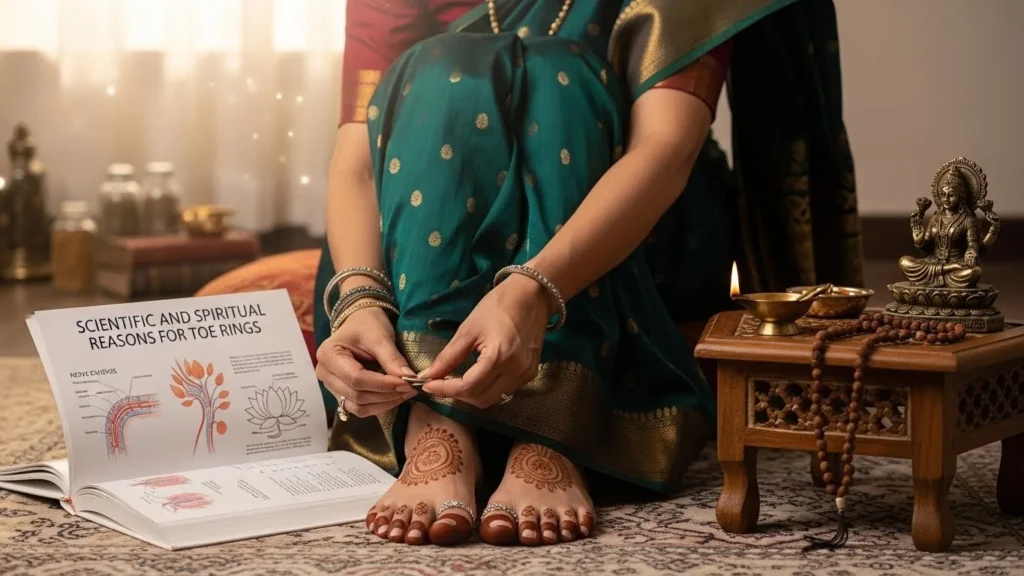
Unlike arbitrary ornamental jewelry or mere cultural convention, toe rings encode remarkable synthesis of scientific health benefits where second toe’s connection to reproductive organs through reflexology pathways means consistent pressure from silver ring regulates menstrual cycles, enhances fertility, alleviates cramps, and promotes uterine health as documented in traditional Ayurvedic texts and increasingly validated by modern reflexology research,
spiritual symbolism where placement on feet represens humility and grounding while pair of rings signifies balanced marital partnership, material significance where silver specifically chosen over gold due to superior conductivity enabling better energy flow plus antimicrobial properties preventing infections alongside astrological association with moon bringing emotional balance and calmness, and social function instantly communicating
woman’s married unavailable status through distinctive adornment visible when barefoot (traditional Indian home custom) or wearing open-toed footwear. The complete toe ring tradition encompasses understanding historical evolution from Vedic period’s simple rings through regional variations creating distinctive styles from Maharashtra’s paired bichhiya through Tamil Nadu’s ornate metti often connected to anklets via delicate chains to contemporary minimalist designs balancing tradition with modern aesthetics, wedding ceremony’s
sacred moment when groom adorns bride’s feet with rings during specific rituals establishing practice that continues throughout married life, scriptural references including Ramayana’s touching episode where kidnapped Sita dropped her toe rings leaving trail for Lord Rama demonstrating these items’ value and significance even in ancient times, Ayurvedic explanations about how silver’s cooling properties balance [translate:pitta dosha] (heat energy) while pressure on second toe’s nerve stimulates [translate:Svadhisthana chakra] governing reproductive and creative energies, and modern scientific
interest where reflexologists document measurable effects of consistent toe pressure on corresponding body systems validating millennia-old traditional wisdom through contemporary research methodologies. For women in 2025 whether newly married brides receiving first toe rings during wedding ceremonies beginning lifelong practice, health-conscious individuals interested in natural remedies for menstrual irregularities discovering toe rings’ therapeutic potential, fashion enthusiasts appreciating beautiful silver jewelry with cultural depth, or simply curious observers wanting to understand distinctive adornment’s significance beyond surface appearance,
recognizing toe rings as sophisticated psycho-spiritual-physical technology rather than outdated superstition or mere ornament enables approaching this practice with renewed appreciation whether choosing to wear for tradition, health, beauty, or meaningful combination thereof while understanding complete framework transforming simple silver rings into powerful symbols encoding ancient wisdom about femininity, fertility, marriage, and holistic wellbeing.
The Cultural and Spiritual Significance
Understanding profound traditional meanings reveals toe rings as far more than decorative accessories.
Symbol of Marital Status
Primary Traditional Function:
Toe rings serve as visible markers of married status, akin to mangalsutra or sindoor.
The Tradition:
Hindu Married Women Wear Toe Rings During Hindu Wedding:
Groom places toe rings on second toe of both bride’s feet, signifying:
- Her transition into married life
- New role as wife
- Sacred bond established
From That Moment:
Wife wears toe rings continuously (traditionally) throughout married life, publicly declaring married status.
Regional Variations:
Different regions, same significance:
Tamil Nadu:
- Called metti or kanaiyazhi
- Often connected to anklet (kolusu) via delicate chain
- Elaborate designs common
Telugu Traditions:
- Known as mettelu
- Part of Sthālīpākaṃ ritual during wedding
- Groom adorns bride’s feet establishing marital bond
Marathi Culture:
- Called jodavi
- Often ornate paired design
- Symbolizes wife’s role and family commitment
North India:
- Bichiya (Hindi term most widely used)
- Simpler designs typically
- Emphasis on silver material
Why Second Toe Specifically?
Not Random Placement:
Multiple Reasons:
1. Anatomical Stability:
- Second toe longest/most stable for ring
- Won’t slip off easily
- Comfortable for daily wear
2. Reflexology Connection:
- Second toe linked to reproductive organs (detailed later)
- Strategic placement for health benefits
- Ayurvedic wisdom about body mapping
3. Traditional Convention:
- Established practice through centuries
- Cultural consistency across regions
- Part of prescribed ritual
Part of Solah Shringar
The Sixteen Sacred Adornments:
[translate:सोलह श्रृंगार (Solah Shringar)] = Sixteen traditional beautifications of married Hindu woman
Toe rings are one of sixteen:
- Bindi (forehead mark)
- Sindoor (vermillion in hair parting)
- Mangalsutra (sacred necklace)
- Nath (nose ring)
- Earrings
- Necklaces
- Bangles
- Rings (fingers)
- Toe rings (bichiya/metti)
- Anklets
- Waist belt
- Henna (mehndi)
- Perfume
- Kajal (eye liner)
- Flowers in hair
- Ornate clothing
Significance:
Complete Solah Shringar = Fully adorned married woman in traditional context
Each element holds specific meaning; toe rings represent grounding and fertility.
Scriptural References: The Ramayana
Ancient Validation:
The epic Ramayana provides notable toe ring reference:
Sita’s Toe Rings:
The Story:
When Sita was abducted by demon king Ravana and carried away in aerial chariot:
She dropped her toe rings along flight path to leave trail for Lord Rama.
Significance:
This demonstrates:
- Toe rings’ value even in ancient times (worth dropping as clues)
- Their recognition as Sita’s personal items
- Identity marker – Rama would recognize them as hers
- Established practice thousands of years ago
The Symbol:
Even in crisis, Sita’s toe rings served purpose – leaving evidence of her path, maintaining hope of rescue.
Association with Goddess Lakshmi
Divine Connection:
According to Puranas, silver toe rings associated with Goddess Lakshmi – deity of wealth, prosperity, and marital bliss.
The Belief:
Wearing silver toe rings:
- Attracts Lakshmi’s blessings
- Brings abundance to household
- Ensures marital prosperity
- Aligns wearer with goddess’s auspicious qualities
Why Silver Specifically?
Lakshmi’s Metal:
Silver = Lakshmi’s favored metal (as gold is Vishnu’s)
Married woman:
- Embodies Lakshmi in household
- Channel for prosperity
- Goddess’s earthly representative
Symbolism of Feet Adornment
Humility and Grounding:
Feet = Earth Connection:
Adorning feet with silver rings symbolizes:
- Grounding in material reality (marriage, family, home)
- Humility (decorating lowest body part, not displaying pride)
- Service (feet walk path of dharma, duty)
- Foundation (marriage as life’s stable base)
Contrast with Head Jewelry:
- Crown/head ornaments = Status, ego, display
- Toe rings = Humility, groundedness, service
The Teaching:
True power lies not in external display but grounded stable foundation.
Pair of Rings: Balance and Partnership
Why Both Feet?
Symmetry and Balance:
Two rings represent:
- Balance between masculine-feminine energies
- Partnership – husband and wife as pair
- Completeness – both sides harmonized
- Equality – neither foot/partner superior
Energy Channels:
Ayurveda recognizes:
- Ida (left/lunar/feminine) and Pingala (right/solar/masculine) nadis
- Balancing both through paired adornment
- Harmonizing energies for marital success
Scientific and Health Benefits: Ayurveda and Reflexology
The documented health advantages transform toe rings from symbolic to functional.
Reflexology: Second Toe’s Reproductive Connection
The Core Scientific Claim:
According to reflexology, “the second toe is connected to the reproductive system in women.”
The Mechanism:
Reflex Points:
Reflexology theory:
- Specific points on feet correspond to organs/systems
- Applying pressure stimulates corresponding areas
- Promotes health and function
Second Toe = Reproductive Organs:
Traditional belief:
- Nerve pathway connects second toe to uterus
- Consistent gentle pressure from ring stimulates this nerve
- Benefits uterine health and fertility
Modern Reflexology Maps:
Contemporary reflexology charts show:
- Reproductive system reflexes in heel and toe areas
- Second toe associated with sinus, eye, and some sources mention reproductive connection
- Ongoing research into these correlations
Health Benefits Claimed
1. Menstrual Cycle Regulation:
The Claim:
“Wearing a toe ring on the second toe is said to apply gentle pressure to this reflex point, helping to stimulate the reproductive system and regulate menstrual cycles.”
Traditional Belief:
- Irregular periods normalized
- Cycle becomes more predictable
- Hormonal balance improved
2. Menstrual Discomfort Relief:
Pain Reduction:
“This is believed to provide relief from menstrual cramps and other discomforts associated with menstruation.”
The Mechanism:
- Pressure point stimulation
- Nerve pathway activation
- Natural pain management through acupressure
3. Enhanced Fertility:
Reproductive Health:
Toe rings thought to:
- Improve uterine health
- Enhance blood flow to reproductive organs
- Support conception
- Promote overall reproductive wellness
Traditional Ayurvedic Wisdom:
Ancient texts mention toe rings’ role in:
- Preparing body for pregnancy
- Supporting healthy gestation
- Postpartum recovery
4. Energy Flow (Prana) Regulation:
Ayurvedic Perspective:
From Ayurvedic view, “toe rings help balance the body’s energy flow, maintaining the prana or life force.”
The Concept:
Nadis (Energy Channels):
- Subtle energy pathways throughout body
- Proper prana flow = Health
- Blockages = Disease
Toe Rings’ Function:
- Stimulate energy channels in feet
- Ensure smooth prana circulation
- Maintain vitality and balance
5. Svadhisthana Chakra Activation:
Second Chakra Connection:
Svadhisthana Chakra:
- Located in lower abdomen
- Governs reproductive organs, creativity, emotions
- Associated with water element
Stimulation Through Feet:
Pressure on second toe believed to activate this chakra:
- Enhancing reproductive health
- Boosting creative energy
- Emotional balance
The Silver Advantage: Material Significance
Why Silver, Not Gold?
Multiple Critical Reasons:
1. Conductivity:
Energy Conduction:
Silver = Excellent conductor (electrical and energetic)
Benefits:
- Better prana/energy flow through body
- Enhances acupressure effects
- Facilitates Earth’s magnetic field absorption
2. Cooling Properties:
Ayurvedic Temperature Balance:
Silver = Cool Metal:
- Balances Pitta dosha (heat/fire energy)
- Reduces inflammation
- Soothes reproductive system
Gold = Hot Metal:
- Increases Pitta
- Creates heat
- Contraindicated for feet (already heat-generating from walking)
3. Antimicrobial Properties:
Scientific fact: “Silver has natural properties which helps to prevent bacteria and fungus growth which can be cause of foot infections.”
Practical Benefit:
- Feet vulnerable to infections (moisture, exposure)
- Silver’s antimicrobial action protects
- Prevents fungal/bacterial problems
4. Astrological Association:
Moon Connection:
Silver = Moon’s Metal:
- Associated with lunar energy in Vedic astrology
- Moon governs emotions, mind, fertility
- Symbolizes calmness, nurturing, femininity
Benefits:
- Emotional balance for married women
- Fertility enhancement (moon-reproductive connection)
- Calming influence on mind
5. Cultural and Spiritual Purity:
Tradition:
Gold = Deity Metal:
- Reserved for worship, upper body adornment
- Considered disrespectful to wear on feet (where dirt, impurity contact)
- Silver appropriate for lower body
Religious Respect:
Feet touch ground (impure) → Gold too sacred for feet → Silver appropriate
Scientific Validation and Skepticism
Important Note:
As article acknowledges: “While the reflexology theory behind toe rings is interesting, it is not scientifically proven. More research is needed to fully understand the potential health benefits.”
Current Status:
Evidence:
- Anecdotal: Many women report menstrual benefits
- Traditional: Thousands of years of Ayurvedic use
- Reflexology: Established practice with documented effects
- Scientific Research: Limited rigorous clinical trials specifically on toe rings
Balanced Perspective:
Benefits likely include:
- Placebo effect (belief creates positive outcomes)
- Actual reflexology stimulation (established mechanism)
- Silver’s antimicrobial properties (proven)
- Psychological comfort (tradition, identity, meaning)
Whether literal nerve-to-uterus pathway or holistic effect:
Many women experience genuine benefits making practice valuable regardless of exact mechanism.
Recommendation:
“It is always recommended to consult with a healthcare professional before using any alternative medicine practices” for serious reproductive health issues.
Toe rings = Complementary practice, not replacement for medical care.
The Wedding Ceremony: Placing the Toe Rings
The ceremonial first wearing marks significant wedding ritual moment.
The Ritual Context
Part of Wedding Ceremonies:
Toe ring placement occurs during Hindu wedding, timing varies by region:
Tamil Nadu Tradition:
Grinding Stone (Ammi) Ritual:
Unique Practice:
“The ritual of placing the bride’s foot on a grinding stone (ammi) symbolizes strength and stability in marriage.”
Following this:
“The groom adorns her feet with silver toe rings, emphasizing his commitment and respect.”
Symbolism:
- Bride stepping on ammi = Strength to face married life’s challenges
- Groom adorning feet = Respect, honor, service to wife
- Beautiful balance of strength and reverence
Telugu Wedding:
Sthālīpākaṃ Ritual:
Specific ceremony where:
- Groom adorns bride’s feet with mettelu (toe rings)
- Signifies her transition to married woman status
- Family witnesses transformation
North Indian Weddings:
Timing Varies:
- Sometimes during main ceremony
- Other times during post-wedding rituals
- Always groom who places rings
The Procedure
Step-by-Step:
1. Rings Prepared:
- Silver toe rings blessed by priest
- Often kept with other wedding jewelry
- Sometimes family heirlooms
2. Bride Seated:
- Feet accessible for groom
- Often on special platform or seat
- Family surrounds
3. Groom’s Action:
- Takes toe rings
- Carefully places on bride’s second toes (both feet)
- May be accompanied by mantras (regional variation)
4. Witnessing:
- Family members observe
- Photographs taken
- Emotional moment recognized
The Transformation
Before Toe Rings:
Bride = Unmarried girl
After Toe Rings (plus other rituals):
Bride = Wife – married woman
Visible Change:
This act, combined with mangalsutra and sindoor:
- Completes marital transformation
- Creates permanent markers
- Public declaration of new status
Lifetime Practice Begins
From This Moment:
Traditional expectation:
Wife wears toe rings:
- Continuously throughout married life
- Until widowhood
- Rarely removed (strictest interpretation)
Modern Variation:
Contemporary women may:
- Remove for bathing, sleeping
- Wear only for special occasions
- Adjust based on comfort
But traditional ideal:
Once groom places them, toe rings become permanent adornment.
Regional Variations and Design Styles
India’s cultural diversity creates distinctive toe ring traditions.
Maharashtra and North India: Bichiya
Simple Paired Design:
Characteristics:
- Typically plain silver bands
- Paired rings (one each foot)
- Second toe placement
- Minimal ornamentation
Cultural Emphasis:
- Function over fashion
- Traditional conservative style
- Emphasis on meaning, not display
Tamil Nadu and South India: Metti
Elaborate Connected Designs:
Distinctive Features:
- Often ornate with detailed work
- Sometimes connected to anklet (kolusu) via delicate chain
- Can be quite large and decorative
- Multiple toe rings sometimes worn
The Chain Connection:
Unique South Indian Element:
Thin silver chain connects:
- Toe ring on second toe
- To anklet around ankle
- Creates integrated foot jewelry
Symbolism:
- Connection throughout married life
- Beauty and elegance emphasized
- Regional cultural pride
Odisha: Filigree Artistry
Tarakasi Work:
Intricate Silver Filigree:
- Known as Tarakasi – traditional Odia silver filigree
- Elaborate designs with nature motifs
- Artistic craftsmanship
- Symbol of regional identity
Characteristics:
- Delicate detailed work
- Often featuring flowers, leaves, peacocks
- Highly decorative while maintaining silver material
Contemporary and Modern Designs
Evolution for Modern Lifestyles:
1. Minimalist Bands:
- Simple thin silver rings
- Professional/office-appropriate
- Less conspicuous
- Daily comfortable wear
2. Adjustable Rings:
- Open-ended design
- Fits various toe sizes
- Easy to put on/remove
- Practical modern innovation
3. Gemstone-Adorned:
- Silver with small embedded stones
- Balances tradition with contemporary aesthetics
- Fashion-forward while maintaining cultural significance
4. Toe-Ring Sandals:
Latest Fashion Trend:
Modern footwear incorporating:
- Attached toe rings
- Eliminates need for separate jewelry
- Fashionable and functional
- Popular in 2024-2025 fashion
Fashion Industry Recognition:
Designers like Paco Rabanne and Miu Miu featured toe rings in Spring/Summer 2024 runway shows, highlighting their resurgence as trendy accessory.
Frequently Asked Questions
Can unmarried women wear toe rings?
Traditionally no, but modern practice varies. Traditional rule: Toe rings exclusively for married Hindu women – cultural marker of marital status like sindoor or mangalsutra. Unmarried girls typically don’t wear before marriage. Modern shift: Contemporary fashion has adopted toe rings as general accessories; unmarried women increasingly wear for style without traditional significance. Cultural sensitivity: In traditional Hindu contexts, unmarried woman wearing toe rings may confuse or appear inappropriate (claiming married status falsely). Recommendation: If unmarried and wanting to wear for fashion, choose clearly decorative modern designs rather than traditional silver bichhiya/metti to avoid cultural misunderstanding. Interfaith/non-Hindu women: Fashion toe rings acceptable; no cultural appropriation concern when not claiming married Hindu status.
Do toe rings really help with menstrual problems?
Mixed evidence – traditional claims partially supported. Scientific status: No rigorous clinical trials specifically proving toe rings regulate menstruation. However: Reflexology research shows foot pressure points affect body systems; many women report genuine benefits. Mechanism: If second toe truly connected to reproductive system via reflexes, consistent gentle pressure could theoretically help. Placebo possibility: Belief in benefit may create positive outcomes (still valuable!). Anecdotal evidence: Thousands of women across generations report improved cycles, reduced cramps. Practical approach: Worth trying if experiencing irregular periods – natural, non-invasive, culturally meaningful. But: Not replacement for medical treatment; serious reproductive issues require doctor consultation. Realistic expectation: May provide subtle support, won’t cure underlying pathologies.
Why silver and not gold for toe rings?
Multiple important reasons: 1. Conductivity – Silver conducts energy better, enhancing acupressure effects. 2. Cooling properties – Ayurveda: Silver cools (balances heat), gold heats (increases Pitta dosha unsuitable for feet). 3. Antimicrobial – Silver prevents bacterial/fungal infections feet prone to. 4. Astrological – Silver = Moon (feminine, fertility, emotions); Gold = Sun (masculine, upper body). 5. Religious respect – Gold too sacred for feet (touch impure ground); silver appropriate. 6. Practical – Silver softer, more comfortable for daily wear; gold harder, less flexible. 7. Traditional – Established practice through millennia; cultural consistency. Can gold be worn? Technically possible but considered inappropriate traditionally and practically less beneficial.
What if toe rings become uncomfortable or cause irritation?
Several solutions exist: 1. Sizing issue – Get properly fitted adjustable rings; too tight = discomfort, too loose = falling off. 2. Material reaction – Some sensitive skin reacts to certain silver alloys; try pure sterling silver (92.5%) or hypoallergenic varieties. 3. Break-in period – New rings may feel strange initially; give few days adaptation. 4. Removal for activities – Take off during sleep, exercise, swimming if causing issues. 5. Rotation – Wear occasionally vs. constantly if full-time uncomfortable. 6. Professional adjustment – Jewelers can resize, smooth rough edges, improve comfort. 7. Alternative designs – Open-ended adjustable styles often more comfortable than closed bands. Traditional flexibility: While ideal is continuous wearing, genuine physical discomfort justifies removal – health and comfort matter.
Can widows or divorced women wear toe rings if they remarry?
Yes, absolutely – through remarriage. Widow remarriage: When Hindu widow remarries, new husband places fresh toe rings during wedding ceremony, establishing practice for second marriage. Traditional resistance to widow remarriage diminishing; modern Hinduism increasingly accepting. Divorced women: If remarrying, full toe ring ritual performed with new husband. First marriage’s symbols don’t prohibit future marriages. The principle: Toe rings represent current living husband – if woman has living husband through remarriage, toe rings appropriate. First marriage rings: Typically removed upon widowhood/divorce; some keep for sentimental value privately. No permanent disqualification: Past marital status doesn’t prevent future full traditional rites including complete Solah Shringar with toe rings.
Do toe rings have any side effects or health risks?
Generally very safe with minimal risks: Potential issues: 1. Metal allergies – Some women allergic to certain silver alloys; solution: pure sterling silver or hypoallergenic options. 2. Circulation problems – Too-tight rings could restrict blood flow; solution: proper sizing, adjustable designs. 3. Skin irritation – Moisture trapped between toe and ring may cause irritation; solution: remove for washing, dry thoroughly, ensure breathability.
4. Fungal infections – Constant moisture + metal can create fungal growth environment; solution: good foot hygiene, occasional removal for cleaning. 5. Nerve compression – Extremely tight rings theoretically could compress nerves; solution: appropriate fit. Overall: Millions of women wear toe rings lifelong without problems. Benefits outweigh risks when properly fitted, quality material, good hygiene maintained. If persistent issues: Consult doctor; underlying health condition may exist unrelated to toe rings.
Can toe rings be worn with Western clothing and footwear?
Absolutely – modern styling accommodates both. Best combinations: 1. Open-toed shoes – Sandals, flip-flops, peep-toe heels perfectly showcase toe rings. 2. Barefoot looks – Beach wear, casual summer outfits, at-home styling. 3. Strappy sandals – Delicate designs complement visible toe jewelry. 4. Anklet pairing – Coordinate toe rings with anklets for cohesive look. Less suitable: Closed-toe shoes obviously hide toe rings (wear for cultural/health benefits even if not visible). Fashion fusion: Many modern women blend traditional toe rings with contemporary Western outfits creating unique personal style. Office wear: Minimalist subtle toe rings appropriate even professional settings when wearing open-toed professional footwear. The beauty: Toe rings versatile enough for traditional sari or modern dress – crosses cultural boundaries as elegant accessory.
What to do if toe ring breaks or gets lost?
Replace promptly with respect: Traditional concern: Some believe losing/breaking toe ring inauspicious for marriage. Modern perspective: Accidents happen; no supernatural consequence from broken jewelry. Practical steps: 1. Replace quickly – Maintain continuous wearing; jewelers have ready stock. 2. Keep spare pair – Some women have backup toe rings preventing gap. 3. Repair if possible – Broken silver rings often can be soldered by jeweler. 4. Dispose respectfully – If irreparable, don’t trash carelessly; some donate to temple or keep as memory. 5. No guilt/superstition – Marriage’s strength lies in relationship, not jewelry. Insurance consideration: Valuable heirloom toe rings can be insured. The key: Toe rings are symbols; their breaking doesn’t break marriage itself. Replace calmly without excessive worry while maintaining respect for tradition.
Conclusion
The ancient practice of wearing toe rings represents remarkable integration of scientific wisdom, spiritual symbolism, and cultural tradition – embodying sophisticated understanding of human physiology through reflexology principles documenting second toe’s connection to reproductive system alongside Ayurvedic knowledge about silver’s cooling antimicrobial properties and energy conduction while simultaneously serving as beautiful visible marker of married status honoring sacred partnership through grounded humble adornment positioned on feet representing earth connection and service-oriented consciousness rather than egotistical display.
Understanding complete framework – that documented health benefits from menstrual cycle regulation through fertility enhancement to cramp relief stem from consistent gentle pressure on strategically located acupressure points validated by both millennia-old Ayurvedic texts and modern reflexology research creating natural non-invasive therapeutic approach complementing conventional medicine, that spiritual significance encompasses multiple dimensions from Goddess Lakshmi association bringing prosperity through Ramayana’s scriptural validation in Sita’s story to Solah Shringar’s complete married woman adornment framework
that silver material chosen specifically over gold for superior conductivity enabling better prana flow plus cooling properties balancing Pitta dosha alongside antimicrobial protection and moon’s astrological connection bringing emotional balance fertility support, that regional variations from simple North Indian bichiya through elaborate South Indian metti connected to anklets to contemporary minimalist designs create rich diversity within overarching tradition, and that wedding ceremony’s sacred moment when groom adorns bride’s feet establishes lifetime practice connecting modern women with countless ancestral wives – enables approaching toe rings with nuanced appreciation acknowledging both genuine therapeutic potential and profound cultural-spiritual meaning.
As you engage with toe ring tradition in 2025, whether newly married bride receiving first rings during wedding ceremony beginning practice connecting you to ancient lineage, health-conscious woman exploring natural approaches to menstrual wellness discovering toe rings’ documented reflexology benefits, fashion enthusiast appreciating beautiful silver jewelry offering cultural depth beyond mere decoration, traditional practitioner maintaining lifelong habit honoring ancestors while potentially enjoying tangible health advantages, or simply curious observer understanding distinctive adornment’s multifaceted significance beyond surface appearance, remember that tradition’s ultimate value emerges
when ancient wisdom meets informed choice where practices adopted from genuine understanding of both scientific mechanisms and spiritual symbolism prove far more meaningful than those maintained through blind compliance or dismissed through uninformed skepticism, that toe rings’ remarkable synthesis of health functionality and sacred symbolism demonstrates Hinduism’s sophisticated holistic approach recognizing body-mind-spirit interconnection rather
than artificial separation treating physical ornament as potential therapeutic device and spiritual practice simultaneously, and that whether wearing for reproductive health support, marital status declaration, cultural heritage connection, aesthetic appreciation, or meaningful combination thereof, simple silver rings placed on second toes encode profound teachings about grounding, partnership, fertility, humility, and integration of material wisdom with spiritual aspiration transforming everyday adornment into conscious practice honoring both scientific understanding and sacred tradition through beautiful accessible form available to all married women seeking to claim this empowering heritage.
[translate:॥ पादयोः रजतं धार्यं सुभगत्वं प्रदायकम्॥]
(Silver should be worn on feet; it bestows auspiciousness and marital bliss.)
About the Author
Sunita Reddy – Ayurveda, Traditional Healing, and Vedic Sciences Expert
Sunita Reddy is a distinguished practitioner and researcher specializing in Ayurvedic medicine, traditional healing modalities, Vedic sciences, and the integration of ancient wisdom with modern scientific understanding particularly regarding practices like toe rings that encode sophisticated physiological knowledge.
Holding advanced degrees in both Ayurvedic medicine and biomedical sciences with extensive clinical experience treating reproductive health issues using traditional and integrative approaches, his work examines how practices dismissed as mere superstition often contain genuine therapeutic mechanisms validatable through contemporary research methodologies from reflexology to acupressure to material science. Vikram has extensively studied
marriage-related health practices including toe rings, specific dietary traditions, herbal remedies, and lifestyle recommendations documenting how these customs emerged from careful observation of human physiology and energetics across generations creating empirical knowledge base that preceded yet aligns with modern medical understanding about connections between pressure points, hormonal regulation, and overall wellness.
He regularly consults with women experiencing menstrual irregularities, fertility challenges, and reproductive health concerns offering integrative treatment plans combining Ayurvedic principles with conventional medicine, teaches courses on Vedic health sciences explaining sophisticated theories underlying seemingly simple practices like wearing silver on specific toes, and conducts research validating traditional claims through rigorous scientific methodology demonstrating how ancient wisdom and modern science can complement rather than contradict each other.
His teaching emphasizes that dismissing traditions as outdated superstition without investigating potential mechanisms represents intellectual laziness equal to blindly accepting claims without evidence, that many traditional practices encode genuine health benefits waiting to be properly studied and understood through contemporary frameworks, and that toe rings specifically exemplify beautiful integration where cultural symbolism, spiritual meaning, and documented therapeutic effects converge making simple adornment into multifaceted practice serving women’s wellbeing across physical, psychological, and spiritual dimensions simultaneously.