

The practice of removing footwear before entering temples Why Do Hindus Remove Shoes represents one of Hinduism’s most universal, immediately visible, and practically significant customs that Why Do Hindus Remove Shoes every temple visitor encounters – the rows of shoes lined outside temple entrances creating distinctive visual marker signaling transition from mundane outer world to sacred inner sanctum where devotees walk barefoot across cool stone floors directly connecting physical body with spiritually consecrated ground embodying beautiful synthesis of practical cleanliness maintaining temple purity.

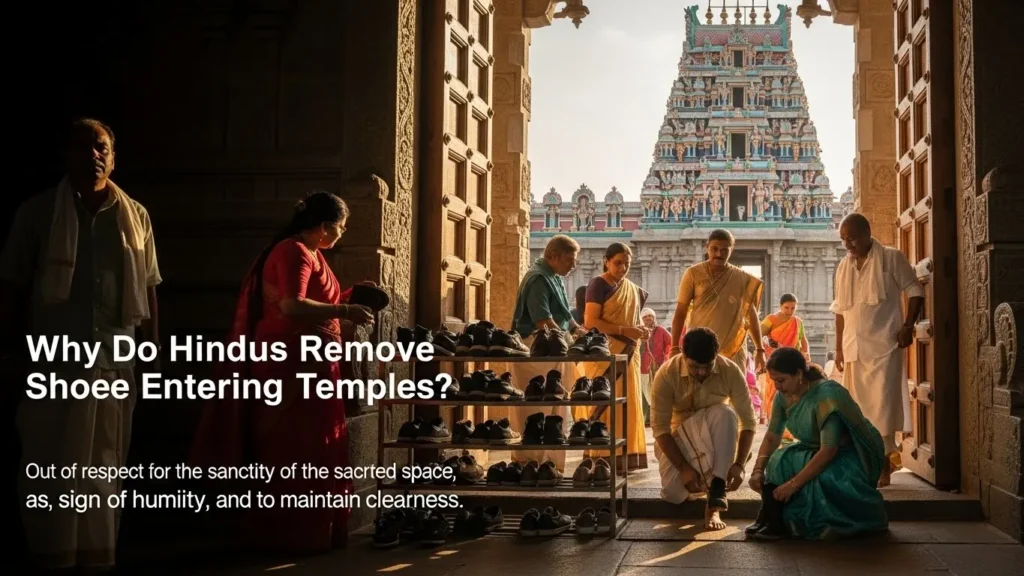
free from outside dirt and impurities, profound respect demonstrating humility before divine presence by removing symbols of worldly status and ego, spiritual energy absorption where bare feet function as receptors drawing positive vibrations from specially consecrated temple architecture built on energetically powerful locations using specific materials and Vastu principles, health benefits through natural foot reflexology activating vital pressure points ([translate:marma]) linked to organs and systems while grounding body’s electrical charge through direct earth contact, and symbolic surrender physically enacting philosophical truth that approaching God requires shedding material attachments and ego’s false superiority presenting oneself in simplest most vulnerable form.
Unlike arbitrary social convention or mere hygiene protocol, removing shoes encodes sophisticated understanding that temples aren’t ordinary buildings but carefully engineered spiritual transmission devices where massive stone structures built through generations following precise architectural science function as energy vortices concentrating and emanating divine vibrations devotees consciously absorb more effectively through barefoot contact establishing direct energetic circuit between consecrated ground and human body’s subtle energy system ([translate:pranamaya kosha]) amplifying worship’s transformative potential beyond intellectual prayer toward embodied experiential communion.
The complete significance encompasses multiple dimensions from scriptural injunctions in texts like [translate:Manusmriti] and [translate:Angirasa Smriti] explicitly stating footwear’s impurity during sacred activities through traditional belief that leather shoes made from dead animals carry energetic contamination violating [translate:ahimsa] (non-violence) principle when brought into sacred spaces consecrated for life-affirming divine worship, to modern scientific validation through studies on “earthing” or “grounding” demonstrating measurable physiological benefits including reduced inflammation, improved sleep.
normalized cortisol rhythms, and enhanced cardiovascular function when bare feet contact earth’s natural electrical field which temple’s stone floors efficiently conduct, plus yogic recognition that walking barefoot activates [translate:Muladhara] (root chakra) governing stability, security, and foundational connection with material plane creating grounded consciousness receptive to spiritual experience rather than scattered mental agitation.
For practitioners and visitors in 2025 whether regular temple devotees maintaining lifelong practice instilled from childhood, spiritual seekers newly discovering Hindu traditions wanting to understand familiar customs’ deeper meanings, tourists visiting India’s magnificent temples seeking culturally respectful etiquette, or interfaith families navigating diverse religious practices in multicultural households, recognizing shoe removal as sophisticated spiritual technology rather than arbitrary rule or inconvenient requirement
enables approaching this simple act with renewed appreciation transforming potentially mechanical compliance into conscious spiritual gesture where each step barefoot upon cool temple stone becomes meditation connecting modern worshipper with countless generations who walked identical path, each removal of worldly footwear symbolizes deliberate shedding of ego and material preoccupations, and direct contact between vulnerable bare feet and consecrated ground creates tangible physical reminder that authentic spirituality requires removing protective barriers allowing divine energy to penetrate consciousness unobstructed by false securities worldly possessions and social status provide.
The Spiritual Significance: Purity, Humility, and Sacred Ground
Understanding profound spiritual dimensions reveals this practice as far more than hygiene or custom.
The Temple as Divine Dwelling
Hindu philosophy recognizes temples as God’s literal house ([translate:Devalaya] – deity’s abode), not mere symbolic structures.
Sacred Space Concept:
Just as we remove shoes entering our own homes, entering deity’s home requires same respect – actually greater reverence given divine resident’s supreme status.
The Transition:
Outside temple boundary: Mundane world ([translate:samsara])
- Chaos, commerce, worldly concerns
- Mixed energies, impurities
- Ego-centered existence
Inside temple: Sacred realm ([translate:divya kshetra])
- Order, peace, divine presence
- Pure vibrations, consecrated space
- God-centered consciousness
Removing shoes marks this transition – physical act signaling mental shift from worldly to spiritual consciousness.
The Threshold:
Temple entrance functions as boundary between two realms. Footwear left outside symbolically remains in outer world while purified barefoot devotee crosses into inner sanctum.
Showing Humility and Respect Why Do Hindus Remove Shoes
The Symbolism of Shoes:
In traditional society, footwear indicates:
- Social status – expensive shoes vs. simple chappal
- Wealth – leather boots vs. rubber slippers
- Worldly identity – professional shoes, casual footwear
- Ego and pride – designer brands, fashion statements
Removing all footwear creates equality:
Before God, all devotees stand identically – rich and poor, high-born and low-born, educated and illiterate become indistinguishable when barefoot.
No visible status markers remain – shoes can’t proclaim wealth or position.
This teaches profound truth: Material distinctions meaningless in divine presence; spiritual worthiness alone matters.
Physical Humility:
Bare feet = vulnerable state:
- No protection from ground’s hardness
- Subject to temperature (hot stones in summer, cold marble in winter)
- Exposed, defenseless
- Childlike simplicity
This vulnerability embodies surrender – approaching God without armor, pretense, or shields ego typically maintains.
Leaving Behind Worldly Concerns
Removing shoes symbolizes shedding material attachments and ego before entering divine presence.
Symbolic Removal:
Physical: Footwear stays outside
Metaphorical: Also leaving behind:
- Ego and arrogance
- Worldly anxieties and stresses
- Material obsessions
- Social masks and pretenses
- Business concerns and ambitions
Teaching: Can’t carry worldly baggage into spiritual realm – must consciously release to receive divine blessings.
Some devotees extend this:
- Remove leather belts (animal products)
- Leave wallets outside (money/materialism)
- Remove watches (time/worldly schedules)
- Maximum simplification
Sacred Ground Concept
The Temple Floor as Holy:
Not ordinary ground but specially consecrated:
Construction Ritual:
Traditional temple building involves:
- Vastu Puja – consecrating land before construction
- Foundation ceremonies – burying sacred items (copper plates, gems, mantras)
- Specific materials – marble, granite, sandstone chosen for energetic properties
- Directional alignment – Vastu Shastra principles followed
- Daily sanctification – floors cleaned with turmeric, sandalwood paste, sacred water
Result: Every inch of temple floor spiritually charged.
Barefoot contact allows:
- Direct absorption of these vibrations
- Energetic circuit between consecrated ground and body
- Maximum benefit from temple’s spiritual engineering
Shoes as barrier blocking this vital connection.
Scriptural Basis:
Biblical parallel (though different religion):
When Moses approached burning bush, God commanded: “Remove your sandals, for the place where you stand is holy ground.”
Similar concept in Hinduism: Sacred spaces demand barefoot approach recognizing ground’s sanctity.
Maintaining Cleanliness and Purity
Practical Consideration:
Shoes carry:
- Dust and dirt from streets
- Bacteria and pathogens
- Energy from varied locations walked
- Mixed vibrations (marketplace, home, workplace)
Bringing into temple:
- Pollutes physically (dirt, germs)
- Contaminates energetically (outside vibrations)
- Disrespects sanctity
- Disrupts purity maintenance
Temple Cleanliness:
Temples typically maintained spotlessly:
- Daily sweeping and mopping
- Sacred substances used (turmeric water, cow dung water – naturally antiseptic)
- Flowers changed daily
- Constant purification
Outdoor footwear would defeat this effort, requiring constant re-cleaning and never achieving true purity.
The Leather Issue: Ahimsa (Non-Violence)
Special Consideration:
Traditional footwear often made from leather – dead animal skin.
Hindu Philosophy:
Ahimsa (अहिंसा) – non-violence, harmlessness – fundamental principle
Leather represents:
- Animal death
- Violence toward living beings
- Impurity from death energy
- Contradiction to life-affirming temple space
Bringing leather into temple:
- Violates ahimsa symbolically
- Introduces death’s vibration into life-consecrated space
- Shows disrespect to divine who sustains all life
Even synthetic materials: While not from animals, shoe removal remains universal – other reasons (cleanliness, humility, energy) still apply.
Some strict temples also prohibit:
- Leather belts
- Leather wallets
- Any animal-derived products
This profound multidimensional significance transforms simple act of shoe removal into conscious spiritual statement.
Scientific and Health Benefits: Grounding, Energy, and Reflexology
Modern science increasingly validates ancient wisdom behind barefoot walking in sacred spaces.
Earthing/Grounding: The Electrical Connection
The Science:
Earth’s surface carries subtle negative electrical charge. Human bodies accumulate positive charge from modern life (electronics, synthetic materials, insulated shoes).
This imbalance causes:
- Inflammation
- Poor sleep
- Stress and anxiety
- Cardiovascular issues
- Weakened immune function
Grounding (direct skin contact with earth) normalizes this:
Research Shows:
Published Studies Demonstrate:
- Reduced inflammation markers (C-reactive protein, white blood cell count)
- Improved sleep quality (normalized cortisol rhythms)
- Decreased pain (chronic and acute)
- Enhanced cardiovascular function (blood viscosity reduction)
- Accelerated wound healing
- Stress reduction (lowered cortisol levels)
Mechanism: Electrons from earth neutralize positively-charged free radicals causing inflammation.
Temple Floors as Conductors:
Stone materials (marble, granite, sandstone) excellent conductors:
- Allow earth’s electrons to flow into body
- More effective than dirt or grass (though those work too)
- Cool temperature enhances effect
- Polished surface provides smooth contact
Barefoot temple walking = grounding therapy our ancestors intuited before modern science explained it.
Activation of Muladhara (Root Chakra)
Yogic Understanding:
Walking barefoot activates Muladhara Chakra – first of seven energy centers located at base of spine.
Muladhara Governs:
- Physical: Survival, security, basic needs
- Emotional: Stability, grounding, safety
- Spiritual: Connection to earth, material plane integration
Feet as Muladhara Extension:
Though chakra located at spine’s base, feet serve as ground connection for this energy center.
Barefoot walking stimulates Muladhara through:
- Direct earth contact
- Pressure on foot soles
- Sensory awareness of ground
- Symbolic grounding
Benefits:
- Enhanced stability and balance (physical and psychological)
- Reduced anxiety and fear
- Improved focus and presence
- Foundation for higher chakra activation
Spiritual implication: Can’t properly activate upper chakras (heart, throat, third eye, crown) without solid root chakra foundation. Barefoot temple walking ensures this grounding before approaching deity.
Foot Reflexology: Activating Marma Points
Ancient Ayurvedic Knowledge:
Marma points (मर्म) – vital energy points where consciousness concentrates, similar to Chinese acupressure points.
Feet contain numerous marma points connected to:
- Internal organs (kidneys, liver, heart, lungs)
- Glands (pituitary, thyroid)
- Nervous system
- Digestive system
Walking barefoot naturally stimulates these:
Benefits:
- Improved circulation – blood flow to all organs
- Enhanced organ function – gentle massage effect
- Immune system boost – lymphatic activation
- Detoxification – pressure points linked to elimination
- Hormonal balance – endocrine gland stimulation
Temple walking specifically:
Circumambulation (pradakshina) involves:
- Repeated circles around sanctum
- Extended barefoot walking (10-30 minutes typical)
- Various floor textures (smooth marble, rough stone)
- Natural reflexology session combined with spiritual practice
Temperature Benefits: The Cooling Effect
Temple Floor Materials:
Stone’s properties:
- Naturally cool – maintains lower temperature even in heat
- Heat absorption – draws excess body heat
- Thermal regulation – helps normalize body temperature
Health Benefits:
Ayurvedic Perspective:
Excess Pitta dosha (heat) causes:
- Anger and irritability
- Inflammation
- Digestive issues
- Skin problems
Cool stone contact:
- Reduces Pitta
- Calms mind
- Soothes nerves
- Balances body temperature
Practical Experience:
Most temple visitors immediately notice:
- Pleasant coolness underfoot
- Calming sensation
- Relief from heat (especially summer)
- Soothing effect on entire body
This cooling contributes to temple’s overall peaceful atmosphere.
Posture and Muscular Benefits
Barefoot Walking vs. Shoes:
Modern shoes:
- Alter natural foot position
- Weaken foot muscles (constant support)
- Affect entire skeletal alignment
- Restrict natural movement
Barefoot walking:
- Strengthens foot muscles – arches, toes, ankles
- Improves posture – proper spinal alignment
- Enhances balance – better proprioception (body position sense)
- Prevents injuries – stronger stabilizing muscles
- Natural gait – feet move as designed
Temple Context:
Regular barefoot temple visits (weekly/monthly):
- Provides natural foot exercise
- Counteracts modern footwear’s negative effects
- Maintains foot health and strength
- Supports overall musculoskeletal wellness
Energy Absorption from Consecrated Space
The Subtle Dimension:
Beyond measurable physical benefits, subtle energy absorption occurs:
Temple as Vortex:
As explained in pradakshina article, temples function as energy vortices:
- Consecration rituals charge space
- Daily worship maintains vibration
- Architectural design concentrates energy
- Specific deity energy radiates
Barefoot contact:
- Maximizes absorption – no insulating barrier
- Creates circuit – energy flows earth → feet → body
- Enhances receptivity – physical openness mirrors spiritual openness
Amplification:
Some traditions recommend:
- Wet feet (after ritual bath) – water enhances conductivity
- Pradakshina (circumambulation) – extended exposure time
- Prostration (full body contact) – maximum ground connection
Scriptural References and Traditional Teachings
Ancient Hindu texts explicitly address footwear and sacred spaces.
Manusmriti: The Dharma Shastra
Key Text:
[translate:मनुस्मृति] (Manusmriti) – ancient legal and ethical code
Chapter 4, Verse 45:
Advises against wearing shoes during:
- Eating
- Worshipping
- Sleeping
- Sitting for study
- Performing bodily functions
Implication: Footwear carries impurities inappropriate for sacred or pure activities.
While not directly mentioning temple entry, principle clear: Remove shoes before approaching anything sacred.
Angirasa Smriti: Explicit Temple Guidance
Direct Reference:
[translate:अंगिरस स्मृति] (Angirasa Smriti) – important Dharma Shastra
Explicitly states:
Footwear should be removed in:
- Places of worship (temples)
- Sacred homes (where worship conducted)
- Presence of elders and teachers
- Any sanctified environment
Purpose: Maintaining environmental sanctity vital for spiritual practice effectiveness.
Traditional Interpretations
Scholarly Commentary:
Ancient commentators emphasized:
External Actions Reflect Internal States:
Removing footwear = physical manifestation of:
- Mental purification
- Ego reduction
- Respect cultivation
- Humility demonstration
Conscious preparation – mindful removal (not casual kicking off) prepares consciousness for worship.
Historical Practice:
Even Wooden Footwear:
Ancient India used:
- Padukas (पादुका) – wooden sandals
- Minimal protection
- Simple construction
Even these removed before temples – any barrier between feet and sacred ground avoided.
Kings and commoners alike – no exceptions based on status.
Cross-Cultural and Interfaith Parallels
Barefoot sacred space entry appears across religions and cultures worldwide.
Islam: Mosque Entry
Universal Practice:
Muslims always remove shoes before entering mosques.
Reasons:
- Cleanliness for prayer (prostration on floor)
- Respect for sacred space
- Following Prophet Muhammad’s example
- Equality before Allah
Very similar principles to Hindu practice.
Buddhism: Temple and Monastery Protocol
Consistent Requirement:
Buddhist temples, monasteries, meditation halls require barefoot entry.
Additional Dimension:
Many Buddhist monks walk barefoot as:
- Humility practice
- Detachment from comfort
- Mindfulness exercise
- Connection with earth
Sikhism: Gurdwara Etiquette
Mandatory Practice:
Sikhs remove footwear before entering Gurdwara (Sikh temple).
Respect for Guru Granth Sahib:
Sacred scripture housed inside demands:
- Utmost cleanliness
- Complete humility
- Removal of all status symbols
Judaism: Ancient and Modern
Biblical Precedent:
Moses at Burning Bush (Exodus 3:5):
God commanded: “Remove your sandals from your feet, for the place on which you stand is holy ground.”
Modern Practice:
While most synagogues don’t require shoe removal, some:
- Orthodox communities during specific ceremonies
- Removing shoes before approaching Torah ark
- Recognizing sacred moments and spaces
Christianity: Varied Traditions
Some Christian Denominations:
Ethiopian Orthodox:
- Shoes removed before entering churches
- Following ancient Near Eastern customs
Monks and Nuns:
- Barefoot or simple sandals
- Symbol of poverty, humility, penance
Special Ceremonies:
- Foot washing rituals
- Holy Thursday observances
Indigenous and Nature-Based Traditions
Earth Connection:
Many indigenous spiritual practices:
- Barefoot ceremonies
- Direct earth contact during rituals
- Recognition of land’s sacredness
- Grounding as spiritual practice
Greek Orthodox: Fire Walking
Anastenaria Ritual:
Participants walk barefoot over burning coals:
- Faith demonstration
- Purification
- Spiritual endurance
- Direct from ancient practices
Universal Pattern:
Common Thread Across Faiths:
- Sacred spaces deserve special respect
- Humility required before divine
- Physical purity supports spiritual purity
- Removing barriers enhances connection
- Equality important in worship
This universality suggests deep human recognition that approaching transcendent requires shedding ordinary world’s trappings.
Frequently Asked Questions
What if I have foot injury or disability preventing barefoot walking?
Temples generally accommodate genuine medical needs. Options: 1) Clean socks – many temples allow fresh socks never worn outside, 2) Indoor-only footwear – special shoes kept exclusively for temple (some temples provide), 3) Wheelchair users – typically exempted from barefoot requirement, 4) Medical documentation – severe conditions may warrant exception with priest’s permission. Key: Distinguish genuine medical necessity from mere preference. Most devotees: Minor discomfort acceptable as tapas (austerity). Sincere intention matters – God recognizes genuine limitation vs. reluctance.
Can we bring shoe covers or clean slippers instead of going completely barefoot?
Generally no – defeats practice’s purpose. Why not acceptable: 1) Symbolic removal lost – still carrying “shoes” spiritually, 2) Energy barrier remains – can’t absorb vibrations through material, 3) Humility gesture incomplete – attempting to maintain comfort/protection, 4) Grounding benefits eliminated – no earth contact. Exception: Some modern temples (especially in cold climates) provide or allow indoor-only slippers maintained temple-side, never worn outside. Traditional temples: Strictly barefoot only. Better: Accept temporary discomfort as sacrifice demonstrating devotion rather than seeking comfort-preserving alternatives.
Are there specific places to leave shoes safely without theft?
Most temples provide designated areas. Options: Shoe stands/racks: Free organized storage near entrance. Paid shoe counters: Small fee (₹2-10) for numbered token system. Carry-along bags: Some devotees bring bags carrying shoes throughout visit. Leave with companion: Take turns watching belongings. Temple trust: Generally safe – theft rare due to sanctity consciousness. Valuable footwear: If concerned, either don’t wear expensive shoes to temple or use paid counter. Lost shoes: Occasionally happens in large crowds; pragmatically accept as lesson in non-attachment if occurs.
Do children and babies also need to remove shoes?
Yes, same rule applies to all ages. Babies: Often carried barefoot or in fresh socks. Toddlers: Learning temple etiquette early establishes lifelong habit. Benefits for children: 1) Foot development – barefoot walking healthier for growing feet, 2) Sensory experience – cool stone, different textures, 3) Cultural education – understanding traditions, 4) Discipline – following rules respectfully. Parental concern: Stone may seem hard/cold for tender feet, but children typically adapt quickly. Teaching moment: Explain why removing shoes matters, making it meaningful not arbitrary.
Can we wear socks in temples or must feet be completely bare?
Varies by temple tradition and regional custom. Barefoot preferred: Maximum energy contact, traditional practice. Socks acceptable in some temples: 1) Clean socks never worn outdoors, 2) Cold weather protection (North India winters), 3) Medical reasons (foot conditions), 4) Personal modesty (some feel uncomfortable with bare feet). Strict traditional temples: May prohibit socks – complete barefoot required. Best practice: Observe what others do, ask temple staff if uncertain. Own preference: Try fully barefoot for authentic experience and maximum spiritual/health benefits.
What about women during menstruation – do they still remove shoes?
Shoe removal applies regardless of other restrictions. Context: Some traditional temples restrict menstruating women’s entry entirely (controversial practice being challenged). Where entry permitted: All normal protocols apply including shoe removal. No separate rule for footwear based on menstrual status. Modern perspective: Increasing temples (especially ISKCON, progressive urban temples) have no menstruation restrictions at all – women welcome always, barefoot like everyone. This question actually involves larger debate about menstruation and temple entry, but shoe removal itself not connected to that issue.
Are temples outside India less strict about shoe removal?
Most Hindu temples worldwide maintain this practice. Diaspora temples: (USA, UK, Canada, Australia, Southeast Asia) Generally require shoe removal maintaining tradition. Some adaptations: 1) Better shoe storage – dedicated rooms, lockers, 2) Clean indoor footwear sometimes allowed (temple-provided slippers), 3) Carpeted areas making barefoot more comfortable, 4) Heated floors (cold climate temples). Western converts: Sometimes initially uncomfortable but adapt once understanding significance. Cultural sensitivity: Non-Hindu visitors welcomed but expected to follow protocol. Rare exceptions: Extremely liberal temples may allow footwear, but vast majority (95%+) maintain traditional practice globally.
Does shoe removal apply to home altars/puja rooms also?
Traditional practice extends to home worship spaces. Common approaches: Dedicated puja room: Many families treat as mini-temple – shoes never worn inside that room. Puja corner/altar: May not restrict footwear in entire room but remove shoes before actually performing puja. Very orthodox families: Separate “indoor” footwear for house, remove even those before puja room. Practical modern adaptation: Many simply remove shoes before sitting for puja, even if wearing them elsewhere in home. More important at home: Consciousness and devotion than strict rule-following. Daily convenience: Most families don’t maintain temple-level strictness at home altars but show respect through mindful approach.
Conclusion
The universal Hindu practice of removing shoes before temple entry represents beautiful convergence of profound spiritual wisdom, practical hygiene, health benefits, and symbolic surrender – encoding sophisticated understanding in deceptively simple act that every devotee performs yet few fully appreciate, demonstrating how tradition preserves multi-dimensional truths accessible to both simple village devotee offering barefoot prayers without intellectual analysis and scholarly seeker exploring layers of meaning from scriptural injunctions through yogic energy principles to modern scientific validation of grounding’s physiological benefits.
Understanding complete framework – that temples aren’t mere buildings but carefully consecrated spaces functioning as spiritual transmission devices where divine energy concentrates and radiates requiring devotee’s maximum receptivity achieved through barefoot contact establishing direct energetic circuit between sanctified ground and subtle body bypassing shoes’ insulating barrier, that humility before God requires shedding worldly status symbols and ego’s protective armor approaching divine presence vulnerable and exposed like child before loving parent.
that scriptural texts from Manusmriti through Angirasa Smriti explicitly address footwear’s impurity during sacred activities reflecting deeper principle that external actions preparing internal consciousness for spiritual receptivity, and that measurable health benefits from grounding’s inflammation reduction through barefoot reflexology’s organ stimulation to root chakra activation’s psychological stability validate ancient practice through modern scientific frameworks confirming our ancestors’ intuitive wisdom – enables approaching this simple gesture with renewed appreciation whether regular temple visitor maintaining lifelong habit instilled from childhood, spiritual seeker discovering Hindu traditions wanting to understand rather than mechanically follow, respectful tourist visiting India’s magnificent temples seeking culturally appropriate behavior, or interfaith family member participating in spouse’s or in-laws’ religious observances.
As you visit temples in 2025, whether weekly routine at neighborhood mandir maintaining daily spiritual rhythm, special pilgrimage to famous ancient temples experiencing centuries of accumulated devotional vibrations, or occasional festival visit participating in massive community celebrations, remember that simple act of removing shoes before crossing threshold represents conscious choice to transition from mundane to sacred, worldly to spiritual, ego-centered to God-centered consciousness.
physically demonstrating through vulnerable bare feet what heart seeks to achieve through devotional surrender, creating tangible reminder that authentic spirituality requires removing protective barriers allowing divine energy to penetrate unobstructed, and participating in universal practice transcending sectarian boundaries as Muslims, Buddhists, Sikhs, and countless other traditions similarly honor sacred spaces through barefoot approach recognizing deep human truth that approaching transcendent reality demands shedding ordinary world’s trappings whether literal shoes or metaphorical ego armor we habitually maintain.
The cool temple stone beneath bare feet becomes meditation in itself – each step grounding awareness in present moment, each contact absorbing subtle vibrations our ancestors engineered into sacred architecture, each vulnerable footfall demonstrating trust in divine grace supporting us more reliably than any worldly security material possessions and social status provide, until eventually the simple act of walking barefoot into temple transforms from externally imposed rule into internally cherished practice we wouldn’t abandon even if permitted since direct contact with sacred ground feeds something deep within soul recognizing home not in worldly accomplishments or possessions but in humble loving approach toward eternal divine presence patiently awaiting our barefoot return.
[translate:॥ सर्वं परवशं दुःखं सर्वमात्मवशं सुखम्।
एतद्विद्यात् समासेन लक्षणं सुखदुःखयोः॥]
(Everything under others’ control brings suffering; everything under self-control brings happiness. Know this as the distinguishing mark of joy and sorrow. – Removing shoes = placing ourselves under God’s control, not ego’s.)
About the Author
Kavita Iyer – Daily Worship Rituals, Home Puja Practices, and Sacred Symbolism Expert
Kavita Iyer is a dedicated teacher and practitioner specializing in Hindu daily worship rituals, home puja practices, sacred symbolism, and making traditional devotional practices accessible and meaningful for contemporary families. Drawing from personal experience growing up in traditional South Indian Brahmin household where grandmother’s meticulous observance of temple protocols including always arriving early to walk barefoot pradakshina absorbing morning’s fresh energy created lasting impression of how simple physical practices carry profound spiritual significance, combined with study of temple agama procedures, Ayurvedic principles, and yogic energy systems, her work focuses on explaining seemingly simple customs’ deep multi-dimensional meanings addressing spiritual aspirations, practical health, symbolic teachings, and conscious devotional cultivation.
Kavita has extensively researched various aspects of Hindu temple worship including shoe removal protocols, barefoot benefits, sacred space concepts, ritual purity maintenance, and integration of traditional wisdom with modern scientific understanding, demonstrating how practices our ancestors established through experiential wisdom increasingly receive validation through contemporary research on grounding, reflexology, energy medicine, and consciousness studies.
She regularly guides temple visitors, new practitioners, and interfaith families through understanding and respectfully observing traditional protocols like shoe removal, emphasizing that these aren’t arbitrary rules or outdated customs but sophisticated spiritual technologies encoding profound wisdom about consciousness, energy, respect, humility, and sacred space recognition, that approaching practices with understanding rather than blind compliance or resistant skepticism enhances both spiritual efficacy and personal meaningfulness, and that simple physical gestures like removing shoes before temples create tangible anchors for abstract spiritual principles making philosophy experienceable through embodied practice accessible to everyone regardless of intellectual sophistication or theological knowledge while simultaneously providing measurable health benefits modern science increasingly documents.