

Among Lord Shiva’s Throat Blue most distinctive iconographic features is his striking blue throat, which has inspired one of his most popular epithets: Neelkanth (नीलकंठ), meaning “the one with a blue throat.” This vivid physical characteristic is not mere artistic embellishment but commemorates one of Hindu mythology’s most dramatic episodes—the churning of the cosmic ocean (Samudra Manthan) and Shiva’s ultimate act of sacrifice in drinking the deadly Halahala poison to save all creation from annihilation. The story reveals why Shiva is revered as not merely the cosmic destroyer but the supreme protector who willingly absorbs the universe’s toxicity into his own being rather than allowing it to devastate existence.

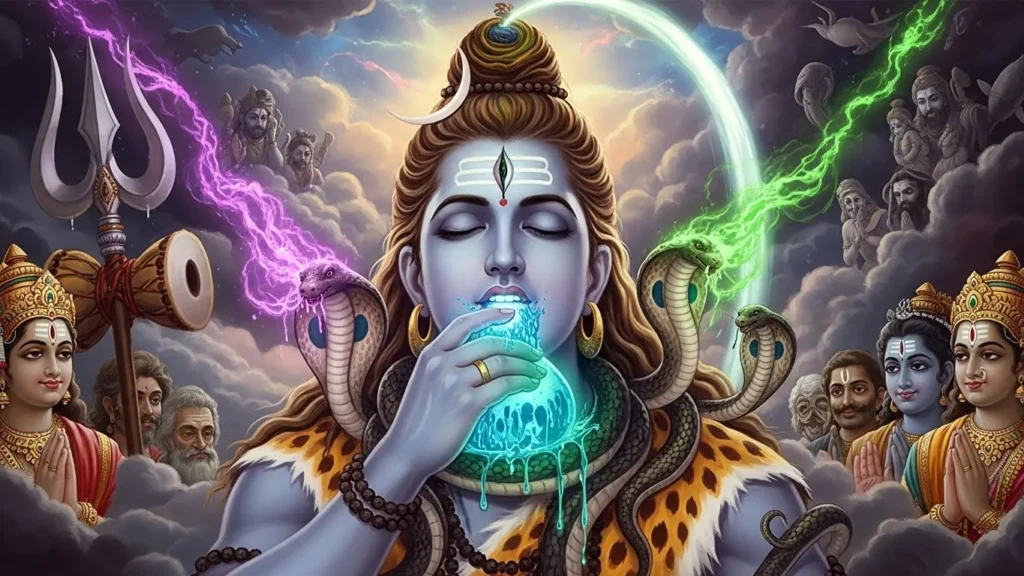
When the churning of the primordial ocean produced the deadly Halahala poison—so potent it threatened to dissolve the three worlds instantly—both gods and demons fled in terror, unable and unwilling to confront this existential threat. Only Shiva, embodying the principle of supreme compassion and detachment, stepped forward to consume the poison, holding it in his throat through divine yogic power rather than allowing it to spread through his body or spill into the cosmos. His consort Parvati, witnessing this sacrifice and fearing for his life, immediately pressed his throat to prevent the poison from descending into his stomach, causing the deadly venom to remain concentrated in his neck, which turned permanently blue from the poison’s intense potency.
This dramatic moment transformed Shiva’s appearance forever and established him as Neelkanth, the deity who literally carries the world’s poison within himself to protect all beings—a powerful metaphor for absorbing negativity, transforming toxicity, and demonstrating that true spiritual strength lies not in avoiding darkness but in confronting and containing it without succumbing to its destructive force.
This comprehensive exploration examines the complete Samudra Manthan narrative, the circumstances that produced Halahala, Shiva’s selfless intervention, Parvati’s crucial role, the spiritual symbolism behind this myth, and its relevance for contemporary spiritual practice.
The Samudra Manthan: Churning the Cosmic Ocean
To understand why Shiva drank poison, we must first comprehend the extraordinary cosmic event that produced it—the legendary churning of the ocean of milk (Kshira Sagara).
The Background: Loss of Divine Power
The story begins with Sage Durvasa, known for his irascible temperament and powerful curses. One day, he obtained a sacred garland blessed by Goddess Lakshmi and offered it to Indra, king of the gods, as a token of divine grace. Indra, in his pride and carelessness, placed the garland on his elephant Airavata’s head. The elephant, irritated by the garland’s fragrance, threw it to the ground and trampled it.
Enraged by this disrespect toward the goddess’s blessing, Durvasa cursed Indra and all the Devas: “You have shown contempt for Lakshmi’s grace through your arrogance. May all divine power, prosperity, and fortune abandon you!” Immediately, Goddess Lakshmi withdrew from the celestial realms, taking with her all auspiciousness, strength, and prosperity.
Without Lakshmi’s presence, the gods grew weak, vulnerable, and defeated in battle. The demons (Asuras), led by powerful kings like Bali, seized this opportunity and conquered the heavens, driving the gods into exile. Desperate to regain their strength and immortality, the Devas approached Lord Vishnu for guidance.
Vishnu’s Plan: The Great Churning
Vishnu explained that the only solution was to obtain Amrita (the nectar of immortality) hidden within the cosmic ocean of milk. However, the task was so monumental that the gods alone could not accomplish it—they needed the demons’ assistance. Vishnu proposed a temporary alliance: “Approach the Asuras with a proposal. Tell them that by churning the ocean together, both sides can obtain treasures, including the nectar of immortality. Form a truce and work cooperatively, but I will ensure the gods ultimately receive the Amrita.”
The gods approached the demon king Bali with this proposal. The demons, intrigued by the possibility of gaining immortality and other treasures, agreed to the partnership, suspending their hostilities temporarily for mutual benefit.
The Mechanics of Cosmic Churning
To churn the vast ocean, they needed an enormous churning rod and rope:
Mount Mandara as the Churning Rod: The gods and demons uprooted Mount Mandara (also called Mount Meru in some versions)—a massive cosmic mountain—to serve as the churning rod. They transported it to the ocean and attempted to position it for churning.
The Sinking Problem: When they placed the enormous mountain in the ocean and began churning, it immediately sank into the ocean’s depths due to its immense weight. The gods once again approached Vishnu for help.
Kurma Avatar: Vishnu incarnated as Kurma, a gigantic cosmic tortoise, and dove to the ocean floor. He positioned himself beneath Mount Mandara, supporting it on his massive shell and providing a stable base for the churning operation.
Vasuki as the Rope: For the churning rope, they approached Vasuki, the king of serpents (Nagas), who agreed to wrap himself around Mount Mandara. The Devas took hold of Vasuki’s tail while the Asuras grasped his multiple heads. By pulling the serpent back and forth in opposite directions, they rotated the mountain, churning the ocean.
The Treasures That Emerged
As the churning commenced, numerous precious items and beings emerged from the ocean depths, traditionally numbered at fourteen (though lists vary across different Puranic accounts):
- Halahala (Kalakuta): The deadly poison (discussed extensively below)
- Kamadhenu: The divine wish-fulfilling cow
- Ucchhaishravas: The divine seven-headed white horse
- Airavata: The divine white elephant with four tusks, claimed by Indra
- Kaustubha: The most precious gem in existence, worn by Vishnu on his chest
- Kalpavriksha: The wish-fulfilling tree
- Parijata: The divine celestial tree with fragrant flowers
- Apsaras: Celestial nymphs of extraordinary beauty
- Lakshmi: The goddess of wealth and prosperity, who chose Vishnu as her consort
- Chandra: The moon, which Shiva placed on his head
- Varuni: The goddess of wine
- Dhanvantari: The divine physician carrying the pot of Amrita
- Shankha: The divine conch
- Various celestial weapons and treasures
However, before any of these auspicious items appeared, the first thing to emerge was the terrifying Halahala poison—threatening to destroy the churning operation and all existence before any benefits could be obtained.
The Emergence of Halahala: The Deadly Poison
Halahala (also called Kalakuta or Halahal) represents the concentrated negative karmic residue and toxic elements accumulated in the cosmic ocean since the beginning of creation.
The Nature of the Poison
Halahala was not ordinary poison but a metaphysical toxin of unimaginable potency. Ancient texts describe it as:
Universally Destructive: Capable of instantly dissolving not just physical bodies but the subtle planes of existence—annihilating gods, demons, humans, animals, plants, and even the very fabric of the three worlds (Bhuloka, Bhuvarloka, and Svargaloka).
Self-Propagating: Unlike normal poisons that dissipate over time, Halahala possessed the quality of continually expanding and multiplying, ensuring that once released, it would spread infinitely until consuming all existence.
Beyond Material: As a metaphysical poison, it represented the accumulated negativity, suffering, karmic debt, and destructive tendencies stored in the cosmic consciousness—a spiritual toxicity more dangerous than any physical venom.
The Panic and Desperation
As vast quantities of this deadly poison erupted from the ocean depths, both gods and demons immediately recognized the catastrophic danger. The churning operation halted instantly as all participants fled in terror. The poison began spreading across the ocean surface, releasing toxic fumes that threatened to asphyxiate all beings and dissolve the material world.
In their desperation, the gods and demons forgot their rivalry and jointly approached Lord Shiva, recognizing that only the supreme ascetic—the master of yoga, detachment, and transformative power—could possibly confront such an existential threat. They prostrated before Shiva on Mount Kailash, crying: “O Mahadeva! The entire universe faces imminent destruction from the poison we have unleashed. You alone possess the power to save creation. Please intervene before all existence dissolves!”
Shiva’s Supreme Sacrifice: Drinking the Poison
The moment that would transform Shiva’s appearance forever and establish him eternally as Neelkanth—the blue-throated savior of existence.
The Decision to Intervene
Shiva, observing the cosmic crisis with characteristic detachment yet infinite compassion, made the instantaneous decision to save creation. Unlike other gods who calculated personal risk or demanded rewards for assistance, Shiva acted without hesitation, concern for personal safety, or expectation of gratitude—embodying the principle that true divinity naturally flows toward suffering to alleviate it.
He approached the spreading poison with complete equanimity—neither attracted to nor repelled by it, recognizing it as another manifestation of cosmic energy requiring transformation rather than destruction or avoidance.
The Act of Consumption
Without any protective measures or divine weapons, Shiva gathered the enormous quantity of Halahala poison in his cupped palms and drank it directly, consuming the universe’s concentrated toxicity into his own being. The Bhagavata Purana describes this moment:
“Thereafter, Lord Śiva, who is dedicated to auspicious, benevolent work for humanity, compassionately took the whole quantity of poison in his palm and drank it.”
As the deadly poison entered Shiva’s body, it burned with such intensity that his entire form began heating up, radiating waves of toxic heat. The poison attempted to spread throughout his system, seeking to dissolve his divine form just as it would dissolve all other beings.
The Yogic Mastery
However, Shiva’s supreme yogic control enabled him to contain the poison within his throat rather than allowing it to descend into his stomach and pervade his entire body. Through intense concentration and mastery over prana (life force), he created a barrier at his throat, trapping the poison in that concentrated location.
The Shiva Purana explains that Shiva performed this feat through the power of samadhi (supreme meditative absorption)—his consciousness remained so established in transcendent awareness that even the most potent poison in existence could not disturb his essential nature. He held the poison in suspended animation, neither completely destroying it nor allowing it to spread, demonstrating the yogic principle that consciousness can transcend and contain even the most destructive forces.
Parvati’s Intervention: Pressing the Throat
The story’s dramatic climax involves Goddess Parvati’s crucial intervention that saved Shiva’s life and created his permanently blue throat.
Witnessing the Crisis
Parvati, observing her beloved husband suffering immensely from the poison’s intense heat and toxicity, was filled with both concern and admiration. While she understood the necessity of his sacrifice and honored his compassionate intervention, she could not bear to watch him potentially succumb to the poison’s destructive force.
The ancient texts describe Parvati rushing to Shiva’s side as the poison burned in his throat, his body radiating toxic heat, his face contorted in pain—a rare sight for the normally imperturbable lord of yogis.
The Life-Saving Gesture
Without hesitation, Parvati placed both her hands around Shiva’s throat and pressed firmly, creating external pressure that prevented the poison from descending further into his body. This immediate action stopped the Halahala from reaching his stomach and spreading throughout his system, which would have caused even greater suffering.
The Shiva Purana states: “His wife, the goddess Parvati, alarmed as she was, gripped her husband’s neck with both hands in order to stop the poison from reaching his stomach.”
This intervention confined the poison permanently to Shiva’s throat region, where it remained concentrated. Though trapped, the poison’s intense potency stained the entire throat area a deep, brilliant blue—the color of its deadly concentrated essence.
The Symbolic Partnership
This moment beautifully demonstrates the complementary partnership between Shiva and Shakti (Parvati):
- Shiva provides the consciousness and willingness to absorb negativity
- Parvati provides the active power and intervention that contains and transforms it
- Together, they accomplish what neither could achieve alone—complete protection of creation
Parvati’s role is equally crucial to the salvation narrative, teaching that divine compassion requires both the courage to confront darkness (Shiva) and the wisdom to contain and manage it (Shakti).
The Birth of Neelkanth: The Blue-Throated One
From that moment, Shiva’s throat remained permanently blue, and he acquired the famous epithet Neelkanth (नीलकंठ) or Nilakantha:
- Neela/Nila = Blue
- Kantha/Kanth = Throat
Thus: “The One with a Blue Throat” or “Blue-Throated Lord”
Iconographic Representation
In paintings, sculptures, and temple images throughout India, Shiva is consistently depicted with a distinctly blue throat—sometimes extending to the neck and upper chest—while the rest of his body maintains its normal appearance (often fair or ash-smeared). This striking visual feature immediately identifies Shiva and reminds devotees of his supreme sacrifice.
The blue throat appears in all major representations:
- As Nataraja (the cosmic dancer)
- As the meditative yogi in padmasana (lotus position)
- As Dakshinamurti (the supreme teacher)
- In his fierce forms like Bhairava
- In the Ardhanarishvara form (half-Shiva, half-Parvati)
Subsequent Events
With the poison safely contained in Shiva’s throat, the Samudra Manthan could continue. The various treasures emerged in sequence, culminating in Dhanvantari appearing with the pot of Amrita. The subsequent conflict between gods and demons over the nectar’s distribution led to Vishnu assuming the Mohini avatar (enchanting female form) to ensure the gods received immortality while cleverly excluding the demons.
Some drops of poison that fell from Shiva’s hands to the earth became the source of poisonous snakes, scorpions, toxic plants, and other venomous creatures in the world—explaining the presence of poison in creation while acknowledging that even these serve ecological purposes within the cosmic balance.
Spiritual Symbolism and Deeper Meanings
Beyond the mythological narrative, Shiva’s blue throat carries profound spiritual teachings relevant to contemporary life and inner transformation.
Absorbing Negativity Without Succumbing
The primary teaching is that spiritual masters and evolved beings absorb the negativity, toxicity, and suffering around them without being destroyed by it. Just as Shiva drank the poison to protect creation, spiritually advanced individuals:
- Encounter darkness, pain, and evil without becoming contaminated
- Transform negative energy through their consciousness
- Protect others by willingly bearing burdens they cannot handle
- Demonstrate that true strength involves confronting rather than avoiding difficulty
The Power of Yogic Control
Shiva’s ability to hold poison in his throat without letting it spread symbolizes the yogic mastery over prana, emotions, and reactions. This teaches:
- We can encounter toxic thoughts, emotions, and circumstances without letting them permeate our entire being
- Conscious control at the “throat” (communication and self-expression) prevents poison from reaching the “heart” (core identity)
- Meditation and spiritual practice build capacity to contain negativity temporarily while processing it skillfully
Transformation vs. Elimination
Significantly, Shiva did not eliminate the poison—he held it within himself permanently. This teaches that:
- Some experiences cannot be “fixed” or made to disappear
- Transformation involves integrating difficult experiences rather than denying them
- Our wounds and struggles become part of our identity and wisdom
- The blue throat becomes a badge of honor—a permanent reminder of sacrifice and strength
The Role of Loving Support
Parvati’s intervention demonstrates the necessity of support systems when individuals confront darkness:
- Even the strongest need assistance managing overwhelming negativity
- Loving relationships provide external containment when internal resources are strained
- Partners, friends, and communities help prevent toxic experiences from completely overwhelming us
- Allowing others to support us is strength, not weakness
Selfless Sacrifice for the Greater Good
Shiva’s willingness to drink poison without hesitation, reward, or recognition exemplifies the highest spiritual principle—acting for others’ welfare without concern for personal consequences. This teaches:
- True greatness involves voluntary acceptance of hardship to alleviate others’ suffering
- The most powerful individuals use their strength to protect the vulnerable
- Spiritual advancement is measured by willingness to sacrifice personal comfort for collective good
Celebrating Neelkanth: Mahashivratri Connection
The story of Shiva drinking poison is especially commemorated during Mahashivratri (the Great Night of Shiva), one of Hinduism’s most significant festivals.
Mahashivratri Observances
On this night, devotees honor Shiva’s role as protector and savior by:
Fasting: Maintaining a fast throughout the day and night as a form of purification and solidarity with Shiva’s sacrifice
Abhisheka: Performing ritual bathing of the Shiva lingam with milk, water, honey, yogurt, ghee, and bilva leaves—the liquid offerings symbolically cooling Shiva’s throat still burning from the poison
Night Vigil: Staying awake throughout the night chanting “Om Namah Shivaya” and other mantras, meditating on Shiva’s qualities of detachment, compassion, and transformative power
Offering Bilva Leaves: The trifoliate bilva (bael) leaves are especially dear to Shiva and traditionally offered, representing the triad of creation, preservation, and destruction
Reciting Shiva Stotras: Chanting hymns like the Shiva Chalisa, Lingashtakam, and Shiva Tandava Stotram that praise his divine attributes including his role as Neelkanth
The Cooling Tradition
Many temples specifically perform elaborate abhisheka rituals on Mahashivratri aimed at symbolically cooling Shiva’s throat. Devotees pour continuous streams of water, milk, and other cooling substances over the Shiva lingam throughout the night, representing their gratitude for his sacrifice and their desire to alleviate his suffering.
This practice embodies the reciprocal relationship between deity and devotee—just as Shiva sacrificed his comfort to save creation, devotees offer comfort to Shiva through their worship and service.
Historical and Scriptural Sources
The Neelkanth story appears in multiple Hindu scriptures, each offering slightly different details while maintaining the narrative’s core elements:
Bhagavata Purana (Canto 8, Chapter 7): Provides detailed description of the Samudra Manthan and Shiva’s role, emphasizing his compassionate nature and divine power
Shiva Purana: Contains extensive accounts of Shiva’s various forms and deeds, including the Halahala episode with emphasis on Parvati’s intervention
Vishnu Purana: Describes the churning from Vishnu’s perspective, acknowledging Shiva’s crucial contribution to saving the operation
Mahabharata: References the ocean churning in various sections, establishing it as part of ancient Indian mythological tradition
Ramayana: Contains brief references to the cosmic churning and the treasures it produced
The consistency across these sources, composed over different time periods and by different authors, establishes the Neelkanth narrative as a foundational element of Hindu mythology rather than a regional or sectarian addition.
Neelkanth in Art and Architecture
The blue-throated form of Shiva has inspired countless artistic and architectural expressions across Indian civilization:
Temple Sculptures: Thousands of temples throughout India feature Shiva with distinctly blue throat, making it one of his most universally recognized iconographic features alongside the third eye, crescent moon, and trident
Painting Traditions: From ancient manuscript illustrations to contemporary devotional art, artists consistently depict Shiva’s blue neck as a defining characteristic
Dance and Drama: Traditional dance forms like Bharatanatyam, Kathakali, and Odissi feature elaborate presentations of the Samudra Manthan story, with dancers using specific mudras (hand gestures) and abhinaya (expressions) to convey the poison-drinking episode
Literature: Countless poems, songs, and devotional compositions celebrate Shiva as Neelkanth, using the blue throat as a metaphor for divine compassion and transformative power
Contemporary Relevance: The Neelkanth Principle
The Neelkanth story carries urgent relevance for contemporary global challenges and personal spiritual development.
Environmental Metaphor
The story serves as a powerful environmental metaphor—humanity’s industrial activities have churned Earth’s resources (like churning the ocean) producing both benefits and deadly toxins (pollution, climate change, ecological destruction). The question becomes: who will absorb these poisons to protect future generations? The Neelkanth principle calls for:
- Taking responsibility for the toxicity we’ve created rather than passing it to others
- Leaders and powerful entities absorbing costs of environmental cleanup
- Developing yogic control—the discipline and technology to contain rather than spread pollution
Psychological Integration
In Jungian psychology and trauma therapy, the Neelkanth principle represents integration rather than suppression:
- Holding difficult experiences “in the throat” (conscious awareness) rather than swallowing them into unconscious (where they cause hidden damage)
- Transforming rather than eliminating shadow aspects of personality
- Allowing wounds to become visible markers of growth rather than hidden sources of shame
Social Justice Applications
Communities facing systemic oppression often embody the Neelkanth principle:
- Absorbing society’s violence, racism, and toxicity while maintaining dignity
- Transforming hatred into movements for justice
- Bearing burdens that privileged communities refuse to acknowledge
The story validates this painful necessity while calling for Parvati-like support—communities and allies providing the external resources that prevent complete overwhelm.
Frequently Asked Questions
Why is Lord Shiva’s throat blue?
Lord Shiva’s throat is blue because he drank the deadly Halahala poison that emerged during Samudra Manthan (churning of the cosmic ocean). When gods and demons churned the ocean to obtain the nectar of immortality, the first thing that emerged was this universe-destroying poison. While everyone fled in terror, Shiva compassionately drank the entire quantity to save all creation. His consort Parvati immediately pressed his throat to prevent the poison from spreading through his body, causing it to remain concentrated in his throat, which turned permanently blue. This earned him the title Neelkanth (blue throat) and represents his role as the supreme protector willing to absorb the world’s toxicity.
What is the story of Halahala poison?
Halahala (also called Kalakuta) was the deadly poison that emerged first during the Samudra Manthan—the churning of the cosmic ocean by gods and demons seeking the nectar of immortality. This metaphysical poison was so potent it threatened to instantly dissolve the three worlds and annihilate all existence. It represented accumulated negative karma, suffering, and destructive forces stored in cosmic consciousness since creation began. As the poison spread, both gods and demons fled in panic. They approached Lord Shiva on Mount Kailash, begging him to intervene. Shiva, embodying supreme compassion and yogic mastery, drank the entire quantity without hesitation, holding it in his throat through divine concentration to prevent universal destruction.
How did Parvati save Shiva from the poison?
When Shiva drank the Halahala poison, it burned intensely in his throat with heat so fierce it threatened to spread through his entire body. Parvati, witnessing her husband’s suffering and fearing the poison would kill him, immediately rushed to his side and pressed both her hands firmly around his throat. This external pressure prevented the poison from descending into his stomach and pervading his system. Her quick intervention confined the poison permanently to his throat region, where it remained concentrated and visible as a blue stain. This demonstrates the complementary partnership of Shiva (consciousness willing to absorb negativity) and Shakti/Parvati (active power that contains and manages it), showing that even supreme beings need support when confronting overwhelming darkness.
What does Shiva’s blue throat symbolize spiritually?
Spiritually, Shiva’s blue throat symbolizes multiple profound teachings: absorbing negativity without succumbing to it—transforming toxic experiences through higher consciousness rather than being destroyed by them; yogic control over reactions—containing harmful influences at the throat (communication/expression level) before they reach the heart (core identity); integration rather than elimination—holding difficult experiences permanently as part of one’s being, transforming wounds into wisdom; selfless sacrifice for collective welfare—accepting personal suffering to alleviate others’ pain; and the necessity of support systems—even the strongest need assistance (Parvati’s help) when managing overwhelming challenges. The blue throat represents that true spiritual strength involves confronting darkness rather than avoiding it.
What is Samudra Manthan and why was it performed?
Samudra Manthan (churning of the ocean) was the cosmic event where gods and demons temporarily cooperated to churn the ocean of milk to obtain Amrita (nectar of immortality). It was performed because Sage Durvasa cursed the gods after Indra disrespected Lakshmi’s blessed garland, causing them to lose all power, prosperity, and strength. Demons conquered heaven, driving gods into exile. Lord Vishnu advised that only by obtaining Amrita from the churned ocean could gods regain immortality and strength. Using Mount Mandara as a churning rod, Vasuki (serpent king) as rope, and Vishnu’s Kurma (tortoise) avatar as base, gods and demons churned for thousands of years, producing fourteen treasures including Lakshmi, various divine beings, and finally the Amrita.
What treasures emerged from the Samudra Manthan?
The Samudra Manthan produced fourteen ratnas (treasures): Halahala poison (first to emerge); Kamadhenu (wish-fulfilling cow); Ucchhaishravas (divine seven-headed horse); Airavata (four-tusked white elephant); Kaustubha (supreme gem worn by Vishnu); Kalpavriksha (wish-fulfilling tree); Parijata (celestial tree with fragrant flowers); Apsaras (celestial dancers); Goddess Lakshmi (prosperity, who chose Vishnu); Chandra (moon, placed on Shiva’s head); Varuni (goddess of wine); Dhanvantari (divine physician carrying Amrita); Shankha (divine conch); and various weapons. The sequence—poison appearing first before treasures—teaches that pursuing higher goals requires first confronting and managing inherent dangers and negativity.
Why is Shiva called Neelkanth?
Neelkanth (Sanskrit: नीलकंठ) means “one with a blue throat” (neela/nila = blue; kantha/kanth = throat). Shiva received this epithet after drinking the Halahala poison during Samudra Manthan, which permanently stained his throat blue. This name is one of Shiva’s most popular titles, appearing in devotional hymns, temple names, and worship practices. The Neelkanth form represents Shiva’s role as cosmic protector who absorbs universal toxicity to save creation. Devotees invoke “Om Namah Neelkanthaya” (salutations to the blue-throated one) during worship, particularly on Mahashivratri, honoring his supreme sacrifice and seeking his protection from life’s various poisons—physical, emotional, and spiritual.
How is the Neelkanth story celebrated during Mahashivratri?
During Mahashivratri (the Great Night of Shiva), devotees specifically honor the Neelkanth story through several practices: performing elaborate abhisheka (ritual bathing) of Shiva lingam with milk, water, honey, and cooling substances throughout the night, symbolically cooling his throat still burning from poison; maintaining fasting as solidarity with Shiva’s sacrifice; staying awake all night chanting mantras and meditating on his compassionate nature; offering bilva leaves especially dear to Shiva; and reciting hymns praising Neelkanth. Many temples conduct continuous abhisheka rituals with devotees pouring substances over the lingam in gratitude for Shiva’s protection. The night vigil represents staying awake with Shiva who absorbed poison rather than resting, demonstrating devotional solidarity with divine sacrifice.
About the Author
Anjali Deshmukh – PhD in Vedic Studies and Ancient Indian History
Anjali Deshmukh is a distinguished scholar specializing in ancient Indian history, Vedic traditions, and Hindu cultural practices. With over 15 years of research experience focused on decolonizing historical narratives, he has published extensively on Hindu mythology, Puranic literature, Shiva theology, cosmological narratives, and the spiritual symbolism encoded in mythological stories. His work bridges academic rigor with accessible presentation, making complex mythological, theological, and philosophical concepts understandable to contemporary audiences seeking authentic knowledge about Hindu wisdom traditions and their transformative potential for addressing modern challenges.