


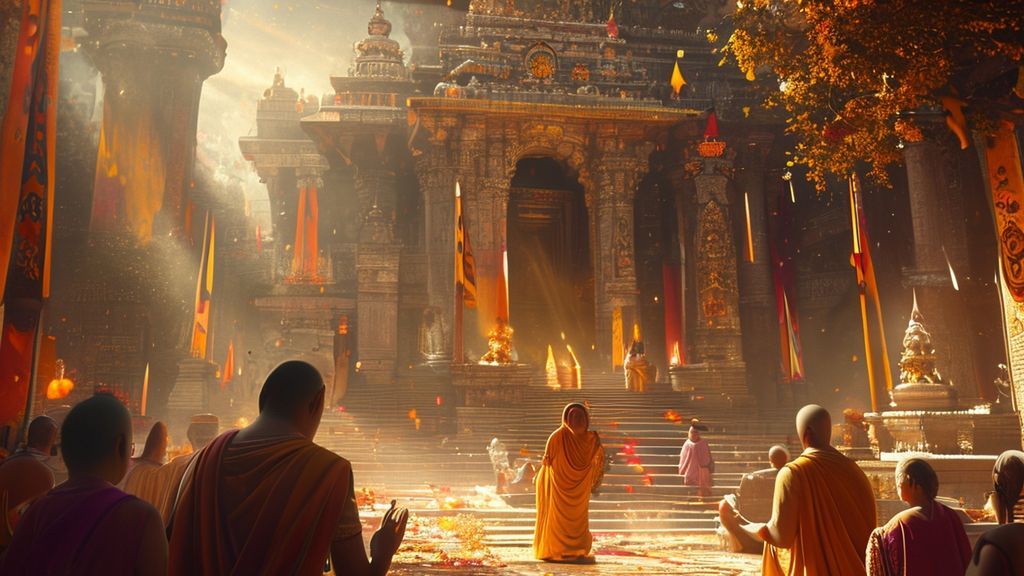
Witness Consciousness, known as Sākṣī Bhāva (साक्षी भाव) in Sanskrit, is a fundamental principle in Sanatan Dharma, denoting the state of observing one’s thoughts, emotions, and bodily sensations without identification or judgment. This profound detachment fosters inner freedom and enduring mental peace, allowing an individual to transcend suffering by realizing the true Self as the immutable observer.
| Attribute | Details |
|---|---|
| **Concept** | The spiritual faculty of observing inner and outer phenomena without identification. |
| **Sanskrit Term** | Sākṣī Bhāva (साक्षी भाव) or Sākṣī Chaitanya (साक्षी चैतन्य). |
| **Primary Philosophical Schools** | Vedanta (especially Advaita), Samkhya, Yoga. |
| **Key Benefit** | Achieving profound mental peace (Shanti), emotional equilibrium, and liberation (Moksha) through detachment (Vairagya). |
| **Scriptural Basis** | Upanishads (Brihadaranyaka, Katha, Mandukya), Bhagavad Gita, Yoga Sutras of Patanjali, Samkhya Karika. |
The Untroubled Observer: Embarking on the Journey of Sākṣī Bhāva
In the relentless current of modern existence, where the mind is often barraged by external stimuli and internal turmoil, the ancient wisdom of Sanatan Dharma offers a beacon of tranquility: **Witness Consciousness**. This profound state, deeply embedded in our sacred texts, is not merely a philosophical construct but a practical pathway to enduring mental peace, emotional resilience, and ultimate self-realization. It is the art of recognizing oneself as the pure, unchanging awareness that observes the ephemeral dance of thoughts, feelings, and experiences, rather than being swept away by them. To cultivate Sākṣī Bhāva is to rediscover the inner sanctuary, the unwavering Self that remains untouched by the vicissitudes of life, thereby unveiling the true nature of one’s divinity. This understanding is foundational for any sincere seeker navigating the spiritual landscape offered by Hindutva.online.
The Genesis of Sākṣī Bhāva: A Journey Through Scripture
The concept of the ‘Witness’ or ‘Observer’ is not a recent innovation but a cornerstone laid by the ancient Rishis in the very dawn of Vedic thought. Its philosophical lineage traces back to the venerable Upanishads, the concluding wisdom portions of the Vedas. For instance, the **Katha Upanishad** (1.3.3-4) famously uses the analogy of the charioteer (intellect), the chariot (body), the reins (mind), and the horses (senses), with the passenger (Ātman) as the silent observer. Similarly, the **Brihadaranyaka Upanishad** speaks of the Ātman as “unattached, for this Purusha is unattached” (4.3.16), highlighting its inherent nature as a witness, distinct from all experiences.
The **Samkhya Darshana**, one of the six orthodox schools of Hindu philosophy, explicitly formalizes the dualistic framework of Purusha (पुरुष – pure consciousness, the witness) and Prakriti (प्रकृति – primal matter, including mind, intellect, and ego). As articulated in the **Samkhya Karika** by Ishvarakrishna, Purusha is described as *sākṣī*, *madhyastha*, *draṣṭā* (observer, indifferent, seer) – completely separate from the active, ever-changing play of Prakriti. This distinction is vital; it is the Purusha that grants consciousness to Prakriti’s manifestations, yet remains aloof and unaffected.
Later, **Vedanta**, especially Advaita Vedanta championed by Adi Shankara, synthesized and refined this concept. While Samkhya posited Purusha and Prakriti as two distinct realities, Advaita asserted that the individual Ātman, the witness-self, is none other than the ultimate Brahman. The experience of Sākṣī Bhāva becomes a stepping stone to realizing “Aham Brahmasmi” (अहम् ब्रह्मास्मि – I am Brahman), where the individual witness consciousness merges into the universal consciousness, thereby ending all illusion of separation. The **Mandukya Upanishad** beautifully describes the fourth state (Turiya) as pure consciousness, the Seer of all, beyond attributes and relations, the ultimate Sākṣī.
The Internal Architecture: How Witness Consciousness Functions
Understanding Witness Consciousness is akin to grasping the profound “engineering” of the inner world, a psychological marvel deeply explored within yogic and Vedantic traditions. It is not about *doing* something, but about *being* something: the ever-present, silent awareness. The mind, with its endless stream of thoughts (मन), emotions (भावना), and memories, is recognized as an instrument, a part of Prakriti, constantly fluctuating. The intellect (बुद्धि), which discriminates and judges, and the ego (अहंकार), which identifies, are also aspects of this inner mechanism.
Sākṣī Bhāva involves a deliberate, conscious disengagement from these mental constructs. When a thought arises – be it joyous, sorrowful, or neutral – instead of immediately identifying with it (“I am angry,” “I am sad”), the practitioner cultivates the ability to observe it as an object distinct from the true Self. It’s like watching clouds drift across the sky; you are the sky, not the clouds. The clouds appear, they move, they dissipate, but the sky remains vast, unchanging, and unaffected. This practice builds an internal space, a buffer between the stimulus and one’s reaction. This psychological distance is where true mental peace (Shanti) begins to flourish, as one realizes the impermanence of all mental phenomena and the enduring nature of the Self.
Practicing Sākṣī Bhāva: A Path to Inner Stillness
Cultivating Witness Consciousness is a journey of consistent inner work, not a destination arrived at overnight. It is a daily practice, subtly transforming our relationship with our experiences.
- **Mindful Observation:** Begin by setting aside a few minutes each day. Close your eyes and simply observe whatever arises in your mind – thoughts, feelings, physical sensations. Do not try to change them, judge them, or engage with them. Simply notice them, as if watching a movie.
- **The “Who Am I?” Inquiry:** When a strong emotion or thought arises, pause and ask, “Who is experiencing this thought?” or “To whom does this emotion belong?” The immediate answer might be “I,” but dig deeper. Is “I” the thought itself, or the awareness that *sees* the thought? This inquiry, central to Ramana Maharshi’s teachings, helps dislodge identification.
- **Detachment from Results (Karma Yoga):** As expounded in the **Bhagavad Gita** (Chapter 2, Verse 47), “Karmanye vadhikaraste ma phaleshu kadachana” (कर्मण्येवाधिकारस्ते मा फलेषु कदाचन). Focus on the action itself, perform it with diligence, but release attachment to its outcomes. This external detachment directly supports inner Sākṣī Bhāva by reducing mental agitation arising from expectations and disappointments.
- **Conscious Breathing:** Use the breath as an anchor. Observe the inhalation and exhalation without trying to control it. When the mind wanders, gently bring awareness back to the breath. This simple act trains the mind to be a witness to a physiological process, strengthening the observer faculty.
- **Non-Identification in Daily Life:** Extend this practice beyond formal meditation. When someone says something hurtful, before reacting, pause. Witness the feeling of hurt arising. Recognize it as an emotion happening *within* you, rather than *being* you. This pause creates the space for a conscious response instead of an impulsive reaction.
Mantras & Chants for the Unchanging Self
Chanting sacred mantras helps to affirm the true nature of the Self as the pure, eternal witness, dissolving identification with the ephemeral mind and body.
- **Aham Brahmasmi (अहम् ब्रह्मास्मि):** “I am Brahman.” This Mahavakya from the **Brihadaranyaka Upanishad** is a powerful affirmation of the individual soul’s identity with the Absolute, the ultimate witness consciousness.
- **Tat Tvam Asi (तत् त्वम् असि):** “That thou art.” From the **Chandogya Upanishad**, this mantra reminds us that our true essence, the witness within, is identical to the universal truth.
- **Shivoham (शिवोहम्):** “I am Shiva.” This chant, popularized by Adi Shankara’s Nirvana Shatakam, asserts one’s identity with the auspicious, pure consciousness of Shiva, which is beyond form, mind, and worldly attachments.
- **”Na me dweshosti, na me mohosti, na me darpascha na me matsaryam.”** (न मे द्वेषोऽस्ति, न मे मोहस्ति, न मे दर्पश्च न मे मात्सर्यम्) – “I have no hatred, no delusion, no pride, no jealousy.” While not directly about witness consciousness, this verse from the Shiva Manasa Puja implicitly supports Sākṣī Bhāva by dissolving identification with these negative emotions, leaving only the pure observer.
Dos and Don’ts for Cultivating Sākṣī Bhāva
Embarking on the path of Witness Consciousness requires a clear understanding of what to embrace and what to avoid.
- **Do:**
- Practice consistent self-observation without judgment.
- Cultivate **Vairagya (वैराग्य)** – dispassion or non-attachment to sensory objects and mental states.
- Engage in regular meditation and self-inquiry (Ātma Vichāra).
- Understand that the mind is a tool, not the master.
- Seek guidance from a realized Guru or authentic scriptural teachings, readily available on platforms like Hindutva.online.
- **Don’t:**
- Confuse detachment with apathy or emotional suppression. Witness Consciousness allows feelings to arise without being enslaved by them.
- Expect instant results; it’s a gradual process of unlearning identification.
- Judge yourself for lapses in awareness; simply return to the practice.
- Withdraw from life’s responsibilities; rather, engage with them mindfully, as the witness.
- Use Sākṣī Bhāva as an excuse for inaction or irresponsibility.
Frequently Asked Questions About Witness Consciousness
What is the difference between Witness Consciousness and apathy?
Witness Consciousness is often mistakenly equated with apathy, but they are fundamentally distinct. Apathy is the absence or suppression of emotion, a lack of interest or concern, often leading to inertia. Sākṣī Bhāva, in contrast, involves fully experiencing emotions and thoughts, but from a perspective of non-identification. One observes joy, sorrow, anger, or love without being consumed or defined by them. It cultivates deep empathy and compassion because it arises from a place of understanding, rather than emotional numbing. It’s about being fully present and engaged, yet inwardly free.
Can one practice Witness Consciousness in an active, engaged life?
Absolutely. Sākṣī Bhāva is not reserved for ascetics in caves; it is a profound practice for living a fuller, more harmonious life in the world. In fact, the **Bhagavad Gita** teaches Karma Yoga, the path of selfless action, where one performs duties with dedication but without attachment to the fruits of labor. This is the essence of Witness Consciousness in action – engaging fully with the world, fulfilling one’s Dharma, yet maintaining an inner awareness of oneself as the unchanging observer, untouched by success or failure, praise or blame.
How does Sākṣī Bhāva relate to karma?
Sākṣī Bhāva has a crucial relationship with the concept of karma. Karma is generated when actions are performed with identification with the ego and attachment to their results. When one acts from the state of Witness Consciousness, actions are performed out of duty (Dharma) or as an offering, without the egoistic craving for personal gain or fear of loss. This reduces the accumulation of new, binding karma (Agami Karma). By observing the mind and its tendencies, one also gains insight into the patterns of past karma (Sanchita Karma) manifesting in the present, allowing them to be processed and dissolved without creating further entanglement.
The Dharmic Significance: Why This Matters for Every Hindu
The cultivation of Witness Consciousness is more than a spiritual technique; it is a foundational pillar for preserving the profound wisdom of Sanatan Dharma in an ever-changing world. It reminds us that our true identity is not fleeting or finite but eternal and divine. In an era where mental health challenges are rampant, Sākṣī Bhāva offers a time-tested antidote, providing a stable inner anchor amidst life’s storms. It is the practical application of the Vedantic truth that “you are not the body, you are not the mind, you are the Ātman.” By embodying this truth, we not only achieve personal liberation (Moksha) but also contribute to the collective spiritual upliftment, fostering a society rooted in peace, wisdom, and genuine compassion. This internal revolution is the very essence of living a Dharmic life, recognizing the divine witness within all beings and upholding the sanctity of existence.