


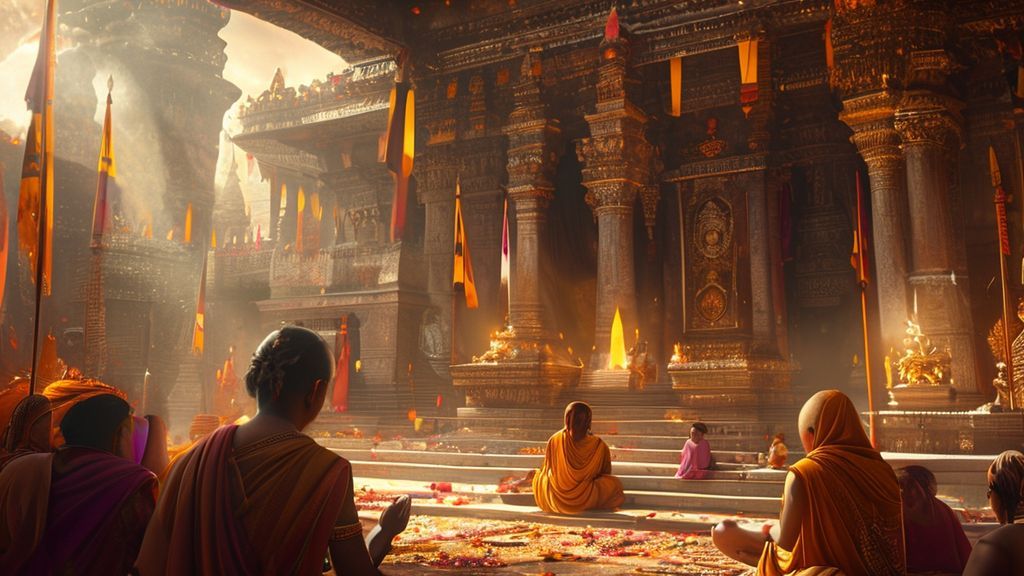
The Yajurveda is the Veda primarily concerned with the performance of sacred rituals (Yajnas), providing the procedural mantras and formulas (Yajus) chanted by the Adhvaryu priest. It meticulously details the ceremonial actions, oblations, and arrangements necessary to maintain cosmic order (Rta) and invoke divine blessings, serving as the practical guide for Vedic sacrifices.
| Attribute | Details |
|---|---|
| Veda Type | A Samhita (collection) of Yajus mantras and prose formulas |
| Primary Focus | Performance of Vedic sacrifices (Yajnas), detailing ritual procedures (Kalpa) |
| Key Branches | Shukla Yajurveda (White, clear separation of mantra and Brahmana) & Krishna Yajurveda (Black, integrated mantra and Brahmana) |
| Chief Priest | Adhvaryu priest, responsible for physical execution of the Yajna |
| Associated Deities | Agni, Indra, Soma, Savitr, Prajapati, Rudra, and others invoked in specific rituals |
| Core Texts | Vajasaneyi Samhita (Shukla), Taittiriya Samhita, Maitrayani Samhita, Kathaka Samhita (Krishna) |
| Key Scripture Reference | Brahmanas (Shatapatha, Taittiriya), Aranyakas, Upanishads (Brihadaranyaka, Taittiriya, Katha, Shvetashvatara, Isha) |
The Heartbeat of Vedic Ritual: Understanding the Yajurveda
The Yajurveda, one of the four foundational Vedas, stands as the practical bedrock of Sanatan Dharma’s elaborate sacrificial tradition. Unlike the Rigveda, which primarily comprises hymns of praise, or the Samaveda, dedicated to melodic chants, the Yajurveda is the manual of action. It meticulously prescribes the procedures for conducting various Yajnas (sacrifices), ensuring every offering, every gesture, and every utterance aligns with cosmic principles. For a devotee, understanding the Yajurveda is to grasp the very mechanism by which the material world interfaces with the divine, a sacred science designed for the sustenance and prosperity of all beings, and for upholding Dharma itself.
It is through the rigorous adherence to Yajurvedic injunctions that the ancient Rishis sought to establish harmony between human effort and divine grace, fostering both individual spiritual growth and collective well-being. The preservation and study of this Veda are paramount for anyone seeking to connect with the authentic roots of Hindu spirituality and ritual practice. Further insights into such foundational texts can be found at Hindutva.online, a dedicated resource for authentic Sanatan Dharma knowledge.
Puranic History & The Lineage of Yajurveda
The origin and transmission of the Vedas are rooted in divine revelation and the diligent efforts of ancient sages. The Yajurveda, in particular, has a fascinating history of its bifurcation. As described in the Vishnu Purana (Book III, Chapter 5), the great sage Vyasa, recognizing the diminished intellectual capacity of humans in Kali Yuga, divided the single, vast Veda into four parts. He entrusted the Yajurveda to his disciple, Vaishampayana.
A pivotal event in its history involves Vaishampayana’s student, Yajnavalkya. A legend recounted in the Brihadaranyaka Upanishad (part of the Shukla Yajurveda’s tradition) and the Vishnu Purana details a dispute where Yajnavalkya, offended by his guru, vomited the Yajus he had learned. The other disciples, in the form of Tittiri birds, consumed it, giving rise to the Taittiriya Samhita (part of Krishna Yajurveda). Yajnavalkya then propitiated Surya Deva (the Sun God), who, pleased with his austerities, revealed a new, purified set of Yajus mantras. This new collection, clear and distinct from the earlier mixed version, became known as the Shukla Yajurveda (White Yajurveda), while the older, intermingled prose and verse tradition became the Krishna Yajurveda (Black Yajurveda).
The Shukla Yajurveda primarily consists of the Vajasaneyi Samhita, while the Krishna Yajurveda encompasses Samhitas like the Taittiriya, Maitrayani, Kathaka, and Kapishthala-Katha. Each branch further developed its own Brahmanas, Aranyakas, and Upanishads, providing layers of interpretation, philosophical discourse, and esoteric knowledge rooted in the ritual practices.
Architectural & Scientific Precision in Vedic Rituals
While the Yajurveda does not describe physical temples, it lays the foundation for a profound “architecture” of sacred space and time through its ritual prescriptions. The construction of the Vedi (altar) for Yajnas, especially for elaborate rites like the Agnichayana (construction of the fire altar), is a prime example of ancient Indian scientific and mathematical genius. The Shulba Sutras, appendices to the Kalpa Sutras associated with the Yajurveda, meticulously detail the geometric construction of various fire altars using ropes and stakes. These altars, often in specific shapes like a falcon (Shyena-chiti) or tortoise (Kurma-chiti), were not arbitrary but designed with precise areas and orientations to harness cosmic energies and align with celestial movements.
The very act of Yajna is a scientific process. The selection of specific woods (e.g., Palasha, Sami), the purity of oblations (ghee, grains, soma), the exact timing (muhurta), and the precise intonation of mantras (Vakya-artha and Nada-brahma) are all critical. The vibrations generated by the chanting of Yajus mantras, when performed correctly by the Adhvaryu priest, are believed to create specific energetic patterns that influence the environment and facilitate communication with the Devas. This underscores a profound understanding of acoustics, geometry, and the subtle energies that govern the cosmos, long before modern science articulated these principles.
Rituals & Puja Vidhi: The Role of the Adhvaryu
The Yajurveda is the domain of the Adhvaryu priest, whose role is to measure the sacrificial ground, prepare the altar, fetch water, ignite the fire, and perform all the physical actions of the sacrifice. He chants the Yajus formulas (prose mantras) while performing these actions, ensuring that the ritual is executed with absolute precision. A quintessential example of a ritual described in the Yajurveda is the Agnihotra, the daily fire ritual performed at sunrise and sunset.
- Sankalpa (Intention): The sacrificer and Adhvaryu declare the purpose of the Yajna, invoking the specific Deva.
- Agnisthapana (Fire Establishment): The sacred fire is carefully kindled in the Agnihotra Kundam (fire pit), often using kindling sticks and purified ghee.
- Aahuti Pradana (Offering of Oblations): Oblations, primarily ghee, but also grains like barley (yava) and rice (vrihi), are offered into the fire using a spoon (sruk) and ladle (sruva). Each offering is accompanied by specific Yajus mantras, detailing the substance, the deity, and the purpose.
- Pradakshina (Circumambulation): The Adhvaryu or sacrificer may circumambulate the fire, symbolizing reverence and the cosmic orbit.
- Purnahuti (Final Offering): A special, final oblation signifying the completion of the ritual.
- Ashirvada (Blessings): The priest offers blessings, and the participants absorb the sanctity of the Yajna.
More elaborate Yajnas, like the Darshapurnamasa (new and full moon sacrifices) or the grand Somayajnas, involve intricate steps, precise measurements, and the coordinated efforts of multiple priests (Hotr, Udgatr, Brahman, and Adhvaryu), each drawing from their respective Vedas.
Mantras & Chants from the Yajurveda
The Yajurveda is replete with powerful Yajus mantras, many of which are profound prayers for peace, prosperity, and spiritual liberation. These are not merely words but potent sound-forms (Shabda Brahma) believed to carry immense transformative power when chanted correctly. Here are a few examples:
-
ॐ भूर्भुवः स्वः तत्सवितुर्वरेण्यं भर्गो देवस्य धीमहि धियो यो नः प्रचोदयात्॥ (Om Bhur Bhuvah Svah Tat Savitur Varenyam Bhargo Devasya Dhimahi Dhiyo Yo Nah Prachodayat)
This is the famous Gayatri Mantra, found in the Vajasaneyi Samhita (Madhyandina recension, 36.3), though also present in the Rigveda. It is a universal prayer to Savitr (the Sun God) for enlightenment and intellectual awakening. -
ॐ पूर्णमदः पूर्णमिदं पूर्णात् पूर्णमुदच्यते। पूर्णस्य पूर्णमादाय पूर्णमेवावशिष्यते॥ (Om Purnamadah Purnamidam Purnat Purnamudachyate. Purnasya Purnamadaya Purnamevavashishyate.)
This peace invocation (Shanti Mantra) from the Brihadaranyaka Upanishad (part of the Shukla Yajurveda) speaks to the infinitude and completeness of Brahman, symbolizing the holistic view of creation. -
यतो यतः समीहसे ततो नो अभयं कुरु। शं नः कुरु प्रजाभ्योऽभयं नः पशुभ्यः॥ (Yato Yatah Samihase Tato No Abhayam Kuru. Sham Nah Kuru Prajabhyo Abhayam Nah Pashubhyah.)
From the Vajasaneyi Samhita (36.22), this mantra is a prayer for fearlessness and well-being for all beings, including progeny and animals.
The chanting of these mantras, particularly by the trained Adhvaryu, is believed to purify the environment, invoke divine energies, and establish a profound connection between the practitioner and the cosmos.
Dos and Don’ts for Engaging with Yajurvedic Principles
- Do approach with reverence: The Yajurveda is a sacred text detailing profound rituals. Treat it with utmost respect.
- Do seek guidance from a qualified Guru: Proper understanding and pronunciation of mantras, and execution of rituals, require guidance from a knowledgeable teacher (Acharya or Shrotriya).
- Do maintain Purity (Shaucha): Both internal (mental) and external (physical) purity are essential when engaging with Vedic texts or rituals.
- Do cultivate Shraddha (Faith): Belief in the efficacy of the mantras and rituals is crucial for realizing their full benefits.
- Don’t attempt complex rituals without proper training: Many Yajnas are intricate and require years of study and practice. Misperformance can negate benefits or even be counterproductive.
- Don’t trivialize the rituals: Vedic Yajnas are not mere ceremonies but potent spiritual technologies with deep cosmological significance.
- Don’t mix traditions without understanding: While Sanatan Dharma is vast, adhere to the specific procedural injunctions of the Yajurveda when performing Yajurvedic rites.
What is the primary difference between Shukla and Krishna Yajurveda?
The primary distinction lies in their structure. The Shukla (White) Yajurveda clearly separates the mantra portions (Samhita) from the prose ritual explanations and theological discussions (Brahmanas). Its main Samhita is the Vajasaneyi Samhita. In contrast, the Krishna (Black) Yajurveda integrates the mantras and Brahmana passages within the same Samhita text, presenting a less organized, mixed collection. Prominent Krishna Yajurveda Samhitas include the Taittiriya and Maitrayani.
Who is the main priest for Yajurveda rituals?
The primary priest for rituals prescribed by the Yajurveda is the Adhvaryu. He is responsible for the physical execution of the sacrifice, including preparing the ground, constructing the altar, fetching fuel and water, performing the oblations, and chanting the prose Yajus formulas that accompany these actions. His role is hands-on and meticulously procedural.
What is the significance of Yajna in contemporary Sanatan Dharma?
Even today, Yajna remains a vital practice in Sanatan Dharma, embodying principles of selfless offering (Tyaaga), ecological balance, and cosmic alignment. While grand Somayajnas are rarer, smaller Homas and Agnihotras continue to be performed for purification, auspiciousness, and spiritual progress. Yajna reinforces the concept of interdependency between humanity and the divine, serving as a means to express gratitude, seek blessings, and contribute to the well-being of the entire universe, inspiring devotees globally, as highlighted on platforms like Hindutva.online.
Dharmic Significance: Preserving Cosmic Order Through Ritual
The Yajurveda is far more than an ancient ritual manual; it is a profound testament to the Sanatan vision of cosmic order (Rta) and humanity’s role in its maintenance. Through the precise performance of Yajnas, our ancestors believed they were actively participating in the ongoing creation and sustenance of the universe. Every mantra, every oblation, every carefully measured act was a conscious endeavor to balance the elements, invoke divine favor, and ensure prosperity, peace, and spiritual evolution for all. In an age often disconnected from nature and the divine, the Yajurveda reminds us of our sacred duty to live in harmony with the cosmos, making our lives an offering, and preserving the timeless traditions that uphold Dharma for generations to come. Its study and practice are a continuous act of devotion, scholarship, and service to the eternal principles of Sanatan Dharma.