


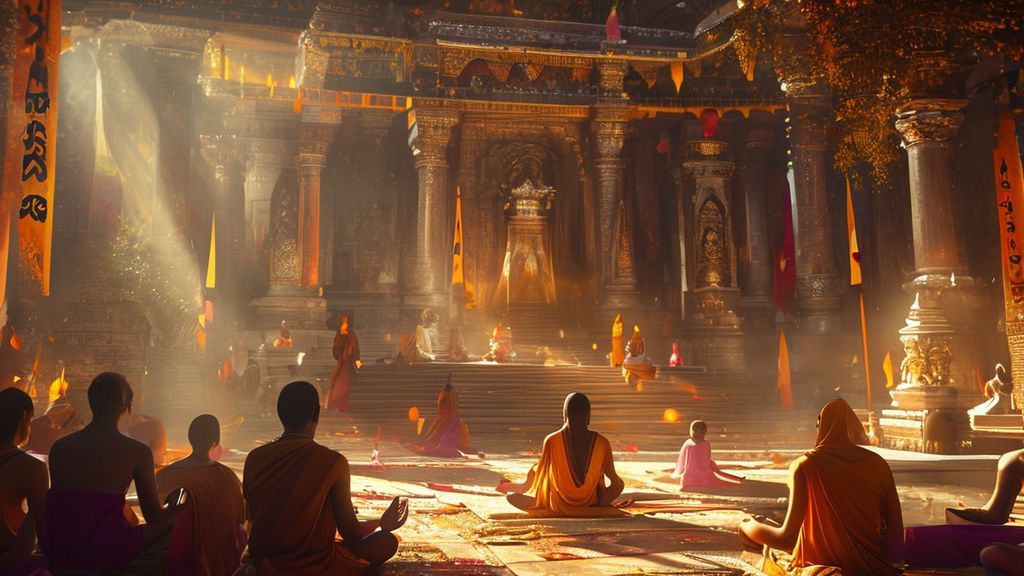
The Yoga Sutras of Patanjali are the seminal, foundational text of Classical Yoga philosophy, attributed to the revered Maharishi Patanjali. This profound Sanskrit treatise systematically codifies the principles of Ashtanga Yoga—the eight-limbed path—offering a precise methodology for attaining spiritual liberation, known as Kaivalya, through the complete cessation of mental fluctuations (Chitta Vritti Nirodha).
| Attribute | Details |
|---|---|
| Author/Sage | Maharishi Patanjali |
| Estimated Period | 2nd to 4th Century CE |
| Core Concept | Ashtanga Yoga (Eight-Limbed Path) |
| Ultimate Goal | Kaivalya (Liberation, Isolation from Prakriti) |
| Key Definition | Yogaḥ Citta-Vṛtti Nirodhaḥ (योगश्चित्तवृत्तिनिरोधः) – Cessation of mental modifications |
| Structure | 196 Sutras divided into 4 Padas (Chapters) |
Introduction: The Timeless Wisdom of Yoga
The Yoga Sutras of Patanjali stand as one of the most profound and influential texts within the vast ocean of Sanatan Dharma. More than just a guide to physical postures, this masterpiece is a comprehensive treatise on the human mind, consciousness, and the systematic path to spiritual liberation. For centuries, sincere seekers and devotees have turned to these aphorisms (sutras) for practical wisdom on navigating the complexities of existence and achieving inner peace and self-realization. Patanjali’s brilliance lies in his ability to distil complex spiritual and psychological truths into concise, memorable verses, offering a precise roadmap for the journey towards Kaivalya (कैवल्य), the ultimate freedom.
Understanding the Yoga Sutras is not merely an academic exercise; it is an invitation to embark on a transformative spiritual discipline. The text illuminates the intricate workings of the mind (Chitta), identifies the obstacles to inner tranquility, and meticulously outlines the practices necessary to transcend suffering and realize one’s true, unconditioned Self (Purusha). It is a testament to the scientific rigor and profound insight embedded within ancient Vedic traditions, offering techniques that remain universally applicable in our modern world.
Puranic History & The Divine Sage Patanjali
While the Yoga Sutras are a work of philosophy and spiritual science, Maharishi Patanjali himself is steeped in rich tradition and reverence within the Hindu imagination. Though precise historical dates are debated (estimated between 2nd-4th century CE), devotional lore often connects him to divine origins. As narrated in various traditions, Patanjali is believed to be an incarnation of Ananta (अनन्त), the divine serpent Shesha Naga, upon whom Lord Vishnu reclines. This connection is profoundly symbolic: just as Ananta upholds the cosmos, Patanjali’s teachings uphold the very fabric of spiritual understanding regarding the mind and consciousness.
A popular invocation, often chanted before studying the Sutras, glorifies him: योगेन चित्तस्य पदेन वाचां मलं शरीरस्य च वैद्यकेनायोऽपाकरोत्तं प्रवरं मुनीनां पतञ्जलिं प्राञ्जलिरानतोऽस्मि ॥ (Yogena Cittasya Padena Vācāṁ Malaṁ Śarīrasya Ca Vaidyakena | Yo’pākarottaṁ Pravaraṁ Munīnāṁ Patañjaliṁ Prāñjalirānato’smi ||) – “To Patanjali, the noblest of sages, who removed the impurities of the mind through Yoga, of speech through grammar, and of the body through medicine, I bow with folded hands.” This sloka highlights his traditional authorship of works on Yoga, Sanskrit grammar (Mahabhashya), and Ayurveda, portraying him as a polymath whose wisdom addressed purification on all levels of human existence.
The Yoga Sutras emerged during a period of intense philosophical development in ancient India, synthesizing and codifying existing yogic knowledge into a coherent system. The earliest and most authoritative commentary on the Sutras is the Yoga Bhashya by the revered sage Vyasa, which serves as an indispensable guide for understanding Patanjali’s terse aphorisms. This commentary, along with others, firmly establishes the Yoga Darshana as one of the six orthodox (Astika) schools of Hindu philosophy, closely allied with the Samkhya school.
Philosophical & Scientific Brilliance: The Four Padas
The true marvel of the Yoga Sutras lies in its structural brilliance and scientific rigor. Divided into four Padas (Chapters), each section systematically unveils a dimension of yogic philosophy and practice:
Samadhi Pada (समाधि पाद) – Chapter on Contemplation
This opening chapter defines Yoga as योगश्चित्तवृत्तिनिरोधः (Yogaḥ Citta-Vṛtti Nirodhaḥ) – the cessation of the modifications of the mind (Sutra 1.2). It explores the nature of the mind, its various fluctuations (vrittis), and the means to achieve Samadhi (समाधि), the state of profound meditative absorption where the Seer (Purusha) rests in its own essential nature. Patanjali introduces अभ्यास (Abhyasa – practice) and वैराग्य (Vairagya – detachment) as the twin pillars of yogic endeavor.
Sadhana Pada (साधन पाद) – Chapter on Practice
This is the most practical chapter, outlining the preparatory steps for Yoga. It introduces क्रियायोग (Kriya Yoga – Yoga of Action) comprising Tapas (austerity), Svadhyaya (self-study), and Ishvara Pranidhana (surrender to the Divine). Crucially, this Pada elaborates on the eight limbs of Ashtanga Yoga, providing the ethical and practical foundation for all subsequent spiritual development. For serious practitioners, this chapter is a daily guide.
Vibhuti Pada (विभूति पाद) – Chapter on Powers
The Vibhuti Pada describes the deeper stages of concentration (Dharana), meditation (Dhyana), and Samadhi, collectively known as संयम (Samyama). Through intense Samyama on various objects, the yogi can gain profound insights and even acquire certain spiritual powers or Siddhis (सिद्धिस). However, Patanjali warns against attachment to these powers, seeing them as potential distractions from the ultimate goal of Kaivalya. This illustrates the ethical discernment inherent in the yogic path.
Kaivalya Pada (कैवल्य पाद) – Chapter on Liberation
The final chapter describes the ultimate goal of Yoga: Kaivalya, a state of absolute liberation where the Purusha (pure consciousness) is completely dissociated from Prakriti (material nature) and its modifications. It explains the nature of liberation, the cessation of suffering, and the irreversible freedom attained by the realized yogi. This Pada addresses philosophical questions about the nature of reality and the journey beyond the cycles of karma.
Rituals & The Ashtanga Yoga Puja Vidhi
While not a “temple ritual” in the conventional sense, the Yoga Sutras lay out a meticulous पूजा विधि (Puja Vidhi – method of worship/practice) through the eight limbs of Ashtanga Yoga (अष्टांग योग). This is the systematic approach to purify the mind and body, leading to spiritual realization. To truly understand the power of Patanjali’s teachings, one must engage in this practice:
- Yamas (यम): Ethical Restraints
- Ahimsa (अहिंसा): Non-violence in thought, word, and deed.
- Satya (सत्य): Truthfulness.
- Asteya (अस्तेय): Non-stealing.
- Brahmacharya (ब्रह्मचर्य): Moderation in all aspects, often interpreted as chastity.
- Aparigraha (अपरिग्रह): Non-possessiveness, non-greed.
- Niyamas (नियम): Observances
- Shaucha (शौच): Purity (internal and external).
- Santosha (संतोष): Contentment.
- Tapas (तपस): Austerity, self-discipline.
- Svadhyaya (स्वाध्याय): Self-study, study of scriptures.
- Ishvara Pranidhana (ईश्वर प्रणिधान): Surrender to the Divine.
- Asana (आसन): Posture
Achieving a steady and comfortable posture for meditation, allowing the body to be still so the mind can focus.
- Pranayama (प्राणायाम): Breath Control
Regulation of the breath, which directly influences the mind and energy (Prana) within the body.
- Pratyahara (प्रत्याहार): Withdrawal of the Senses
Drawing the senses inward, away from external distractions, to prepare the mind for inner focus.
- Dharana (धारणा): Concentration
Fixing the mind on a single point or object, holding sustained attention.
- Dhyana (ध्यान): Meditation
Sustained concentration that flows effortlessly, a continuous stream of thought on the object of focus without interruption.
- Samadhi (समाधि): Contemplation/Absorption
The superconscious state where the meditator, the act of meditating, and the object of meditation become one. This is the culmination of the yogic path, leading to Kaivalya.
Mantras & Chants for Yogic Practice
While the Yoga Sutras themselves are aphorisms, the practice they advocate is deeply connected to specific spiritual sounds and invocations:
- Om (ॐ): The Pranava Mantra
Patanjali emphasizes the significance of प्रणव (Pranava), the sacred syllable Om (Sutra 1.27-1.28). Chanting Om with devotion and understanding its meaning is a powerful means for connecting with Ishvara (ईश्वर), the Cosmic Lord or Supreme Self, and removing obstacles to spiritual progress. Regular recitation facilitates inner stillness.
- Patanjali Invocation
As mentioned earlier, chanting the योगेन चित्तस्य… sloka at the beginning of practice invokes the blessings of Maharishi Patanjali and aligns the practitioner with the lineage of yogic wisdom.
- Ishvara Pranidhana Mantras
The practice of ईश्वर प्रणिधान (Ishvara Pranidhana) – surrender to the Divine – can be enhanced by devotional chanting and bhajans dedicated to one’s chosen deity (Ishta Devata), fostering a sense of humility and devotion essential for transcending ego.
Dos and Don’ts for the Aspiring Yogi
Approaching the Yoga Sutras with reverence and discipline is paramount for genuine spiritual growth.
Dos:
- Seek a Qualified Guru: The subtler aspects of the Sutras require guidance from an experienced teacher (Guru) who has traversed the path.
- Consistent Practice (Abhyasa): Regular, disciplined engagement with the eight limbs, especially meditation, is crucial.
- Ethical Foundation: Steadfastly adhere to the Yamas and Niyamas; they are the bedrock of yogic progress.
- Self-Study (Svadhyaya): Deeply reflect upon the meaning of the Sutras and related scriptures. Consider exploring more insights at Hindutva.online for further understanding.
- Cultivate Detachment (Vairagya): Develop a dispassionate attitude towards worldly desires and outcomes.
Don’ts:
- Practice Without Understanding: Do not merely perform techniques without comprehending their philosophical underpinnings.
- Misuse Siddhis: If spiritual powers (Siddhis) manifest, do not become attached to them or use them for egoistic purposes, as Patanjali warns they are obstacles to Samadhi.
- Neglect Ethical Conduct: Believing that advanced physical postures or breathwork alone constitute yoga without the ethical framework is a grave misunderstanding.
- Seek Instant Gratification: The path of Yoga is long and requires immense patience and perseverance; results unfold gradually.
Frequently Asked Questions
What is the main purpose of the Yoga Sutras of Patanjali?
The primary purpose of the Yoga Sutras is to provide a systematic methodology for stilling the incessant fluctuations of the mind (चित्तवृत्ति निरोध), thereby enabling the individual consciousness (Purusha) to realize its true, unconditioned nature and attain spiritual liberation, known as Kaivalya.
Are the Yoga Sutras only about physical postures (Asanas)?
No, the Yoga Sutras are not solely about physical postures. Asana is just one of the eight limbs of Ashtanga Yoga, serving as a stable foundation for higher practices. The text offers a holistic path encompassing ethical principles, breath control, sensory withdrawal, concentration, meditation, and ultimately, superconscious states.
How do the Yoga Sutras relate to other Hindu philosophies (Darshanas)?
The Yoga Sutras constitute the Yoga Darshana, one of the six orthodox schools of Hindu philosophy. It is intricately linked with the Samkhya Darshana, adopting its metaphysical framework of Purusha (consciousness) and Prakriti (matter) while providing the practical spiritual discipline (Sadhana) to achieve liberation from this duality. This comprehensive guide and more on Sanatan Dharma’s philosophical schools can be found at Hindutva.online.
Dharmic Significance: A Pillar of Sanatan Dharma
The Yoga Sutras of Patanjali are not merely an ancient relic; they are a living, breathing testament to the timeless wisdom of Sanatan Dharma. Their profound teachings provide a universal framework for understanding the human mind, transcending suffering, and realizing the inherent divinity within. By offering a meticulously crafted path—the Ashtanga Yoga—Patanjali empowers every seeker to embark on a journey of self-discovery, discipline, and ultimately, liberation. These Sutras represent the very essence of spiritual psychology and existential philosophy, guiding generations towards a life of dharma, inner peace, and ultimate freedom, ensuring the continued vibrancy and relevance of our sacred traditions.