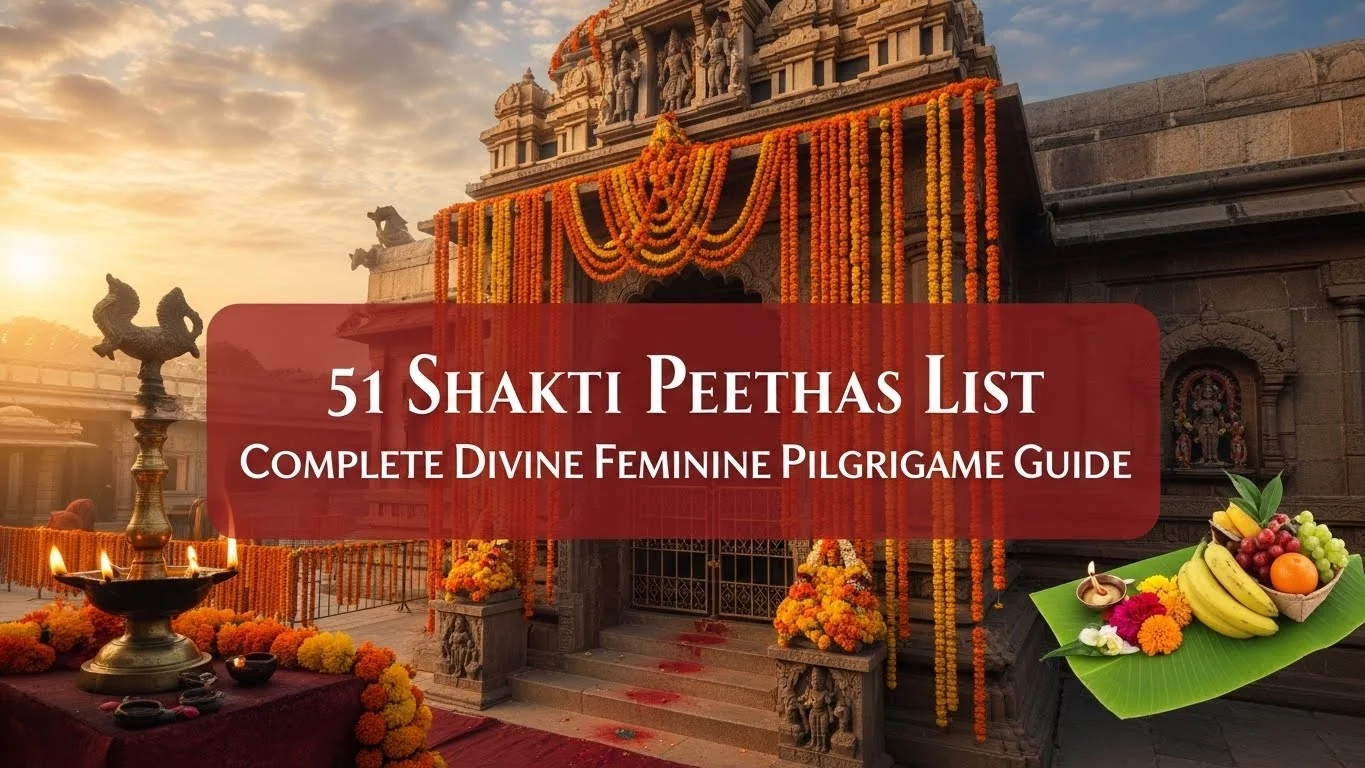
The 51 Shakti Peethas scattered across the Indian subcontinent and beyond—sacred shrines marking locations where Goddess Sati’s body parts, ornaments, or belongings fell after Lord Vishnu’s divine intervention—represent Hinduism’s most powerful centers of Shakti (divine feminine energy) and pilgrimage destinations for goddess worship, with Wikipedia’s authoritative documentation confirming that according to Shiva Purana and multiple Puranas mentioning varying numbers of 51, 52, 64, and 108 Shakti Peethas, the sacred sites originated when Daksha Prajapati organized a grand yajna (sacrificial ritual) inviting all deities except his daughter Sati and son-in-law Lord Shiva—despite Shiva’s attempts to dissuade
her Sati attended uninvited, couldn’t bear her father’s public humiliation and insults aimed at her husband, and self-immolated in the sacrificial fire (yoga-agni)—enraged Shiva in Virabhadra form destroyed the yajna cutting off Daksha’s head, then devastated by grief picked up Sati’s charred body performing Tandava (cosmic destruction dance) wandering across universe causing chaos and imbalance, prompting terrified deities to request Vishnu’s intervention who used Sudarshana Chakra to cut Sati’s corpse into 51 parts which fell at various locations across earth becoming Shakti Peethas—each temple housing both Shakti manifestation (goddess) and Kalabhairava consort (Shiva form) [web:939][web:940][web:942][web:944].
According to the spiritual significance documented in Kalika Purana, Brahmanda Purana, and Adi Shankaracharya’s Ashtadasha Shakta Pitha Stotram, among the 51 Shakti Peethas exist 4 supremely sacred Adi (original) Shakti Peethas where most divine energy concentrates—Vimala at Puri Odisha (feet and thighs), Tara Tarini (breasts), Purnagiri Uttarakhand (arms and neck), Kamakhya at Guwahati Assam (yoni/genitals)—and 18 Ashtadasha Maha (major) Shakti Peethas established by Adi Shankaracharya including the three most sacred representing Mother Goddess’s fundamental aspects: Kamakhya at Guwahati (Kamarupa Devi symbolizing Creation), Mangalagauri at Gaya Bihar (Sarvamangala Devi representing Nourishment), and Mahakali at Ujjain Madhya Pradesh (signifying Annihilation)—remarkably lying in perfect straight line from Kamakhya to Ujjain via Gaya symbolizing that every creation inevitably annihilates [web:942][web:949][web:952][web:953][web:955].
The extraordinary geographical and spiritual distribution validates profound significance: YatraDham’s 2025 comprehensive documentation reveals that the 51 Shakti Peethas span across Indian subcontinent with most concentrated in Bengal region (West Bengal has 19-20 temples including Kalighat Kolkata with right toes, Tarapith with third eye, Kankalitala with waist, Bakreshwar with portion between eyebrows; Bangladesh has 6-7 including Dhakeshwari Dhaka with crown gem now relocated to Kolkata during 1947 partition, Jeshoreshwari with palms), followed by significant presence in Assam (Kamakhya), Himachal Pradesh (Jwalamukhi with tongue, Bajreshwari Kangra with left breast, Naina Devi with eyes, Chintpurni with feet),
Uttar Pradesh (Vishalakshi Varanasi with earrings, Lalita Allahabad with fingers), Maharashtra (Mahalakshmi Kolhapur with third eye, Saptashrungi with chin, Tuljabhavani), Andhra Pradesh-Telangana (Bhramaramba Srisailam with neck, Jogulamba Alampur with teeth), and extending beyond India to Nepal 4 locations (Guhyeshwari Kathmandu with anus, Muktinath with head), Pakistan 1 (Hinglaj with brahmarandhra head part), Bangladesh 6, Sri Lanka 2, Tibet 1, and Bhutan 1—with each shrine worshipping specific Shakti manifestation alongside corresponding Bhairava (Shiva form) creating complete tantric worship system [web:939][web:940][web:942][web:954][web:956].
The transformative pilgrimage significance documented by devotees represents unique spiritual awakening opportunity where visiting all or multiple Shakti Peethas—especially the 18 Maha Peethas circuit including Kamakhya’s bleeding goddess phenomenon during Ambubachi festival (yoni menstruates annually for 3 days when temple closes), Kalighat’s powerful Kali worship in Kolkata, Vaishno Devi’s cave shrine in Jammu Kashmir (most visited among all Shakti Peethas with 8+ million annual pilgrims), Jwalamukhi’s eternal flames in Himachal, Vishalakshi at Kashi Varanasi, Bhramaramba at Srisailam—grants devotees proximity to divine feminine energy, liberation (moksha), fulfillment of desires, and protection from all evils through Goddess’s compassionate grace [web:942][web:943][web:949][web:950][web:952].
As millions undertake pilgrimage to experience Shakti Peethas’ transformative goddess worship—with West Bengal offering concentrated Shakti Peeth circuit covering Kalighat-Tarapith-Kankalitala-Bakreshwar-Nandikeshwari within Kolkata-Birbhum-Bardhaman districts (11-12 days pilgrimage), Northeast providing Kamakhya-Guhyeshwari-Jayanti circuit, Himachal showcasing Jwalamukhi-Bajreshwari-Naina Devi-Chintpurni Shakti triangle, and modern infrastructure connecting major sites through improved roads-railways-airports with temple timings varying by location,
free entry at most shrines, special rituals during Navratri-Durga Puja-Kali Puja festivals, and understanding that Dhakeshwari’s original idol relocated from Bangladesh to Kumartoli Kolkata temple requiring devotees visit both locations—grasping the complete Daksha Yajna-Sati self-immolation-Shiva Tandava-Vishnu Chakra legend, 51 body parts distribution across geography, 4 Adi Peethas’ supreme energy, 18 Maha Peethas’ significance, three Creation-Nourishment-Annihilation sites’ cosmic symbolism, and practical visiting guide becomes essential for meaningful
Hindu pilgrimage focused on divine feminine worship [web:939][web:942][web:954]https://hindutva.online. This comprehensive article presents complete 51+ Shakti Peethas list with locations and body parts, sacred Daksha Yajna-Sati story, 4 Adi Shakti Peethas’ original energy sites, 18 Ashtadasha Maha Peethas established by Adi Shankaracharya, geographical distribution across India-Nepal-Bangladesh-Pakistan-Sri Lanka-Tibet, goddess-worship significance, and pilgrimage circuit planning guide.
The Sacred Legend: Daksha Yajna and Sati’s Sacrifice
Daksha’s Insult to Shiva
The brewing conflict [web:939][web:940][web:942]:
- Lord Brahma conducted grand yajna inviting all prajapatis, deities, kings
- Shiva and Sati participated along with everyone
- When Daksha Prajapati arrived last, all stood except Brahma (his father) and Shiva
- Shiva remained seated as Daksha’s son-in-law and superior deity
- Daksha misunderstood gesture as insult
- Vowed to take revenge in same manner
The Exclusionary Yajna
Deliberate exclusion [web:939][web:940][web:942][web:944]:
- Daksha performed yajna with revenge desire
- Invited all deities except Shiva and Sati
- Deliberate snub to humiliate son-in-law
- Sati deeply hurt by not being invited
Sati’s Insistence to Attend
The fateful decision [web:939][web:940][web:942]:
- Despite exclusion, Sati desired to attend
- Shiva tried to dissuade her from going
- Relented at her continued insistence
- Sati went uninvited to father’s yajna
Public Humiliation and Self-Immolation
The ultimate sacrifice [web:939][web:940][web:942][web:944]:
- Sati not given due respect at yajna
- Daksha publicly insulted Shiva in front of all guests
- Sati couldn’t bear humiliation of her husband
- Anguished Sati cursed her father
- Self-immolated in sacrificial fire (yoga-agni)
- Ended her life to protest father’s behavior
Shiva’s Fury and Daksha’s Beheading
Virabhadra’s vengeance [web:939][web:942]:
- Enraged Shiva at insult and Sati’s death
- Took Virabhadra avatar (fierce warrior form)
- Destroyed Daksha’s yajna completely
- Cut off Daksha’s head
- When deities requested mercy
- Restored Daksha’s life but with goat’s head
Tandava: The Dance of Destruction
Cosmic destruction [web:939][web:940][web:942][web:944]:
- Shiva picked up Sati’s charred body
- Performed Tandava—cosmic destruction dance
- Wandered across universe carrying corpse
- Reminiscing their moments as couple
- Caused chaos and imbalance in universe
- Three worlds threatened with annihilation
Vishnu’s Sudarshana Chakra Intervention
Divine intervention [web:939][web:940][web:942][web:944]:
- Frightened deities requested Vishnu to intervene
- To save universe from Shiva’s destruction
- Vishnu used Sudarshana Chakra (divine discus)
- Cut Sati’s corpse into 51 parts
- Body parts fell at various locations across earth
- Each location became sacred Shakti Peetha
Birth of 51 Shakti Peethas
The places where these parts fell came to be Shakti peeths [web:939].
Sacred transformation [web:939][web:942][web:943]:
- 51 body parts/ornaments/belongings fell on earth
- Each site became Shakti Peetha (seat of goddess)
- Places deemed great spiritual importance
- Every location houses Shakti (goddess) and Bhairava (Shiva form)
- Pilgrimage destinations for goddess worship
The 4 Adi (Original) Shakti Peethas
Supreme Energy Centers
Four primal seats [web:942][web:955]:
- Adi Shakti Peethas = “Original seats of Shakti”
- Most concentrated divine energy
- Four locations originated from lifeless body of Devi Sati
- Hold particularly significant place in tradition
1. Vimala at Puri, Odisha
The first pitha is Odra (Biraja and Vimala) where the pair of feet fell along with pair of thighs [web:942].
Temple details:
- Location: Inside Jagannath Temple, Puri, Odisha
- Body part: Feet and thighs
- Goddess: Vimala Devi
- Bhairava: Jagannatheshwar
2. Tara Tarini, Odisha
The second pitha is Jalasaila (Chandi) where the pair of breasts fell [web:942].
Temple details:
- Location: Purushottampur, Ganjam district, Odisha
- Body part: Breasts
- Goddess: Tara Tarini Devi
- Bhairava: Tumbeshwar
3. Purnagiri, Uttarakhand
The third pitha is Purnagiri (Purneswari) where the arms along with the neck fell [web:942].
Temple details:
- Location: Near Tanakpur, Champawat district, Uttarakhand
- Body part: Arms and neck
- Goddess: Varahi Devi/Purneswari
- Bhairava: Maharudra
4. Kamakhya at Guwahati, Assam
The fourth is Kamrupa (Kamakhaya) where the yoni fell [web:942].
Temple details [web:942][web:949][web:952]:
- Location: Neelachal Hills, Guwahati, Assam
- Body part: Yoni (genitals)
- Goddess: Kamakhya Devi (“Bleeding Goddess”)
- Bhairava: Umanandeshwar
- Significance: Most powerful tantric center
The 18 Ashtadasha Maha Shakti Peethas
Adi Shankaracharya’s Selection
Adi Shankara’s Ashtadasha Shakta pitha stotram mentions 18 locations known as the Maha Shakta pithas [web:942].
Major pilgrimage sites [web:942][web:951][web:952]:
- Ashtadasha = Eighteen
- Maha = Major/Great
- Established by Adi Shankaracharya (9th century)
- Most important among all Shakti Peethas
- Complete list below with details
The Three Most Sacred: Creation-Nourishment-Annihilation
Cosmic trinity [web:942][web:953]:
| Aspect | Temple | Goddess | Symbolism |
|---|---|---|---|
| Creation | Kamakhya, Guwahati | Kamarupa Devi | Birth, fertility, beginning |
| Nourishment | Mangalagauri, Gaya | Sarvamangala Devi | Sustenance, preservation |
| Annihilation | Mahakali, Ujjain | Mahakali Devi | Destruction, transformation |
Sacred alignment: These three lie in perfect straight line from Kamakhya to Ujjain via Gaya, symbolizing that every creation inevitably annihilates [web:953]
Complete List of 18 Maha Shakti Peethas
| # | Temple | Location | State/Country | Body Part | Shakti | Image Significance |
|---|---|---|---|---|---|---|
| 1 | Koneswaram Temple | Trincomalee | Sri Lanka | Groin | Shankari | Disputed location |
| 2 | Kamakshi Amman | Kanchipuram | Tamil Nadu | Navel | Kamakshi | South India power center |
| 3 | Shrinkala Temple | Pandua | West Bengal | Stomach | Shrinkhala | Disputed site |
| 4 | Chamundeshwari | Mysuru | Karnataka | Hair | Chamundeshwari | Royal patronage |
| 5 | Jogulamba Devi | Alampur | Telangana | Teeth | Jogulamba | Ancient temple |
| 6 | Bhramaramba | Srisailam | Andhra Pradesh | Neck | Bhramarambika | With Mallikarjuna Jyotirlinga |
| 7 | Mahalakshmi | Kolhapur | Maharashtra | Third Eye | Mahalakshmi | Wealth goddess |
| 8 | Renuka | Mahur | Maharashtra | Left Hand | Renuka | Parashurama’s mother |
| 9 | Mahakaleswar | Ujjain | Madhya Pradesh | Upper Lip | Mahakali | Annihilation aspect |
| 10 | Kukkuteswara | Pithapuram | Andhra Pradesh | Back | Puruhutika | Ancient Andhra site |
| 11 | Biraja Temple | Jajpur | Odisha | Abdomen | Biraja | Tantric center |
| 12 | Bhimeswara | Draksharamam | Andhra Pradesh | Left Cheek | Manikyamba | Gem goddess |
| 13 | Kamakhya | Guwahati | Assam | Genitals | Kamakhya | Most powerful tantric |
| 14 | Alopi Devi | Prayagraj | Uttar Pradesh | Fingers | Madhaveshwari | At Triveni Sangam |
| 15 | Jwalamukhi | Jwalamukhi | Himachal | Tongue | Jwala | Eternal flames |
| 16 | Mangla Gauri | Gaya | Bihar | Breast | Sarvamangala | Nourishment aspect |
| 17 | Vishalakshi | Varanasi | Uttar Pradesh | Earrings | Vishalakshi | At Kashi with Vishwanath |
| 18 | Sharada Peeth | Sharda (POK) | J&K (disputed) | Right Hand | Sharada | New temple Kupwara 2023 |
Complete List of 51 Shakti Peethas
Geographic Distribution
Spread across South Asia:
- India: 40+ temples (West Bengal 19-20, Himachal 4, Uttar Pradesh 4, Assam, Maharashtra, Odisha, etc.)
- Bangladesh: 6-7 temples
- Nepal: 4 temples
- Pakistan: 1 temple (Hinglaj)
- Sri Lanka: 2 temples
- Tibet: 1 temple
- Bhutan: 1 temple (mentioned in some texts)
West Bengal: Highest Concentration
Bengal’s spiritual dominance [web:942][web:954][web:956]:
- West Bengal: 19-20 Shakti Peethas
- Bangladesh: 6 (after Dhakeshwari idol transfer)
- Concentrated in Birbhum-Bardhaman-Hooghly-Medinipur districts
- Enables powerful Shakti Peeth pilgrimage circuit
Complete 51+ Shakti Peethas with Body Parts
Below is the Shakti Pitha list with name, location and body part [web:939][web:940]:
| # | Shakti Peeth | Location | State/Country | Body Part | Goddess |
|---|---|---|---|---|---|
| 1 | Amarnath | Pahalgam | Jammu & Kashmir | Throat | Mahamaya |
| 2 | Katyayani | Mathura/Vrindavan | Uttar Pradesh | Hair | Uma/Katyayani |
| 3 | Vishalakshi | Varanasi | Uttar Pradesh | Earrings | Vishalakshi |
| 4 | Lalita | Allahabad | Uttar Pradesh | Fingers | Lalita |
| 5 | Jwalamukhi | Kangra | Himachal Pradesh | Tongue | Jwalamukhi |
| 6 | Tripurmalini | Jalandhar | Punjab | Left Breast | Tripurmalini |
| 7 | Savitri | Kurukshetra | Haryana | Right Ankle | Bhadrakali |
| 8 | Pataliputra | Patna | Bihar | Right side of body | Goddess Parvati |
| 9 | Dakshayani | Burang | Tibet | Right Palm | Dakshayani |
| 10 | Mahishasuramardini | Kolhapur | Maharashtra | Third Eye | Mahalakshmi |
| 11 | Bhramari/Bhadrakali | Nashik | Maharashtra | Chin | Bhadrakali |
| 12 | Ambaji | Ambaji | Gujarat | Heart | Amba |
| 13 | Gayatri | Pushkar | Rajasthan | Wrist | Gayatri |
| 14 | Ambika | Bharatpur | Rajasthan | Left Foot | Ambika |
| 15 | Sarvashail | Draksharamam | Andhra Pradesh | Left Cheek | Manikyamba |
| 16 | Sravani | Kanyakumari | Tamil Nadu | Back/Spine | Sarvani |
| 17 | Bhramaramba | Srisailam | Andhra Pradesh | Neck | Bhramarambika |
| 18 | Narayani | Suchindrum | Tamil Nadu | Upper Teeth | Narayani |
| 19 | Phullara | Attahas | West Bengal | Lower Lip | Phullara |
| 20 | Bahula | Ketugram | West Bengal | Left Arm | Bahuladevi |
| 21 | Mahishmardini | Bakreshwar | West Bengal | Between eyebrows | Mahishamardini |
| 22 | Dakshina Kali | Kalighat, Kolkata | West Bengal | Right Toes | Kali |
| 23 | Devgarbha | Kankalitala | West Bengal | Waist | Devgarbha |
| 24 | Vimla | Kiriteswari | West Bengal | Crown | Vimala |
| 25 | Kumari | Ratnavali | West Bengal | Right Shoulder | Kumari |
| 26 | Bhramri | Jalpaiguri | West Bengal | Left Leg | Bhramari |
| 27 | Nandini | Nandikeshwari | West Bengal | Necklace | Nandini |
| 28 | Mangal Chandika | Ujaani | West Bengal | Right Wrist | Mangal Chandika |
| 29 | Kapalini | Vibhash | West Bengal | Left Ankle | Kapalini |
| 30 | Kamakhya | Guwahati | Assam | Yoni (Genitals) | Kamakhya |
| 31 | Jayanti | Jaintia Hills | Meghalaya | Left Thigh | Jayanti |
| 32 | Tripura Sundari | Udaipur | Tripura | Right Foot | Tripura Sundari |
| 33 | Biraja | Jajpur | Odisha | Navel | Biraja |
| 34 | Jai Durga | Deoghar | Jharkhand | Heart | Jayadurga |
| 35 | Avanti/Harsiddhi | Ujjain | Madhya Pradesh | Upper Lip/Elbow | Mahakali |
| 36 | Narmada | Amarkantak | Madhya Pradesh | Right Buttock | Narmada |
| 37 | Nagapooshani | Nainativu | Sri Lanka | Anklets | Bhuvaneshvari |
| 38 | Gandaki Chandi | Muktinath | Nepal | Cheek | Gandaki Chandi |
| 39 | Mahamaya | Kathmandu | Nepal | Both Knees | Mahamaya |
| 40 | Hinglaj | Balochistan | Pakistan | Head (Brahmarandhra) | Kottari |
| 41 | Sugandha | Shikarpur | Bangladesh | Nose | Sugandha |
| 42 | Aparna | Bogra | Bangladesh | Anklet/Ribs/Right Eye | Aparna |
| 43 | Jeshoreshwari | Khulna | Bangladesh | Palms | Jeshoreshwari |
| 44 | Bhavani/Chattal | Chittagong | Bangladesh | Right Arm/Upper Teeth | Bhavani |
| 45 | Dhakeshwari | Dhaka (Now Kolkata) | Bangladesh | Crown Gem | Dhakeshwari |
| 46 | Vaishno Devi | Katra | Jammu & Kashmir | Skull/Right Arm | Vaishno Devi |
| 47 | Naina Devi | Bilaspur | Himachal Pradesh | Right Eye | Mahishamardini |
| 48 | Bajreshwari | Kangra | Himachal Pradesh | Left Breast | Jayadurga |
| 49 | Chintpurni | Una | Himachal Pradesh | Feet | Chhinnamastika |
| 50 | Tarapith | Rampurhat | West Bengal | Third Eye | Tara (Mahavidya) |
| 51 | Guhyeshwari | Kathmandu | Nepal | Anus | Guhyakali |
| 52+ | Vimala | Puri | Odisha | Feet | Vimala |
Note: Different texts mention 51, 52, 64, or 108 Shakti Peethas. The above represents most accepted 51+ primary sites.
Most Important Shakti Peethas for Pilgrimage
1. Kamakhya Temple, Guwahati, Assam
Significance [web:942][web:949][web:952]:
- Most powerful tantric Shakti Peetha
- Yoni (genitals) fell here
- “Bleeding Goddess” phenomenon
- Ambubachi Festival: Temple closes 3 days annually (June) when goddess menstruates
- Creation aspect of Mother Goddess
2. Kalighat Temple, Kolkata, West Bengal
Significance [web:949][web:952][web:954]:
- Right toes of Sati fell here
- Dedicated to Goddess Kali
- In heart of Kolkata
- One of most visited Shakti Peethas
- Powerful Kali worship center
3. Vaishno Devi, Jammu & Kashmir
Shri Mata Vaishno Devi Temple is one of the 64 and 108 Maha (Major) Shakta pithas and is also the most visited among all [web:942][web:950].
Significance:
- Most visited Shakti Peetha
- 8+ million annual pilgrims
- Skull/Right arm fell here
- Cave shrine at altitude
- 13 km trek from Katra
4. Jwalamukhi Temple, Himachal Pradesh
Significance [web:942][web:952]:
- Tongue of Sati fell here
- Eternal flames worship (no idol)
- Natural gas flames burn continuously
- Major Himachal pilgrimage site
5. Vishalakshi Temple, Varanasi
Significance [web:942][web:952]:
- Earrings fell at sacred Kashi
- Adjacent to Kashi Vishwanath Jyotirlinga
- Dual Shiva-Shakti worship
- One of holiest sites
6. Hinglaj Mata, Balochistan, Pakistan
Significance [web:942]:
- Brahmarandhra (head part) fell here
- Only Shakti Peetha in Pakistan
- Pilgrimage challenging due to location
- Some believe idol secretly shifted to Talcher, Odisha
Shakti Peeth Pilgrimage Circuits
West Bengal Shakti Peeth Circuit (11-12 Days)
Complete Bengal circuit [web:954][web:956]:
- Day 1: Kolkata—Kalighat Temple (right toes)
- Day 2: Bargabhima Temple (left ankle)
- Day 3: Ujaani Shaktipeeth, Dhakeswari Kali Mata
- Day 4: Bishnupur terracotta temples
- Day 5: Bolpur Shantiniketan, Kankalitala (waist)
- Day 6: Bakreshwar (between eyebrows), Tarapith (third eye)
- Day 7: Nandikeshwari Temple (necklace)
- Day 8: Return Kolkata, Dakshineshwar
- Day 9-11: Fly Guwahati for Kamakhya Temple
Himachal Shakti Triangle
Four major temples:
- Jwalamukhi (tongue)—Eternal flames
- Bajreshwari Kangra (left breast)
- Naina Devi (right eye)
- Chintpurni (feet)
Northeast Shakti Circuit
Sacred triangle:
- Kamakhya, Guwahati (yoni)—Assam
- Guhyeshwari, Kathmandu (anus)—Nepal
- Jayanti, Jaintia Hills (left thigh)—Meghalaya
Significance of Shakti Peethas
Divine Feminine Energy Centers
Spiritual benefits:
- Connection to divine feminine
- Spiritual awakening
- Liberation (moksha)
- Fulfillment of desires
- Protection from evils
Shakti-Shiva Unity
Tantric worship system:
- Every Shakti Peetha has dual worship
- Shakti (goddess manifestation) worshipped
- Bhairava (Shiva form) as consort
- Represents Shiva-Shakti unity
- Complete tantric energy system
Pilgrimage Tips
Essential Guidelines
- Start with nearest Shakti Peethas: Local goddess temples
- Plan multi-day circuits: West Bengal 11-12 days, Himachal 5-7 days
- Visit 18 Maha Peethas: Priority pilgrimage
- Experience three cosmic aspects: Kamakhya (creation), Gaya (nourishment), Ujjain (annihilation)
- Respect temple traditions: Dress modestly, follow rituals
- Special festivals: Navratri, Durga Puja, Kali Puja, Ambubachi
What to Experience
- Kamakhya’s bleeding goddess: Ambubachi festival June
- Jwalamukhi’s eternal flames: Natural gas worship
- Kalighat’s powerful Kali: Kolkata’s spiritual heart
- Vaishno Devi cave trek: 13 km pilgrimage
- Tarapith’s tantric worship: Third eye location
- Vishalakshi at Kashi: With Vishwanath Jyotirlinga
- Bengal circuit: 19-20 temples in concentrated area
Frequently Asked Questions
What are the 51 Shakti Peethas?
What is the legend behind Shakti Peethas?
Daksha organized yajna excluding Shiva-Sati; Sati attended but self-immolated unable to bear father’s insults; enraged Shiva performed Tandava carrying her body; Vishnu used chakra cutting body into 51 parts which fell across earth becoming Shakti Peethas [web:939][web:940][web:942][web:944].
What are the 4 Adi Shakti Peethas?
Four original Shakti Peethas with most energy: Vimala at Puri (feet/thighs), Tara Tarini (breasts), Purnagiri Uttarakhand (arms/neck), Kamakhya Guwahati (yoni/genitals) [web:942][web:955].
What are 18 Maha Shakti Peethas?
18 major Shakti Peethas established by Adi Shankaracharya including Kamakhya, Kalighat, Vaishno Devi, Vishalakshi, Jwalamukhi, Bhramaramba, Mahalakshmi Kolhapur, Mangalagauri Gaya, Mahakali Ujjain [web:942][web:951][web:952].
Which three Shakti Peethas are most sacred?
Which state has most Shakti Peethas?
West Bengal has 19-20 Shakti Peethas (most in India) including Kalighat Kolkata, Tarapith, Kankalitala, Bakreshwar, Nandikeshwari concentrated in Birbhum-Bardhaman-Hooghly districts [web:942][web:954][web:956].
What is most visited Shakti Peetha?
Vaishno Devi Temple in Katra, Jammu & Kashmir is most visited with 8+ million annual pilgrims; cave shrine requiring 13 km trek from Katra base [web:942][web:950].
Are there Shakti Peethas outside India?
Yes: Nepal 4 (Guhyeshwari-Mahamaya Kathmandu, Muktinath), Bangladesh 6 (Jeshoreshwari, Sugandha, Dhakeshwari), Pakistan 1 (Hinglaj), Sri Lanka 2, Tibet 1, Bhutan 1 [web:939][web:942].
Conclusion
The 51 Shakti Peethas scattered across the Indian subcontinent and beyond—sacred shrines marking locations where Goddess Sati’s body parts, ornaments, and belongings fell after Lord Vishnu’s Sudarshana Chakra intervention to stop grief-stricken Shiva’s Tandava destruction dance following Sati’s self-immolation at father Daksha’s insulting yajna—represent Hinduism‘s most powerful centers of divine feminine energy (Shakti) and transformative goddess worship, with Wikipedia’s documentation confirming varying Puranic references to 51, 52, 64, or 108 Shakti Peethas among which exist 4 supremely sacred Adi (original) Peethas with most concentrated energy (Vimala at Puri with feet/thighs, Tara Tarini with breasts, Purnagiri with arms/neck, Kamakhya at Guwahati with yoni/genitals),
18 Ashtadasha Maha Peethas established by Adi Shankaracharya’s Shakta Pitha Stotram including the three most sacred representing Mother Goddess’s fundamental Creation-Nourishment-Annihilation aspects (Kamakhya’s Kamarupa Devi symbolizing creation, Gaya’s Mangalagauri representing nourishment, Ujjain’s Mahakali signifying annihilation)—remarkably lying in perfect straight line symbolizing universal creation-destruction cycle, with greatest concentration in Bengal region (West Bengal 19-20 temples including Kalighat-Tarapith-Kankalitala-Bakreshwar, Bangladesh 6) enabling powerful Shakti Peeth pilgrimage circuits [web:939][web:942][web:953]https://hindutva.online.
What distinguishes Shakti Peethas’ extraordinary significance is the convergence of mythological depth (Daksha Yajna-Sati sacrifice-Shiva Tandava-Vishnu Chakra intervention creating 51 sacred geography), tantric worship system (every site houses dual Shakti-Bhairava manifestations representing Shiva-Shakti unity completing divine energy circuit), hierarchical significance (4 Adi Peethas with supreme energy, 18 Maha Peethas most important, remaining 33+ highly revered), geographical spread (40+ India with West Bengal concentration 19-20, Nepal 4, Bangladesh 6, Pakistan 1 Hinglaj, Sri Lanka 2, Tibet 1 enabling pan-South Asian goddess worship),
unique phenomena (Kamakhya’s bleeding goddess menstruating annually during Ambubachi closing temple 3 days, Jwalamukhi’s eternal natural gas flames worshipped without idol, Vaishno Devi’s 8+ million annual pilgrims making it most visited), and complete pilgrimage circuits (West Bengal 11-12 days covering Kalighat-Tarapith-Kankalitala-Bakreshwar-Nandikeshwari, Himachal Shakti triangle Jwalamukhi-Bajreshwari-Naina Devi-Chintpurni, Northeast Kamakhya-Guhyeshwari-Jayanti circuit, three cosmic aspects Kamakhya-Gaya-Ujjain straight-line pilgrimage) [web:939][web:942][web:949][web:952][web:954].
By understanding these sacred divine feminine energy centers—combining Daksha Yajna legend comprehension, visiting 18 Maha Peethas especially three Creation-Nourishment-Annihilation sites lying in cosmic straight line, experiencing Kamakhya’s bleeding goddess Ambubachi phenomenon, undertaking concentrated West Bengal circuit covering 19-20 temples in Birbhum-Bardhaman districts, exploring each site’s unique Shakti-Bhairava dual worship with specific body part significance, and participating in major festivals Navratri-Durga Puja-Kali Puja-Ambubachi—devotees access the transformative pilgrimage that ancient Hindu wisdom established as supremely powerful goddess worship granting spiritual awakening, liberation (moksha), desire fulfillment, and protection through divine feminine grace [web:942][web:943][web:952]https://hindutva.online.
About the Author
Kavita Nair – Certified Yoga Therapist & Spiritual Wellness Expert
Kavita Nair is a certified yoga therapist with over 18 years of experience specializing in Hatha Yoga, pranayama, meditation, and traditional shatkarma purification practices. He holds advanced certifications in yoga therapy and has trained extensively in classical yogic texts including the Hatha Yoga Pradipika and Gheranda Samhita. Kavita Nair integrates ancient yogic wisdom with Ayurvedic principles to help students achieve optimal physical health and spiritual growth through authentic practices. His teaching focuses on making traditional techniques accessible to modern practitioners while maintaining the depth and transformative power of the original methods. He has guided thousands of students through systematic yoga sadhana at leading institutions and retreat centers across India and internationally.